
Describe the Connection Between Historical Events
Teaching elementary students to describe the connections between historical events is challenging, but they can be successful with it. Thanksgiving is a holiday with historical events that demonstrate a sequence and cause and effect relationship. Here is how I developed a Thanksgiving unit focused on the historical events of the holiday to meet this Common Core Standard.

This is PART THREE of a series of blog posts about a Thanksgiving thematic unit for middle elementary grades. In part one, we created a timeline about the events that lead up to the first Thanksgiving. You can access PART ONE and PART TWO as well.
Through this unit, students learned how to create a timeline, how to describe how events are connected to each other and how to ask and answer questions about historical events. This has been developed into a full product that is described in this blog post.
This series of blog posts focus on the second grade Common Core Standard that asks students to “describe the connection between a series of historical events . . . in a text.” Over several weeks, we learned how to connect the events, but we started with the timeline, moved onto asking and answering questions about the timeline, and are now at the point where students will describe the connections between the events.
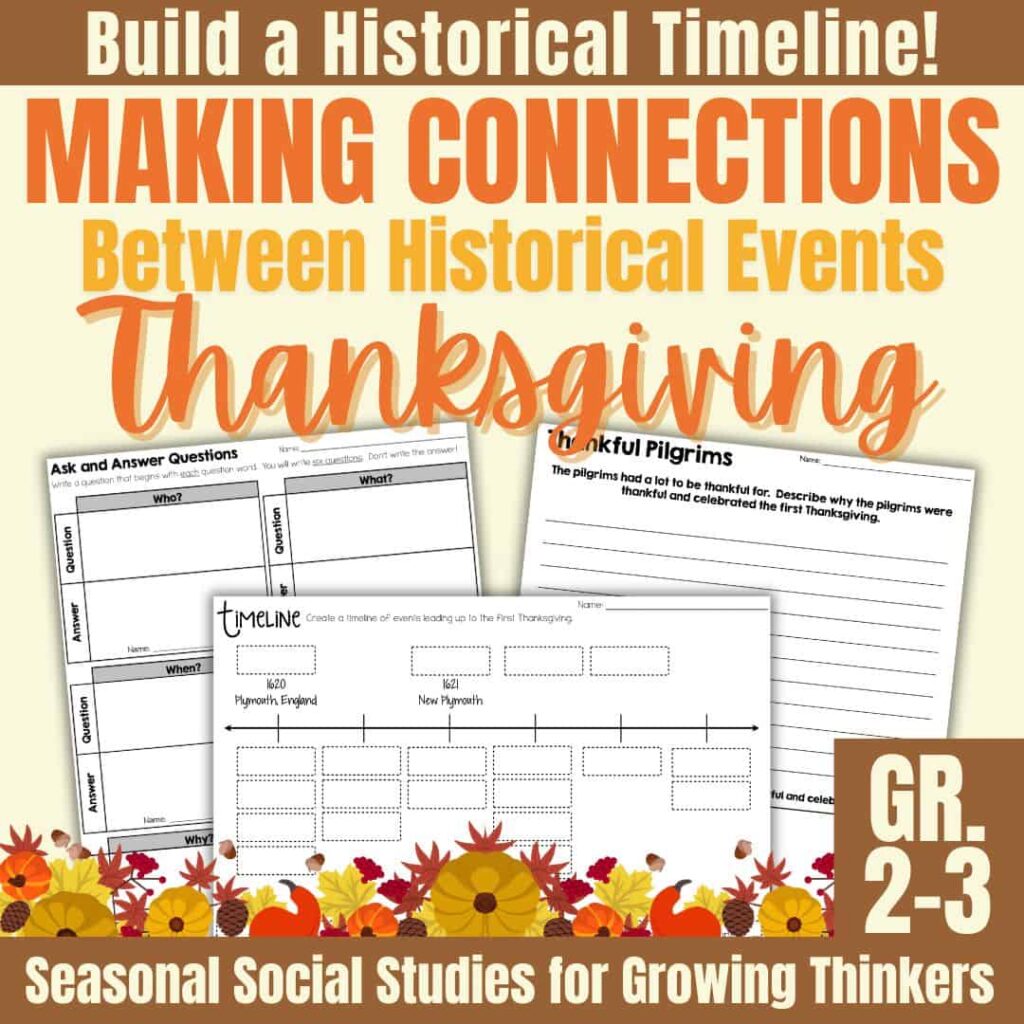
Thanksgiving Make Connections between a Series of Historical Events
This mini-unit helps students understand the events leading up to the first Thanksgiving and gives them tools to make connections between those events.
How to Assess “Describe the Connections Between Events”
There are a lot of events that lead up to the first Thanksgiving. More than we listed on our timeline and discussed as a class. It was difficult to find a place to focus and a way to assess students without making the prompt too broad.
I chose to ask the students to describe why the pilgrims were thankful.
I created a worksheet with the directions: The pilgrims had a lot to be thankful for. Describe why the pilgrims were thankful and celebrated the first Thanksgiving. The worksheet has writing space and as space to draw a picture.
(Yes, I know it’s not quite grammatically correct and the prompt on the actual worksheet has an extra the, as you’ll see below This is what happens when I create a worksheet quickly!).
Watch a Video & Create a Graphic Organizer
I prefaced the assessment by watching a video with students and, again, outlining the events leading up to the first Thanksgiving. We created a new graphic organizer, in addition to the timeline, using the video as a foundation.
The link to the video is in the full Thanksgiving Unit Product. As we watched the video, I paused it at certain places and we discussed the main idea of the section we watched.
We did the left side of this anchor chart prior to the assessment. As I wrote the event I also underlined the keywords in yellow.

The video also included information about how Thanksgiving became a national holiday. We watched the first part of the video before the assessment. After the assessment, we continued the video and recorded the information on the righthand side.
Rubric Used to Assess Students
I introduced the assessment and the rubric at the bottom of the assessment page. I didn’t spend too much time on the rubric, but it was there for reference. Here’s how I assessed the students:
- 5 – Describe all the events leading up to Thanksgiving in complete sentences and connect the ideas.
- 4 – Describe most of the events leading up to Thanksgiving in complete sentences.
- 3 – Describe most of the events leading up to Thanksgiving in incomplete sentences.
- 2 – Describe one or two of the events leading up to Thanksgiving.
- 1 – Does not describe the events leading up to Thanksgiving.
At that time our district used a 5-point rubric and 3-5 is considered at grade level.
Samples of Student Work
Students were able to use both the timeline that we’d worked on for the past two weeks as well as the anchor chart we had just created. I wasn’t assessing whether students could memorize the events, but describe their connection. They could use any resources available to them.
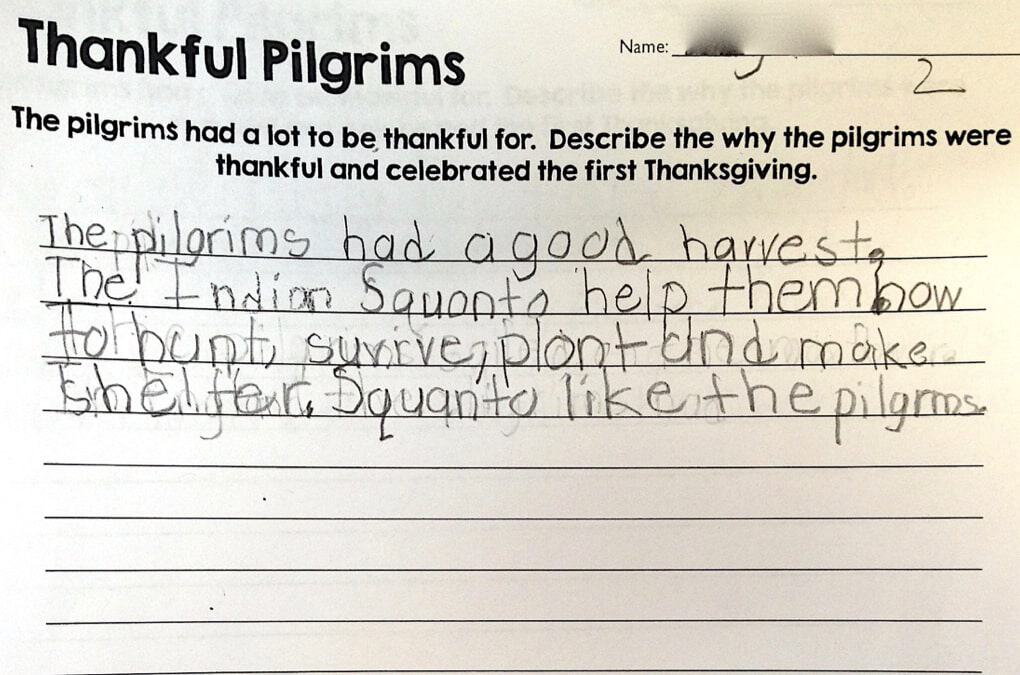
Here’s how my students did on the assessment. Scores are on most of the papers in the upper right.

This had all the elements I was looking for in this type of activity.

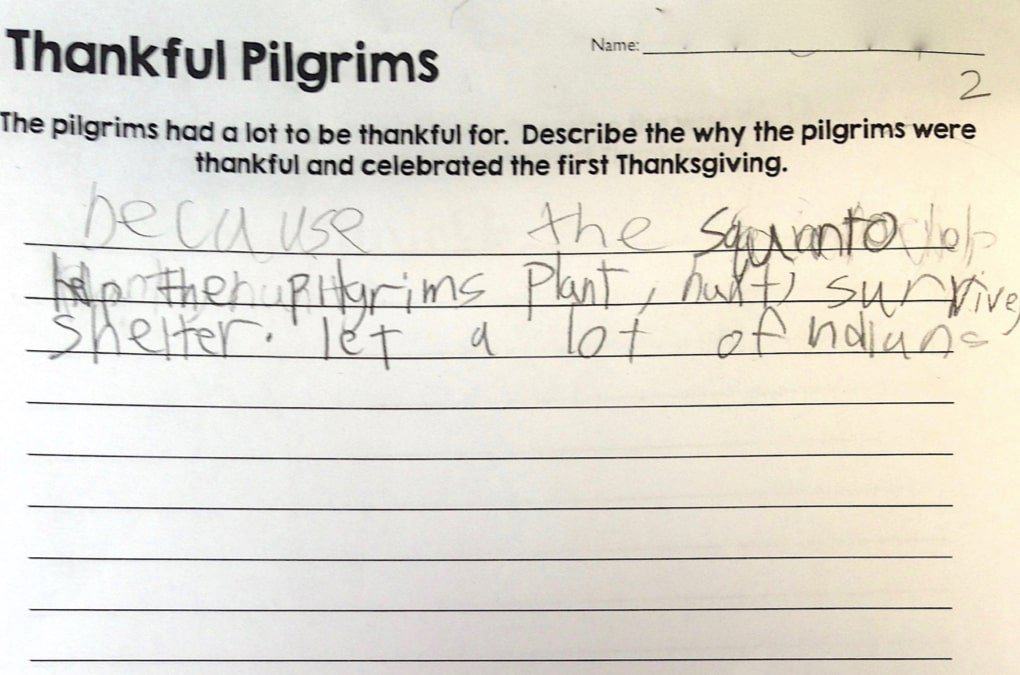
These explained one or two events (Squanto, the harvest). Although they did a good job with those one or two events, these students didn’t describe a connection between historical events. This student really got the connection between the pilgrims and Indians, though!
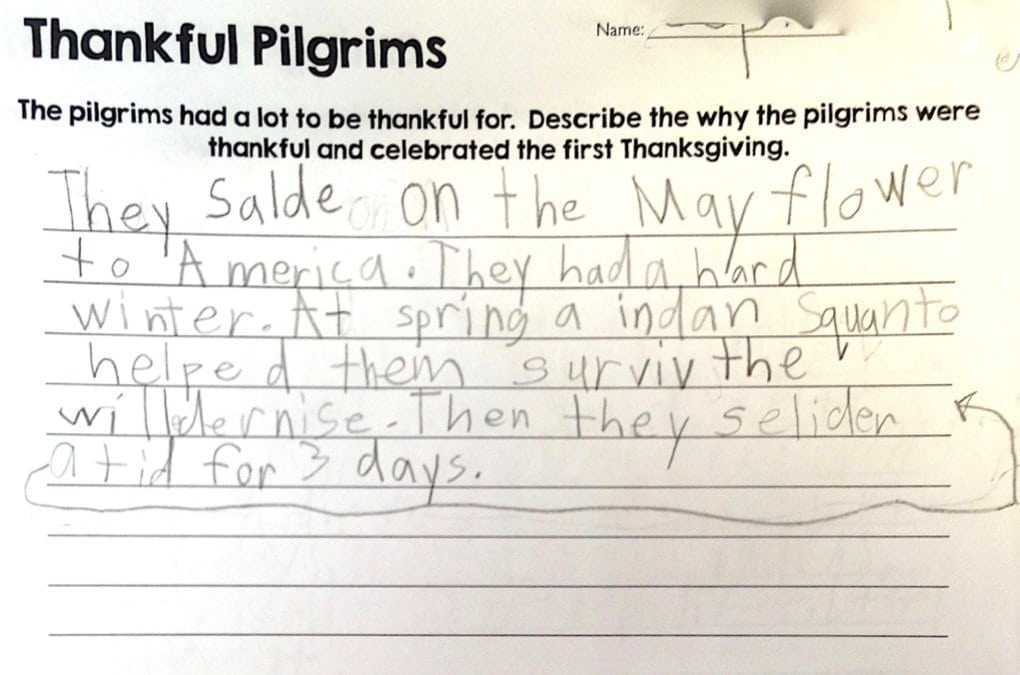
This is a great model and contains most of the events. It lacks a bit of voice, but the student accurately answered the prompt.
Reflection on the Unit and Assessment
Overall, the assessment worked out well. The scores I gave students, for the most part, match up with the levels I saw in the classroom.
I did have three of my higher students score a “2” because they only mentioned one event and described it in depth rather than describing all the things that made the pilgrims thankful. Maybe sharing the standard with them more explicitly (instead of orally) would have prevented that.
It’s difficult to just do “fun” things around the holidays without using them for some academic purpose. As a whole, I love what I was able to do with this Thanksgiving unit by teaching and assessing some key Reading Informational standards. This definitely made it more academic.
More information about the Thanksgiving Unit
There are two other posts that describe the work we did before students described the connection between events:
If you’d like more information about the Thanksgiving Unit, see this blog post.
Thanksgiving Make Connections between a Series of Historical Events
This mini-unit helps students understand the events leading up to the first Thanksgiving and gives them tools to make connections between those events.
Jessica BOschen
Jessica is a teacher, homeschool parent, and entrepreneur. She shares her passion for teaching and education on What I Have Learned. Jessica has 16 years of experience teaching elementary school and currently homeschools her two middle and high school boys. She enjoys scaffolding learning for students, focusing on helping our most challenging learners achieve success in all academic areas.