
Compare and Contrast Sentence Starters and Frames for Elementary Students
Compare and contrast sentence starters give students the language they need to explain similarities and differences without getting stuck on how to begin. Instead of writing short, repetitive sentences, students can use a starter to structure their thinking into clear academic language.
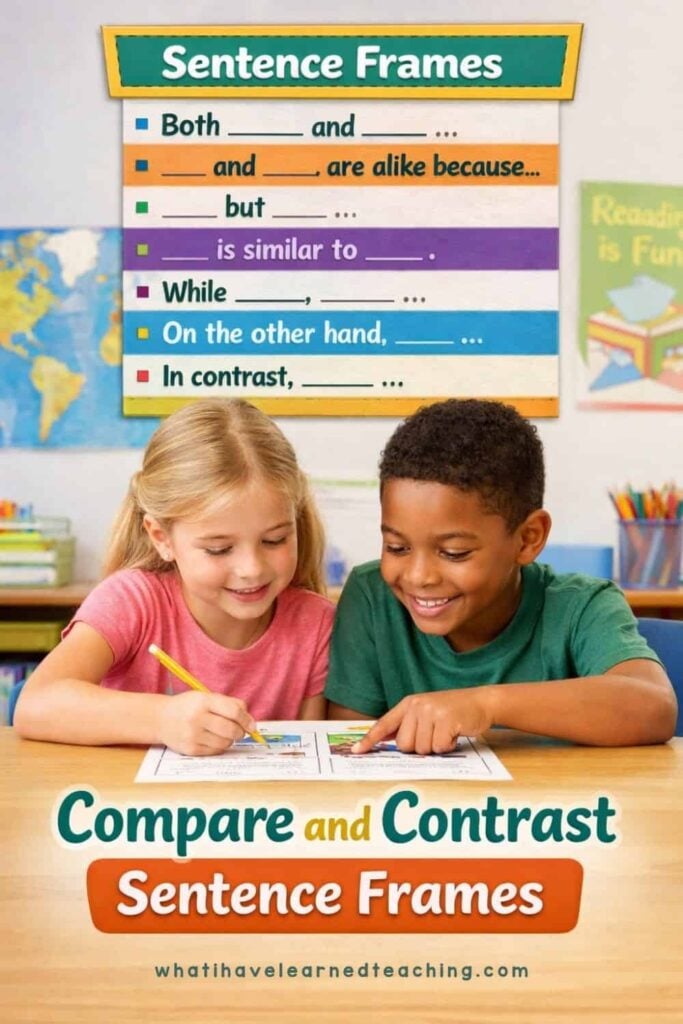
These sentence starters and sentence frames work across subjects — reading, writing, science, and social studies — and are organized by purpose so students can find the right scaffold at any stage of the comparison.
If you are looking for completed writing samples that show what compare and contrast looks like in sentences, paragraphs, and essays, see compare and contrast examples for students.
What Are Compare and Contrast Sentence Starters?
Compare and contrast sentence starters are short phrases that help students begin sentences when explaining similarities and differences between two or more ideas.
They act as scaffolds for academic writing. Instead of students writing short or repetitive sentences like:
“Dogs and cats are different.”
Students can expand their thinking with structured language such as:
“One similarity between dogs and cats is that…”
“A key difference between the two animals is…”
These starters support students when they are writing paragraphs, answering reading questions, or explaining ideas in science and social studies.
If you are looking for ideas students can write about, this collection of Compare and Contrast Topics for Students includes many classroom-friendly comparison ideas.
Compare and Contrast Sentence Starters and Sentence Frames
Below you’ll find compare and contrast sentence starters and compare and contrast sentence frames that work well for grades 2–5. These can be used in writing lessons, reading responses, science journals, and social studies comparisons.
Sentence Starters for Similarities
Students often begin by identifying how two things are alike. These sentence starters help students introduce similarities clearly.
Examples students can use:
- One similarity between ___ and ___ is that ___.
- Both ___ and ___ have ___.
- ___ and ___ are alike because ___.
- A way that ___ and ___ are similar is ___.
- Another similarity is that ___.
- Just like ___, ___ also ___.
- Both examples show ___.
These starters work well when students compare characters, animals, inventions, or scientific ideas.
Sentence Starters for Differences
When students identify differences, they often need more structured language. These sentence starters help students explain how two ideas are not the same.
Examples include:
- One difference between ___ and ___ is ___.
- ___ is different from ___ because ___.
- Unlike ___, ___ ___.
- In contrast, ___ ___.
- While ___ has ___, ___ has ___.
- Another difference is that ___.
- ___ has ___, but ___ has ___.
These starters are useful for reading comprehension responses, science observations, and social studies comparisons.
Sentence Frames Students Can Use
Compare and contrast sentence frames are similar to sentence starters, but they provide more structure. Sentence frames include blanks where students fill in their ideas.
Sentence frames are helpful for students who are still developing academic language or who benefit from additional support.
Examples of compare and contrast sentence frames:
- Both ___ and ___ have ___, but ___ has ___.
- ___ and ___ are similar because ___.
- A key difference between ___ and ___ is ___.
- While ___ can ___, ___ cannot ___.
- ___ is similar to ___ because ___.
- One important way they are different is ___.
Teachers often introduce sentence frames first and then transition students to sentence starters as students gain confidence.
The table below shows examples of compare and contrast sentence starters and compare and contrast sentence frames that students can use when writing about similarities and differences.
| Purpose | Sentence Starter | Sentence Frame |
|---|---|---|
| Similarities | One similarity between ___ and ___ is… | Both ___ and ___ have ___ |
| Similarities | ___ and ___ are alike because… | Both ___ and ___ can ___ |
| Similarities | Another way they are similar is… | ___ is similar to ___ because ___ |
| Differences | One difference between ___ and ___ is… | ___ has ___, but ___ has ___ |
| Differences | Unlike ___, ___… | While ___ has ___, ___ has ___ |
| Differences | In contrast, ___… | ___ is different from ___ because ___ |
| Comparing Details | Both examples show… | Both ___ and ___ show ___ |
| Contrasting Details | A key difference is… | One important difference between ___ and ___ is ___ |
Compare and Contrast Unit
If you are looking for a structured way to teach this skill, this Compare and Contrast Unit provides lessons and activities that guide students through identifying similarities and differences, organizing ideas, and writing comparison sentences.
The unit includes activities that help students:
- practice identifying similarities and differences
- use sentence frames to explain comparisons
- organize ideas with graphic organizers
- write clear compare and contrast sentences and paragraphs
Teachers often use the lessons during reading instruction, writing workshop, or integrated science and social studies units where students compare characters, animals, events, or ideas.

Compare and Contrast Paragraphs & Reading Passages, Comprehension Activities for Academic Language
Help students master the academic language of comparing and contrasting with this unit that enhances reading comprehension by comparing and contrasting topics through differentiated texts and sentence frames.
Using Sentence Starters in Informational Writing
Compare and contrast writing is common in informational texts. Students may compare two animals, two historical events, or two scientific processes.
When students write informational paragraphs, sentence starters help them organize their ideas. They can introduce similarities, explain differences, and connect details across multiple sentences.

If you are building informational writing skills, this resource on Informational Writing Sentence Starters for Grades 3–5 includes additional sentence starters students can use for introductions, explanations, and conclusions.
Teaching Compare and Contrast with Mentor Texts
Books are one of the easiest ways to introduce comparison thinking. Many nonfiction and fiction texts naturally highlight similarities and differences between characters, animals, or events.
Students can read a short text and then use sentence starters to explain their thinking. For examples of what finished compare and contrast sentences and paragraphs look like, see compare and contrast examples for students.
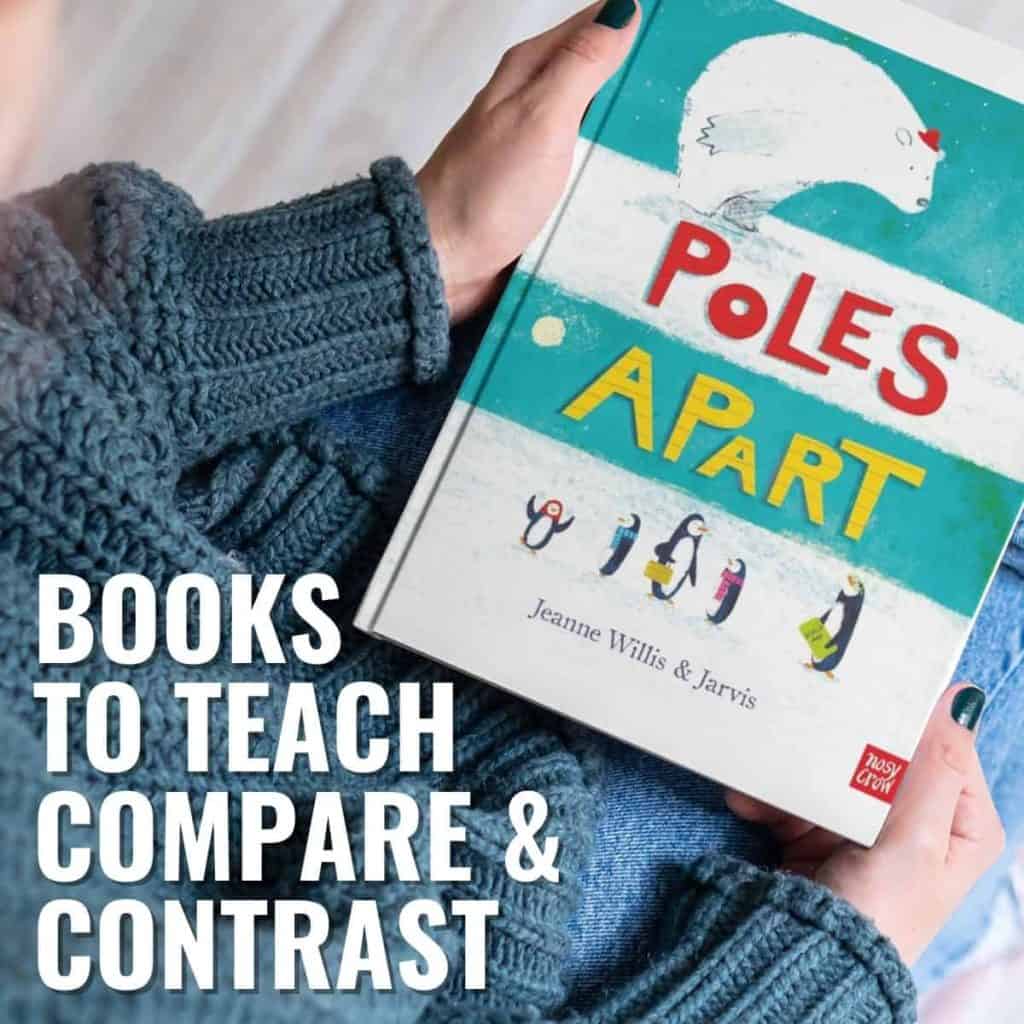
You can find classroom book ideas in this list of Books to Teach Compare and Contrast.
Why Sentence Starters Help Students Compare and Contrast
Students usually begin learning this skill by noticing similarities and differences in pictures or simple topics. As they grow, they compare characters, themes, historical events, and scientific concepts.
Sentence starters support students through each stage of the learning process.
Sentence starters can be added to anchor charts, writing folders, or small reference cards students keep in their desks. Many teachers post them near writing centers so students can quickly reference them during writing time.

For a step-by-step approach to teaching the skill, see How to Teach Compare and Contrast, which includes lesson ideas and classroom strategies.
When students compare and contrast ideas, they are doing complex thinking. They must identify relationships between ideas and explain those relationships clearly.
Sentence starters reduce the language barrier that often slows students down.
With structured language support, students can:
- organize their thinking
- explain similarities and differences clearly
- expand short answers into full sentences
- develop stronger informational writing
Over time, students begin using this language naturally in their writing and discussions.
Describing Is a Key Skill Before Comparing and Contrasting
Before students can compare and contrast ideas, they need to be able to describe them. Describing helps students notice details, traits, and characteristics. Without those details, it becomes difficult for students to explain similarities and differences.
For example, if students are comparing two animals, they first need to describe each animal’s features such as where it lives, what it eats, or how it moves.
For completed examples showing what these sentences look like in finished student writing, see compare and contrast examples for students.
Building strong descriptive skills helps students write clearer and more specific compare and contrast sentences.
Building Strong Comparison Skills in Student Writing
Compare and contrast sentence starters give students a practical tool for explaining similarities and differences across subjects. With simple language supports, students can move from short answers to thoughtful explanations.
Using compare and contrast sentence frames during instruction helps students learn the language of comparison while building writing confidence. As students practice these structures in reading responses, science journals, and informational writing, the skill becomes part of how they naturally explain their thinking.
Jessica BOschen
Jessica is a teacher, homeschool parent, and entrepreneur. She shares her passion for teaching and education on What I Have Learned. Jessica has 16 years of experience teaching elementary school and currently homeschools her two middle and high school boys. She enjoys scaffolding learning for students, focusing on helping our most challenging learners achieve success in all academic areas.