
Informational Writing Sentence Starters For Grades 3-5
If you’re teaching informational writing in grades 3–5, one of the biggest challenges students face is knowing how to start their sentences. Informational writing sentence starters, sometimes called informational paragraph starters, give students the structure they need to introduce topics, develop paragraphs, explain ideas, and write strong conclusions.
Whether students are writing informational essays, research reports, science explanations, or social studies responses, sentence starters help them organize their thinking into clear, complete sentences.
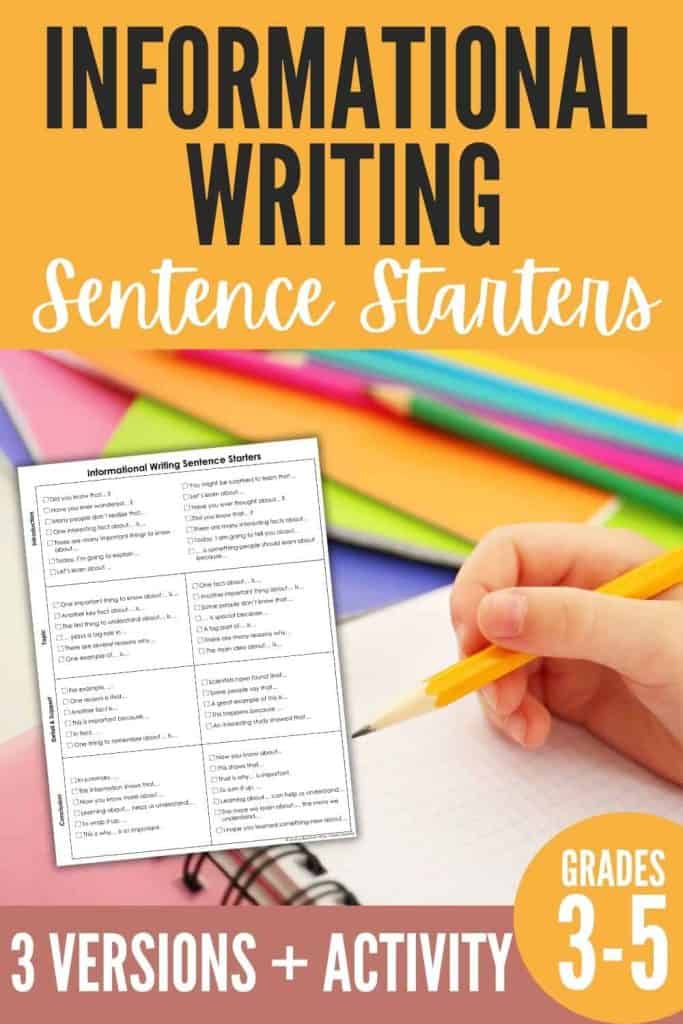
Looking for sentence starters across all writing genres? You can find informational, opinion, personal narrative, and fictional story starters organized in one place on this Writing Sentence Starters for Elementary Students page.
Below you’ll find sentence starters for informational writing, organized by purpose, including introduction starters, topic sentence starters, supporting detail starters, cause-and-effect starters, compare-and-contrast starters, and conclusion starters.
Quick List of Informational Writing Sentence Starters
Here are a few informational writing sentence starters students can use when explaining ideas, introducing facts, and writing conclusions:
Introduction starters
- Have you ever wondered how…
- Did you know that…
- One interesting fact about… is…
Topic sentence starters
- One important fact about… is…
- Another reason… is…
- A key idea about… is…
Detail starters
- For example, …
- This is important because…
- In fact, …
Conclusion starters
- Now you know…
- This shows that…
- That is why… is important.
What Are Informational Writing Sentence Starters?
Informational writing sentence starters are short phrases that help students begin sentences when writing informational or nonfiction texts. They provide structure for introducing topics, explaining facts, showing relationships between ideas, and writing conclusions.
These starters support students in grades 3–5 by reducing writer’s block and helping them organize their paragraphs more effectively.
When to Use These Sentence Starters
Each type of sentence starter serves a different role in informational writing. Here’s how they can be used effectively:
- Introduction Starters: These help students engagingly introduce their topic. They should be used at the beginning of a paragraph or essay to hook the reader.
- Topic Sentence Starters: These introduce the main idea of a paragraph. Students can use them to start a new section of their writing.
- Detail and Supporting Sentence Starters: These help students add facts, examples, and explanations that support the main idea.
- Cause & Effect Sentence Starters: These help students explain relationships between events or ideas.
- Compare & Contrast Sentence Starters: These guide students in showing similarities and differences between two things.
- Conclusion Sentence Starters: These help students wrap up their writing by summarizing key points.
Encouraging students to use a variety of these sentence starters will improve their writing structure and clarity.
What is the difference between an introduction and a topic sentence starter?
When teaching informational writing, it’s important to understand the difference between an introduction sentence starter and a topic sentence starter because they serve different purposes.
- An introduction sentence starter begins the entire piece of writing. It introduces the main topic and often includes a hook to grab the reader’s attention. It gives a broad idea of what the writing will be about.
- Example: “Have you ever wondered how plants grow?”
- A topic sentence starter begins a new paragraph within the writing. It introduces a specific detail or key idea that supports the main topic. Each paragraph should have its own topic sentence that connects back to the introduction.
- Example: “One important thing plants need to grow is sunlight.”
In short, the introduction sets up the whole piece, while topic sentences guide individual paragraphs. Teaching students to use both will help them organize their writing more effectively!
Informational Writing Sentence Starters
By explicitly teaching students how to use sentence starters, we give them tools to strengthen their explanations, support their ideas with details, and write more complex sentences. These skills improve their writing and enhance their critical thinking ability across all subject areas.
Here are some basic informational sentence starters you can use in your classroom!
Introduction Sentence Starters
- Let’s learn about…
- Have you ever thought about…?
- Did you know that…?
- There are many interesting facts about…
- Today, I am going to tell you about…
- One important thing to know about… is…
- … is something people should learn about because…
Topic Sentence Starters
- One fact about… is…
- Another important thing about… is…
- Some people don’t know that…
- … is special because…
- A big part of… is…
- There are many reasons why…
- The main idea about… is…
Detail and Supporting Sentences
- For example, …
- One reason is that…
- Another fact is…
- This is important because…
- In fact, …
- One thing to remember about… is…
- Scientists have found that…
- Some people say that…
- A great example of this is…
Conclusion Sentence Starters
- Now you know about…
- This shows that…
- That is why… is important.
- To sum it up, …
- Learning about… can help us understand…
- The more we learn about…, the more we understand…
- I hope you learned something new about…
Informational Writing Sentence Stems for Students
Sentence stems are similar to sentence starters, but they often provide a partially completed sentence that students finish themselves.
Teachers use sentence stems when modeling how to explain information clearly.
Examples include:
The main reason … happens is …
One example of … is …
Scientists have discovered that …
A key fact about … is …
Sentence stems are especially helpful for English learners and developing writers because they reduce the cognitive load of starting a sentence.
Advanced Informational Writing Sentence Starters
Teaching students how to structure their informational writing is key to helping them communicate their ideas clearly. Cause & Effect and Compare & Contrast sentence starters are especially valuable because they encourage deeper thinking and help students make meaningful connections in their writing.
Cause & Effect Sentence Starters
These sentence starters help students explain why something happens and what results from it. Understanding cause-and-effect relationships is essential in subjects like science, history, and even everyday life. For example, students might write:
- “When plants don’t get enough sunlight, they stop growing.”
- “Because of pollution, many animals lose their habitats.”
By using these sentence starters, students learn how to explain reasoning, support claims with evidence, and develop logical explanations—important skills for both writing and critical thinking.
Here are a few cause and effect sentence starters:
- When… happens, …
- This happens because…
- Since… , …
- If… , then…
- … causes…
- As a result, …
- Because of this, …
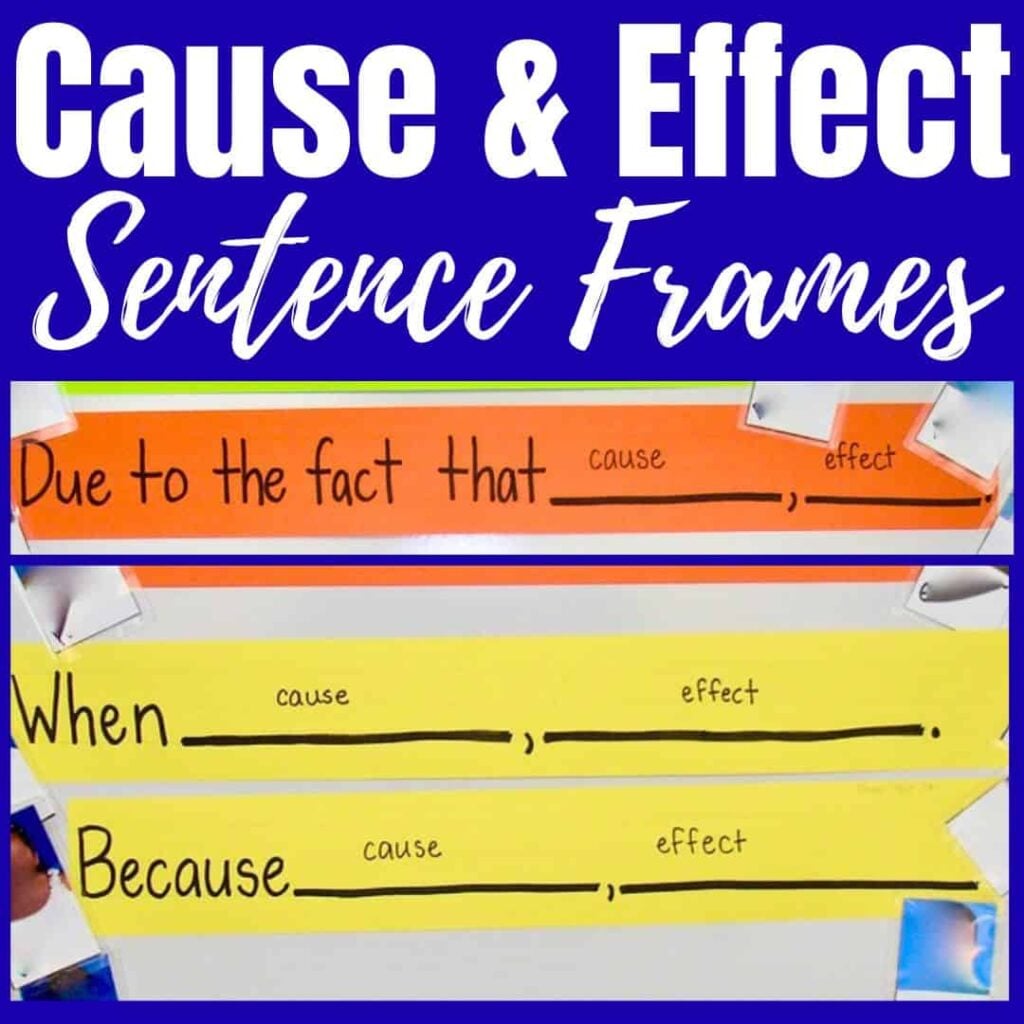
See this post for more cause and effect sentence frames to use during your daily instruction.
Compare & Contrast Sentence Starters
These sentence starters help students describe similarities and differences between two things, which is a foundational skill in both writing and comprehension. Whether comparing different animals, historical events, or problem-solving methods, students learn to express complex ideas more clearly. For example:
- “Unlike mammals, reptiles lay eggs instead of giving birth to live young.”
- “Both honeybees and butterflies help pollinate flowers, but they do so in different ways.”
Encouraging students to use Compare & Contrast sentence starters helps them analyze information, identify key characteristics, and develop a well-structured writing style.
Here are some compare and contrast sentence starters:
- … is like… because…
- … is different from… because…
- Unlike…, …
- One way… and… are the same is…
- A difference between… and… is…
- Both… and… have…
Example Informational Paragraph Using Sentence Starters
Unlike opinion writing sentence starters, which focus on stating a claim and supporting it with reasons, informational writing sentence starters help students present facts and explain ideas clearly.
Example: Bees and Pollination
Introduction:
Have you ever wondered how bees help the environment?
Topic Sentence:
One important way bees help the environment is through pollination.
Supporting Details:
For example, bees transfer pollen between flowers.
Because of this, plants are able to produce fruits and seeds.
As a result, many crops grow successfully.
Conclusion:
Now you know why bees play such an important role in nature.
Showing students how sentence starters build a full paragraph helps them understand how to use them effectively.
These sentence starters also pair well with biography writing projects and research report assignments, where students need support organizing facts into clear paragraphs.
Example: The Water Cycle
Introduction
Did you know that water on Earth is constantly moving through a process called the water cycle?
Topic Sentence
One important stage of the water cycle is evaporation.
Supporting Details
For example, heat from the sun causes water in lakes and oceans to turn into vapor.
As a result, the water rises into the atmosphere and forms clouds.
Conclusion
This shows how evaporation plays an important role in the water cycle.
Classroom-Ready Informational Writing Sentence Starters
If you want these sentence starters organized and ready for immediate classroom use, having them in a printable format makes implementation much easier.
Teachers often use sentence starter lists as:
- Anchor charts
- Writing notebook references
- Small-group scaffolds
- Student desk helpers
- Revision checklists
When students can see sentence starters grouped by purpose—introduction, topic sentence, supporting detail, cause and effect, compare and contrast, and conclusion—they begin to understand how informational writing is structured.
Over time, they rely on them less and internalize the patterns of strong nonfiction writing.

Helping students structure their writing can make a big difference in their confidence and clarity. This resource provides sentence starters to guide students through the process of writing strong informational texts.
How to Use Informational Sentence Starters in 3rd, 4th, and 5th Grade
3rd Grade
Students often write short informational paragraphs. Focus on:
- Introduction starters
- Topic sentence starters
- Simple supporting detail starters
Model how one paragraph is built using one topic sentence and 2–3 supporting details.
4th Grade
Students begin writing multi-paragraph informational essays. Add:
- Cause and effect starters
- Compare and contrast starters
- Transitional phrases
Teach students how each paragraph connects back to the introduction.
5th Grade
Students should begin expanding explanations and synthesizing information. Encourage:
- Evidence-based detail starters
- Logical connectors
- Strong conclusion starters
Have students revise by replacing repeated sentence starters with varied phrasing.
Helping Students Become Stronger Informational Writers
Giving students structured sentence starters helps them feel more confident in their writing. Instead of staring at a blank page, they’ll have the tools to express their thoughts clearly. As they practice using these sentence starters, they’ll gradually develop the skills to write independently and organize their ideas logically.
Try introducing a small set of sentence starters during your next informational writing lesson and model how they build a complete paragraph. Over time, students will begin choosing stronger sentence structures independently.
Sentence Starters for Other Writing Genres
Students don’t just write informational texts. They also write opinion pieces and narratives throughout the year. If you’re looking for sentence starters for other types of writing, you may find these helpful:
- Opinion Writing Sentence Starters
- Personal Narrative Writing Sentence Starters
- Fictional Story Sentence Starters
Each set supports students in organizing their ideas based on the structure of that genre.
Jessica BOschen
Jessica is a teacher, homeschool parent, and entrepreneur. She shares her passion for teaching and education on What I Have Learned. Jessica has 16 years of experience teaching elementary school and currently homeschools her two middle and high school boys. She enjoys scaffolding learning for students, focusing on helping our most challenging learners achieve success in all academic areas.