
Cause and Effect Sentence Frames for Students (Examples and Classroom Use)
Understanding cause and effect is a foundational reading and writing skill for elementary students. When students recognize how events are connected, they become stronger readers, clearer writers, and better thinkers.
Many students understand the idea of cause and effect when discussing a story or science topic, but struggle when it comes time to put those ideas into sentences. This is where sentence frames can make a huge difference.
Cause and effect sentence frames give students a structure they can use to explain relationships between ideas. Instead of staring at a blank page, students can focus on the thinking while the sentence structure guides their writing.
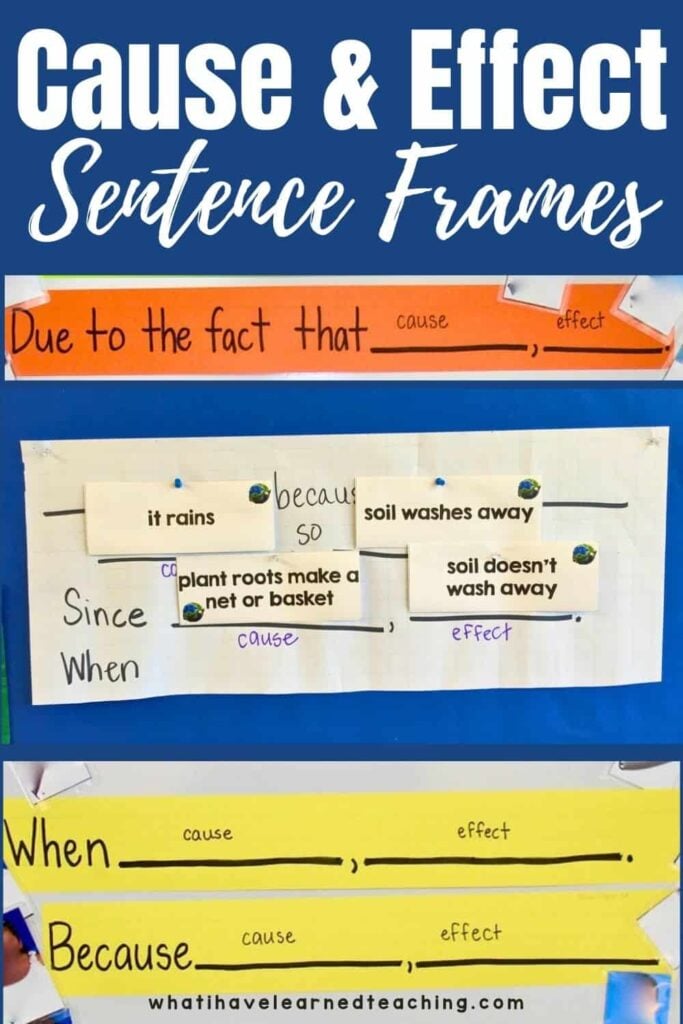
In this guide, you’ll find examples of cause and effect sentence frames, ideas for using them in reading and science lessons, and tips for helping students move from sentence frames to independent writing.
What Are Cause and Effect Sentence Frames?
Cause and effect sentence frames are partially completed sentences that help students explain why something happened (cause) and what happened as a result (effect).
They provide students with the structure needed to organize their thinking.
A simple cause and effect example looks like this:
Because ______ happened, ______ happened.
Students fill in the missing information while practicing how cause and effect relationships work in writing.
Sentence frames are especially helpful for:
- English learners
- students developing writing skills
- students learning academic vocabulary
- younger writers who need structure

If you’re interested in the difference between sentence stems and frames, you can read more in this guide on sentence stems and sentence frames.
Examples of a Cause and Effect Sentence
Before giving students frames, it helps to show a few complete examples.
- Because it rained all night, the river flooded.
- The plants died because they did not receive enough water.
- When the temperature dropped, the water turned into ice.
- Since the student studied for the test, she earned a high score.
These examples help students see how one event leads to another.
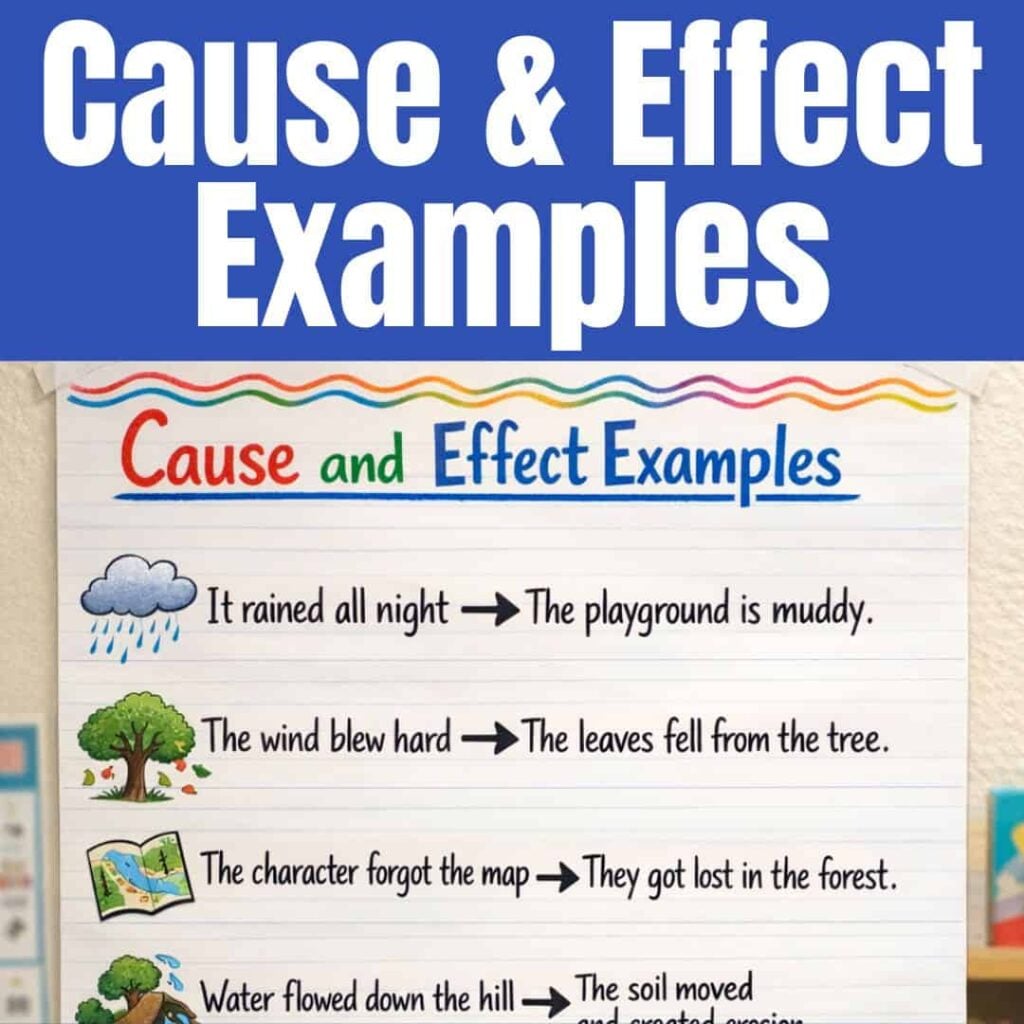
Need more ideas for teaching cause & effect? Check out these cause and effect examples to use in your classroom!!
Simple Cause and Effect Sentence Frames for Students
These frames work well with younger elementary students or writers who need strong support.
Basic Cause and Effect Frames
- Because ______, ______ happened.
- ______ happened because ______.
- When ______ happened, ______ occurred.
- Since ______ happened, ______ resulted.
Example:
Because the wind blew strongly, the tree branches moved.
Cause and Effect Sentence Frames for Reading Responses
Students often need to explain cause and effect relationships in stories.
These frames help students respond to reading.
Reading Cause and Effect Frames
- The character did ______ because ______.
- Because ______ happened, the character ______.
- One reason ______ happened is ______.
- ______ caused ______ to happen in the story.
Example:
Because the wolf was hungry, he searched for the pigs.
Cause and Effect Sentence Frames for Informational Writing
Cause and effect relationships appear frequently in informational texts and science lessons.
Students can use frames like these when writing about nonfiction topics.
Informational Writing Frames
- One cause of ______ is ______.
- One effect of ______ is ______.
- ______ led to ______.
- ______ resulted in ______.
- ______ happened as a result of ______.
These are particularly helpful during science investigations or research writing.
If you’re teaching informational writing, these informational writing sentence starters for grades 3–5 provide additional writing support.
Cause and Effect Sentence Frames for Science
Science lessons are full of cause and effect relationships. Students observe how one action leads to another result.
Examples:
- Because water flows downhill, soil moves during erosion.
- Heavy rain caused the riverbank to collapse.
- Wind causes sand to move across the desert.
Students can use frames like these during science writing.
Science Cause and Effect Frames
- Because ______ occurred, ______ happened.
- When ______ changed, ______ resulted.
- ______ caused ______ during the experiment.
- As a result of ______, ______ happened.

You can see a classroom example in this lesson on cause and effect with soil erosion.
Why Sentence Frames Help Students Learn Cause and Effect
Sentence frames support student thinking in several ways.
They reduce writing frustration
Students already know what they want to say. The frame simply gives them a structure.
They model academic language
Words like because, since, caused, resulted, and led to are common in academic writing. Sentence frames expose students to this language naturally.
They build confidence
Students quickly realize they can explain complex ideas once they have a structure to follow.
They support English learners
Sentence frames provide language support while students develop vocabulary.
Moving Students Beyond Sentence Frames
Sentence frames are a support tool, not a permanent crutch.
As students gain confidence, gradually remove the scaffolding.
You can move students forward by:
- providing sentence starters instead of full frames
- asking students to write their own cause and effect sentences
- encouraging multiple causes or effects
- asking students to explain their reasoning in paragraphs
Over time, students learn to structure cause and effect explanations independently.
Classroom Activities Using Cause and Effect Sentence Frames
Here are a few simple ways to incorporate these frames into daily lessons.
Turn and Talk
Students complete a sentence frame with a partner after reading a passage or completing a science investigation.
Example prompt:
Because ______ happened in the story, ______ happened next.

Learn about this cooperative learning strategy.
Science Observations
During experiments, students record results using cause and effect frames.
Example:
Because we tilted the tray, the water moved faster.
Exit Tickets
Students complete one cause and effect frame at the end of a lesson.
Example:
One effect of today’s experiment was ______.
These quick activities reinforce cause-and-effect thinking across subjects.
Helping Students Master Cause and Effect Writing
Cause and effect sentence frames help students organize their thinking and communicate ideas clearly. By giving students structured language support, teachers make it easier for young writers to explain relationships between events.
Over time, students begin to recognize cause and effect patterns in reading, science, and everyday experiences. As their confidence grows, they move from using sentence frames to writing clear explanations independently.
If you’re teaching writing skills across subjects, sentence frames are a simple strategy that can make a big difference in how students express their ideas.
Jessica BOschen
Jessica is a teacher, homeschool parent, and entrepreneur. She shares her passion for teaching and education on What I Have Learned. Jessica has 16 years of experience teaching elementary school and currently homeschools her two middle and high school boys. She enjoys scaffolding learning for students, focusing on helping our most challenging learners achieve success in all academic areas.