
Fictional Narrative Sentence Starters: Story Writing Scaffolds for Grades 3–5
Fictional narrative sentence starters give students a framework for writing made-up stories without staring at a blank page. Instead of getting stuck on how to begin, students can use a starter to launch into a strong opening, build a vivid setting, introduce dialogue, or write a satisfying ending.
These sentence starters work across story types — fantasy, realistic fiction, mystery, adventure — and are organized by purpose so students can find the right kind of support at any stage of their writing.
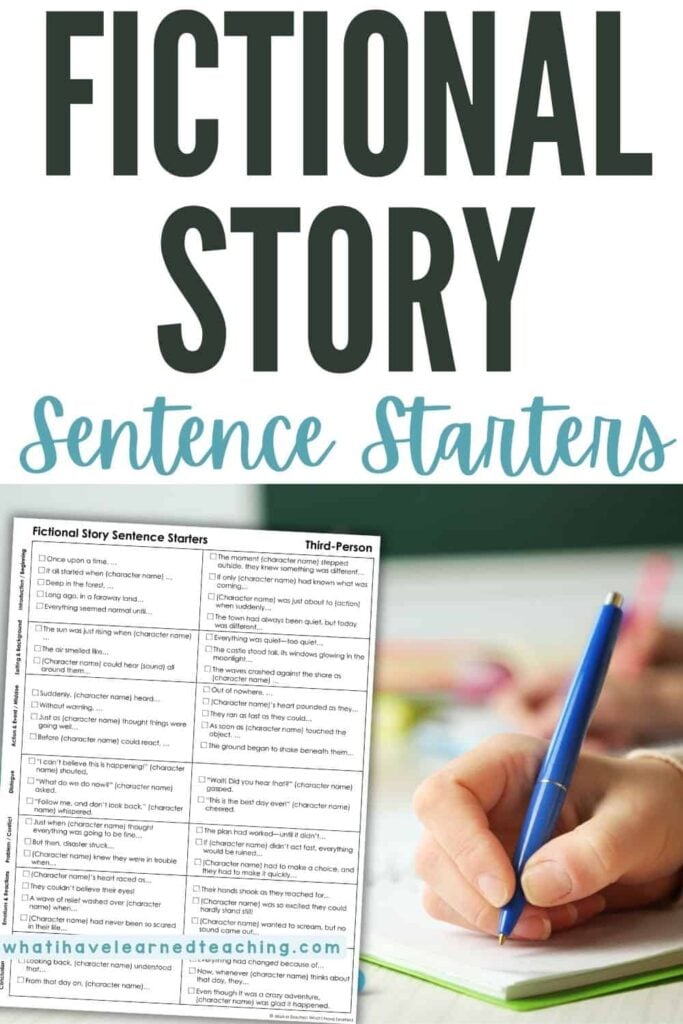
If you are teaching personal narrative instead of fiction, the personal narrative sentence starters page covers sentence starters for real-life experiences separately.
Teaching multiple writing genres? Visit the Writing Sentence Starters for Elementary page to see informational, opinion, personal narrative, and fictional story starters organized in one place.
Below, you’ll find fictional narrative sentence starters organized by purpose: story beginnings, setting development, character actions, dialogue, problem and conflict, and story endings.
Fictional Narrative Sentence Starters: Quick Reference
Here is a quick reference for fictional narrative sentence starters, organized by purpose. Find the specific category and examples in each section below.
Story beginnings: “It all started when…” / “One ordinary day, everything changed when…” / “Little did she know…”
Setting: “The sky was…” / “Deep in the forest…” / “The room was filled with…”
Action: “Without thinking, I…” / “Before anyone could react…” / “Heart pounding, I…”
Dialogue: “We have to hurry,” whispered… / “I can’t believe this!” shouted… / “Are you sure about that?” asked…
Problem and conflict: “That’s when the trouble began.” / “Everything went wrong when…” / “I knew something wasn’t right.”
Story endings: “From that day on…” / “That was the moment I realized…” / “Everything finally made sense.”
What Are Fictional Narrative Sentence Starters?
Fictional narrative sentence starters are short phrases that help students begin sentences when writing made-up stories. Unlike informational writing, which focuses on facts, fictional narratives focus on characters, plot, setting, and conflict.
These starters help students:
- Introduce characters
- Establish setting
- Show action
- Add dialogue
- Build suspense
- Develop a problem
- Write a strong ending
They reduce writer’s block while still allowing students to be creative.
When to Use Fictional Narrative Sentence Starters
Each type of sentence starter plays a different role in story writing. Teaching students how and when to use each type helps them move from random sentences to structured storytelling.
Story Beginning Sentence Starters
These help students hook the reader and introduce characters or settings.
Strong beginnings grab attention immediately.
Examples:
- Once upon a time…
- It all started when…
- One ordinary day, everything changed when…
- In the middle of the night…
- Little did she know…
Setting Sentence Starters
These help students describe where and when the story takes place. Strong setting details make stories feel vivid.
Examples:
- The sky was…
- The air felt…
- In a small village…
- Deep in the forest…
- The room was filled with…
Action Sentence Starters
These move the story forward. They are especially useful during rising action.
Examples:
- Without thinking, I…
- Quickly, she…
- Before anyone could react…
- In a flash…
- Heart pounding, I…
Dialogue Sentence Starters
These help students include conversations naturally instead of repeating “said.”
Examples:
- “I can’t believe this!” shouted…
- “Wait for me!” cried…
- “Are you sure about that?” asked…
- “We have to hurry,” whispered…
Problem & Conflict Starters
These introduce the main challenge in the story.
Examples:
- That’s when the trouble began.
- Everything went wrong when…
- The real problem started when…
- I knew something wasn’t right.
Ending Sentence Starters
These help students resolve the story in a satisfying way.
Examples:
- In the end…
- From that day on…
- That was the moment I realized…
- Everything finally made sense.
Example Fictional Narrative Paragraph Using Sentence Starters
Beginning:
It all started when the mysterious package arrived at my door.
Setting:
The sky was dark, and the wind howled outside my window.
Action:
Without thinking, I tore open the box.
Dialogue:
“Don’t open that!” my sister shouted from across the room.
Problem:
That’s when the trouble began.
Ending:
From that day on, I knew my life would never be the same.
Showing students how sentence starters build a complete story helps them understand how structure supports creativity.
How Fictional Narrative Starters Differ from Personal Narrative Starters
Although both genres fall under narrative writing, fictional narratives and personal narratives serve different purposes, and students need different supports for each.
Personal narrative writing focuses on real-life experiences. Students reflect on something that actually happened to them. The emphasis is on feelings, personal growth, and meaningful moments.
Personal narrative sentence starters guide reflection and help students organize real events chronologically. For the full list, see personal narrative sentence starters.
Fictional narrative writing, on the other hand, is based on imagination. Students create characters, invent conflicts, and design story plots. The emphasis is on story structure: setting, rising action, problem, climax, and resolution.
Fictional narrative sentence starters often sound like:
- “Little did she know…”
- “Suddenly, everything changed when…”
- “That’s when the trouble began.”
- “In the end…”
These starters help students build suspense, introduce conflict, and resolve story problems.
How to Use Fictional Narrative Sentence Starters in 3rd–5th Grade
Fictional narrative sentence starters should grow with students. Here’s how to increase expectations from 3rd through 5th grade.
| Grade Level | Instructional Focus | What to Teach with Sentence Starters |
|---|---|---|
| 3rd Grade | Building basic story structure | • Strong story beginnings • Simple setting descriptions • Basic dialogue • Clear beginning, middle, and end structure |
| 4th Grade | Expanding plot development | • Conflict development • Dialogue variety (moving beyond “said”) • Character emotions • Paragraph transitions • Rising action and resolution |
| 5th Grade | Deepening storytelling skills | • Suspense-building starters • More complex sentence structures • Character reflection • Show-don’t-tell revisions • Replacing repeated sentence starters with varied phrasing |
Classroom-Ready Fictional Narrative Sentence Starters
If you want these sentence starters organized for easy classroom use, having them in an anchor chart, a bookmark, or a one-page reference format makes implementation simple.
Teachers often use them as:
- Writing workshop anchor charts
- Student notebook references
- Small group scaffolds
- Desk helpers
- Revision tools
When students see story sentence starters grouped by purpose, they begin to understand how fiction is structured, and their storytelling improves.
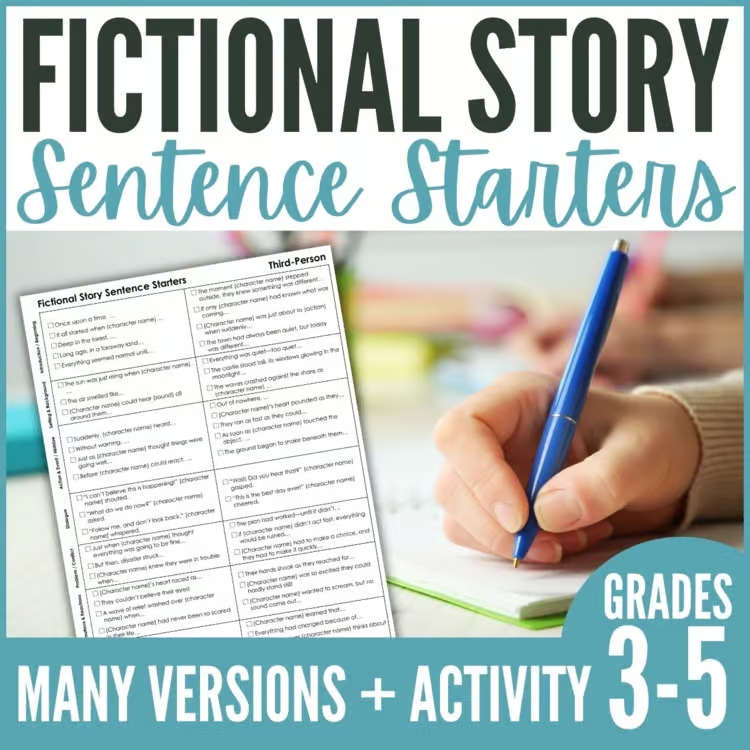
This Story Narrative Sentence Starters resource provides structured sentence prompts to help students begin, develop, and conclude their creative stories with confidence.
Helping Students Become Stronger Story Writers
Fictional narrative writing should feel creative, not stressful. Sentence starters provide scaffolding without limiting imagination.
As students grow more confident, they rely on them less and begin crafting their own engaging openings, strong dialogue, and satisfying endings.
Try introducing one category at a time during your next narrative unit and watch your students’ stories grow stronger.
Jessica BOschen
Jessica is a teacher, homeschool parent, and entrepreneur. She shares her passion for teaching and education on What I Have Learned. Jessica has 16 years of experience teaching elementary school and currently homeschools her two middle and high school boys. She enjoys scaffolding learning for students, focusing on helping our most challenging learners achieve success in all academic areas.