
Personal Narrative Sentence Starters (Grades 3–5)
Teaching personal narrative writing can be challenging, especially when students struggle to get their stories started. Many students know what happened, but they don’t know how to begin their sentences in an engaging or descriptive way.
Personal narrative sentence starters give students the structure they need to introduce their story, describe the setting, develop events, add dialogue, express emotions, and write meaningful conclusions.
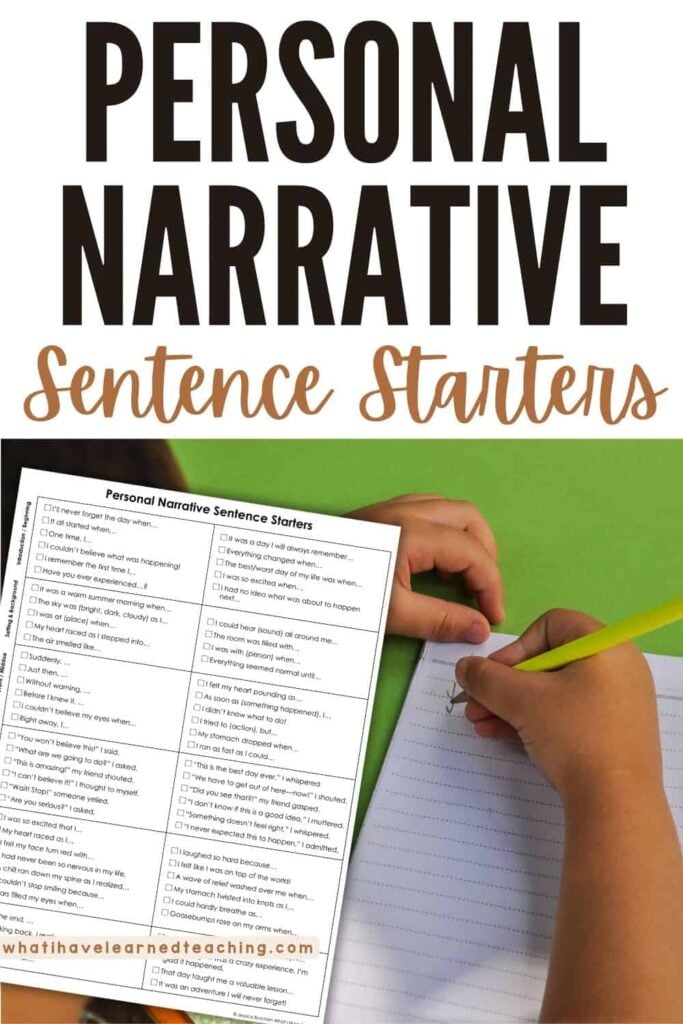
Whether students are writing about a special memory, a funny experience, or a lesson they learned, sentence starters help them organize their thoughts and bring their stories to life.
Personal narratives are just one part of elementary writing instruction. You can find sentence starters for informational, opinion, and fictional narrative writing in the complete Writing Sentence Starters guide.
Below you’ll find personal narrative sentence starters organized by purpose so students can use the right type of sentence at the right moment in their writing.
What Are Personal Narrative Sentence Starters?
Personal narrative sentence starters are short phrases that help students begin sentences when writing about real-life experiences. They guide students in structuring their story from beginning to end.
These sentence starters support students by:
- Reducing writer’s block
- Encouraging descriptive details
- Supporting story organization
- Helping students express emotions
- Modeling strong storytelling structure
Instead of staring at a blank page, students have a starting point that builds confidence and fluency.
When to Use Personal Narrative Sentence Starters
Each type of sentence starter plays a different role in narrative writing.
Introduction / Beginning Sentence Starters
These help students hook the reader and introduce the event.
Examples include: PersonalNarrativeSentenceStarte…
- I’ll never forget the day when…
- It all started when…
- One time, I…
- Everything changed when…
- I had no idea what was about to happen next…
These should be used at the beginning of the story to establish the main event.
Setting & Background Sentence Starters
These help students describe where and when the story takes place.
Examples include: PersonalNarrativeSentenceStarte…
- It was a warm summer morning when…
- I was at (place) when…
- The air smelled like…
- Everything seemed normal until…
- Shadows stretched across the ground as the sun began to set…
Encourage students to use sensory details to make the setting vivid.
Action & Event Sentence Starters
These help move the story forward.
Examples include: PersonalNarrativeSentenceStarte…
- Suddenly, …
- Just then, …
- Before I knew it, …
- I tried to (action), but…
- My stomach dropped when…
These starters increase pacing and tension in the middle of the story.
Dialogue Sentence Starters
Dialogue makes personal narratives more engaging.
Examples include: PersonalNarrativeSentenceStarte…
- “You won’t believe this!” I said.
- “What are we going to do?” I asked.
- “Wait! Stop!” someone yelled.
- “Something doesn’t feel right,” I whispered.
Teaching students to combine dialogue with action builds stronger storytelling skills.
Emotions & Reactions Sentence Starters
These help students express feelings and internal reactions.
Examples include: PersonalNarrativeSentenceStarte…
- I was so excited that I…
- Tears filled my eyes when…
- A wave of relief washed over me when…
- A chill ran down my spine as I realized…
Encouraging emotional detail helps students move beyond simple retelling.
Conclusion Sentence Starters
These help students reflect and wrap up their narrative.
Examples include: PersonalNarrativeSentenceStarte…
- In the end, …
- Looking back, I realize…
- I learned that…
- That day taught me a valuable lesson…
- I will always remember that day because…
Conclusions in personal narratives often include reflection or a lesson learned.
Example Personal Narrative Paragraph Using Sentence Starters
Introduction:
I’ll never forget the day when I got lost at the fair.
Setting:
It was a warm summer evening, and the air smelled like popcorn and cotton candy.
Action:
Suddenly, I realized my parents were gone.
Dialogue:
“Mom?” I called nervously. “Dad?”
Emotion:
My stomach twisted into knots as I looked around the crowded midway.
Conclusion:
Looking back, I realize that staying calm helped me solve the problem.
Showing students how these sentence starters build a complete narrative helps them understand how stories are structured.
How to Use Personal Narrative Sentence Starters in 3rd, 4th, and 5th Grade
3rd Grade
Focus on:
- Beginning sentence starters
- Basic setting descriptions
- Simple action transitions
Model one clear beginning, middle, and end.
4th Grade
Students can begin adding:
- Dialogue
- Emotional reactions
- Stronger transitions
Teach them how dialogue and emotions strengthen the middle of the story.
5th Grade
Encourage:
- Rich sensory details
- Reflection in the conclusion
- Varied sentence structures
Students should begin to reduce their reliance on starters as their narrative voice develops.
Personal Narrative vs. Fictional Narrative Sentence Starters
Personal narrative writing focuses on real-life experiences and reflections. Fictional narrative sentence starters often emphasize imaginative settings, characters, and plot development.
If you’re teaching multiple narrative genres, you may also find fictional narrative sentence starters helpful for creative writing units.
Personal Narrative vs. Informational and Opinion Writing
Unlike informational writing sentence starters, which help students explain facts, and opinion writing sentence starters, which support stating and defending a claim, personal narrative sentence starters focus on storytelling, emotions, and reflection.
Classroom-Ready Personal Narrative Sentence Starters
If you prefer printable versions organized by category, this resource includes:
- Anchor chart versions
- Student notebook copies
- A one-page reference sheet
- A sorting activity
Teachers use these for:
- Writing mini-lessons
- Small-group support
- Narrative units
- Writer’s workshop
You can view the full resource here:
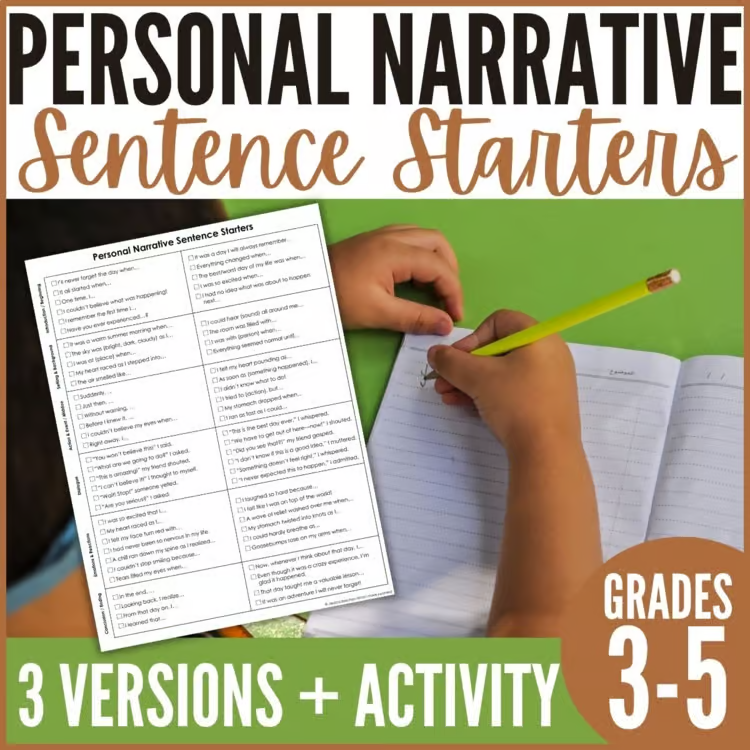
This resource provides sentence starters that guide students through the process of writing engaging personal narratives.
Helping Students Become Stronger Narrative Writers
Personal narrative writing is about more than telling what happened. It’s about showing what happened and reflecting on why it mattered.
Sentence starters provide structure at the beginning. Over time, students internalize those patterns and develop independence.
Try introducing one category at a time and modeling how it builds a stronger story.
Jessica BOschen
Jessica is a teacher, homeschool parent, and entrepreneur. She shares her passion for teaching and education on What I Have Learned. Jessica has 16 years of experience teaching elementary school and currently homeschools her two middle and high school boys. She enjoys scaffolding learning for students, focusing on helping our most challenging learners achieve success in all academic areas.