
Opinion Writing Sentence Starters for Grades 3-5: Every Part of the Essay
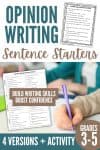
Opinion writing sentence starters (sometimes called opinion sentence stems or opinion sentence frames) give elementary students the language structure they need to clearly introduce their opinion, support it with reasons, address counterarguments, and write strong conclusions.
Teaching opinion writing in elementary classrooms can feel challenging when students know what they think but don’t know how to say it. Many students default to “I like it because…” and struggle to move beyond basic reasoning.

Whether students are writing persuasive essays, responding to reading, or participating in classroom debates, sentence starters help them organize their thinking into clear, supported arguments.
If you’re building a full writing toolkit, you can explore sentence starters for informational, narrative, and opinion writing on the Writing Sentence Starters for Grades 3–5 hub page.
Sentence starters help students organize their thinking and begin writing more confidently. They provide a structure for stating opinions, giving reasons, and explaining ideas. For more strategies that support opinion writing instruction, visit this complete guide to teaching opinion writing in elementary school.
Below, you’ll see how different types of opinion writing sentence starters align with each part of the opinion writing process. For each section, you’ll find:
- A quick explanation of the skill
- Sentence starter examples
- A link to deeper instruction
What Are Opinion Writing Sentence Starters?
Opinion writing sentence starters are short phrases that help students begin sentences when expressing and defending a viewpoint.
Unlike informational writing, which focuses on presenting facts, opinion writing requires students to:
- Clearly state a claim
- Provide supporting reasons
- Use evidence or examples
- Address opposing viewpoints
- Restate their opinion in a strong conclusion
Sentence starters reduce writer’s block while reinforcing the structure of persuasive writing.
You may also see these called opinion sentence stems, sentence frames, or persuasive writing sentence starters — the terms are used interchangeably in elementary classrooms.
Why Opinion Writing Sentence Starters Work
Opinion writing sentence starters don’t replace instruction. They reinforce it. With structured language, students can focus on developing their ideas instead of struggling to begin. This allows teachers to model reasoning, evidence, and persuasive structure more effectively.
Introduction Sentence Starters
Getting started is half the battle. These sentence starters support the same skills taught in my post on introducing the topic in opinion writing, but give students ready-to-use language they can apply immediately.
These sentence starters give students a launching pad to confidently share their opinions:
- Have you ever thought about…?
- In my opinion,…
- I strongly believe that…
- Everyone should consider…
Encourage students to choose one or two as their opening line in an opinion paragraph or essay. You can even have them write multiple leads using different starters to see which one has the strongest voice.
Try this: Project several introduction starters on the board. As a class, brainstorm opinion topics (Should recess be longer? Is pizza the best school lunch?) and practice crafting introductions together.

Teach Students to Introduce a Topic
If you need more support teaching introductions, read this post on how to teach students to introduce a topic in opinion writing.
Topic Sentence Starters
Once students introduce their opinion, they need to back it up! These starters reinforce the work students do when learning how to clearly state an opinion, providing consistent academic language they can use across discussions and writing.
Topic sentences introduce the reasons behind their thinking:
- One reason I believe this is…
- People should care about this because…
- A big reason why… is…
- … has many benefits, such as…
These starters help students develop strong body paragraphs. They’re especially helpful for students who tend to wander in their writing or repeat the same sentence structure over and over.
Mini-lesson idea: Use a mentor text or model paragraph and highlight the topic sentence. Then, have students use the starters to write their own supporting reasons.

Teach Students to State an Opinion
For a step-by-step approach, read this post on how to teach students to state an opinion clearly.
Detail & Support Sentence Starters
Supporting details bring their reasons to life. These sentence starters align with the strategies in my post on teaching students to support their opinions with reasons, helping students move beyond listing ideas and into explaining their thinking.
Help students explain why their opinion makes sense with these:
- For example,…
- The evidence proves that…
- Experts agree that…
- If we look at… we can see that…
Teaching students to move beyond surface-level reasoning can be tough. These starters prompt them to go deeper and provide actual evidence—something many students skip.
Hands-on idea: Create a sentence sorting center where students match topic sentences with detail sentence starters to build full body paragraphs. Hint: We have a sorting activity in the Opinion Writing Sentence Starters resource below.
Counterargument Sentence Starters
Ready for the next level? Counterargument starters are most helpful for older or more advanced writers and work best after students are confident in stating opinions and supporting them with reasons.
Introducing counterarguments helps students strengthen their writing by addressing opposing views:
- Some people believe that… but I disagree because…
- While others may think…, I think…
- Although it’s true that…, it’s more important that…
This strategy is great for more advanced writers in grades 4–5, but even your third-graders can learn this skill with modeling and sentence frames.
Tip: Use the examples in the resource to show how acknowledging the “other side” strengthens their argument. Then, challenge students to try it in one of their paragraphs.
Conclusion Sentence Starters
Time to wrap it up! These conclusion starters connect directly to the skills taught in my post on writing opinion writing conclusions, giving students clear language for restating their opinion and bringing closure.
Strong conclusions leave a lasting impression and summarize key points:
- As you can see,…
- To sum it up,…
- After considering the facts, it’s obvious that…
- I encourage everyone to…
These are perfect for helping students avoid ending with “That’s why I like it.” They bring closure to their writing in a clear, persuasive way.
Writing workshop idea: Have students highlight the sentence starter they used for their conclusion and reflect on whether it effectively ties back to their opinion.
These sentence starters work best when paired with explicit instruction and repeated practice across an opinion writing unit.
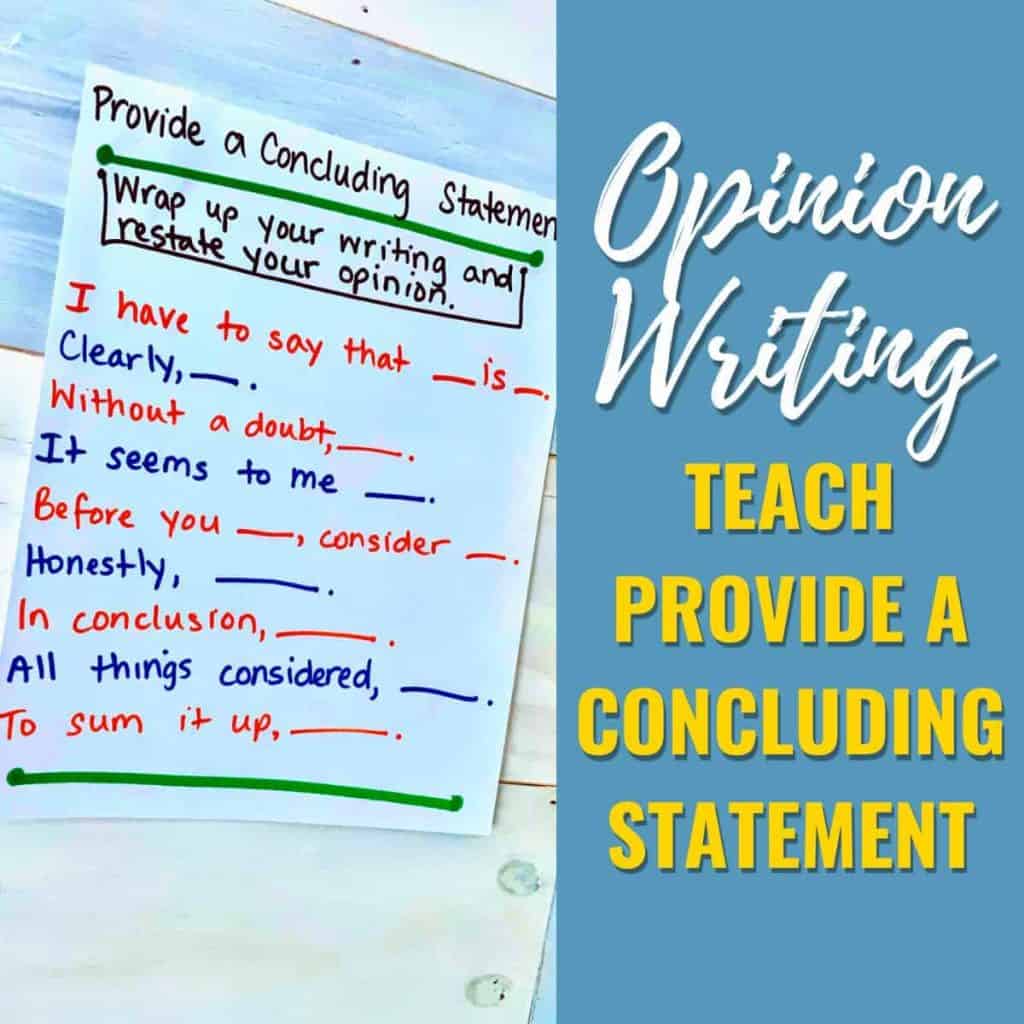
Teach Students to Write a Conclusion for Opinion Paragraphs
For more ideas, check out this post on teaching opinion writing conclusions.
Example Opinion Paragraph Using Sentence Starters
Introduction:
In my opinion, school uniforms should not be required.
Reason:
One reason I believe this is that students express themselves through clothing.
Detail:
For example, clothing allows students to show their interests and personalities.
Counterargument:
While some people believe uniforms reduce distractions, I think students can stay focused without strict dress codes.
Conclusion:
As you can see, allowing students to choose their clothing encourages individuality.
Showing students how sentence starters build a complete opinion paragraph helps them understand persuasive structure more clearly.
Bonus: A Sentence Sorting Activity That Reinforces Structure
One of the best features of this resource is the sentence-sorting activity. Students cut out sentence starters and organize them into categories: Introduction, Topic, Detail, Counterargument, and Conclusion. It reinforces structure and gives students language to explain their sorting choices.
Classroom application: Use it in writing centers, as a pre-writing warm-up, or after a mini-lesson to assess understanding.
Classroom-Ready Opinion Writing Sentence Starters
If you prefer having these sentence starters organized for immediate classroom use, printable anchor charts, bookmarks, and sorting activities can make implementation simple.
When students understand where each sentence starter fits within the opinion writing structure, their arguments become clearer and more convincing.

This resource includes anchor charts, bookmarks, and a hands-on sorting activity.
How Opinion Writing Sentence Starters Fit Into an Opinion Writing Unit
Opinion writing sentence starters work best when paired with direct instruction. I introduce them during mini-lessons for each writing component, then gradually release responsibility as students gain confidence.
Printed as anchor charts, trimmed into bookmarks, or used as writing center reference cards, these starters give students immediate access to the language structures they need during any writing task.
Over time, students internalize these patterns and begin writing persuasive arguments independently.
Read More about Teaching Opinion Writing
7 Ways to Introduce Opinion Writing
Teaching How to State an Opinion
Teaching How to Supply Reasons
Teaching How to Introduce Opinion Writing
Teaching How to Conclude the Opinion Writing
Teaching Ideas to Solidify Students’ Understanding of Opinion Writing
Picture Books to Teach Opinion Writing
Opinion Writing Unit
Opinion Writing Sentence Starters
100 Opinion Writing Prompts
Jessica BOschen
Jessica is a teacher, homeschool parent, and entrepreneur. She shares her passion for teaching and education on What I Have Learned. Jessica has 16 years of experience teaching elementary school and currently homeschools her two middle and high school boys. She enjoys scaffolding learning for students, focusing on helping our most challenging learners achieve success in all academic areas.