
Sentence Combining: How to Teach It in 5 Minutes a Day
Read a stack of 3rd grade writing, and you will see the same pattern over and over: “The dog ran. The dog was fast. The dog went to the park.” Every idea gets its own short, choppy sentence. Sentence combining is the fix, and it is one of the most research-backed moves in writing instruction. When students practice turning two or three short sentences into one clear, well-built sentence, that skill carries straight into their own writing.
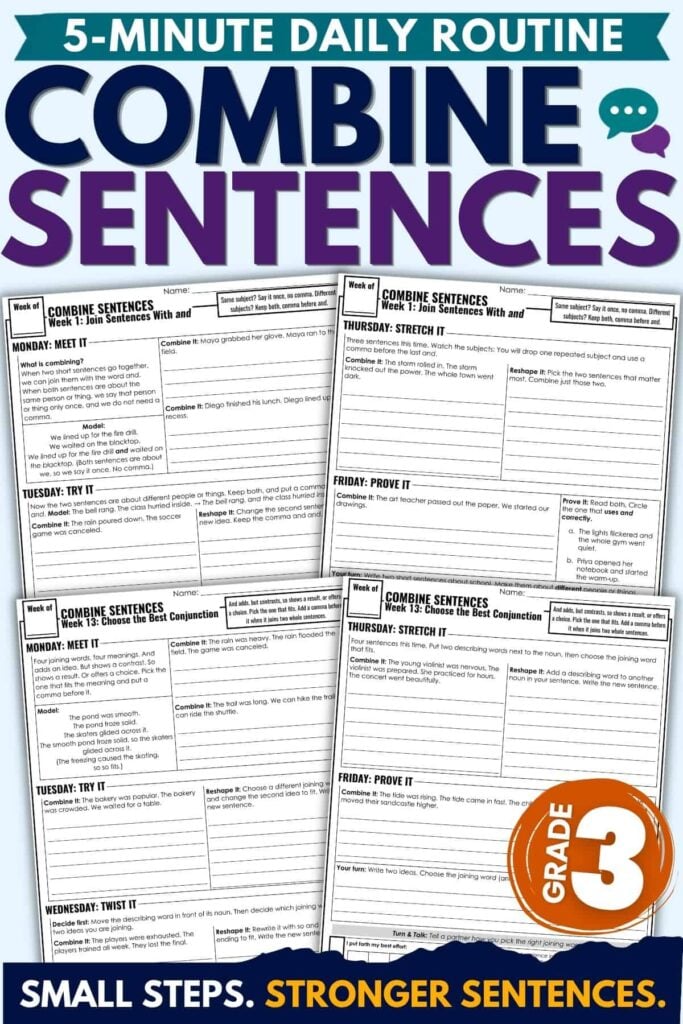
This post explains what sentence combining is, why it works, and how to teach it as a short daily routine, along with the skills that build across a full year.
What Is Sentence Combining?
Sentence combining is exactly what it sounds like: students take two or more short sentences and join them into one stronger sentence. Instead of learning grammar as a list of rules to memorize, students learn structure by building. They might join two ideas with and, move a describing word in front of a noun, add an adverb, or connect two complete thoughts with but or so.
The point is not one correct answer. Usually, more than one strong way exists to combine a set of sentences, and comparing those versions is where students learn that writing is a series of choices. A student who can look at “The lights flickered. The gym went dark.” and decide how to join them is doing real sentence-level thinking, not filling in a blank.
Why Sentence Combining Works
Sentence combining has one of the strongest research bases in writing instruction. More than 85 studies over the past 50 years point the same direction, and the influential Writing Next report named it one of the most effective practices for improving student writing. You can read a clear summary of the strategy and its evidence at Reading Rockets.
It works because of transfer and fluency. Practicing at the sentence level, where the task is small and contained, builds structures students then reach for automatically when they write longer pieces. Because combining becomes more fluent, students spend less mental energy on wrestling with each sentence and more on their ideas. It also teaches grammar in context. A comma rule learned while joining two real sentences sticks better than the same rule taught in isolation.
How to Teach Sentence Combining in Five Minutes a Day
Sentence combining does not need a whole lesson block. It works best as a short, predictable daily routine, the kind of thing students can run on their own once they know the pattern. A rhythm that works well across a week:
- Model the skill first. On day one, show the new move with an example and have students try one alongside you.
- Practice and reshape. Each day, students combine the sentences one way, then reshape that sentence a different way, so they see the choice.
- Talk it through. A quick midweek partner share lets students compare versions out loud, where much of the learning happens.
- Prove the rule. End the week by having students spot the sentence that follows the rule and write one of their own.
Because the routine stays the same all year, students learn it once, and only the skill and the sentences change. That predictability is what makes it work as morning work, a bell ringer, or a warm-up before writing. If you build sentence-level skills through other short routines, my sentence writing warm-ups take a similar add-detail approach, and my post on how to teach students to stretch a sentence pairs well with combining.
Sentence Combining Skills That Build Across the Year
One reason sentence combining fits so well into a daily routine is that the skills stack. Students start simple and grow into more complex sentences over the year. A natural progression for 3rd grade looks like this:
- Build with detail. Join two sentences with and, then add one and two describing words.
- Add more detail. Bring in adverbs and phrases that tell where or when.
- Make compound sentences. Join two complete ideas with but, so, and or, and learn the comma rules that come with them.
- Choose and fix. Pick the joining word that fits, list three ideas in a series, and fix run-on sentences.
- Grow into complex sentences. Join ideas that tell why, when, and in what order using words like because, when, before, and after.
- Put the tools together and revise. Combine the same ideas more than one way, then revise choppy paragraphs of their own.
Every few weeks, it helps to pause on a review week with no new skill, where students choose how to combine from everything they have learned. That is where you see whether the skill has become their own, and it is often where the biggest writing growth shows up.
Frequently Asked Questions
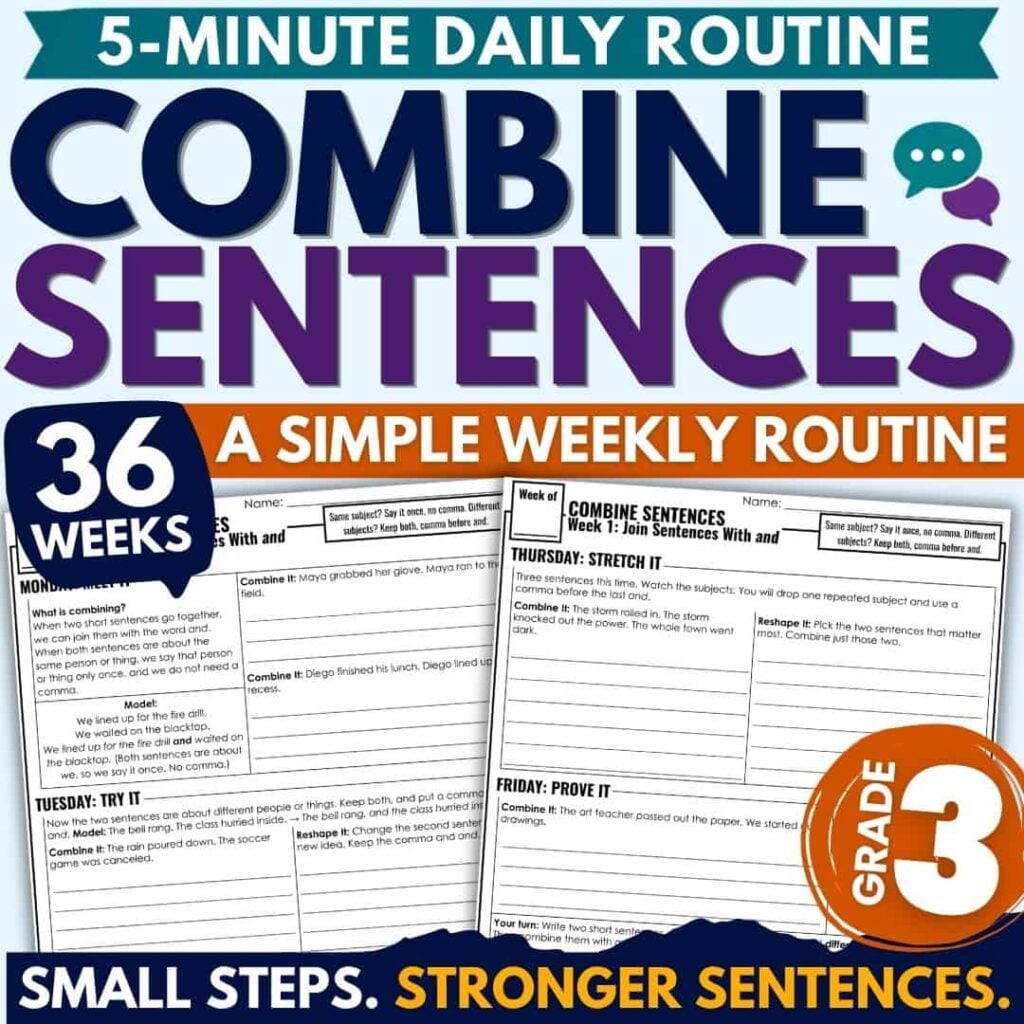
Take a look at the combining sentences resource for third grade.
Bringing It All Together
Sentence combining is a small daily habit with an outsized payoff. Five minutes of joining, reshaping, and comparing sentences builds the structures students carry into every piece they write. Keep the routine predictable, let the skills stack across the year, and honor the fact that there is more than one strong way to combine.
Want it ready to go? My Combine Sentences Daily line gives students five minutes of no-prep practice a day, one skill per week, building across a full school year. Start with Weeks 1-4: Build With Detail, then continue with Weeks 5-8: More Detail, Weeks 9-12: Compound Sentences, and Weeks 13-16: Choose and Fix. Each month stands on its own, and the skills stack toward students revising their own writing.
Jessica BOschen
Jessica is a teacher, homeschool parent, and entrepreneur. She shares her passion for teaching and education on What I Have Learned. Jessica has 16 years of experience teaching elementary school and currently homeschools her two middle and high school boys. She enjoys scaffolding learning for students, focusing on helping our most challenging learners achieve success in all academic areas.