
Teaching run-on sentences usually starts with a page like this: one long sentence held together by the word “and,” a margin note that says “run-on,” and a second draft where the student has put a period at the end of every line. The fix doesn’t stick because students were told something was wrong but never shown how to hear it or fix it.
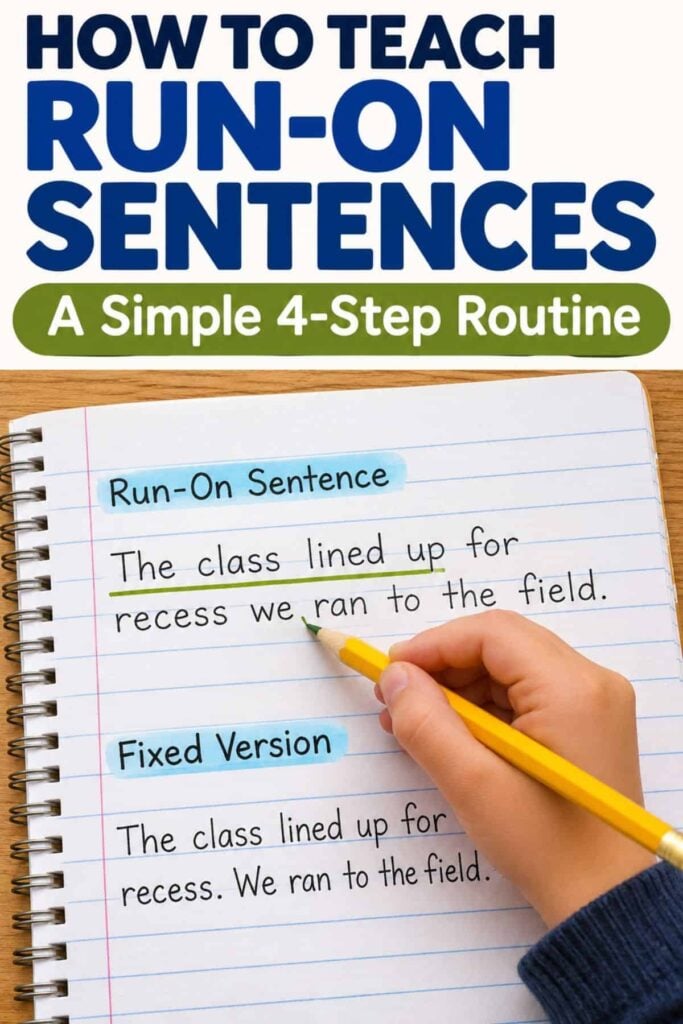
This post walks through a simple method for 3rd, 4th, and 5th grade, with examples you can copy straight onto the board.
What Is a Run-On Sentence?
A run-on sentence is two or more complete thoughts stuck together without the right punctuation or joining word. Here is the definition I give students: if you can put a period in the middle and get two sentences that each make sense on their own, you have a run-on.
Fused sentences
A fused sentence has no punctuation between the two thoughts at all.
- The class lined up for recess we ran to the field.
Comma splices
A comma splice joins two complete thoughts with only a comma.
- The class lined up for recess, we ran to the field.
Both are run-ons. In 3rd grade, I call them both run-ons and leave it there. By 4th grade, students can learn the term comma splice.
One caution: long is not the same as run-on. After we finished our science stations, we cleaned up the materials, and then we lined up for lunch is a long sentence, but it is punctuated correctly. Students need to see that difference, or they start chopping every long sentence into pieces.
Why Students Write Run-On Sentences
Run-ons are rarely careless. Most come from a few predictable places:
- Students write the way they talk, and speech runs on without stopping.
- They cannot yet hear where one complete thought ends.
- They have been told to “add more detail,” so they keep adding without stopping.
- They are unsure what makes a thought complete, which means they are unsure when a period is allowed.
That last one matters most. A student who cannot name the who and the what in a sentence will not know where to split it, which is why teaching run-on sentences works best when it is paired with a clear sense of what a complete sentence is.
Teaching Run-On Sentences Step by Step
I use the same four steps every time. Students learn the routine once, and after that, only the sentences change.
Step 1: Read it aloud
Have students read the sentence aloud and listen for where they naturally pause. That pause is usually where one idea ends.
Step 2: Find each complete idea
Ask, “Who or what is this part about, and what did they do?” Students bracket each complete thought. If a part has no who or no what, it is not finished yet.
Step 3: Choose a fix
Students have three options, and I teach them in this order:
- Split it with a period and a capital letter.
- Join it with a comma and a joining word: and, but, so, or.
- Combine it into one smoother sentence.
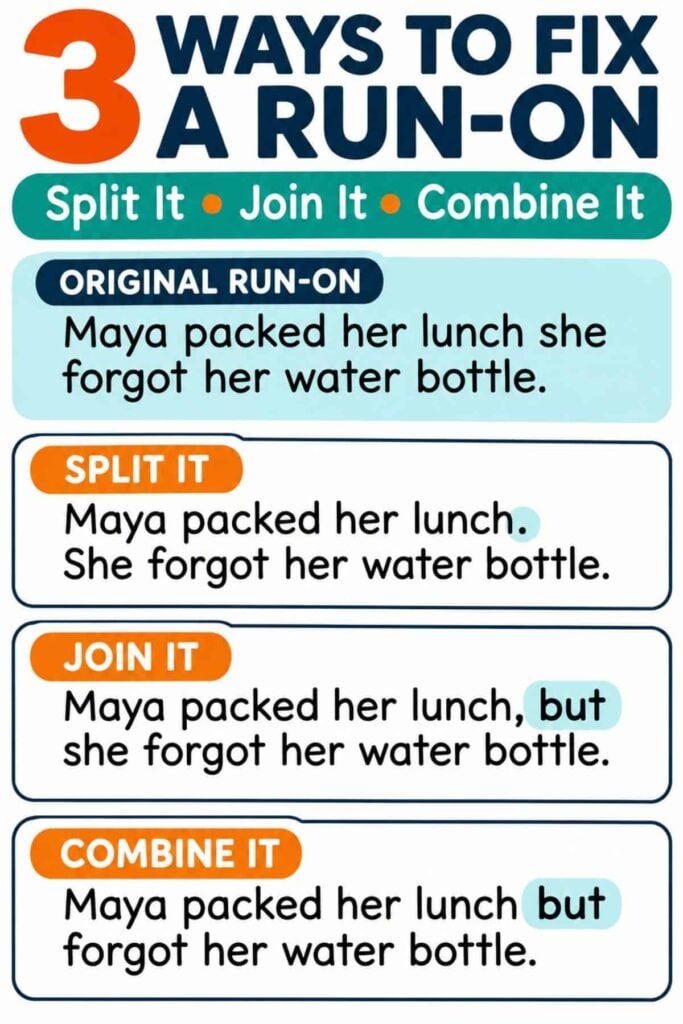
Here is how one run-on looks with all three fixes:
- Run-on: Maya packed her lunch she forgot her water bottle.
- Split: Maya packed her lunch. She forgot her water bottle.
- Join: Maya packed her lunch, but she forgot her water bottle.
- Combine: Maya packed her lunch but forgot her water bottle.
Showing all three matters. Students see that there is more than one correct answer, which takes the pressure off finding the one right fix.
Step 4: Reread to check
Students read the fixed version aloud once more. Each sentence should sound finished, and the whole thing should sound like writing, not like a list of short bursts.
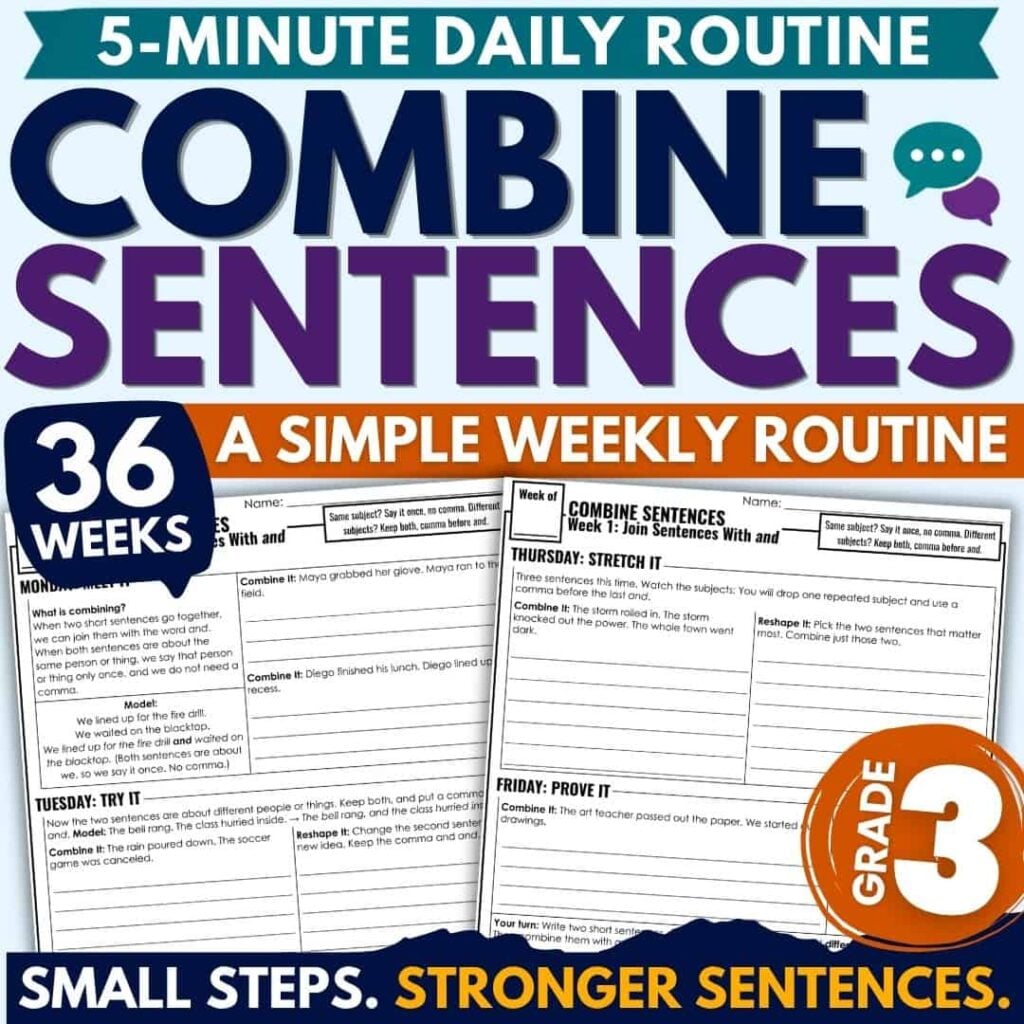
Once students can find and fix a run-on, they are ready to build smoother sentences on their own. My post on sentence combining shows how to teach students to join short sentences into one stronger sentence.
Teaching Run-On Sentences by Grade Level
3rd grade: spot it and split it
Keep it to two skills: hearing the pause and fixing it with a period. Add the joining words and, but, and so once students are confident. Use short, familiar sentences with one clear who and one clear what.
4th grade: join it with a comma and a joining word
Fourth graders can handle the comma-plus-conjunction fix and the term comma splice. Give them sentences that contain two ideas of similar weight, and have them decide whether and, but, or so fits the meaning.
5th grade: combine it
By 5th grade, students can take a run-on and rebuild it with words like because, after, and when. For example, Maya packed her lunch in a hurry she forgot her water bottle becomes Because Maya packed her lunch in a hurry, she forgot her water bottle. This is where run-on work and sentence combining start to look like the same skill.
A Daily Run-On Sentences Practice Routine
Students get better at fixing run-ons through short, repeated practice, not one big lesson. I give one run-on a day, have students work through the four steps, and take a minute at the end to compare fixes. The whole thing fits in about ten minutes, and it works well as morning work or a warm-up.
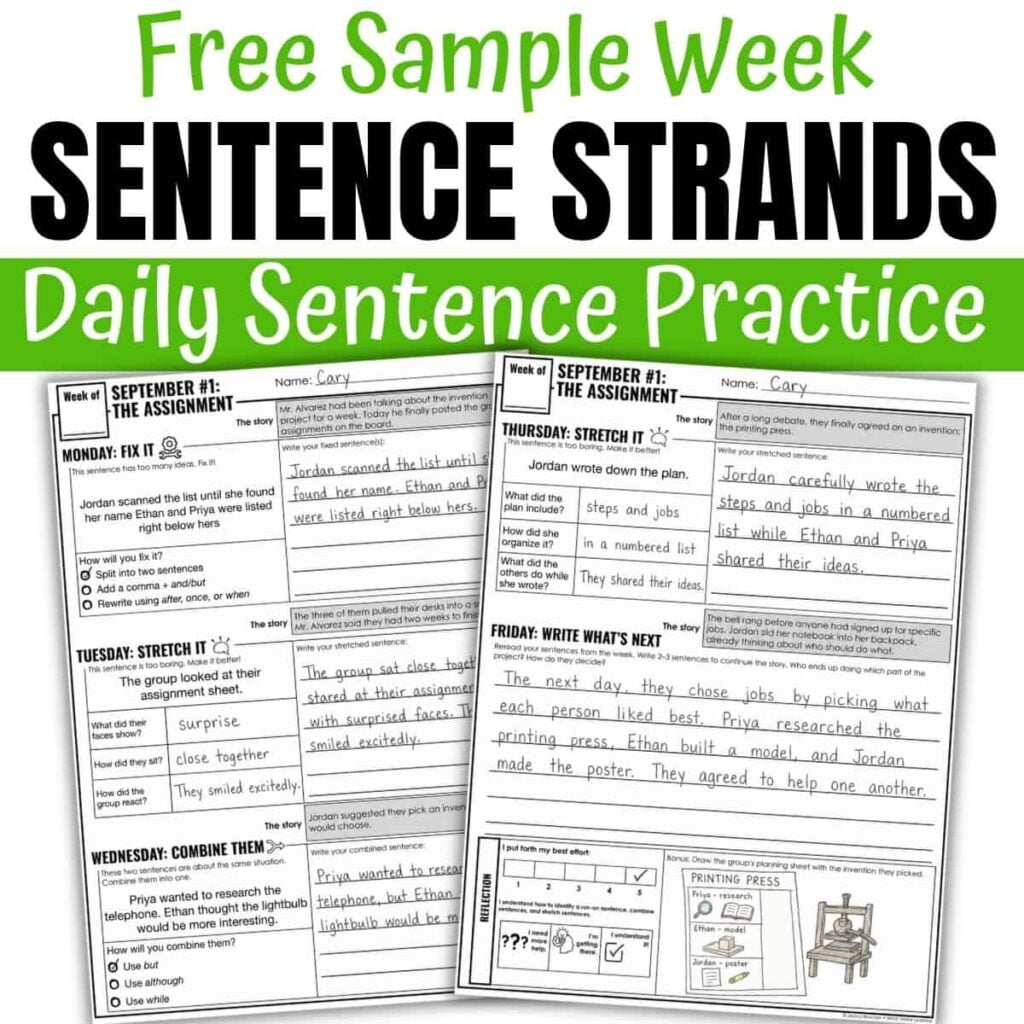
If you want to see how this fits into a bigger routine, my post on daily sentence practice shows how fixing, stretching, and combining sentences can share one short block of time. Once students can fix a run-on, stretching a sentence is the natural next step, because they already know what a complete thought looks like.
Common Mistakes When Fixing Run-On Sentences
- Over-splitting into fragments. A student turns the run-on into Maya packed her lunch. Forgot her water bottle. The second part has no who. Go back to Step 2.
- Adding only a comma. This turns a fused sentence into a comma splice. Remind students that a comma needs a joining word.
- The “and then” chain. Some students fix a run-on by adding “and then” and keep going. Ask them where the big ideas stop.
- Skipping the reread. Students who skip Step 4 miss most of their own errors.
Checking this work can feel like a lot, since several fixes can be correct. If you find yourself wondering how to grade it, my post on why sentence combining has no answer key covers a quick way to check student answers.
Why Fixing Run-On Sentences Leads to Better Writing
Fixing run-ons builds the same awareness students need for combining and expanding sentences. Students who can find the edges of a complete thought write clearer sentences and stronger paragraphs. Sentence combining is also one of the writing strategies highlighted in the Carnegie Corporation report Writing Next, which reviewed research on effective writing instruction. The report focuses on students in grades 4 through 12.
Frequently Asked Questions
Bringing It All Together
Teaching run-on sentences works best as a short, repeated routine: read it aloud, find each idea, choose a fix, and reread. Start with splitting in 3rd grade, add joining words in 4th, and move to combining in 5th. If you try only one thing from this post, try having students reread every fix aloud.
Looking for a ready-made resource? Fiction Story Sentence Strands give students a short story with daily sentences to fix, stretch, and combine. You can try a full week with the free sample week.
Jessica BOschen
Jessica is a teacher, homeschool parent, and entrepreneur. She shares her passion for teaching and education on What I Have Learned. Jessica has 16 years of experience teaching elementary school and currently homeschools her two middle and high school boys. She enjoys scaffolding learning for students, focusing on helping our most challenging learners achieve success in all academic areas.