
Every so often, a teacher asks me why my sentence-combining or sentence-stretching activities don’t come with an answer key. It’s a fair question, especially when you are trying to make life easy for a substitute. The honest answer is that these activities are intentionally open-ended. When students fix a run-on, combine two sentences, or stretch a short sentence, no single response is correct, so an answer key would only show one of many right answers.
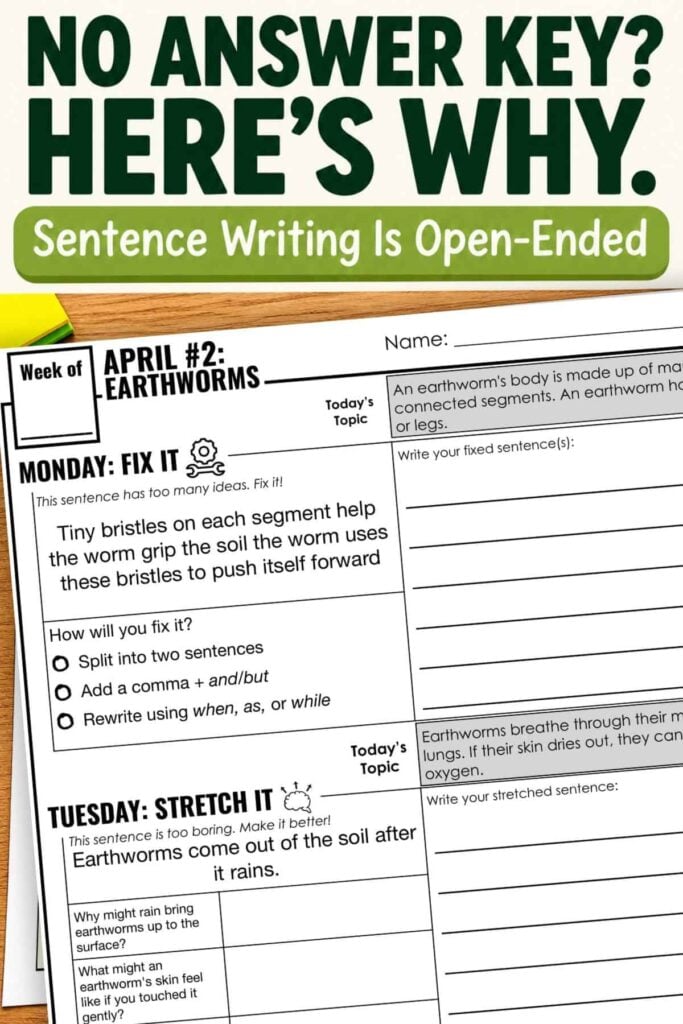
This post explains why that is, what “correct” actually looks like without a key, and how you or a substitute can check student work in seconds.
Why Open-Ended Sentence Activities Don’t Have One Right Answer
The whole point of sentence work is that students make their own writing choices. Take a run-on sentence like this one: Jordan slid the notes across the table Priya barely looked up from her device. A student could fix it several correct ways:
- Split it into two sentences: Jordan slid the notes across the table. Priya barely looked up from her device.
- Join it with a comma and a conjunction: Jordan slid the notes across the table, but Priya barely looked up from her device.
- Rewrite it with a subordinating word: When Jordan slid the notes across the table, Priya barely looked up from her device.
All three are correct. The same is true for combining and stretching. Ask students to stretch Jordan felt frustrated by adding details, and one student writes about her face, another about her voice, and another about why she felt that way.
An answer key would have to pick one and call it “the” answer, which misses the entire point. In fact, a single key would train students to hunt for the response the teacher wanted instead of making real decisions as writers.
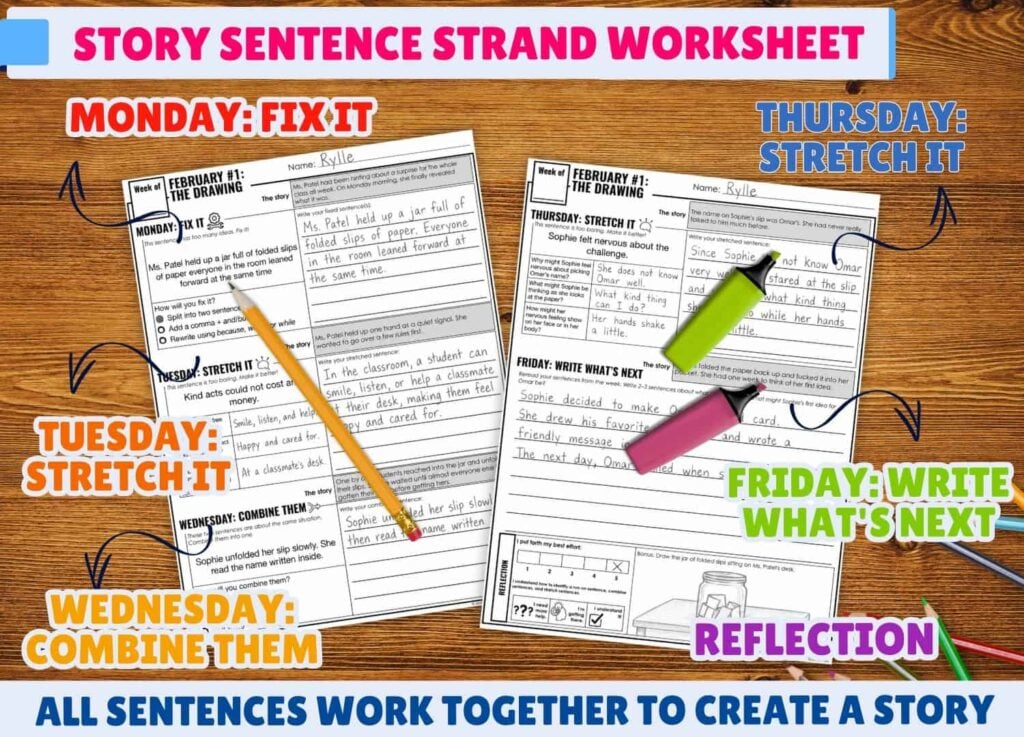
What “Correct” Looks Like Without an Answer Key
No answer key does not mean there is no way to tell right from wrong. A response is correct when it meets two simple tests:
- It is grammatically correct. The sentence is complete, punctuated properly, and reads cleanly.
- It follows the directions. If the task said to fix the run-on, the run-on is gone. If it said to stretch the sentence with details, the details are there.
That is the whole rubric. As long as a student’s sentence is grammatically correct and does what the directions asked, it counts, even if it looks nothing like a neighbor’s. Different responses are not just allowed. They are expected and encouraged.
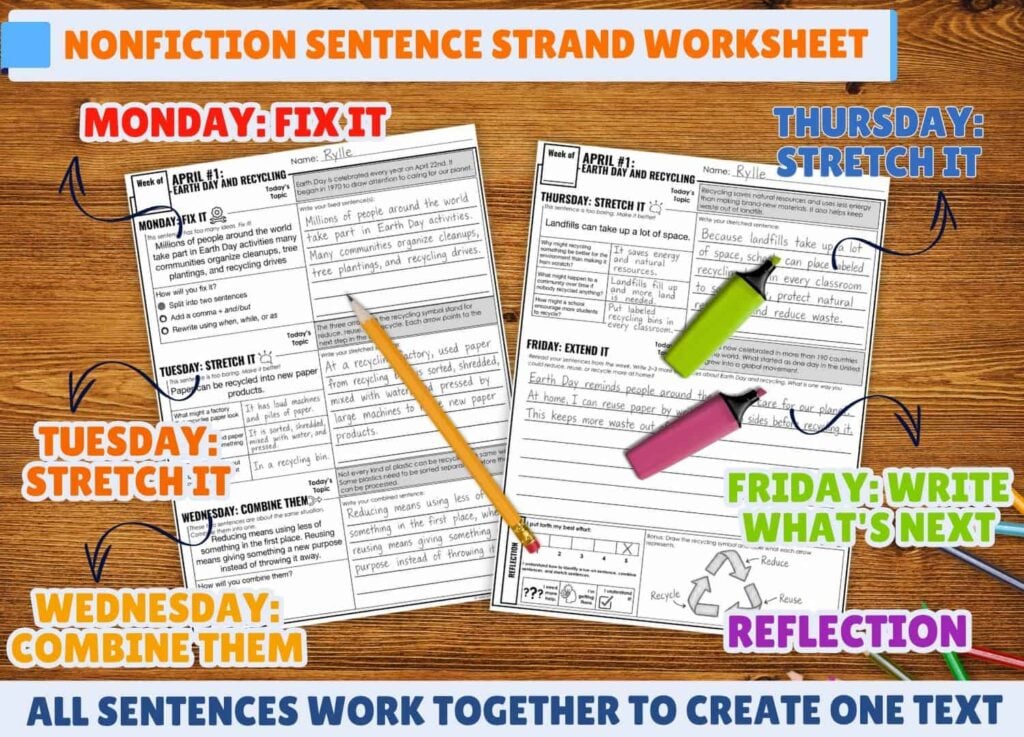
How to Check the Work Quickly (Even With a Substitute)
Because the two tests above are so quick, open-ended sentence work is actually easy to check on the fly. Here is the fastest way for you or a sub to do it:
- Read the student’s sentence out loud in your head. Does it sound like a complete, correct sentence?
- Check it against the task. Did they fix, combine, or stretch as the page asked?
- If both are yes, it is correct. If something is off, that is your teaching point.
Many sentence routines, including my own, build in a student self-check and a quick partner check so students confirm their sentences make sense before an adult ever looks at them.
For a substitute, that is a gift: students can keep each other honest, and the sub only needs to confirm that the sentences are complete and on task. A note at the top of your sub plans, something like “answers will vary; a sentence is correct if it is grammatically complete and follows the directions,” is usually all a substitute needs.
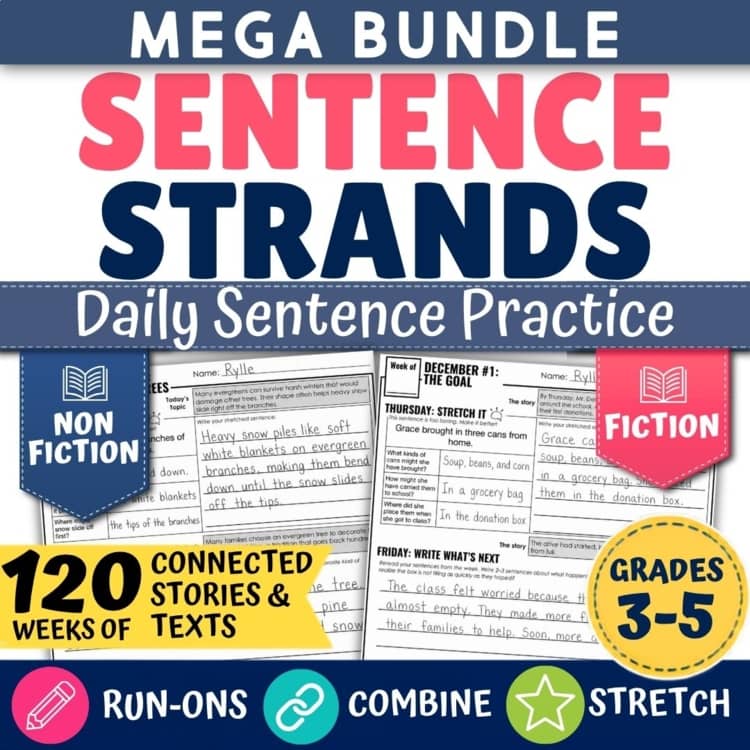
Sentence Strands Yearlong MEGA BUNDLE Combining Stretching Run-on Thematic
The sentence strands mega bundle gives grades 3 to 5 a full year of daily grammar and sentence writing practice, with both fiction and nonfiction sets for every month. Students fix run-on sentences, combine sentences, and stretch simple sentences in short Monday to Friday routines.
Why Open-Ended Practice Is Better for Writers
The lack of an answer key is a feature, not a gap. Real writing never has one correct answer, and the goal of daily sentence practice is to build the judgment students use in their own writing: how to fix an awkward sentence, how to combine choppy ones, how to add detail that matters.
When every student can reach the goal by a different path, more students stay engaged, and the strongest writers can stretch further than any key would allow. If you want more on the skills behind this, my posts on sentence combining and expanding sentences go deeper.
Frequently Asked Questions
Bringing It All Together
There is no answer key for open-ended sentence writing because there is no single right answer, and that is exactly what makes it good practice. Judge a response by two things: is it grammatically correct, and does it follow the directions? Teach students the self-check and partner check, leave a one-line note for any substitute, and you have a daily routine that builds real writing skill without a key to chase.
Jessica BOschen
Jessica is a teacher, homeschool parent, and entrepreneur. She shares her passion for teaching and education on What I Have Learned. Jessica has 16 years of experience teaching elementary school and currently homeschools her two middle and high school boys. She enjoys scaffolding learning for students, focusing on helping our most challenging learners achieve success in all academic areas.