
First grade self reflection often starts with a student who finishes a math page, says it was “good” or “hard,” and stops there. That is a normal place to begin, and it is exactly why young students need structure. They can think about their own work and behavior, but they need simple language, something to point to, and a consistent routine.
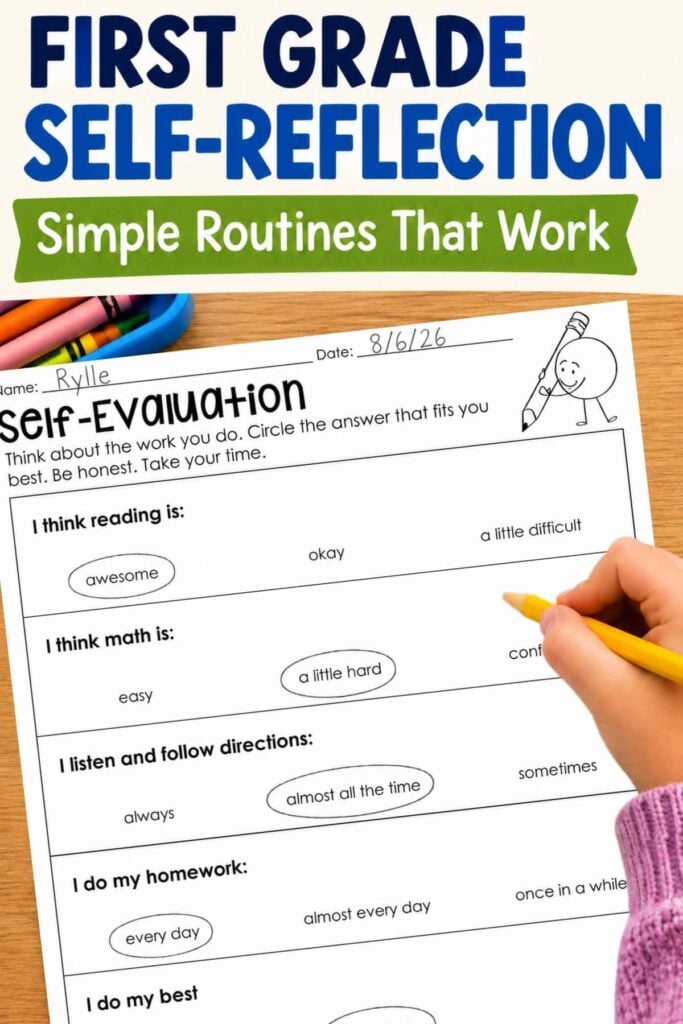
This post covers what 1st, 2nd, and early 3rd graders can realistically reflect on, how to run a short reflection session, and how to adjust it as students get older.
Why First Grade Self-Reflection Is Worth the Time
Reflection feels like a skill for older students, but young learners benefit from it too. When a 6 or 7 year old can say “I tried hard on my writing today” or “I need to listen better during directions,” they are starting to connect their choices to results. Edutopia’s article on teaching young students how to reflect on their learning is a good read if you want more background on why this works in the early grades.
In my experience, a few things change once students reflect on a regular schedule:
- Students begin to name what they do well instead of waiting for you to tell them
- They connect effort to results, which supports a growth mindset
- Conversations with families become two-way, because the student has something to say
- You learn how students see themselves, which is not always how you see them
What Young Students Can Actually Reflect On
The biggest mistake with primary self-reflection is asking too much. Open questions like “How do you feel about your learning?” leave most 1st graders staring at the page. Narrow the focus to three areas and keep the language concrete.
- Behavior: listening, following directions, being kind, and working with others
- Learning habits: trying your best, asking for help, and finishing work
- Growth and goals: something I am proud of and something I want to get better at
Statements work better than questions at this age. “I listen when others are talking” with a simple rating scale is much easier for a 1st grader to answer than a blank line. A rubric with kid-friendly wording and a visual scale gives students something to point to, and it lets you scan the results quickly.
How to Run a Self-Reflection Session in 1st Grade
A good session takes 10 to 15 minutes. The routine below works for whole-group, small-group, or one-on-one check-ins.
Model Your Own Reflection First
Fill out a sample on the board and think aloud. “I would give myself a 3 for finishing my work, because I got most of it done but I rushed the last part.” Students learn that an honest rating is not a bad rating.
Use Statements and a Simple Scale
Read each statement aloud together and have students circle or color their rating. Young students rate themselves most accurately when you ask about a specific recent example, such as “Think about this morning’s reading time.”
Add One Sentence Starter
End with a short written or oral response. “I am proud that I…” and “Next, I want to…” are enough. Students who are not writing yet can draw or tell you, and you can write the sentence for them.
Share With a Partner
Two minutes of partner sharing builds oral language and makes the reflection feel meaningful. Partners can finish the sentence “One thing my partner is good at is…”
★★★★★
Love using this with the students and allowing them the opportunity to self-reflect. Parents like seeing how their students view themselves.
Kelly T.
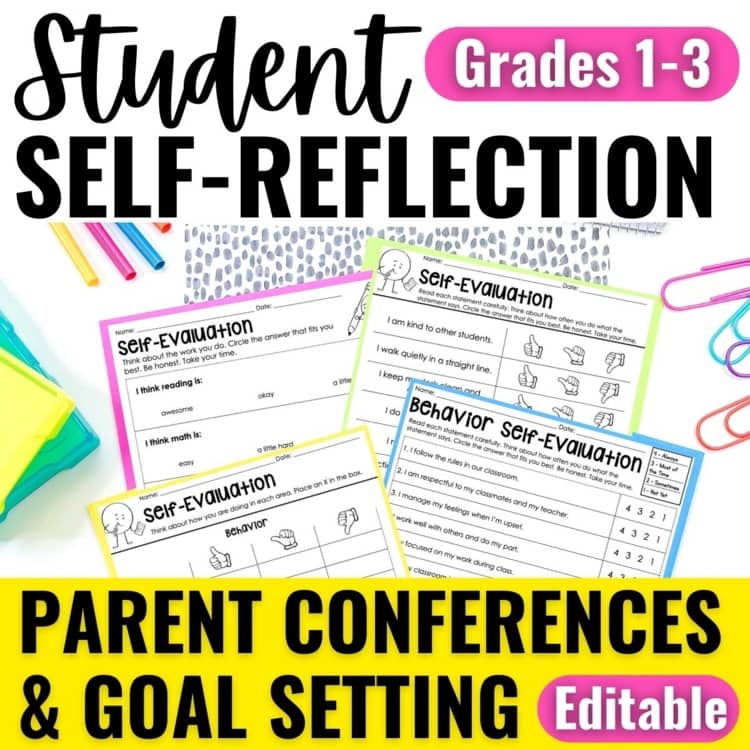
Student Self Evaluation Conference Self Reflection Assessment Forms
These student self evaluation forms give students in grades 1 to 3 a simple way to reflect on their behavior, learning habits, and goals. Editable Google Slides include a behavior rubric, an academic rubric, and open-ended prompts that work for student-led conferences, parent-teacher conferences, and data binders.
Self Reflection for 2nd and 3rd Grade
The same routine grows with students. Here is how I would adjust it by grade.
- 1st grade: circle a rating, finish one sentence starter, and share orally
- 2nd grade: add a written reason for one rating (“I gave myself a 4 because…”) and a goal in a full sentence
- 3rd grade: compare this reflection to an earlier one and name one specific action to reach a goal
If your students are ready for more writing, my post on student self-reflection sheets for grades 3 to 5 covers the upper elementary version.
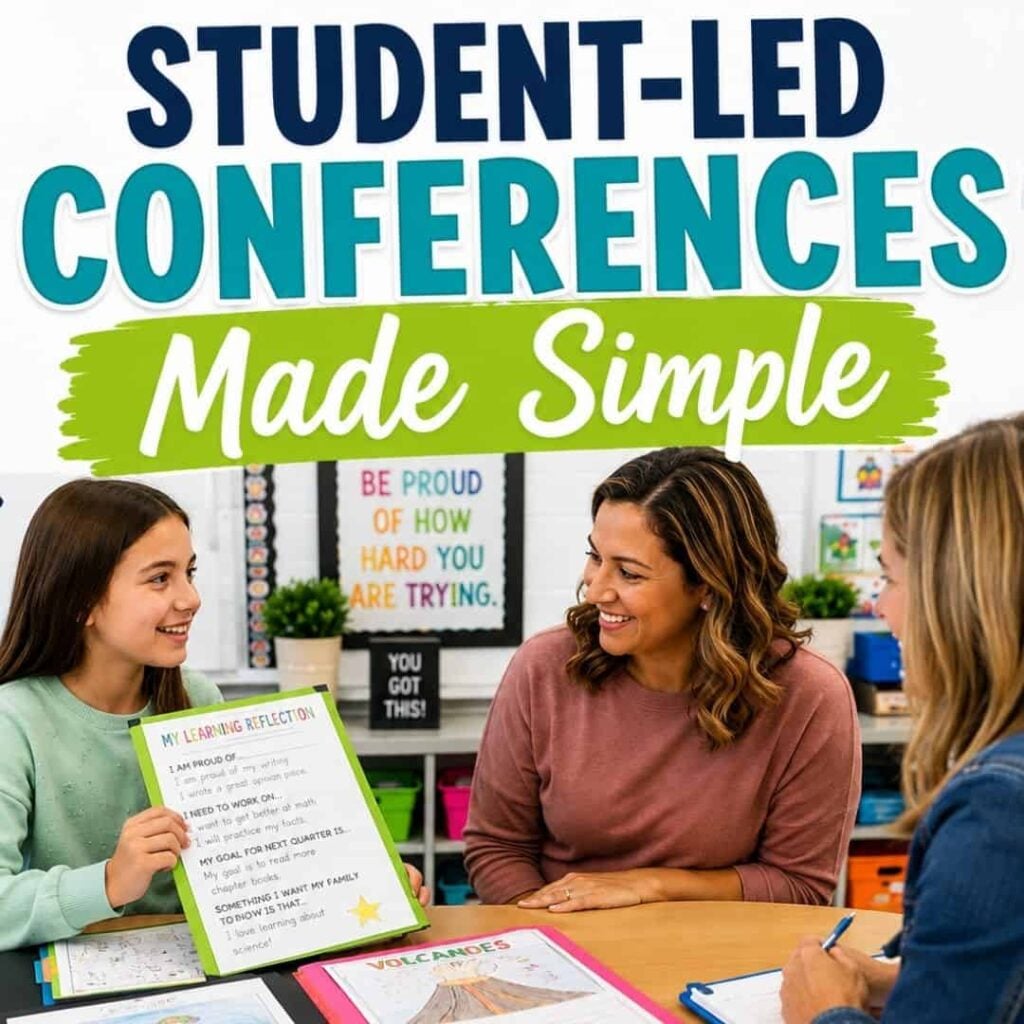
Student-led parent conferences give students ownership over their classwork.
Sharing Student Reflections With Families
Completed reflections are useful beyond the classroom. Many teachers send them home or tuck them into a data binder so a student can talk through them with a family member. If you want to take that further, my guide to student-led conferences walks through how to set it up.
Final Thoughts
Young students can reflect on their own learning when the language is simple and the routine is predictable. Start with one short session this week, model it yourself, and let students see that honest answers are welcome. A small habit now builds the self-awareness they will use in every grade after this one.
Looking for a ready-made resource? My Student Self Evaluation Forms for grades 1 to 3 include an editable behavior rubric, an academic reflection rubric, and open-ended prompts written in student-friendly language.
Jessica BOschen
Jessica is a teacher, homeschool parent, and entrepreneur. She shares her passion for teaching and education on What I Have Learned. Jessica has 16 years of experience teaching elementary school and currently homeschools her two middle and high school boys. She enjoys scaffolding learning for students, focusing on helping our most challenging learners achieve success in all academic areas.