
What Is Differentiated Instruction? Definition + Examples
You sit in a staff meeting, the evaluator mentions differentiated instruction, and everyone nods like they know exactly what it means. If you have ever wanted a clear, confident answer instead of a nod, this is for you. Differentiated instruction means adjusting what you teach, how you teach it, or how students show what they know, so that each student can access the same learning goal from where they actually are. It is not a separate program or a mountain of extra prep. It is a mindset plus a handful of concrete moves.
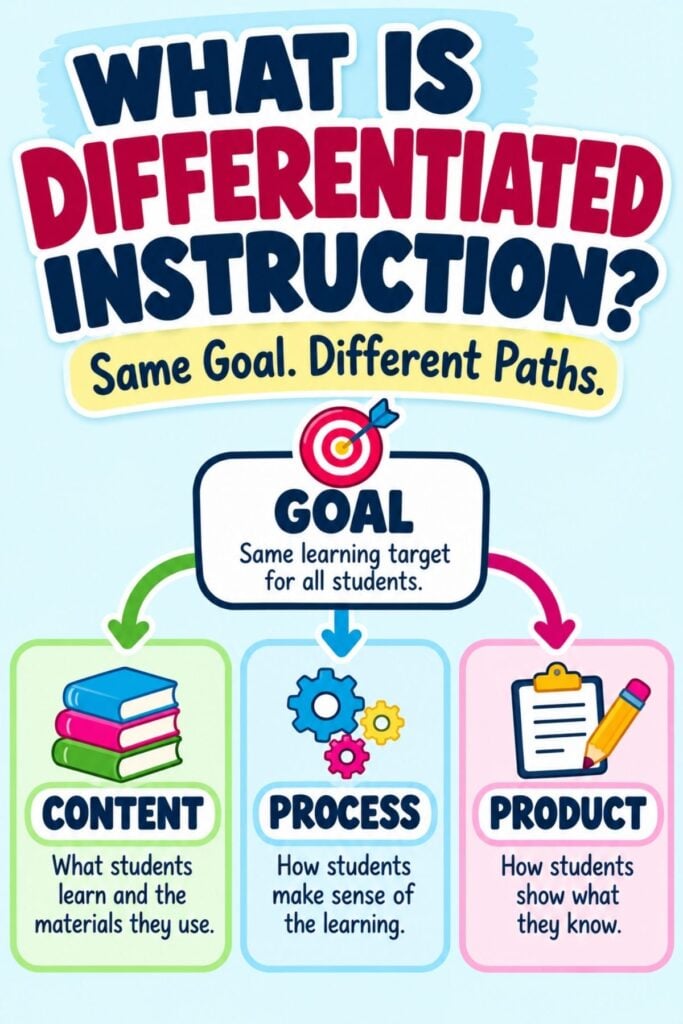
This post gives you a plain-English definition, where the idea comes from, the three main ways teachers differentiate, named strategies you can use tomorrow, and real elementary examples in math and reading.
What Is Differentiated Instruction? (And What Does “Differentiated” Mean?)
Simply put, to differentiate something means to adjust it to fit different needs. In a classroom, that means recognizing that your students arrive with different readiness levels, interests, and ways of learning, and adjusting your teaching so each one can reach the same standard. The goal never changes. The path to it does.
A One-Sentence Definition You Can Use
Here is a definition you can say out loud in an evaluation: differentiated instruction is the practice of adjusting content, process, or product based on a student’s readiness, interest, or learning profile, so that every student works toward the same goal in the way that fits them best. That single sentence covers what the term means and why teachers do it.
Differentiated vs. Differentiating vs. Differentiation
These three words trip people up, but they are just different forms of the same idea. Differentiation is the noun, the overall practice. Differentiating is the verb, what you are doing in the moment. Differentiated is the adjective that describes instruction shaped that way, as in a differentiated lesson. You do not need to keep them straight to teach well. They all point to the same thing: meeting students where they are.
Where Differentiated Instruction Comes From: Carol Ann Tomlinson
The name most associated with differentiated instruction is Carol Ann Tomlinson, a professor of educational leadership at the University of Virginia and a former public school teacher. She popularized the framework and wrote the book that put it on staff-room shelves everywhere, The Differentiated Classroom: Responding to the Needs of All Learners. Her core argument is simple and still holds up: in any classroom, students differ in readiness, interest, and learning profile, so one-size-fits-all teaching will always leave some students behind and others unchallenged. The content, process, and product framework most teachers use today traces back to her work. You can read more about her approach through ASCD, her longtime publisher.
Differentiation vs. Other Classroom Terms
Part of what makes differentiation confusing is that it sits next to several similar-sounding terms. Knowing the difference between differentiation and its neighbors makes the concept click.
Differentiation vs. Scaffolding
Scaffolding is temporary support that helps a student reach a shared goal, then gets removed as they gain independence. Differentiation is the ongoing adjustment of the learning itself to fit different students.
They work hand in hand, and I dig into exactly how in my post on how scaffolding and differentiation work together.
Differentiation vs. Accommodations and Modifications
Accommodations and modifications change the requirements or supports for specific students, often because an IEP or 504 plan legally requires it. An accommodation changes how a student accesses the work, like extra time, while a modification changes what the work actually asks. Differentiation, by contrast, is a general teaching practice you use with the whole class, not a legal requirement tied to one student.
Differentiation vs. Individualized or Personalized Learning
Personalized or individualized learning tailors instruction down to a single student’s plan, pace, and goals. Differentiation usually works at the level of small groups or a few versions of a task rather than a unique plan for every child. Think of individualized learning as differentiation taken to its most granular extreme.
The Three Ways Teachers Differentiate: Content, Process, and Product
Tomlinson’s framework gives you three levers, and most differentiation comes down to adjusting one. You rarely change all three at once. Choosing the single lever that fits the lesson keeps differentiation manageable.
Differentiating Content
Content is what students learn and the materials they use to learn it. You differentiate content when you offer the same topic at different entry points. A few examples: provide leveled texts on the same subject so every student can read about it, record a mini-lesson at two different levels of explanation, or hand out informational articles at different Lexile levels for the same research task. The learning target stays identical; the material meets students where they are in reading and thinking.
Differentiating Process
Process is how students make sense of the content. You differentiate process when you vary the activity students use to work toward understanding. That might look like flexible small groups working the same skill at different depths, tiered task cards, a graphic organizer for students who need structure, or an extension problem for students who are ready to go further. Everyone is practicing the same concept, just through a task sized for them.
Differentiating Product
Product is how students show what they learned. You differentiate product when you offer more than one way to demonstrate mastery. A choice board is the classic move: a student might write a paragraph, make a poster, or record a short video explaining the concept. Rubrics can also vary in complexity while measuring the same core understanding. The evidence of learning looks different; the understanding behind it is the same.
Some versions of the framework add a fourth element, the learning environment, which covers things like flexible seating, quiet work areas, and how the room supports different working styles. It is worth a mention, but content, process, and product are where most of your day-to-day differentiation happens.
Differentiated Instruction Strategies You Can Start Using Tomorrow
The framework is the why. These named strategies are the how. Each one is a concrete way to put content, process, or product differentiation into practice without rebuilding your whole lesson.
Tiered Assignments and Tiered Instruction
Tiered instruction means giving students different versions of the same task matched to their readiness. All three tiers practice the same skill, but one group gets more support and another gets more challenge. For example, on a main-idea lesson, one tier identifies the main idea from a short paragraph while another defends it with evidence from a longer passage.
Curriculum Compacting
Curriculum compacting means letting students skip content they have already mastered so you can free up time for enrichment. It is used most often with gifted students. If a quick pre-assessment shows a student already knows the week’s spelling pattern, compacting lets them move on to an independent project instead of sitting through practice they do not need.
Flexible Small Groups
Flexible small-group instruction means grouping students by current need and regrouping as that need changes. The key word is flexible: a student might be in your top group for fractions and your support group for reading, and the groups shift week to week. This keeps grouping from hardening into permanent labels.
Choice Boards and Learning Menus
A choice board or learning menu offers students a set of tasks to pick from, all tied to the same goal. Choice drives engagement, and because you design the options, every path still leads to the standard. A tic-tac-toe board where students complete any three connected tasks is a simple place to start.
What Differentiated Instruction Looks Like by Subject
The framework is easier to picture in a real subject. Here is one example each in math and reading.
Examples in Math
Math centers are a natural fit. Set up three versions of the same skill at different difficulty levels, and rotate students to the tier that matches where they are. A place-value center might have one station building two-digit numbers and another comparing four-digit numbers, all practicing the same underlying concept.

For more ways to do this, see my posts on ways to differentiate math instruction and using math centers to differentiate.
Examples in Reading
Guided reading is differentiation in action. Small groups matched to each student’s instructional reading level let you teach the same strategy, like making inferences, with texts each group can actually read. Another move is a leveled text set: several articles on the same topic at different reading levels, so the whole class can discuss one subject while reading at their own level.
How Do You Differentiate Instruction? A Simple Starting Process
Differentiation feels overwhelming when you think you have to redesign everything. You do not. This four-step process keeps it manageable enough to try this week.
- Name the goal every student must reach. Start with the one standard or learning target for the lesson. This is the thing that does not change for anyone.
- Find your groups. Use a quick pre-assessment or existing data to see who is ready, who needs support, and who needs more challenge.
- Pick one lever. Decide whether to adjust the content, the process, or the product for this lesson. One is plenty.
- Check that it worked. Build in a fast formative check so you know whether each group reached the goal, and adjust next time.
Start with one lesson and one lever. Differentiation grows from small, repeatable habits, not a total overhaul.
Differentiating for Specific Groups of Learners
Differentiation serves every student, but two groups come up most often when teachers ask about it.
Gifted Students
For gifted students, differentiation usually means more depth, not more work. Curriculum compacting frees them from content they have mastered, and extension projects or independent study contracts let them dig deeper into a topic. The aim is to keep them truly challenged, not to assign extra problems as filler.
Students with IEPs
Differentiation works alongside IEP accommodations, but they are not the same thing. IEP accommodations are legally required supports for a specific student, while differentiation is a general practice you use with everyone. The two overlap in the classroom, and collaborating with the specialists who support those students makes both work better. My post on collaborating with IEP service providers has more.
How Do You Assess Differentiated Instruction?
Assessment can be differentiated too, as long as it measures the same learning target. The format flexes; the standard does not. One student might explain their understanding of a science concept out loud while another writes a paragraph and a third draws and labels a diagram. All three show whether they met the goal, just in the mode that fits them. The key is a clear target and a rubric focused on the understanding, not the format.
For quick ways to check for understanding across a class, see my post on formative assessment ideas.
Differentiated Instruction: Frequently Asked Questions
Bringing It All Together
Differentiated instruction is not a program you add on top of everything else. It is the everyday practice of keeping the goal fixed while flexing the path, through content, process, or product, so every student can get there. Start with one lesson and one lever, check whether it worked, and build from there. Done consistently, it is simply what good teaching looks like in a room full of different learners.
Jessica BOschen
Jessica is a teacher, homeschool parent, and entrepreneur. She shares her passion for teaching and education on What I Have Learned. Jessica has 16 years of experience teaching elementary school and currently homeschools her two middle and high school boys. She enjoys scaffolding learning for students, focusing on helping our most challenging learners achieve success in all academic areas.