
The best student self reflection questions are the ones students can answer in a sentence or two without staring at a blank page. I learned that the hard way the first time I handed out a sheet that said “Reflect on your quarter” and got back a lot of “it was good.” Once I switched to specific, concrete questions, the answers got honest and useful.
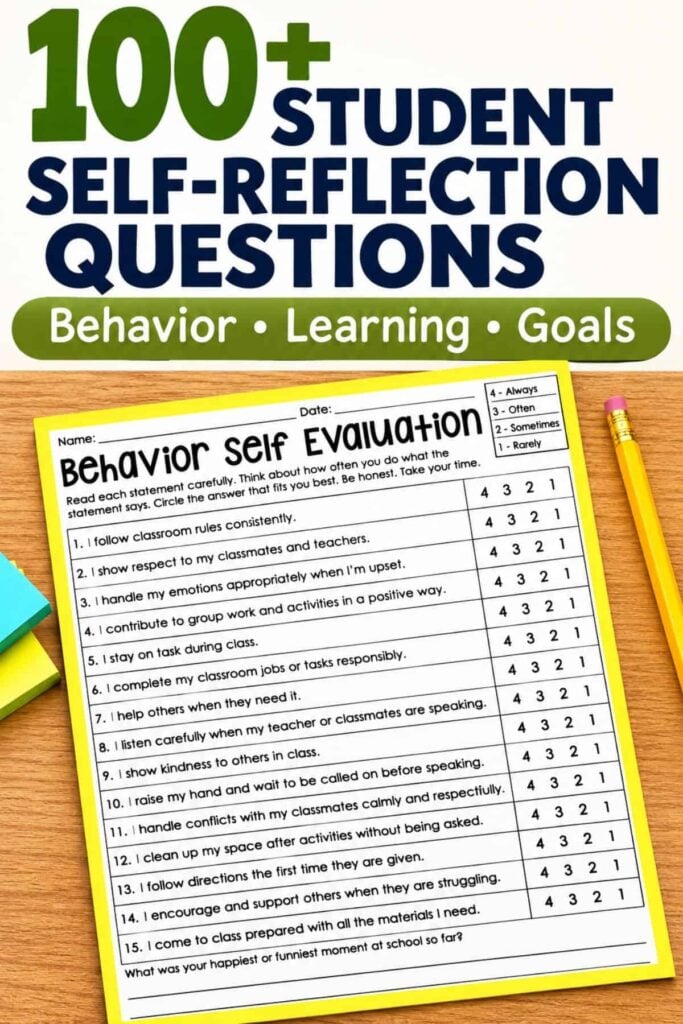
Below you will find over 100 student self reflection questions for behavior, learning habits, feelings, teamwork, every core subject, tests and projects, goals, and end-of-year reflection, with K-2 and 3-5 versions where the wording needs to change.
How to Choose Student Self Reflection Questions
Broad prompts ask students to do two jobs at once: decide what to look at and then judge it. Specific questions do the first job for them. “Did I follow directions the first time?” points a student at one behavior they can actually remember. Edutopia’s article on teaching young students to reflect on their learning is a good read on starting small. A few things help the questions land:
- Pick 5 to 8 questions per sheet, not the whole list, so students finish without rushing
- Keep each question about one thing, so students are not guessing what you mean
- Use “I” statements with a rating scale for K-2, and add a short written answer for 3-5
- Ask about actions students can see and change, such as listening, finishing work, or asking for help
- End every set with one forward-looking question so reflection leads somewhere
Behavior Self Reflection Questions for Students
Behavior questions are the easiest place to start, because students know right away what you are asking. Use them as statements with a scale of always, sometimes, or not yet, or as written questions.
For Kindergarten to 2nd Grade
- I listen when others are talking.
- I follow directions the first time.
- I use kind words with my classmates.
- I keep my hands and feet to myself.
- I clean up my space when I am done.
- I raise my hand before I speak.
- I stay in my seat during lessons.
- I use a quiet voice inside.
- I walk in the hallway.
- I am a good sport when I lose a game.
For 3rd to 5th Grade
- When did I handle a disagreement well this quarter?
- What is one thing that distracts me during independent work, and what can I do about it?
- How do I show respect to my classmates and my teacher?
- When I feel frustrated, what do I do?
- Which classroom expectation is hardest for me, and why?
- Do I follow directions the first time, or do I need reminders?
- How do I act when the teacher is not watching?
- What is one choice I made this quarter that I would change?
- How do I help keep our classroom a good place to learn?
- What behavior am I most proud of this quarter?
Learning Habits Self Reflection Questions
Learning habits questions look at how students work, not just what they produce. These are the ones I find most useful for conferences, because families rarely see this side of school.
- Do I try my best before I ask for help?
- Do I check my work before I turn it in?
- What do I do when something is hard?
- How do I use my time during independent work?
- What is one thing I did this quarter that I am proud of?
- Do I turn in my homework on time?
- Is my desk and folder organized?
- Do I listen carefully during lessons?
- Do I finish my work, or do I rush at the end?
- Do I ask questions when I am confused?
- Where do I do my best work in the classroom?
- What helps me focus?
For younger students, pair each question with a picture scale (smiling, neutral, or frowning face) and read it aloud. For 4th and 5th graders, ask them to give one example for each rating. “Sometimes, because I rushed my last two math pages” tells you far more than a circled number.
Effort and Growth Mindset Reflection Questions
Effort questions help students see the link between what they do and how they do. They also pair best with a growth mindset routine.
- What is something I can do now that I could not do at the beginning of the year?
- What did I practice a lot this quarter?
- What was the hardest thing I worked on, and how did I keep going?
- When I make a mistake, what do I say to myself?
- What is a mistake I made that taught me something?
- Did I give up too quickly on anything this week?
- What would I try if I knew I could not fail?
- Who or what helps me keep trying?
Social Emotional Self Reflection Questions
Feelings questions work best when students have words for what they feel. Post a feelings chart before you start, and let K-2 students point to a face instead of writing.
For Kindergarten to 2nd Grade
- How do I feel at school most days?
- What makes me feel happy at school?
- What makes me feel upset at school?
- What do I do when I feel angry?
- Who can I talk to when I have a problem?
- What can I do to calm down?
- What makes me feel proud?
- How do I feel when I make a mistake?
For 3rd to 5th Grade
- What emotion did I feel most this quarter, and what caused it?
- What helps me calm down when I feel stressed or frustrated?
- How do I ask for help when I am struggling with something?
- Which feeling is the hardest for me to handle?
- When did I feel most confident this quarter?
- How do I act when I feel nervous before a test or presentation?
- What is one strategy I can use next time I feel overwhelmed?
- How do my feelings affect my work?
Friendship and Teamwork Reflection Questions
- Am I a good friend to my classmates? How do I know?
- How do I include other students who are alone?
- What do I do when I disagree with a partner?
- Do I share the work fairly in a group?
- How do I listen to other people’s ideas?
- What role do I usually take in a group, and is it a good fit?
- How did my group work together this time?
- What is one thing I can do to be a better teammate?
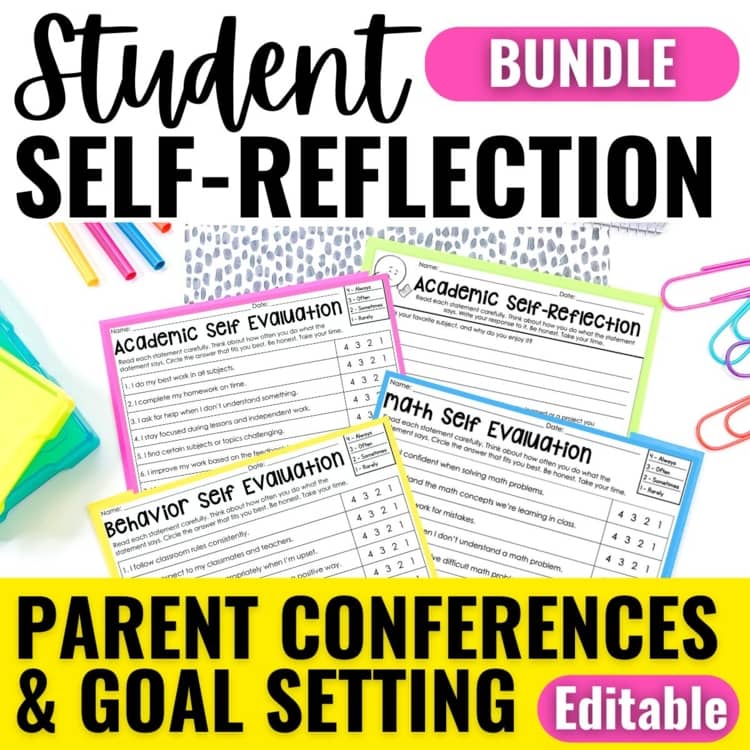
Parent Teacher Conference Student Self Reflection Sheets Forms Goals Behavior
This student self evaluation bundle helps students in grades 1 to 5 reflect on their learning, behavior, and work habits. It includes differentiated rubrics and short-answer questions that prepare students for conferences and goal setting.
Self Reflection Questions for Reading, Math, and Writing
Subject-specific questions help students see their own strengths instead of just their grades. Pick two or three per subject so the sheet stays short.
Reading
- What kinds of books do I choose to read, and why?
- What do I do when I come to a word I do not know?
- How well can I retell what I read in my own words?
- Do I read at home, and how often?
- What is the best book I read this quarter?
- Do I think about what I am reading while I read?
- What is one reading skill I want to get better at?
- Do I ask questions about the text as I read?
Math
- Do I show my steps when I solve a problem?
- What math skill feels easy for me now that was hard before?
- What do I do when I get stuck?
- Can I explain my thinking to someone else?
- Do I check my answers to see if they make sense?
- How well do I know my math facts?
- Which kind of math problem do I like best?
- What math skill do I need to practice more?
Writing
- Do I re-read my writing before I turn it in?
- What is my strongest piece of writing this quarter, and what makes it strong?
- What is one thing I can add to make my writing better?
- Do I plan my writing before I start?
- Do I use details to help my reader picture what I mean?
- How do I fix my mistakes when I revise?
- What do I like to write about most?
- What part of writing is hardest for me?
Self Reflection Questions After a Test, Project, or Assignment
Reflection is most useful right after the work, while students still remember how it went. These questions fit on the back of a test, a project rubric, or an exit slip.
- How did I prepare for this?
- What part of this went well?
- What part was hardest for me?
- What would I do differently next time?
- Did I use my time well?
- What mistakes did I make, and what did I learn from them?
- How does my result compare to what I expected?
- What is one thing I will do before the next test or project?
Student Self Reflection Questions About Goals
Reflection works best when it leads into a goal. After students look back, ask them to look ahead. These questions turn a reflection into a plan:
- What is one thing I want to get better at?
- Why does this goal matter to me?
- What is one small step I can take this week?
- Who can help me reach this goal?
- How will I know I am improving?
- What might get in my way, and what will I do about it?
- What is my goal for the next quarter?
- How did I do on the goal I set last time?
If students need ideas, a ready-made list helps. My post on goals for elementary students has categorized lists of behavior, reading, math, writing, and general school goals, plus a whole-group lesson for turning a goal into action steps. Students can look over their reflection answers, circle the area they most want to work on, and then choose a goal from the list that fits.
A 2nd grader might choose “use kind words with classmates.” A 5th grader might choose “add more details to my writing” and then list two actions, such as re-reading each paragraph and adding one detail per paragraph. Either way, the goal comes straight from the student’s own reflection, which makes it far more likely to stick.
End of the Quarter and End of the Year Reflection Questions
- What am I proudest of this quarter?
- What was my favorite thing we learned?
- What was the hardest thing I learned?
- How have I changed since the beginning of the year?
- What would I tell next year’s students about this class?
- What advice would I give myself in September?
- What do I want to remember about this year?
- What are my goals for next year?
- Who helped me the most, and how?
- What is one thing I wish I had done differently?
Quick Daily and Weekly Check-In Questions
Not every reflection needs a full sheet. These work as exit tickets, morning meeting prompts, or a Friday sentence starter.
- Today I did my best when…
- One thing I learned today is…
- Something that was hard today was…
- I helped someone today by…
- Tomorrow I want to…
- A mistake I learned from this week is…
Using Self Reflection Questions Before Conferences and Report Cards
The most useful time to use these questions is a few days before parent-teacher conferences. Students complete the reflection, and families see their child’s thinking before the meeting starts. That one change makes conferences feel like a conversation instead of a report.
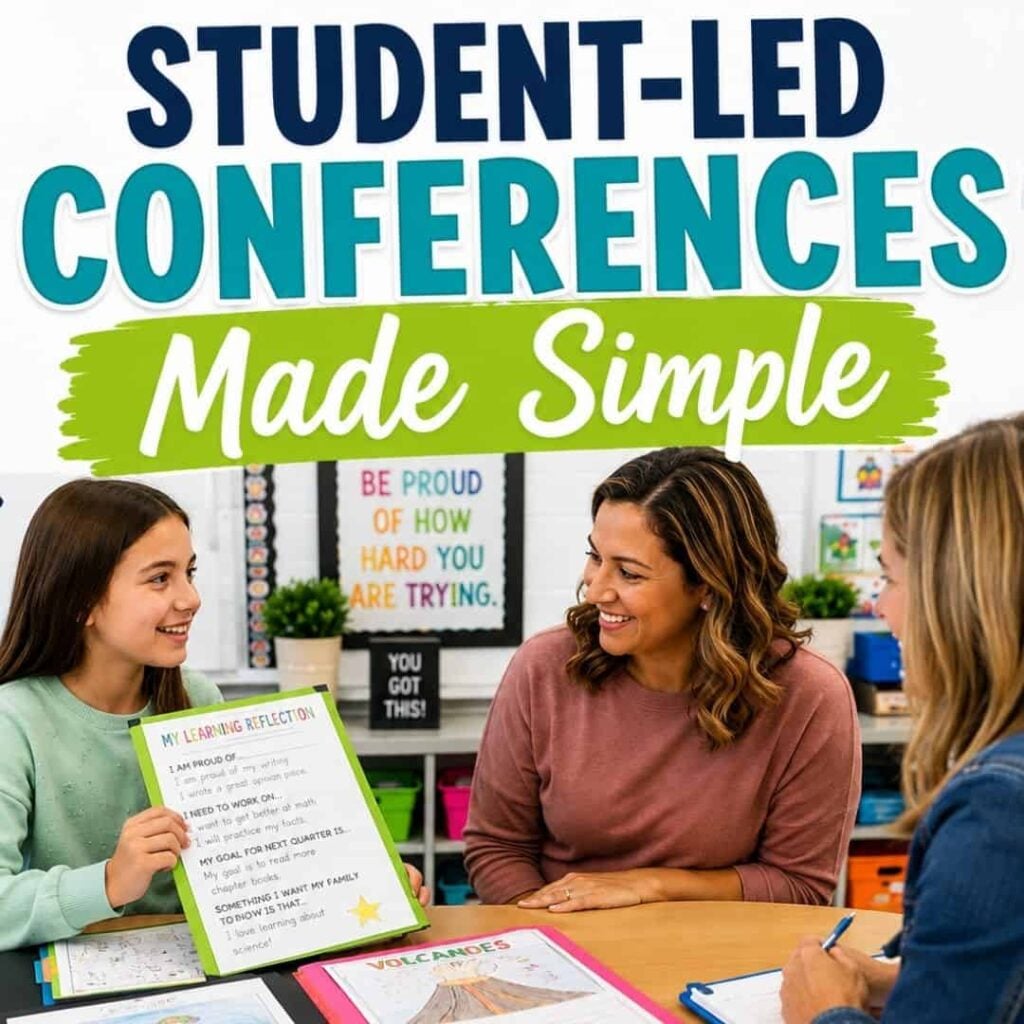
If you are working toward student-led conferences, this complete guide walks through how to set them up.
The same questions work at the end of each quarter, in a data portfolio, or as a quick Friday check-in. For students in 3rd to 5th grade, my student self-reflection sheets turn many of these questions into rubrics and short-answer pages. Working with younger students? Start with my post on first grade self reflection, which shows how to shorten the routine for 1st to 3rd grade.
Frequently Asked Questions
Final Thoughts
Start small. Pick one set of questions, use it before your next conference or report card, and see what students say. Specific questions give you honest answers, and honest answers give students something real to work on. If you try one thing from this post, end every reflection with a goal.
Looking for a ready-made resource? My Student Self-Reflection Forms for Parent Teacher Conferences include rubrics, short-answer questions, and goal-setting pages so students can reflect and plan their next steps in one sitting.
Jessica BOschen
Jessica is a teacher, homeschool parent, and entrepreneur. She shares her passion for teaching and education on What I Have Learned. Jessica has 16 years of experience teaching elementary school and currently homeschools her two middle and high school boys. She enjoys scaffolding learning for students, focusing on helping our most challenging learners achieve success in all academic areas.