
Opinion Writing Conclusion Sentence Starters and Frames
Once students can state an opinion and give reasons, the next challenge is helping them bring their writing to a clear close with an effective conclusion statement. How can we guide students in writing impactful closing statements after completing their opinion paragraphs?
In my classroom, I review different types of conclusion statements and help students craft their own by building anchor charts with sentence frames.

This post does not focus on generating reasons or writing full paragraphs, only on teaching students how to craft a clear conclusion.
For help with other opinion writing skills, explore these posts:
- 7 Ways to Introduce Opinion Writing
- Picture Books to Teach Opinion Writing
- Teaching How to State an Opinion
- Teaching How to Supply Reasons
- Teaching How to Write an Introduction for Opinion Writing
- Teaching Ideas to Solidify Students’ Understanding of Opinion Writing
Writing a strong conclusion helps students wrap up their ideas and remind readers of their opinion. Conclusions work best when they connect back to the reasons presented earlier in the piece. If you’re looking for more strategies, this complete guide to teaching opinion writing in elementary school walks through each step of the writing process from introduction to conclusion.
Explicitly teach what an opinion writing conclusion is and how to write one
Just like teaching introductions, conclusions need to be explicitly taught. Start with an anchor chart that explains why an opinion piece needs a strong conclusion and how it gives the reader a sense of closure.
I explain to students that introductions open the door, while conclusions close it and help the reader feel finished.
Note that a conclusion is not like an introduction. An introduction generally doesn’t state the opinion, whereas a conclusion restates it. The conclusion statement aligns more closely with the opinion statement than with the introduction. Making this connection with students can be helpful.
Use picture books and samples to generate ideas for conclusion statements
Identify the conclusion statement in a text and record it on the chart paper. As you did with introductions, discuss whether the conclusion clearly restates the opinion and brings closure.
If it is weak, what could be improved? If you have introduced students to types of conclusions, consider recording them from picture books into a specific category or organizational system you have set up.
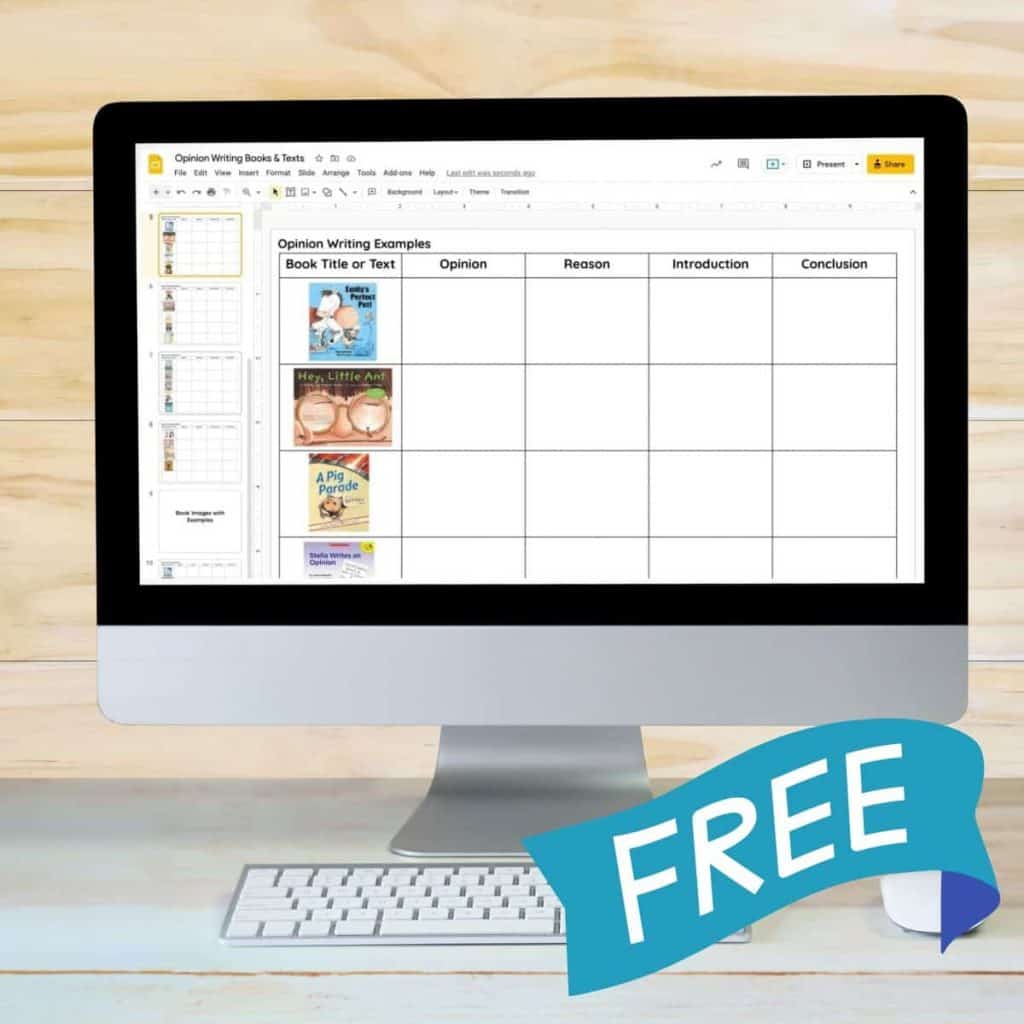
FREE DIGITAL ANCHOR CHART OF PICTURE BOOKS
Would you like a free digital anchor chart of the picture books in this blog post? This chart helps students see multiple ways to restate an opinion at the end of a paragraph.
Sign up to receive a link to copy this fully editable Google Slides file. Use it as a starting point to create your own classroom anchor chart for opinion writing.
Consider organizing the conclusion statements when teaching how to write a conclusion
After generating a list of closing statements for opinion writing, consider categorizing them. You can do this in a couple of different ways. One, you can tell students the categories and have students sort the statements into the category that best fits. This is called a closed sort. Second, you can do an open sort and have students sort the conclusion statements into groups, then determine a category for each group.
I usually start with a closed sort early in the week and move to an open sort once students understand the purpose of a conclusion.
Whether you do an open sort or a closed sort, adding a label to the type of conclusion statement helps students deepen and solidify their understanding of the concept. It also gives students language for talking about their writing choices.

Some categories you or your students might come up with include:
- Repeating the opinion statement
- Offering a suggestion for the reader
- Giving another related fact
- Sharing a personal experience with the topic
These are just several ideas for categories. I’m sure your students can come up with more!
Not every student needs to use every type of conclusion. At this stage, clarity matters more than variety.

Opinion Writing Unit | 2nd & 3rd Grade Common Core Writing Resource
Teach opinion writing with confidence using this Common Core-aligned Opinion Writing Unit for 2nd and 3rd grade students. This comprehensive resource includes graphic organizers, sentence frames, anchor charts, writing prompts, assessments, and engaging activities that help students develop strong opinion writing skills through both oral language practice and written application.
Give Students Sentence Frames to Use when Writing a Conclusion Paragraph or Statement
Here are some examples of sentence frames that help students write a solid conclusion statement. These frames intentionally revisit the opinion rather than introduce a new idea.
Here are conclusion sentence starters organized by type. Students don’t need to use every type. Pick one that fits the opinion and the grade level.
- To wrap it all up, ___ is ___.
- Now you know why ___ is __.
- I hope you’ll agree with me that __ is __.
Restate the opinion:
- As I have shown, ___ is ___ because ___.
- For these reasons, I believe ___ is ___.
- That is why I think ___ should ___.
Call to action or suggestion:
- Next time you ___, think about ___.
- If you haven’t tried ___, I encourage you to ___.
- The next time you have a choice between ___ and ___, choose ___.
Personal reflection close:
- After thinking about this topic, I am sure that ___.
- ___ has changed the way I think about ___.

Practice using the conclusion sentence frames in a variety of contexts
The post about how to solidify students’ understanding of opinion writing has many examples of cooperative learning strategies that can be used throughout this unit. The key idea is that students practice writing and saying a conclusion statement in many different contexts and on many different topics. The more practice students have with the skill, the more likely they are to succeed.
Once students can write a clear conclusion statement, adding it to a full paragraph becomes much more manageable.
Opinion Writing Unit
Teaching conclusions works best after students are confident with opinions and reasons, and before expecting polished paragraphs.
Are you interested in an Opinion Writing Unit that develops students’ academic language through games and activities?
Opinion Writing Unit | 2nd & 3rd Grade Common Core Writing Resource
Teach opinion writing with confidence using this Common Core-aligned Opinion Writing Unit for 2nd and 3rd grade students. This comprehensive resource includes graphic organizers, sentence frames, anchor charts, writing prompts, assessments, and engaging activities that help students develop strong opinion writing skills through both oral language practice and written application.
Read More about Teaching Opinion Writing
7 Ways to Introduce Opinion Writing
Teaching How to State an Opinion
Teaching How to Supply Reasons
Teaching How to Introduce Opinion Writing
Teaching How to Conclude the Opinion Writing
Teaching Ideas to Solidify Students’ Understanding of Opinion Writing
Picture Books to Teach Opinion Writing
Opinion Writing Unit
Opinion Writing Sentence Starters
100 Opinion Writing Prompts
Jessica BOschen
Jessica is a teacher, homeschool parent, and entrepreneur. She shares her passion for teaching and education on What I Have Learned. Jessica has 16 years of experience teaching elementary school and currently homeschools her two middle and high school boys. She enjoys scaffolding learning for students, focusing on helping our most challenging learners achieve success in all academic areas.