
Help Students Solidify Opinion Writing Skills Through Cooperative Learning Routines & More
How do you help elementary students solidify their knowledge of how to write an opinion piece? While you go through an opinion writing unit, there are a few classroom strategies teachers can use to deepen students’ understanding and help them write well-organized opinion paragraphs and essays.

This post focuses on what comes after students have learned the basics—strategies that help them internalize, apply, and transfer opinion writing skills over time.
Once students understand the basics of opinion writing, they benefit from additional practice that strengthens their reasoning and organization. Activities, discussions, and writing practice help students become more confident writers. This guide to teaching opinion writing in elementary school brings together strategies, prompts, and lesson ideas for teaching the full opinion writing process.
Read More about Teaching Opinion Writing
7 Ways to Introduce Opinion Writing
Teaching How to State an Opinion
Teaching How to Supply Reasons
Teaching How to Introduce Opinion Writing
Teaching How to Conclude the Opinion Writing
Teaching Ideas to Solidify Students’ Understanding of Opinion Writing
Picture Books to Teach Opinion Writing
Opinion Writing Unit
Opinion Writing Sentence Starters
100 Opinion Writing Prompts
Focus on the Components of Opinion Writing
While you have taught about each part of opinion writing, focus students attention on WHY they should use each component. Have them articulate the importance of each component and explain how each component helps the reader. Ask them questions about the actual framework and purpose of it, when to use it, and some sample sentence frames that could be used to talk or write about that component. Have students not only state an introduction, but tell WHY they need an introduction.
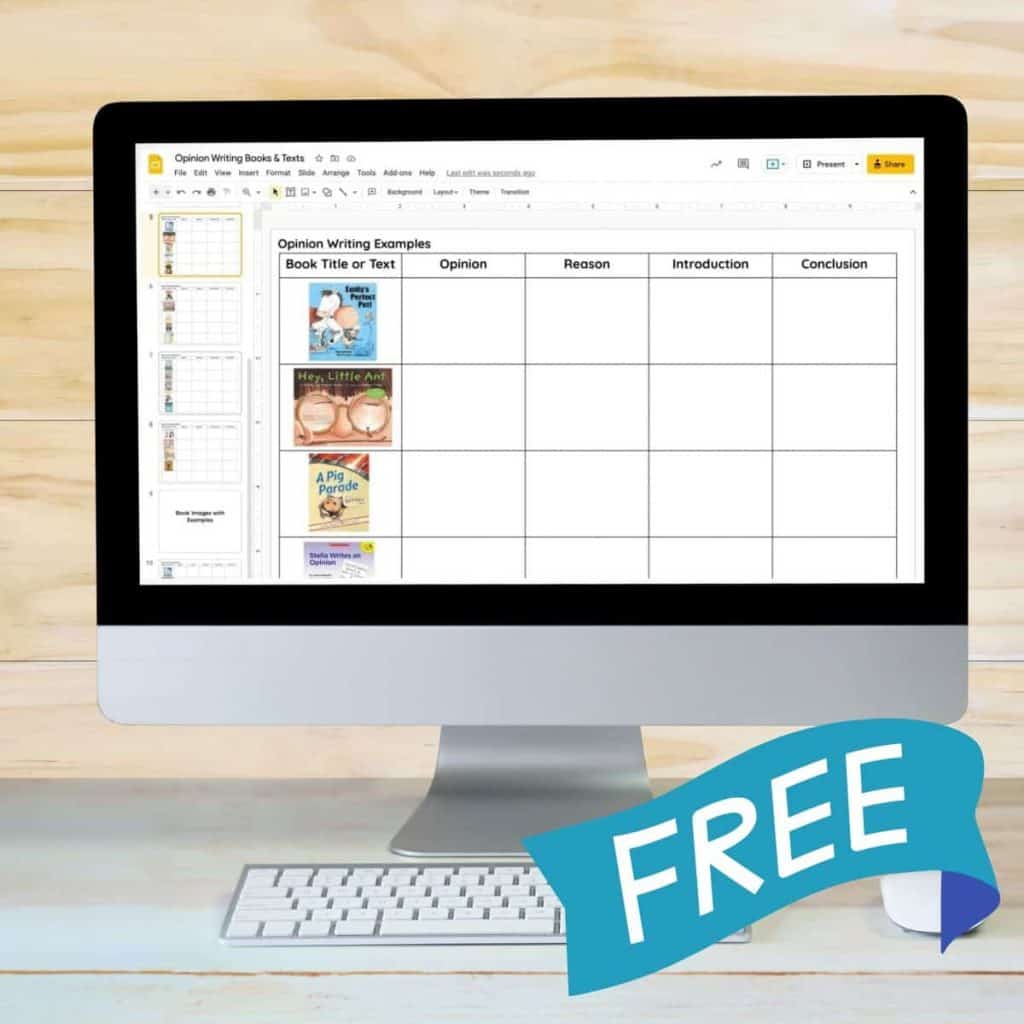
Use real-world examples
At this stage, the goal isn’t to introduce opinion writing, but to analyze how it works in different contexts.
Using Opinion read alouds, kid-appropriate news articles, and student samples, see if students can identify the opinion being stated and the components of opinion writing.
Create an anchor chart to record the components of opinion writing and help students see similarities and differences between different examples. As you explore texts, books and examples of opinion writing, record how the piece of writing or activity demonstrated that component. Record the title of the book, but also record HOW the book demonstrated that specific component.
Likewise, use a rubric to evaluate the effectiveness of the writing in these real-world examples. If you don’t have a rubric available, consider having students group and rank the examples. Do this exercise in small group,s then have two groups get together to explain their reasoning.
Use Student Samples of Opinion Writing
The first year, consider using the current year’s student samples. Another idea is to exchange papers with a neighboring teacher. In either case, remember to remove student names. Comparing samples helps students see what makes writing more effective, not just correct.
Keep copies of the samples every year. Add to your collection year after year, and have students go through the samples to identify the opinion writing components. After you have at least a year’s worth of student samples, use a rubric or have students rank the samples.
The end of my 7 Ways to Introduce Opinion Writing has even more ideas for where to find opinion writing examples.

Opinion Writing Unit | 2nd & 3rd Grade Common Core Writing Resource
Teach opinion writing with confidence using this Common Core-aligned Opinion Writing Unit for 2nd and 3rd grade students. This comprehensive resource includes graphic organizers, sentence frames, anchor charts, writing prompts, assessments, and engaging activities that help students develop strong opinion writing skills through both oral language practice and written application.
Use Cooperative Learning Strategies for Opinion Writing.
Cooperative learning strategies are some of the best ways you can help students articulate their learning. Talking about and working with other students on new learning moves the concepts through different parts of the brain. These routines aren’t about introducing new skills. They’re about reinforcing language and structure students already know.
Several layers of cooperative learning strategies can be used for opinion writing.
Whole Group Cooperative Learning Routines
As I teach new sentence frames and vocabulary, I often use a call/response routine. I’ll read a word or sentence frame and then prompt students to orally repeat the word or sentence frame.
Along the same line, I’ll use a turn to my partner and say routine. This is almost like a call and response, but instead of facing forward and talking to me, they turn to a partner and repeat the vocabulary word or sentence. This gives students two more opportunities for structured talk.
Partner to Partner Cooperative Learning Routines
There are several partner cooperative learning strategies I love to use in my classroom. If we’re doing a whole group lesson and I need students to quickly practice, I’ll have them do a think-pair-share routine.
A more complicated routine, which we include in our Opinion Writing Uni,t is a Hand-Up Pair-Up routine. The way I use this for opinion writing is that I give half of the class a prompt and half of the class a set of sentence frames. Students find a partner with the opposite sheet of paper. One student reads the prompt, and the other student uses the sentence frame to respond. Students trade papers and find a new partner. You can structure this cooperative learning routine by asking students to not move to a new partner until they hear a signal.
One routine I love using is Inside-Outside Circle. This strategy takes a bit more setup but works well for structured partner practice. I mark two concentric circles on the floor using different colors of tape so students can quickly find a partner facing them.
I assign students a place to stand based on number and color. We move through the same routine as Hand-Up Pair-Up, where some students have a prompt, and others have a sentence frame. After talking, students trade papers. One side of the circle stays in place, and the other side moves in one direction.
Lines of Communication works similarly to Inside-Outside Circle, but students are standing in two lines vs. in a circle.
At the beginning of the school year, I put down tape on my floor for both cooperative learning routines so I can use them throughout the first few weeks of school. We use them with basic questions and answers. The goal is that students learn the routine and can successfully move through the classroom space.
Small Group Cooperative Learning Routines
Before we transition to small group routines, I make sure that students have had plenty of partner practice. Partner practice is more structured, and I can easily check in with each pair of students. In small groups, even if you set up a structured routine, some students will be more talkative than others. It’s just the nature of having more than two students in a group.
I tend to use board games for small groups. Games add repetition without fatigue and allow students to practice opinion language multiple times in a low-pressure setting.
For the Opinion Writing Unit, I use the same board game and prompts, but switch out the sentence frames for each focus.
Take it to Writing
Each of these can also have written components as well as oral language development. The partner strategies are the easiest to take it to writing. One way to do this is to trade papers or have students walk to other students’ desks. This routine is similar to others in the blog post 80 Sponge Activities.
Start with a blank piece of paper. Give each student a different topic. Have the students write the introductory statement.
Have students move to the next piece of paper or have students trade papers. Then have students read the topic and introductory statement. Ask students to write an opinion. Repeat the movement and writing of each sentence until the opinion paragraph is written. Share out a few of the examples.
To take it a step further, give students a rubric or checklist (a checklist is included in the Opinion Unit) and have students evaluate the paragraph. Have students revise the opinion paragraph into a more polished piece of writing. While the entire piece is not the student’s original work, the process of rewriting, revising, and editing can help students solidify and deepen their understanding of each component of opinion writing.
This kind of shared construction helps students see how each opinion writing component fits together.
Weave opinion writing into other content areas and throughout your curriculum
This is where opinion writing truly solidifies, when students use it outside of writing time.
Teach the academic language of opinion writing first, but after students have a solid understanding of the process, require the academic language throughout your content areas.
Here are a few content area ideas where you can teach and practice opinion writing:
- As you engage in a read-aloud, ask questions that prompt an opinion statement and require students to use a sentence frame and give reasons. This is an ELA standard for second grade and above. Students at different grade levels are required to support their opinions using a variety of strategies.
- As students solve a problem in math, have them use academic language to explain why they think their math strategy is the most effective or efficient strategy for that problem.
- Do you use Project-Based Learning activities? They are very conducive to opinion writing. Have students use opinion strategies during a PBL activity to explain their reasoning about a solution.
- As students learn about pollution, solutions to natural disasters, or other science topics, have them state their opinions and support them with reasons.
- In social studies, analyze the activities of people or historical events and determine whether the actions were justified or whether different actions could have created a different outcome.
There are many ways to deepen students’ ability to write opinion paragraphs and essays. Your opinion writing unit may be for a set time, but you can continue the process of writing opinions throughout the school year. Opinion writing becomes stronger when students revisit it often, talk about it explicitly, and apply it in many different contexts.
Opinion Writing Unit
Are you interested in an Opinion Writing Unit that develops students’ academic language through engaging games and activities? Here’s a blog post all about it.
Opinion Writing Unit | 2nd & 3rd Grade Common Core Writing Resource
Teach opinion writing with confidence using this Common Core-aligned Opinion Writing Unit for 2nd and 3rd grade students. This comprehensive resource includes graphic organizers, sentence frames, anchor charts, writing prompts, assessments, and engaging activities that help students develop strong opinion writing skills through both oral language practice and written application.
Read More about Teaching Opinion Writing
7 Ways to Introduce Opinion Writing
Teaching How to State an Opinion
Teaching How to Supply Reasons
Teaching How to Introduce Opinion Writing
Teaching How to Conclude the Opinion Writing
Teaching Ideas to Solidify Students’ Understanding of Opinion Writing
Picture Books to Teach Opinion Writing
Opinion Writing Unit
Opinion Writing Sentence Starters
100 Opinion Writing Prompts
Jessica BOschen
Jessica is a teacher, homeschool parent, and entrepreneur. She shares her passion for teaching and education on What I Have Learned. Jessica has 16 years of experience teaching elementary school and currently homeschools her two middle and high school boys. She enjoys scaffolding learning for students, focusing on helping our most challenging learners achieve success in all academic areas.