
How to Write a Biography About a Famous Person
Writing a biography is one of those projects that covers a lot of ground. Students practice research skills, organize information, write in paragraphs, and learn about real people who shaped history and the world around them. Reading, writing, and social studies come together in a single meaningful assignment.
At the same time, writing a biography can feel overwhelming for young learners. Many students do not know what information to look for, how to take notes, or how to turn scattered facts into a coherent report. With a clear structure and the right scaffolding, the process becomes manageable, and students often produce work they are proud to share.
If you are teaching students how to write a biography, this step-by-step guide walks through each stage of the process. It is part of a larger approach to biography projects for elementary students, in which research, writing, and presentation come together in a single extended unit.
Step 1: Choose a Famous Person to Research
The first step in writing a biography is selecting a subject. Students tend to do more thorough research and write more detailed reports when they are genuinely interested in the person they chose.
In elementary classrooms, common subjects include United States historical figures, scientists and inventors, athletes, artists, civil rights leaders, and modern changemakers.

I’ve curated a list of 101 individuals whose lives and legacies can serve as powerful teaching tools. This collection spans centuries and continents, encompassing a range of disciplines, achievements, and challenges.
In my classroom, I provide a list of possible people and ask students to choose their top three. I assign one person to each student so that everyone researches a different person. Students still get some ownership over their choice, and the class ends up with a wider variety of presentations to learn from.
If students are having trouble narrowing down their options, a biography sort activity works well. Students read short descriptions explaining why each person is famous and categorize them by field or contribution. The activity builds background knowledge and often helps students discover someone they are excited to research.
The Biography Sort is a free resource you can grab below. Students sort cards describing famous figures into categories such as scientist, civil rights leader, and athlete, giving them a low-pressure way to explore their options before committing to one person.

Step 2: Gather Information
Research is often the most challenging part of a biography project for elementary students. Full-length biographies written for adults often include long narratives and details that make it hard for students to find the key facts they need.
A few approaches that make research more manageable:
Provide sources written at an appropriate level. Kid-friendly biography websites and articles designed for elementary readers help students find information without wading through complex text. My students struggled with this, so I created my own informational articles for them to use during research.
Teach students how to skim. Show them how to use headings, bold words, and section titles to jump to the information they need rather than reading everything word by word.
Give students guiding questions before they begin. Specific questions keep students focused and prevent them from copying random sentences. Useful questions to provide: When and where was this person born? What was their childhood like? What major events shaped their life? What are they known for? What challenges did they face? How did they make a difference?
These questions also map directly onto the biographical structure students will follow when they write, making the transition from notes to draft much smoother.
Asking the right questions is key for students as they explore the life stories of famous people who lived before them. Here are 40 questions kids can ask with a FREE download!
Step 3: Create a Timeline
Before students begin drafting, have them build a timeline of important events in the person’s life. This step is easy to skip, but it pays off significantly in the writing stage.
A timeline helps students see events in chronological order, notice cause-and-effect relationships, and avoid jumping randomly between time periods in their reports. Students can list 6 to 10 major events, covering birth and early life, education or training, major accomplishments, obstacles or setbacks, important contributions, and death if applicable.
When students can see the full sequence laid out in order before they write, their paragraphs flow more naturally. Writing chronologically stops being something they have to actively manage and starts feeling intuitive.
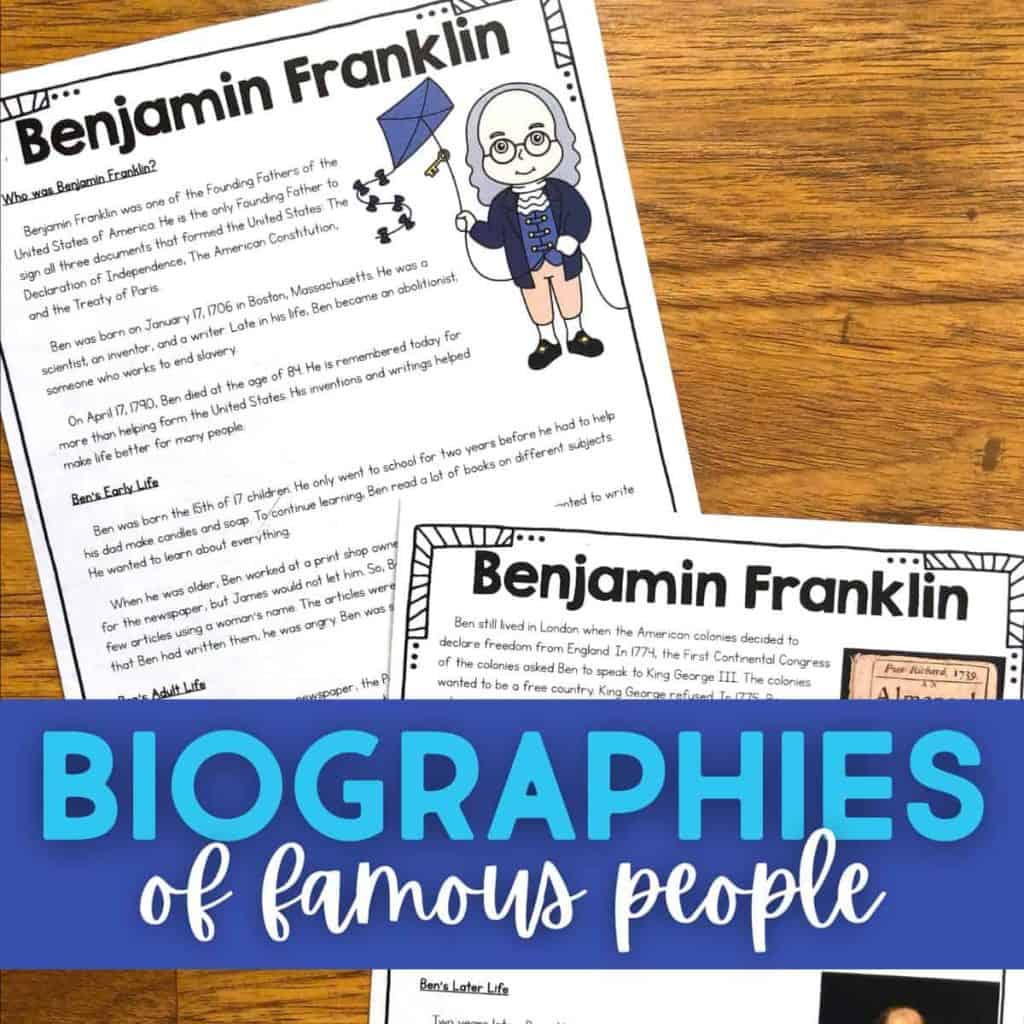
My students struggled to find information for their biography reports, so I created informational articles for them to use.
Step 4: Organize the Information
With a timeline in place, students are ready to plan their report. Breaking the biography into clear sections gives students a framework to follow and reduces the blank-page uncertainty that often stalls them.
A typical elementary biography follows this structure:
- Introduction: Briefly introduce the person and explain why they are important.
- Early Life: Describe childhood, family background, and early influences. Include the date and place of birth.
- Major Accomplishments: Explain what the person is best known for and why those accomplishments matter.
- Challenges or Obstacles: Discuss difficulties the person faced and how they responded.
- Impact and Legacy: Describe how they changed their field, their community, or the world.
Graphic organizers for biographies are especially useful at this stage. Students can transfer their timeline events into categories and plan what each paragraph will cover before they start writing. Mapping out the structure in advance makes the drafting stage far less daunting.
The Biography Report for Any Person resource includes research graphic organizers, report writing pages, and more for students writing about any historical or famous figure.

Take a look at more photos of the biography graphic organizers and report options in this post. Or click the links below to purchase it!
Step 5: Write the Biography Report
Once students have organized their notes, they are ready to write a first draft. Before they begin, remind them to write in third person, use complete paragraphs, include specific facts rather than general statements, transition between ideas, and keep events in chronological order.
One of the most effective things you can do at this stage is help students see how to expand thin sentences. Show them the difference side by side:
A thin draft sentence: “Marie Curie was a scientist.”
A stronger version: “Marie Curie was a pioneering scientist who conducted groundbreaking research on radioactivity and became the first woman to win a Nobel Prize.”
The second version includes specific facts and context that make the biography more informative. Modeling this kind of expansion before students write on their own noticeably improves the quality of first drafts.

Biography Report & Biography Project – Research and Writing Activities (Grades 2–5)
Make biography projects meaningful and engaging with this Biography Report & Research Project for grades 2–5! This flexible resource includes graphic organizers, genre posters, multiple report formats, lapbook templates, trifold reports, and construction paper people so students can research and present any historical figure.
Step 6: Revise and Edit
Revision does not need to become a grammar marathon. Start with content: Are all important events included? Does the writing follow a logical order? Is anything missing or unclear?
Once the content is solid, students can shift into editing: capitalization, spelling, punctuation, and paragraph structure.
Peer review checklists work well at this stage. Students generally enjoy giving feedback, and reading each other’s drafts reinforces what a complete, well-organized biography looks like. A clear rubric helps students understand exactly what is expected before they begin revising.
Step 7: Present the Biography
Presentations give the project audience and purpose. Students teach one another about the people they researched, which builds oral communication skills and gives them a genuine reason to take the writing seriously.
Options for presenting biography projects include oral presentations, slide shows, wax museum events, posters, craft projects, and short videos. For more ideas, see these creative ways to present a project.
Frequently Asked Questions about Biography Writing
Additional Tips for Teaching Biography Writing
Reading and modeling a biography together as a class before students begin their own projects is one of the most useful things you can do. Students need to see what a complete biography looks like before they can write one.
A few other approaches worth adding to your unit: display a sample timeline as a classroom reference, provide sentence starters for introductions and conclusions, use rubrics that clearly outline expectations, and break the project into daily steps so students are not trying to research, organize, and write all at once.
Biography writing is one of those assignments that can feel overwhelming at the start and rewarding at the end. With a clear process and the right scaffolding, students produce organized, detailed reports they are proud to share. And along the way, they learn that individual lives and the choices people make can shape communities, ideas, and history long after those people are gone.
Jessica BOschen
Jessica is a teacher, homeschool parent, and entrepreneur. She shares her passion for teaching and education on What I Have Learned. Jessica has 16 years of experience teaching elementary school and currently homeschools her two middle and high school boys. She enjoys scaffolding learning for students, focusing on helping our most challenging learners achieve success in all academic areas.