
Famous Inventors for Kids: Inventors and Their Inventions
Inventors have shaped the way we live, communicate, travel, and learn. From the first electric light bulbs to modern space exploration, many discoveries began with curious thinkers asking questions and experimenting with new ideas.
For elementary students, learning about inventors is a powerful way to connect science, history, and problem-solving. When students see how inventions were created, they begin to understand how innovation changes the world.
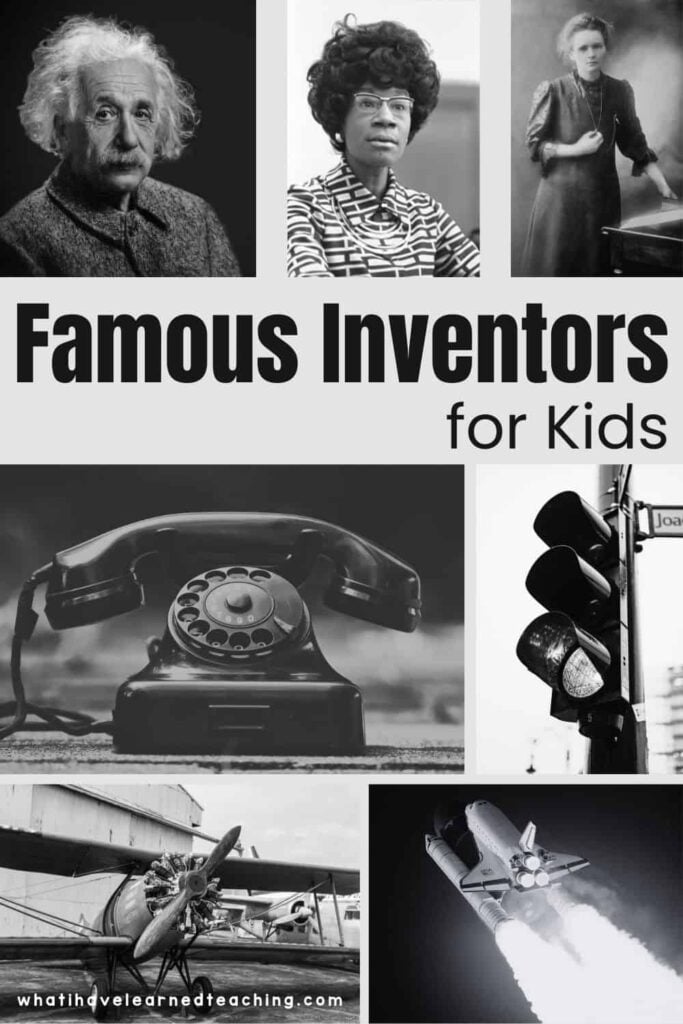
This list of famous inventors for kids highlights important inventors and their inventions. It can help teachers introduce STEM history, support biography projects, or spark classroom discussions about how inventions solve real-world problems.
Famous Inventors for Kids
The following list of famous inventors for kids includes scientists, engineers, and innovators whose discoveries changed how people communicate, travel, and understand the world.
| Inventor | Famous Invention or Discovery |
|---|---|
| Albert Einstein | Theory of relativity |
| Alexander Graham Bell | Telephone |
| Benjamin Franklin | Lightning rod, bifocal glasses |
| Garrett Morgan | Traffic signal, gas mask |
| George Washington Carver | Agricultural innovations using peanuts and crops |
| Jane Goodall | Groundbreaking research on chimpanzees |
| Mae Carol Jemison | First Black woman astronaut in space |
| Marie Curie | Research on radioactivity |
| Nikola Tesla | Alternating current electrical systems |
| Sally Ride | First American woman in space |
| Sarah E. Goode | Folding cabinet bed |
| The Wright Brothers | First successful airplane flight |
| Thomas Edison | Practical electric light bulb |
These inventor names and inventions often appear in science lessons, history units, and biography projects for elementary students.
Important Inventors and Their Inventions
Many famous inventions began as attempts to solve everyday problems. Some inventors wanted better communication, while others tried to improve safety, transportation, or scientific knowledge.
Here are a few examples of how inventors and their inventions changed history. Click on the inventor’s name to access the full biography.
Alexander Graham Bell – Telephone
Bell developed the first practical telephone, allowing people to communicate instantly over long distances. This invention transformed communication and eventually led to modern phones.
Thomas Edison – Electric Light Bulb
Although earlier versions of electric lights existed, Edison created a practical design that could be used in homes and businesses. His work helped bring electric lighting into everyday life.
Garrett Morgan – Traffic Signal
Morgan invented an early traffic signal to reduce accidents at busy intersections. His design helped shape the traffic signals used today.
The Wright Brothers – Airplane
Orville and Wilbur Wright achieved the first powered airplane flight in 1903. Their work launched modern aviation and changed global transportation.
Scientists and Their Inventions
Some inventors made discoveries that expanded scientific understanding rather than creating physical machines.
Curie conducted groundbreaking research on radioactivity. Her discoveries helped scientists understand atomic structure and eventually contributed to medical treatments and energy research.
Einstein’s theories changed the way scientists understand space, time, and gravity. While he did not invent a physical device, his scientific work led to technologies such as GPS and nuclear energy.
Goodall’s research transformed how scientists study animal behavior. Her work with chimpanzees revealed how closely humans and primates are related.
Women Inventors and Scientists
Women have made important contributions to science and invention throughout history. These scientists and innovators continue to inspire students interested in STEM fields.
Mae Jemison became the first Black woman astronaut to travel to space in 1992.
Sally Ride was the first American woman to fly on the Space Shuttle.
Sarah E. Goode invented the folding cabinet bed, an early space-saving furniture design.
These inventors show students that innovation can come from anyone with curiosity and determination.
More Important Inventors and Their Inventions
Throughout history, inventors have created tools, machines, and technologies that changed how people live and work. Some inventions improved communication, others made travel easier, and many helped scientists better understand the world.
Introducing students to a variety of inventors and their inventions helps them see how ideas build on one another over time. Many modern technologies grew from earlier discoveries and experiments.
Here are additional important inventors and their inventions that students may recognize from science and history lessons.
| Inventor | Invention or Contribution |
|---|---|
| Johannes Gutenberg | Printing press |
| Eli Whitney | Cotton gin |
| Samuel Morse | Telegraph and Morse code |
| James Watt | Improved steam engine |
| Hedy Lamarr | Frequency-hopping communication technology that later contributed to Wi-Fi and Bluetooth |
| Louis Pasteur | Pasteurization and advances in germ theory |
| Tim Berners-Lee | World Wide Web |
| Steve Jobs | Innovations in personal computing and mobile technology |
These inventors made discoveries that helped shape communication, industry, medicine, and technology. For example, Gutenberg’s printing press made books widely available, allowing ideas and knowledge to spread much faster. Samuel Morse’s telegraph allowed messages to travel long distances almost instantly for the first time.
Students may notice that inventions often lead to new inventions. Early communication systems like the telegraph eventually led to telephones, computers, and modern internet technology.
Exploring these inventions helps students understand how scientific discoveries, engineering, and creative thinking work together to solve problems and improve daily life.
Inventors and Their Inventions by Category
Another way to explore famous inventors is to group their discoveries by the type of problem they solved. Some inventors focused on communication, others on transportation, and many helped expand scientific knowledge.
This chart organizes well-known inventors and their inventions by category so students can see patterns in how innovation develops.
| Category | Inventor | Invention or Discovery |
|---|---|---|
| Communication | Alexander Graham Bell | Telephone |
| Electricity & Technology | Nikola Tesla | Alternating current electrical system |
| Electricity & Technology | Thomas Edison | Practical electric light bulb |
| Transportation | The Wright Brothers | Airplane |
| Science & Physics | Albert Einstein | Theory of relativity |
| Science & Chemistry | Marie Curie | Research on radioactivity |
| Agriculture & Food Science | George Washington Carver | Agricultural innovations using peanuts and crops |
| Safety & Public Infrastructure | Garrett Morgan | Traffic signal and gas mask |
| Furniture & Engineering | Sarah E. Goode | Folding cabinet bed |
| Early Science & Experimentation | Benjamin Franklin | Lightning rod and bifocal glasses |
| Space Exploration | Sally Ride | First American woman in space |
| Space Exploration | Mae Carol Jemison | First Black woman astronaut |
| Animal Science | Jane Goodall | Research on chimpanzee behavior |
Grouping inventions this way helps students see that innovation happens in many different fields—from agriculture and transportation to medicine, physics, and space exploration.
Teachers can even turn this chart into a quick classroom activity by asking students:
- Which category has the most inventions?
- Which invention changed everyday life the most?
- Which field might still have inventions waiting to happen?
These types of discussions help students see how inventions grow out of real problems and scientific curiosity.
Match the Inventor to the Invention
Students often recognize famous inventions but may not remember the name of the scientist or inventor who created them. Matching activities help students connect important discoveries with the people behind them.
Try this quick challenge with your class: can students match the inventor to the correct invention?
| Inventor | Invention |
|---|---|
| Alexander Graham Bell | Telephone |
| Thomas Edison | Electric light bulb |
| Nikola Tesla | Alternating current electrical system |
| The Wright Brothers | Airplane |
| Garrett Morgan | Traffic signal |
| George Washington Carver | Agricultural innovations using peanuts and crops |
| Benjamin Franklin | Lightning rod |
| Sarah E. Goode | Folding cabinet bed |
| Johannes Gutenberg | Printing press |
| Samuel Morse | Telegraph and Morse code |
Teachers sometimes turn this into a quick classroom activity by:
• covering the invention column and asking students to guess
• turning the chart into matching cards
• using it as a warm-up before a biography research project
Activities like this help students remember both the inventor names and inventions while building background knowledge for science and history lessons.
If you’re planning a larger inventor study or biography unit, activities like this matching chart pair well with structured research tools and sorting activities that help students organize information about historical figures and their discoveries.
Free Biography Sort for Students
If your students are learning about famous inventors, a simple sorting activity can help them connect inventor names with their inventions before beginning a research project.
This free Biography Sort activity gives students practice matching important historical figures with their discoveries and inventions. Students sort cards, read short descriptions, and discuss how each person changed everyday life. It’s an easy way to introduce historical people before assigning a full biography report.

How Teachers Can Use Inventor Lists in the Classroom
Lists of inventors and their inventions are helpful tools for introducing research projects and STEM learning.
Teachers often use inventor lists to:
• assign biography research projects
• introduce famous inventions during science units
• connect science discoveries to historical events
• spark invention brainstorming activities for students
Students can research how an invention works, why it was created, and how it changed people’s lives.
If your students are completing biography reports, these inventors make excellent research topics. You can find additional biography ideas in this list of historical people for biography reports.

Biography Report & Biography Project – Research and Writing Activities (Grades 2–5)
Make biography projects meaningful and engaging with this Biography Report & Research Project for grades 2–5! This flexible resource includes graphic organizers, genre posters, multiple report formats, lapbook templates, trifold reports, and construction paper people so students can research and present any historical figure.
Researching Inventors for Biography Projects
Students researching inventors often need safe and reliable sources. Many classrooms begin with curated websites designed for student research.
If you’re helping students research famous people, these guides can help:
• Biography Websites for Students (safe research sources)
• Historical People for Biography Reports
• U.S. Historical Figures for Student Reports
Many of the inventor biographies on this site also include links to trusted research websites that students can use to learn more about each person.
Why Learning About Inventors Matters
Studying inventors helps students see how creativity, curiosity, and persistence can lead to discoveries that change the world.
When students learn about inventors and their inventions, they begin to see science as something people actively create—not just facts in a textbook.
Who knows? The next great invention might start as a classroom idea.
Exploring the lives and inventions of these innovators can inspire students to ask questions, experiment with ideas, and imagine the discoveries they might one day create.
Looking for meaningful informational texts that your elementary students will stay engaged with?
The Biography Collection includes 46+ biographies across topics like civil rights, athletes, scientists, government leaders, and more—each paired with reading comprehension, vocabulary, and structured writing activities.
Students build skills in informational reading, research, and biography report writing while learning about influential people from history and today.
Jessica BOschen
Jessica is a teacher, homeschool parent, and entrepreneur. She shares her passion for teaching and education on What I Have Learned. Jessica has 16 years of experience teaching elementary school and currently homeschools her two middle and high school boys. She enjoys scaffolding learning for students, focusing on helping our most challenging learners achieve success in all academic areas.