
101 Famous People to Write a Biography About (Historical Figures for Students)

Looking for famous people to write a biography about? When students are assigned a biography report or research project, choosing the right historical figure can make the assignment much more engaging.
This list includes 101 historical figures students can research for biography projects. The people are organized by categories such as leaders, scientists, artists, writers, explorers, and athletes so students can easily find someone that fits their interests.

These famous people work well for:
- biography reports
- history research projects
- famous person presentations
- biography writing assignments
If you’re planning a full research unit, this guide to biography projects for elementary students explains how students research historical figures and turn their notes into reports and presentations.
Looking for U.S. historical figures specifically? See this focused list.
This post discusses historical events in an educational context.
People to Write a Biography About (Student-Friendly Ideas)
Trying to choose a person for your biography report?
Here are 101 famous and interesting people you can research, write about, and present in class. Whether you need someone inspiring, historical, creative, or groundbreaking, this list gives you plenty of options.
If you’re looking for:
- People to write about
- Famous people to do a biography on
- Interesting people to research
- Good people for a biography project
Scroll down and choose a category that fits your assignment.
101 Famous People for Biography Research Projects
This list includes famous people from many fields, including:
- leaders and historical figures
- scientists and inventors
- explorers
- artists and writers
- activists and reformers
- athletes and musicians
Choose a category below to find biography ideas for your research project.
Easy Biography Subjects for Elementary Students
If younger students are completing a biography report, these historical figures are often easier to research because their accomplishments are clear and widely documented.
Good biography topics for younger students include:
- Martin Luther King Jr.
- Rosa Parks
- Amelia Earhart
- Helen Keller
- George Washington Carver
- The Wright Brothers
- Jackie Robinson
These figures have a strong historical impact and many student-friendly resources available.
Here is a list of people categorized by fields such as leadership, science, exploration, arts, social activism, and more:
Leaders, Political, and Historical Figures
- Abraham Lincoln: The 16th President of the United States, emancipated slaves and led the nation through the Civil War.
- Cleopatra VII: The last active ruler of Egypt, known for her political savvy and alliances with Rome.
- George Washington: First president of the USA and commander-in-chief of the Continental Army during the American Revolutionary War.
- Nelson Mandela: Anti-apartheid revolutionary, became South Africa’s first black president.
- Mahatma Gandhi: Leader of India’s non-violent independence movement against British rule.
- Joan of Arc: French heroine and saint who led French forces to victory over the English.
- Queen Elizabeth I: Queen of England and Ireland, reigned during a time known as the Elizabethan Era, notably marked by the English Renaissance and the defeat of the Spanish Armada.
- Winston Churchill: British politician, army officer, and writer who was Prime Minister of the United Kingdom during World War II.
- Simón Bolívar: Military and political leader who played a key role in Latin America’s successful struggle for independence from the Spanish Empire.
- Catherine the Great: Empress of Russia who greatly increased the empire’s strength and prestige.
- Julius Caesar: Roman general and statesman who played a critical role in the events that led to the demise of the Roman Republic and the rise of the Roman Empire.
- Barack Obama: The 44th president of the United States and the first Black American to hold the office. He served two terms from 2009 to 2017.
Scientists, Inventors, Mathematicians, STEM Figures, and Entrepreneurs
- Marie Curie: First woman to win a Nobel Prize, known for her work on radioactivity.
- Albert Einstein: Developed the theory of relativity, making significant contributions to physics.
- Isaac Newton: Formulated the laws of motion and universal gravitation.
- Galileo Galilei: The father of modern observational astronomy.
- Charles Darwin: Developed the theory of natural selection in evolution.
- Thomas Edison: Inventor and businessman who developed many devices that greatly influenced life worldwide, including the phonograph and the electric light bulb.
- Archimedes: Ancient Greek mathematician, physicist, engineer, inventor, and astronomer
- Nikola Tesla: Inventor, electrical engineer, mechanical engineer, and futurist best known for his contributions to the design of the modern alternating current (AC) electricity supply system
- Stephen Hawking: Theoretical physicist and cosmologist who made significant contributions to cosmology, general relativity, and quantum gravity, especially in the context of black holes.
- Ada Lovelace: Mathematician and writer known for her work on Charles Babbage’s early mechanical general-purpose computer, the Analytical Engine. She is sometimes considered the first computer programmer.
- Dmitri Mendeleev: Chemist and inventor best known for formulating the periodic law and creating a farsighted version of the periodic table of elements.
- Marie Tharp: Geologist and oceanographic cartographer who co-created the first scientific map of the Atlantic Ocean floor. Her work provided evidence for the theory of plate tectonics.
- Rosalind Franklin: Chemist whose work on X-ray diffraction was critical in discovering the DNA double helix.
- Carl Sagan: Astronomer, cosmologist, astrophysicist, astrobiologist, author, and science communicator in astronomy and other natural sciences, well known for his work as a science popularizer and communicator
- Steve Jobs: Business magnate, industrial designer, investor, and media proprietor. He was the chairman, chief executive officer (CEO), and co-founder of Apple Inc.
- Henry Ford: Industrialist, founder of the Ford Motor Company, and sponsor of the development of the mass production assembly line technique
- Walt Disney: Entrepreneur, animator, voice actor, and film producer. A pioneer of the American animation industry, he introduced several developments in the production of cartoons.
- Madam C.J. Walker: Black American entrepreneur, philanthropist, and political and social activist. Eulogized as the first female self-made millionaire in America for her successful line of hair care products.
- Elon Musk: Entrepreneur and business magnate known for founding SpaceX and co-founding Tesla Motors and PayPal.
- Alan Turing: Mathematician, computer scientist, logician, cryptanalyst, philosopher, and theoretical biologist. Turing was highly influential in the development of theoretical computer science.
- Tim Berners-Lee: Engineer and computer scientist best known as the inventor of the World Wide Web.
- Katherine Johnson: Black American mathematician whose calculations of orbital mechanics as a NASA employee were critical to the success of the first and subsequent U.S. crewed spaceflights.
- Gregor Mendel: Scientist, Augustinian friar, and abbot of St. Thomas’ Abbey in Brno, Margraviate of Moravia. Mendel was the founder of the modern science of genetics.
- James Clerk Maxwell: Scientist in the field of mathematical physics. His most notable achievement was to formulate the classical theory of electromagnetic radiation.
- George Washington Carver: Agricultural scientist and inventor who promoted alternative crops to cotton and methods to prevent soil depletion. He was the most prominent black scientist of the early 20th century.
- Percy Julian: Chemist and pioneer in the chemical synthesis of medicinal drugs from plants. He was the first to synthesize the natural product physostigmine and a pioneer in the industrial large-scale chemical synthesis of the human hormones, steroids, progesterone, and testosterone from plant sterols, such as stigmasterol and sitosterol.
- Mae Jemison: Engineer, physician, and former NASA astronaut. She became the first black woman to travel into space when she served as a mission specialist aboard the Space Shuttle Endeavour.
- Chien-Shiung Wu: Chinese-American experimental physicist who made significant contributions in the field of nuclear physics. Wu worked on the Manhattan Project and conducted the Wu experiment, which contradicted the hypothetical law of conservation of parity.
- Tu Youyou: Chinese pharmaceutical chemist and malariologist who discovered artemisinin and dihydroartemisinin, used to treat malaria – a significant breakthrough in 20th-century tropical medicine, saving millions of lives.
Explorers and Adventurers
- Amelia Earhart: First female aviator to fly solo across the Atlantic Ocean.
- Marco Polo: Venetian explorer known for his travels through Asia.
- Wright Brothers: Achieved the first powered, sustained, and controlled airplane flight.
- Alexander the Great: Created one of the ancient world’s largest empires.
- Ibn Battuta: Moroccan Berber Muslim scholar and explorer who widely traveled the medieval world.
- Ernest Shackleton: British polar explorer who led three British expeditions to the Antarctic.
- Zheng He: Chinese mariner, explorer, diplomat, fleet admiral, and court eunuch during China’s early Ming dynasty.
- Sacagawea: Lemhi Shoshone woman who helped the Lewis and Clark Expedition achieve their chartered mission objectives by exploring the Louisiana Territory.
Artists
- Leonardo da Vinci: Renaissance polymath known for art, science, and invention.
- Frida Kahlo: Mexican painter known for her unique style and self-portraits.
- Vincent van Gogh: Dutch Post-Impressionist painter whose work, notable for its beauty, emotion, and color, highly influenced 20th-century art.
- Pablo Picasso: Spanish painter, sculptor, printmaker, ceramicist, and stage designer considered one of the greatest and most influential artists of the 20th century.
Writers and Poets
- Anne Frank: Jewish teenager who wrote a diary during the German occupation of the Netherlands in WWII.
- Shakespeare: English playwright, poet, and actor, widely regarded as the greatest writer in the English language and the world’s greatest dramatist.
- Emily Dickinson: American poet known for her bold and innovative verse, largely unpublished during her lifetime.
- Haruki Murakami: Contemporary Japanese writer. His books and stories have been bestsellers in Japan as well as internationally.
- Maya Angelou: Poet, memoirist, and civil rights activist known for her series of seven autobiographies, which focus on her childhood and early adult experiences, the first and most famous being “I Know Why the Caged Bird Sings.”
- Langston Hughes: Poet, social activist, novelist, playwright, and columnist. He was one of the earliest innovators of the then-new literary art form called jazz poetry and a leading figure of the Harlem Renaissance.
- James Baldwin: Novelist, playwright, essayist, poet, and activist. His essays, as collected in “Notes of a Native Son” (1955), explore intricacies of racial, sexual, and class distinctions in Western societies, most notably in mid-20th-century America.
- Gabriel García Márquez: Colombian novelist, short-story writer, screenwriter, and journalist, known affectionately as Gabo or Gabito throughout Latin America. He was one of the greatest writers of the 20th century, with works like “One Hundred Years of Solitude” and “Love in the Time of Cholera.”
- Harper Lee: American novelist best known for her 1960 novel “To Kill a Mockingbird,” which won the 1961 Pulitzer Prize. The book deals with issues of racial injustice in the Deep South.
- J.K. Rowling: British author of the globally acclaimed “Harry Potter” series, which follows the young wizard Harry Potter and his friends through their adventures at Hogwarts School of Witchcraft and Wizardry. Rowling’s work has sparked a new generation’s love for reading.
- Beverly Cleary: An American author who created iconic characters like Ramona Quimby and Henry Huggins. Cleary’s books explore the complexities of childhood with humor and sensitivity.
- Eric Carle: Author and illustrator best known for “The Very Hungry Caterpillar,” a classic children’s picture book translated into over 65 languages. Carle’s distinctive collage illustrations and simple, engaging texts have made his books a staple of early childhood education.
- Maurice Sendak: American illustrator and author of children’s books, best known for “Where the Wild Things Are.” Sendak’s work is celebrated for its narrative depth, imagination, and insight into the emotions of children.
- Astrid Lindgren: Swedish author of a series of books about the independent and spirited girl, Pippi Longstocking. Lindgren’s works are beloved worldwide for their humor, warmth, and celebration of childhood freedom.
- C.S. Lewis: British author of “The Chronicles of Narnia,” a series of seven fantasy novels considered classics of children’s literature. The series, including “The Lion, the Witch, and the Wardrobe,” has inspired and entertained readers with its themes of adventure, courage, and the battle between good and evil.
- E.B. White: American author of “Charlotte’s Web,” “Stuart Little,” and “The Trumpet of the Swan.” White’s children’s novels are celebrated for their warmth, wit, and enduring themes of friendship and loyalty.
- Lois Lowry: American author known for her versatility and invention. She has written more than 40 books for children and young adults, including “The Giver” and “Number the Stars,” exploring themes of humanity, societal structures, and the power of memory.
Musicians
- Ludwig van Beethoven: German composer and pianist; his music is amongst the most performed of the classical music repertoire.
- Wolfgang Amadeus Mozart: Prolific and influential composer of the Classical period.
- Louis Armstrong: Jazz musician and trumpet player who connected well with the Harlem Renaissance and civil rights.
Social and Civil Rights Activists
- Martin Luther King Jr.: Civil rights leader, known for his “I Have a Dream” speech.
- Rosa Parks: Civil rights activist known for her pivotal role in the Montgomery Bus Boycott.
- Harriet Tubman: Abolitionist who led many slaves to freedom on the Underground Railroad.
- Mother Teresa: Founded the Missionaries of Charity, helping those in great need in India.
- Jane Goodall: Primatologist known for studying chimpanzee social and family life.
- Susan B. Anthony: Social reformer and women’s rights activist who was pivotal in the women’s suffrage movement.
- Frederick Douglass: American social reformer, abolitionist, orator, writer, and statesman after escaping slavery in Maryland.
- Malala Yousafzai: Pakistani activist for female education and the youngest Nobel Prize laureate.
- Sojourner Truth: American abolitionist and women’s rights activist who was born into slavery but escaped with her infant daughter to freedom.
- Cesar Chavez: American labor leader and civil rights activist who, with Dolores Huerta, co-founded the National Farm Workers Association.
- Dolores Huerta: American labor leader and civil rights activist who, with Cesar Chavez, co-founded the National Farm Workers Association (later the United Farm Workers Union, UFW).
- Booker T. Washington: Educator, author, orator, and advisor to multiple U.S. presidents. He was a dominant leader in the African American community in the United States from 1890 to 1915.
- W.E.B. Du Bois: Sociologist, historian, civil rights activist, Pan-Africanist, author, and editor. He co-founded the National Association for the Advancement of Colored People (NAACP) in 1909.
- Shirley Chisholm: Politician, educator, and author. In 1968, she became the first black woman elected to the United States Congress, and she ran for the Democratic nomination for president in 1972, making her the first black candidate for a major party’s nomination for President of the United States and the first woman to run for the Democratic Party’s presidential nomination.
Humanitarians and Reformers
- Florence Nightingale: Founder of modern nursing, improved hospital sanitation.
- Helen Keller: Advocate for people with disabilities, the first deaf-blind person to earn a BA degree.
Philosophers and Thought Leaders
- Socrates: Foundational figure in Western philosophy.
- Confucius: Chinese philosopher who emphasized morality, social relationships, and justice.
- Plato: Philosopher in classical Greece and the founder of the Academy in Athens, the first institution of higher learning in the Western world.
- Aristotle: Greek philosopher and polymath during the Classical period in Ancient Greece. Taught by Plato, he was the founder of the Lyceum, the Peripatetic school of philosophy, and the Aristotelian tradition.
- Voltaire: French Enlightenment writer, historian, and philosopher famous for his wit, his criticism of Christianity, especially the Roman Catholic Church, and his advocacy of freedom of speech, separation of church and state, and freedom of religion.
- Friedrich Nietzsche: German philosopher, cultural critic, composer, poet, writer, and philologist whose work has profoundly influenced modern intellectual history.
Athletes and Sports Figures
- Muhammad Ali: American professional boxer, activist, and philanthropist. Nicknamed “The Greatest,” he is widely regarded as one of the most significant and celebrated sports figures of the 20th century.
- Serena Williams: American professional tennis player and former world No. 1 in women’s singles tennis.
- Pele: Retired Brazilian professional footballer regarded as one of the greatest players ever.
- Jackie Robinson: American professional baseball player who became the first Black American to play Major League Baseball in the modern era.
- Michael Jordan: American former professional basketball player and the principal owner of the Charlotte Hornets of the NBA. He is widely considered the greatest basketball player of all time.
- Usain Bolt: Jamaican former sprinter widely considered the greatest sprinter of all time. He is a world record holder in the 100 meters, 200 meters, and 4 × 100 meters relay.
How Teachers Can Use This List of Biography Topics
Teachers often use lists like this when assigning a biography report or research project. Students can choose one of the historical figures and then research:
- early life
- major accomplishments
- important historical events
- the person’s impact on history
Students can present their research through written reports, posters, timelines, or creative biography projects.
If you’re planning a full unit, this guide explains how to teach a biography unit in elementary school, including research tools and writing supports.
Here are several strategies for incorporating this list into elementary education:
Biography Projects
Assign students to research and present on one of the individuals from the list. They can create posters and PowerPoint presentations or dress up as the person to give a first-person account of their life and achievements.
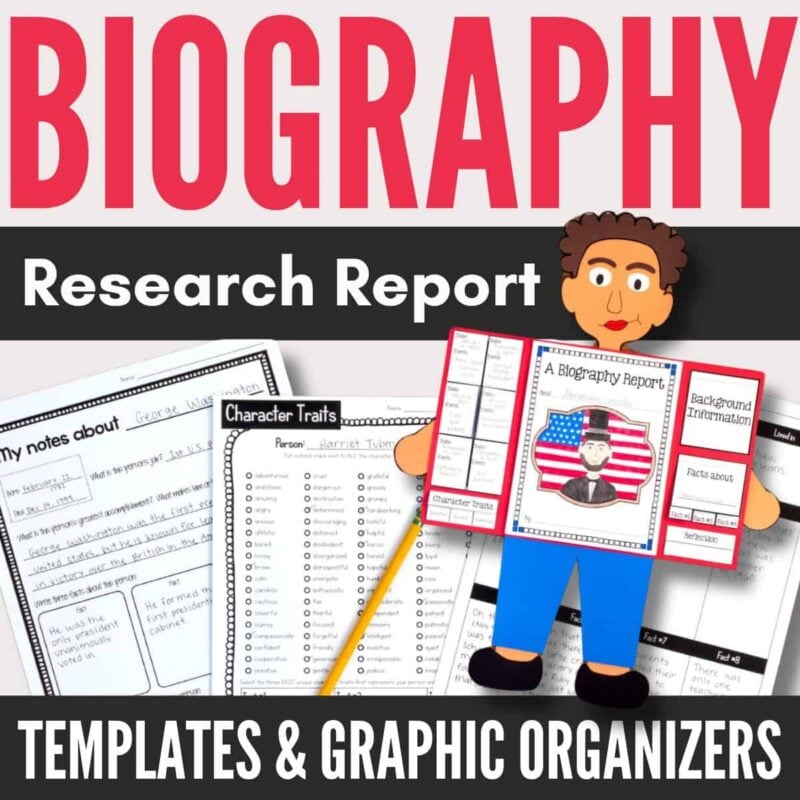
Biography Report & Biography Project – Research and Writing Activities (Grades 2–5)
Make biography projects meaningful and engaging with this Biography Report & Research Project for grades 2–5! This flexible resource includes graphic organizers, genre posters, multiple report formats, lapbook templates, trifold reports, and construction paper people so students can research and present any historical figure.
Reading Circles
Organize reading circles focused on children’s books written by or about these influential figures. These can include autobiographies adapted for children, biographies, or books by authors.
Thematic Units
Develop thematic units around specific categories, such as scientists, explorers, or civil rights leaders. Integrate lessons across subjects—science, social studies, language arts—around these themes.
Art Projects
Have students create art projects inspired by the work or life of the individuals. This could include drawing or painting portraits, creating timelines of their lives, or illustrating scenes related to their contributions.
Writing Assignments
Students can write essays, poems, or short stories inspired by the achievements and challenges these figures face. Prompts could include writing a day in the life, imagining conversations between two figures from different eras, or explaining the importance of their work.
Discussion and Debate
Facilitate classroom discussions or debates on topics related to the challenges and achievements of these figures. This could include discussing the importance of perseverance, the impact of innovation, or the ethics of exploration and discovery.
STEM Activities
For scientists and inventors on the list, design STEM activities that allow students to explore their inventions or discoveries. Simple experiments related to their work can make learning more interactive and engaging.
Cultural Studies
Use the diverse backgrounds of these figures to explore different cultures and historical periods. This can include studying the geographical regions they came from, the languages they spoke, and the cultural norms of their times.
Multimedia Presentations
Incorporate technology by having students create multimedia presentations or digital storybooks about these figures. This can include videos, podcasts, or interactive websites.
Field Trips
Organize field trips to museums, historical sites, or science centers related to the lives and achievements of these figures. Virtual field trips can also be an option if physical travel is not feasible.
Guest Speakers
Invite guest speakers who are experts on or have a connection to the work of these individuals. This could include authors of children’s books on these figures, historians, scientists, or cultural educators.
Community Service Projects
Inspired by humanitarians and activists on the list, organize community service projects that reflect the spirit of their work. This can help students understand the value of contributing to their communities and the impact of collective action.
Using this list in such diverse ways can help students develop a multifaceted understanding of historical figures and contemporary leaders, encouraging them to see the relevance of these individuals’ lives and achievements to their own.
Free Biography Sorting Activity for Students
If you’d like a ready-to-use activity that helps students categorize and analyze historical figures before writing their reports, this free biography sorting activity makes a perfect introduction.
This set includes 43 people from various backgrounds spanning ten different categories, plus an additional option for creating your own!

Looking for meaningful informational texts that your elementary students will stay engaged with?
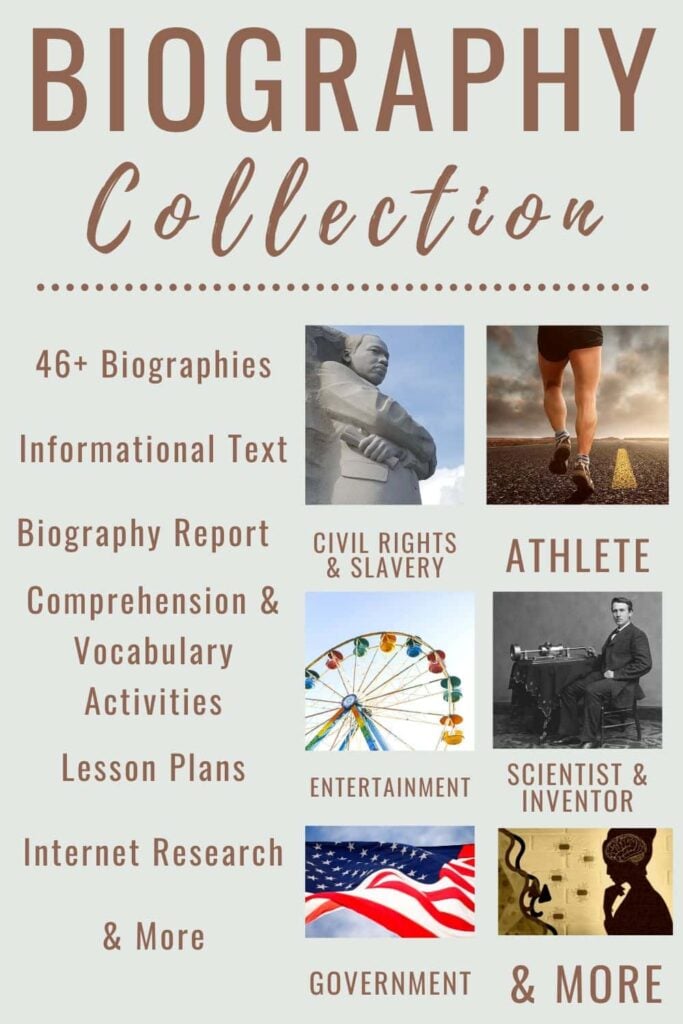
The Biography Collection includes 46+ biographies across topics like civil rights, athletes, scientists, government leaders, and more—each paired with reading comprehension, vocabulary, and structured writing activities.
Students build skills in informational reading, research, and biography report writing while learning about influential people from history and today.
Jessica BOschen
Jessica is a teacher, homeschool parent, and entrepreneur. She shares her passion for teaching and education on What I Have Learned. Jessica has 16 years of experience teaching elementary school and currently homeschools her two middle and high school boys. She enjoys scaffolding learning for students, focusing on helping our most challenging learners achieve success in all academic areas.