
Plate Tectonics Science Stations for Fourth Grade
As a child, I was utterly fascinated by earthquakes and volcanoes. Never mind that I lived nowhere near a faultline or plate boundary and would likely never experience these phenomena associated with plate boundaries. Perhaps it was watching the news, reading books, or just a general fear of the power of nature that made me write my first elementary paper on volcanoes. I even drew the cover myself. I was proud of that erupting volcano… and all the people running away from it in terror.

It was then that I learned more about the cause of volcanoes and earthquakes: plate tectonics! While we may not all live near plate boundaries, plate tectonics either affected in the past or currently affect the shape of our Earth. Dormant volcanoes in New Mexico, cold, pristine lakes in Oregon and Montana, tremors in California, and the rolling Smokies are just a few examples of land features caused by plate tectonics.
Not only is this a super interesting topic to teach (and learn!), it’s part of the NGSS standards for your fourth-grade science lessons. So, to help you teach this to your fourth graders, we’ve developed these science stations specifically with that in mind. These Plate Tectonics Science Stations are NGSS aligned, thorough and engaging. Let’s take a look at all that is included. Perhaps, just like it was for me, the topic of Plate Tectonics ends up being a favorite for your students, too.
Focus on NGSS Standards for 4-ESS-2.B
All Plate Tectonics Science Stations are NGSS-aligned, which means
- Your students will get a thorough grasp of the material and
- YOU don’t have to worry about whether all standards have been met once you’re finished with the unit!
The Plate Tectonics Science Stations meet the NGSS Standards for 4-ESS. The focus is on 4-ESS2.B. Concepts include volcanoes, the structure of the Earth, types of maps, features of the ocean floor, seafloor maps, the Pacific Ring of Fire, plate boundaries, and geographic features caused by plate boundaries.
You can read about the standards more in-depth here.

What’s Included in the Plate Tectonics Science Stations
Included are 8 different science stations where students deepen their understanding of plate tectonics. Students watch videos about volcanoes, play games about the tectonic plates, investigate earthquakes, and more! The science stations contain challenging material for fourth graders, with new words and concepts in easy-to-implement, interactive stations.

Big Idea Posters for Plate Tectonics
To create a more immersive learning experience, we’ve included Big Idea Posters. These posters include key concepts accompanied by colorful (or black-and-white) images. You can do so much with these! Display them on your whiteboard, on a bulletin board, or on the walls across the room. Print them in color or black and white, adjust the size, or even use them as flashcards.
Some of the big ideas include information about the three different plate boundaries and the Earth’s layers.

Vocabulary Cards for Plate Tectonics
An integral part of all our science stations is vocabulary cards. We realize each classroom situation is different, so we’ve provided these in two formats; with pictures, and without pictures. Just as with the Big Idea Posters, you can print these in color or in black-and-white.
Here are some tips for using the vocabulary cards in your classroom:
- Have your students cut them out. Why not let them do the work? Not only will they practice their fine motor skills, but they will also become familiar with the definitions as they cut out the cards.
- Use either version to create a matching game. Have students do this individually at their desks, or play it as a whole class. For the picture-less version, just match each vocabulary word with the correct definition. If you’re using the version with the picture, make sure to separate (cut) the pictures, vocabulary words, and definitions, and match those. Who said vocabulary is boring?
- They work well in pocket charts, too!


Differentiated Responses for Each Science Station
Classrooms and learning styles differ, so we’ve created the science stations in such a way that students can display their understanding in different ways.
Each station includes five different ways to respond to the experience at the station:
- short answer questions
- fill-in-the-blank questions without a word bank
- fill-in-the-blank with a word bank
- task cards with short answers
- task cards with multiple choice
All the variations are similar to one another, but require a different level of independence. The fill-in-the-blank is the easiest and perfect for your students who struggle with reading. The short answer is the most difficult as it requires students to construct their own responses without much support.
Choose the format that best fits your classroom and students. Students are also encouraged to use their science journal task cards. Answer keys are included.
Some activities also include an activity sheet or worksheet in addition to the differentiated responses. This activity sheet is the “work” of the station while the differentiated responses require students to think broadly about the topic and concept.
See examples of the questions in some of the images below.
Reading Passages
All stations, except the Watch and Play stations, include reading passages. Most of the reading passages are optional, but they do build students’ background knowledge and solidify key concepts. Use them if your students do not have prior knowledge of the topic of the station.
The reading passages come in two formats. You’ll see versions of both of these formats in the below photographs. Both versions have the same text, but different layouts.
- Full-page with color border
- Two-Column with a black border
See examples of the two formats in the images below.
Google Classroom Components
Digital learning has become an important part of classrooms across the world, especially these past couple of years! To meet the growing needs of teachers and students, we have included Google classroom components so that these Plate Tectonics Science Stations can be completed entirely in the virtual classroom, or partially in digital format in the physical classroom.
All of our fourth-grade science stations come with components easily integrated with Google Classroom. Google Forms and Google Slides are included for most stations.
- A Google Form™️ with Reading Passage & Differentiated Questions is available for the Watch, Investigate, Diagram, Read, Model, Explore and Sort stations.
- Google Slides™️ with Activity Directions & Worksheets are available for for Investigate, Diagram, Model, Explore, Sort
Most of the hands-on activities still require physical components, but we have provided the directions and recording sheets in Google Slides.
Watch a Video about Plate Tectonics
In the Watch a Video Station, students watch one of two videos and then answer questions about the videos. One video deals specifically with volcanoes, while the other explores the question of if you could dig through the Earth (and what you might encounter on the way if you could!)
Students can watch these videos on their own electronic devices, or you can present them in front of the class. Cards with QR codes are included so your students can easily and safely navigate to the videos.

After they’ve watched a video, provide your students with the included multiple-choice cards and/or fill-in-the-black sheets to reinforce what they’ve just watched and to check their understanding of the topic(s) presented in the video.

Play a Game about Plate Tectonics
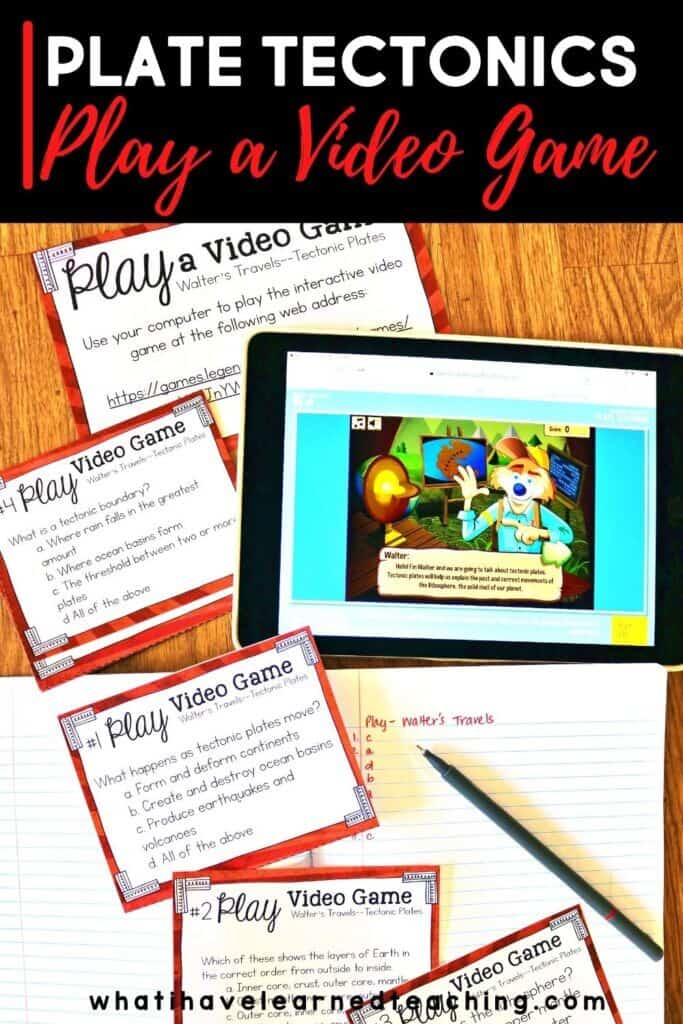
This may just be your students’ favorite station… The Play a Game Station! I mean, what fourth-grader does not want to play a game?
As with all the stations, this station includes differentiated responses. Below is an example of the board game, crossword puzzle, and word search. The puzzles can be completed individually, the board game with a partner: perfect for cooperative learning! Answers are provided in the Answer Key.

If you’d rather have your students play a video game, there’s that option, too! Your students will need individual devices to play the game. Question cards (multiple-choice) are provided to check for understanding.
Investigate Earthquakes and Plate Boundaries
The Investigate station of the Plate Tectonics unit is called Shake, Rattle, and Roll for a reason! After reading a passage, students will construct a building to investigate what happens to buildings during earthquakes.
The reading passages in the Investigate stations are accompanied by activity sheets, such as response sheets and task cards, to aid in comprehension and retention.

Using a variety of building materials, they will aim to build a structure that will withstand movement of the earth caused by moving plates. No real earthquake needed to test their structures – thank goodness! – just a skateboard simulating moving and shaking plates.
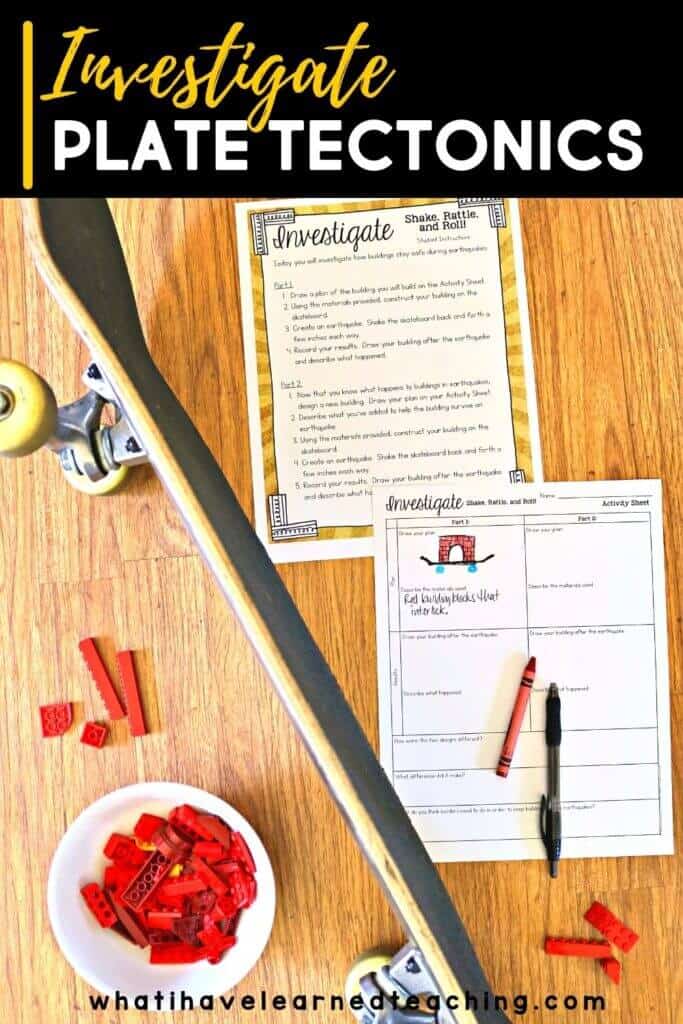
Diagram the Seafloor by Mapping It!
In the Diagram station, students will first read about features of the ocean floor and how scientists make seafloor maps. This station, too, provides you with numerous activity sheets such as response sheets and tasks cards.

Next, students get to make their own models and diagrams of the seafloor! Hands-on activities such as these are so important in aiding the learning process. Students form a hypothesis, make a plan, build a seafloor with playdough according to certain specifications, and then make a map of the seafloor they created.

Here is an image of my son doing a similar activity. My kids built a “seafloor”, covered it with paper, and measured the depths of their seafloor.

Read About the Ring of Fire
Students read about the Pacific Ring of Fire in this Read station. They learn about the location of the ring of fire and how convergent plate boundaries build volcanoes.
Included are the four types of differentiated responses.

Model Plate Boundaries Using Clay
In the Model station, students read about plate tectonics and plate boundaries and build actual models of the plate boundaries discussed in the text: convergent, divergent, and transform boundaries.

Again, there are several ways students can respond to what they have learned. The response sheets include open-ended questions, multiple-choice questions, and fill-in-the-blank sentences (not pictured).
As students build their plate boundaries with clay, they draw and label their observations on the included worksheets.

Explore
Students read about volcanoes in this station and then explore a volcanic eruption using a simulation. The reading passage discusses the three types of volcanoes and how they are formed.

Like all of our stations, students can respond to the text in a way that meets their learning style.
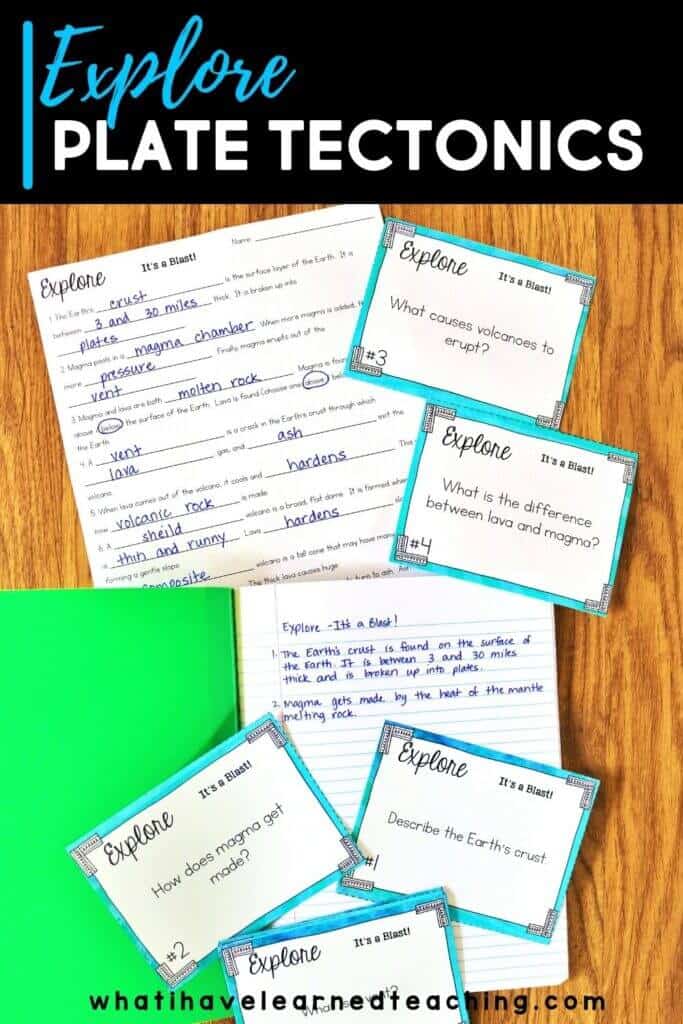
In the activity part of the Explore station, students will watch a video and create a small classroom-safe volcanic explosion! Students follow the directions and draw and record their observations.

Sort Different Types of Plate Boundaries
In this sorting activity, students read about the different types of plate boundaries: Convergent, Divergent, and Transform. They will then sort pictures into the correct categories. The sort can be completed as a worksheet like in the picture below or with included color cards. The station also includes differentiated responses.

You can see more about the SORT station in this blog post. We go into more detail about this particular science station.
Planning your whole earth science unit? The 2nd–5th Grade Earth Science Guide pulls together every standard, every grade level, and all the resources on this site in one place.
How to Purchase the Fourth Grade Plate Tectonics Science Stations
Purchase the Plate Tectonics Science Stations on my website or on Teachers Pay Teachers.
Other Fourth Grade Science Stations
We have many other science stations aligned with the NGSS for fourth grade.
-
 Product on sale4th Grade NGSS Science Station Yearlong BUNDLEOriginal price was: $287.57.$159.00Current price is: $159.00.
 -
-
-
-
-
-
-
-
-
-
-




Jessica BOschen
Jessica is a teacher, homeschool parent, and entrepreneur. She shares her passion for teaching and education on What I Have Learned. Jessica has 16 years of experience teaching elementary school and currently homeschools her two middle and high school boys. She enjoys scaffolding learning for students, focusing on helping our most challenging learners achieve success in all academic areas.