
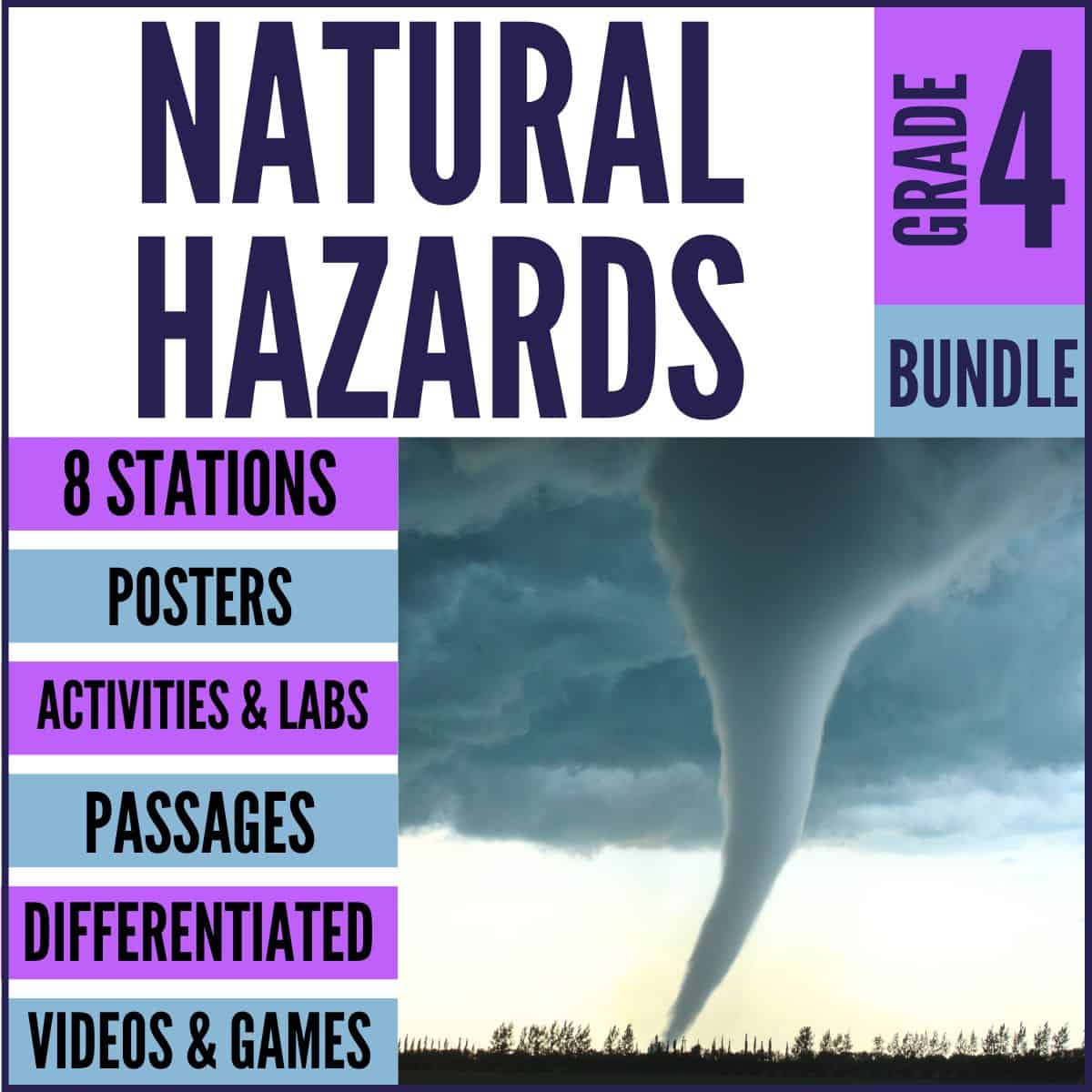
Natural Hazards – Wild Weather & Shifting Plates BUNDLE
$14.78
These Natural Hazards Fourth Grade Next Generation Science Standards include 8 different science stations where students deepen their understanding of natural forces behind natural disasters that influence communities and individuals.

These Natural Hazards Fourth Grade Next Generation Science Standards include 8 different science stations where students deepen their understanding of natural forces behind natural disasters that influence communities and individuals. The focus is on 4-ESS3.B. Natural disasters include earthquakes, ocean waves and currents, volcanoes, plate tectonics, tsunamis, winter storms, thunderstorms, hurricanes, tornadoes, and flooding.
- Vocabulary Cards in two formats with and without pictures.
- Watch – Students watch one of two videos and then answer questions about the videos. Videos include: earthquakes or waves and currents.
- Play – Students play a video game and learn about volcanoes or a game to learn bout the tectonic events that occur at plate boundaries. Students answer questions to reinforce the new learning.
- Investigate – Students read about earthquakes. They participate in a design challenge to build earthquake-safe buildings. Students then answer questions to reinforce the concepts learned.
- Diagram – Students read about tsunamis. They create a diagram and answer questions in order to reinforce what they have learned.
- Read a Passage – Students read about winter storms. They answer questions in order to reinforce what they have learned.
- Model – Students read about thunderstorms, hurricanes, and tornadoes. They will model convection currents, which are the source of storms. They answer questions in order to reinforce what they have learned.
- Explore – Students read about flooding rivers and explore flood mitigation techniques. They then answer questions about the exploration.
- Sort – Students read about natural disasters and solutions for living in areas with natural disasters. They sort examples into two categories. Students then answer questions in order to reinforce what they have learned.
Google Classroom™️ Components Include:
- Google Form™️ with Reading Passage & Differentiated Questions (for Watch, Investigate, Diagram, Read, Model, Explore and Sort)
- Google Slides™️ with Activity Directions & Worksheets (for Investigate, Diagram, Model, Explore, Sort)
Each station is designed to last about 15-20 minutes. Students may do one a day for eight days, two a day for four days, or any format that works for your classroom. Because there are additional activities for the Watch and Play stations, you can offer those as a choice within that station or offer them as an early finisher station, as well.
Integration with Other 4th Grade Science Stations
This station set integrates with 4-ESS2.A (Weathering and Erosion) and 4-ESS2.B (Plate Tectonics). Both ESS2 station sets introduce the natural forces behind the natural hazards that affect communities and individuals. This station set (4-ESS3.B) is an extension of the stations in those two sets.
DCI Expectations
In Fourth Grade, students are expected to “generate and compare multiple solutions to reduce the impacts of natural Earth processes on humans.” (4-ESS3-2). This correlates with the DCI 4-ESS3.B, which states, “A variety of hazards result from natural processes (e.g., earthquakes, tsunamis, volcanic eruptions). Humans cannot eliminate the hazards but can take steps to reduce their impacts.”
All stations in this set meet the DCI, helping students gain an understanding of how disaster situations happen in nature, as well as how communities and individuals can mitigate the effects of natural hazards. The Investigate station goes into more detail and helps students generate and compare multiple building designs, as outlined in the Performance Expectation. The Explore station likewise helps students generate and compare multiple flood mitigation designs.
This DCI is the same as 3-ESS3.B. We have a set of stations for this DCI in the Third Grade Stations. The stations in the third grade station set have a reduced reading level and lower performance expectations.
leah J. –
This resource is well-organized, clear, and easy to implement. It saved me a lot of planning time and was effective in engaging my students. I would definitely recommend it to other educators looking for quality teaching materials.
Jacqueline W. –
Used to teach a student with special needs about weather science. Great resource.
Carma A. –
Great resource and reading passages for our Natural Disasters unit of study.
Katharine F. –
A very educational resource. My students loved it!
kendall C. –
This resource was exactly what I needed! It was easy to use, well-organized, and saved me so much planning time. My students were engaged and enjoyed the activities. Definitely worth the purchase!