
Literacy Centers for Upper Elementary
Literacy centers for upper elementary have to do more than keep hands busy. In grades 3 through 5, a good station holds students accountable, reinforces the reading and word work you are teaching whole group, and runs without you hovering over every table. Your students already decode, so they should spend center time building vocabulary, breaking apart longer words, writing stronger sentences, and thinking more deeply about text.
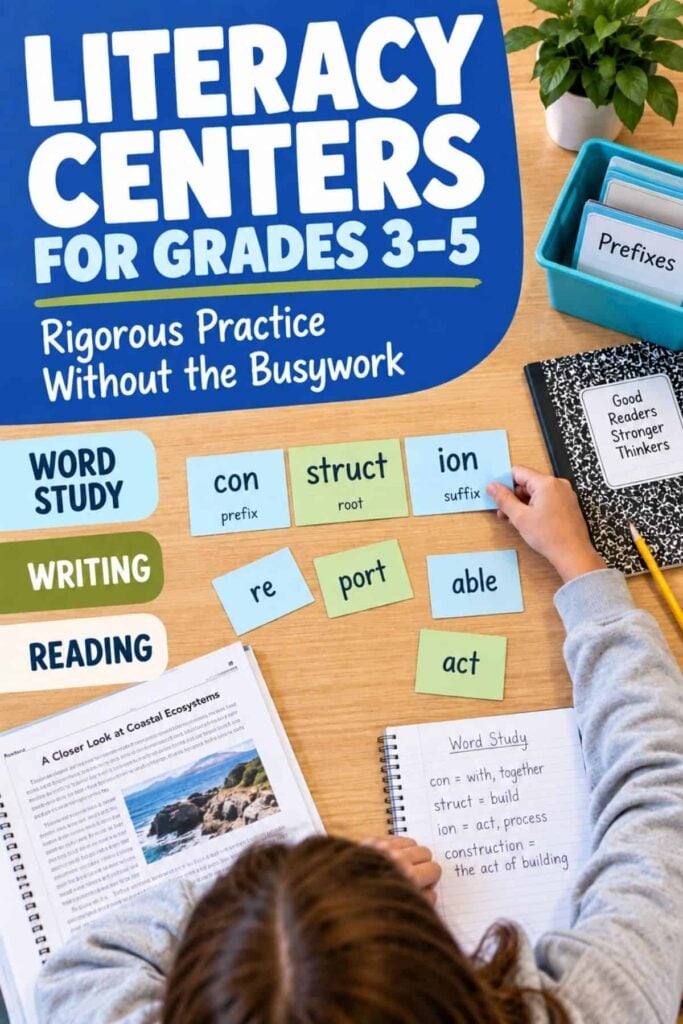
This post walks through how to set that up, which stations are worth your time, and how to keep the work rigorous instead of filler.
Why Literacy Centers for Upper Elementary Look Different
The goal of a center in kindergarten is exposure and repetition. In upper elementary, the goal is application. Your students already decode. Now they need to build vocabulary, break apart longer words, write stronger sentences, and think more deeply about text. That shifts what a good station looks like.
A strong upper elementary center has three things going for it.
- It connects to something you have already taught, so students practice rather than guess.
- It produces something you can check, whether that is a recorded answer, a written sentence, or a sorted set of words.
- You can repeat it with new content week after week, so you don’t rebuild centers from scratch every Sunday night.
When you build around those three ideas, centers stop being busywork and start pulling real weight in your literacy block.
Word Study Centers That Build Real Vocabulary
Word study is the single best fit for an upper elementary center. By third and fourth grade, students can start pulling words apart by their meaningful parts: prefixes, suffixes, and roots.
A morphology station teaches them that a word like unbreakable isn’t one thing to memorize, but three parts they can reason through. That skill compounds. Every root a student learns unlocks a whole family of words they can now attack independently.
Word study centers work well because the format stays the same while the content rotates. Once students know the routine, you can swap in a new prefix, a new set of roots, or a new group of words each week without reteaching the station.
A few that hold up across the year:
- Root and affix sorts. Students group word cards by shared root or affix, then write what the words have in common. This forces them to notice meaning, not just spelling.
- Build-a-word stations. Give students a set of prefixes, roots, and suffixes on cards and have them assemble real words, then record the meaning of each part.
- Word wall reference tasks. A morphology word wall gives students a place to check their thinking and a source for quick “find a word with this root” challenges.
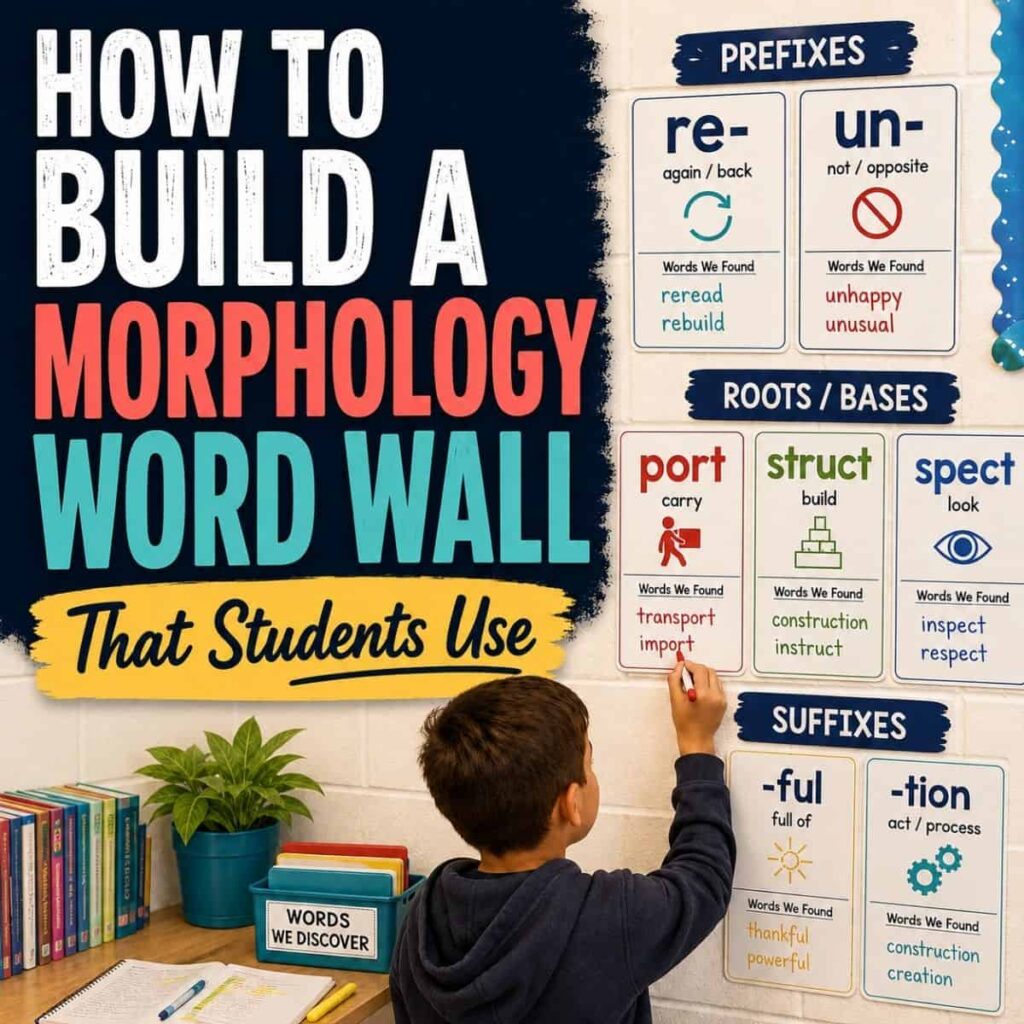
This morphology word wall set includes cards and worksheets students can use to build multisyllabic words.
- Morphology morning work carried into a center. If you use a daily word study routine, the same structure works as an independent station later in the week.
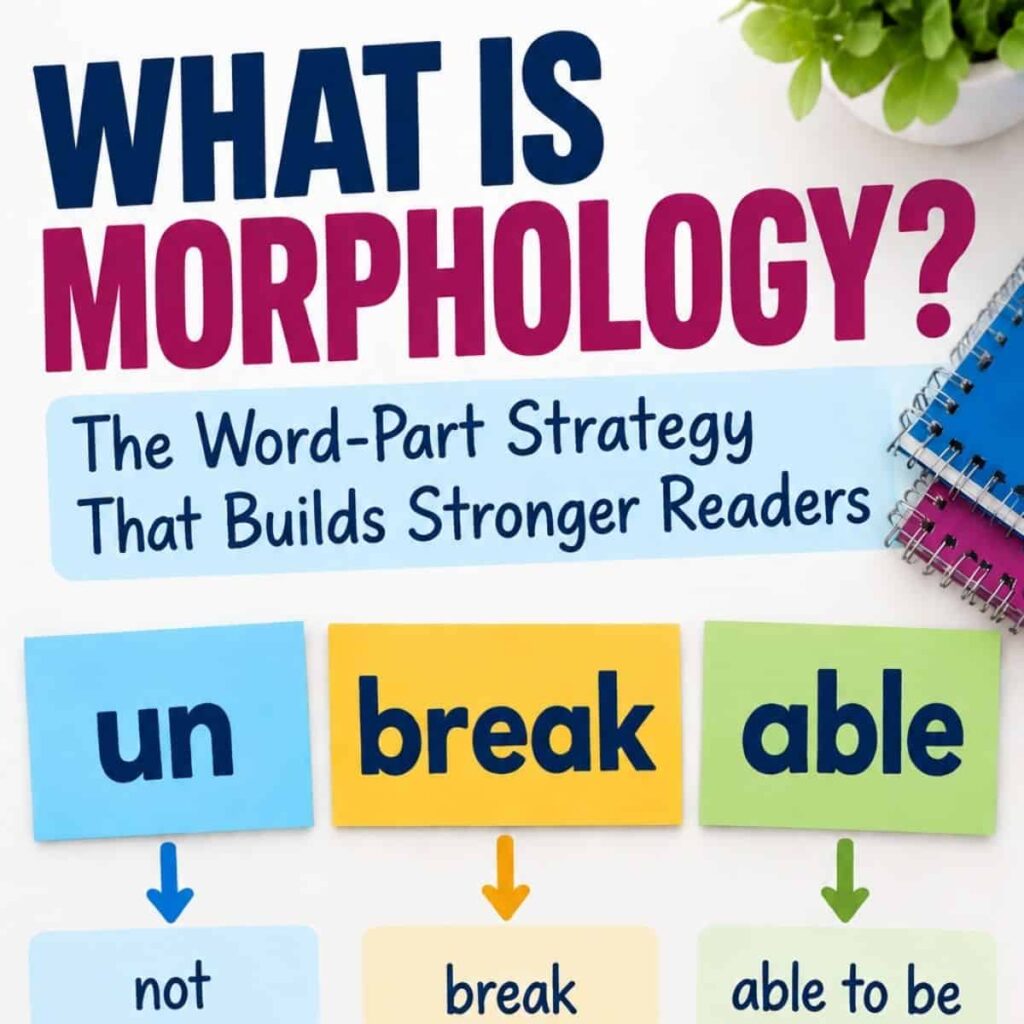
If you are new to teaching words this way, my post on what morphology is and how to teach it lays out the whole approach, and the common Latin and Greek roots post gives you a ready list to build stations around.
Writing Stations for Upper Elementary
Writing is the other place upper elementary centers earn their keep. Most students this age can write a sentence, but they default to short, flat ones, and open journal time often turns into ten minutes of staring at the page.
A good writing station fixes both problems by giving students a concrete task, whether that is tightening a sentence or responding to a prompt that actually gives them something to say. Because the work is short and self-contained, it fits a fifteen-minute rotation without feeling rushed.
The two writing stations I lean on most are a sentence station and a writing prompt station. They pull in different directions in a useful way: one sharpens the sentences students already write, and the other gets them generating ideas and writing at length.
A sentence station
Writing is the other place upper elementary centers earn their keep. Most students this age can write a sentence, but they default to short, flat ones. A sentence station gives them structured practice at expanding and combining, and because the work is short, it fits a fifteen-minute rotation without feeling rushed.
A few formats that work as independent stations:
- Sentence stretching. Students start with a bare sentence and add detail one question at a time, so they can see their sentence grow.
- Sentence combining. Give two or three choppy sentences and have students combine them into one smooth sentence. This builds the exact skill that separates fluent writers from list writers.
- Picture-prompted writing. An image gives reluctant writers something to describe, and it pairs naturally with stretching and combining tasks.
If sentence work is new to your rotation, my post on sentence combining explains why it matters and how to run it.
A writing prompt station
Where a sentence station works on craft, a writing prompt station works on volume and idea generation. The whole point of a good prompt is that it removes the “I do not know what to write about” barrier, so students can spend their center time actually writing instead of deciding. That makes prompts one of the easiest writing stations to run independently: students pull a prompt, write for the set time, and leave a response behind.
A few ways to keep a prompt station from going stale in upper elementary:
- Rotate the type of prompt. Mix narrative, opinion, and “would you rather” style prompts so students practice more than one kind of writing across the week.
- Set a length target, not just a time. Ask for a full paragraph or a certain number of sentences so students push past a one-line answer.
- Let students choose from a few. A small stack of prompts gives reluctant writers a way in without turning the station into a decision.
You do not have to write fresh prompts every week to keep this station going. I keep a running bank of writing prompts for kids that I pull from all year, and rotating a handful into the station each week is enough to keep it fresh.
Reading Stations That Go Beyond Comprehension Questions
Reading stations are the most familiar of the bunch, and also the easiest to let go stale. A stack of passages with the same five questions gets old fast, and students learn to skim for answers rather than read. Upper elementary reading stations work better when they ask students to do something with the text.
Rotate the task, not just the passage
Keep the reading material varied, but also vary what students do with it. One week they summarize in three sentences. The next they find and explain the central idea. The next they pull out unfamiliar words and use context clues to define them, which ties your reading station straight back to your word study work. Rotating the task keeps the thinking fresh even when the format stays predictable.
Build in accountability
Every reading station should leave a trace: a recording sheet, a sticky note on an anchor chart, a short written response. When students know their thinking gets seen, the quality of the work climbs. It also gives you a quick way to spot who needs a small group next.
How to Set Up and Manage Upper Elementary Centers
The stations themselves matter less than the system around them. Upper elementary students can handle real independence, but only if you teach the routine first. Spend the first week or two running centers with the expectation that students are learning how centers work, not producing perfect output. Model each station, practice the rotation, and set a clear transition signal.
Keep each station accessible and stretchable
The point of a well-built center is that the same task works for a range of readers, so you are free at your small-group table. Design each station with a floor and a ceiling.
A struggling reader might build words from a root using a word bank you provide, while a stronger student builds without the bank and then writes two sentences instead of one. A sentence station can hand one student a sentence to stretch and ask another to combine three on their own.
When the task itself flexes, you rarely need separate versions, and no student is stuck or coasting.
A few things that keep centers running without constant redirection:
- Keep rotations to three or four stations. More than that and you spend the whole block managing movement instead of teaching.
- Use the same format week to week. When only the content changes, students already know what to do, and you cut your prep dramatically.
- Make one station your small-group table. Centers exist so you can pull a group. Protect that time.
- Give every station a clear “done” and an early-finisher option. Upper elementary students move at different speeds, and a backup task prevents the wandering that derails a rotation.
If you want the research behind why word-part instruction belongs at the center of your literacy block, Reading Rockets has a solid overview of word study and morphology that is worth a read.
A Sample Weekly Literacy Center Rotation
The stations only work if they fit into a week you can actually run. A rotation keeps students moving through the same set of centers on a predictable schedule while you pull small groups. Here is a four-day rotation that covers word study, sentence writing, and reading without asking you to build something new each day. Students visit one or two stations a day and cycle through the full set by the end of the week.
- Monday: introduce the week. Teach the root, sentence skill, or reading task to the whole group, then have students start the word study station so they know the routine before they work independently.
- Tuesday: word study and sentence stations. Half the class builds and sorts words at the word study center while the other half works the sentence station, then they swap. You pull your first small group.
- Wednesday: reading station. Students work the reading task for the week, summarizing, finding the central idea, or defining unfamiliar words with context clues, and leave a recording sheet behind. You pull a second group.
- Thursday: finish and apply. Students complete any station they missed and use an early-finisher task, like building extra words from the week’s root or combining a longer set of sentences. You pull the students who need one more look.
Friday works well as a light day, whether that is a root game, a share-out, or a quick check. The exact days matter less than the pattern. Once students learn the flow, you can keep the schedule and swap in fresh content every week, which is what makes a rotation sustainable across a whole year.
Adjusting Centers for 3rd, 4th, and 5th Grade
Grades 3 through 5 can run the same stations, but the amount of independence and the length of the task should shift as students get older. Matching the demand to the grade is what keeps a center challenging without tipping into frustrating.
In third grade, model more and expect less on the page. Third graders are still learning how centers work, so keep tasks short, give a word bank or sentence frame, and practice the rotation itself for a couple of weeks before you expect smooth independence.
By fourth grade, students can handle a full station on their own and take on multi-part tasks, like building words and then sorting them by part of speech in one sitting.
In fifth grade, students can manage multi-step, multi-day work, compare and explain their thinking in writing, and take real responsibility for finishing a rotation without check-ins. The station stays the same. What changes is how much you hold and how much you hand over.
Frequently Asked Questions
Bringing It All Together
Literacy centers for upper elementary work when they respect what your students can already do. Build around word study, sentence writing, and reading with a purpose, keep the format steady so the content can rotate, and protect the small-group time centers are meant to buy you. Start with one strong station, solidify the routine, and add from there.
Looking for ready-made stations to build from? My morphology and sentence resources are designed to drop straight into an upper elementary rotation. You can find them in my TPT store.
Jessica BOschen
Jessica is a teacher, homeschool parent, and entrepreneur. She shares her passion for teaching and education on What I Have Learned. Jessica has 16 years of experience teaching elementary school and currently homeschools her two middle and high school boys. She enjoys scaffolding learning for students, focusing on helping our most challenging learners achieve success in all academic areas.