
What Is Text Structure? Types and Examples for Teachers
A student reads a two-page article about volcanoes, closes the book, and cannot tell you a single thing it said. The words were not the problem. What they missed was the text structure, the way the author organized the information on the page. Text structure is how a writer arranges ideas and information in a piece of writing, and it is one of the quietest reasons strong decoders still struggle to comprehend nonfiction. When students can recognize how a text is built, they predict what is coming, connect ideas, and remember far more of what they read.
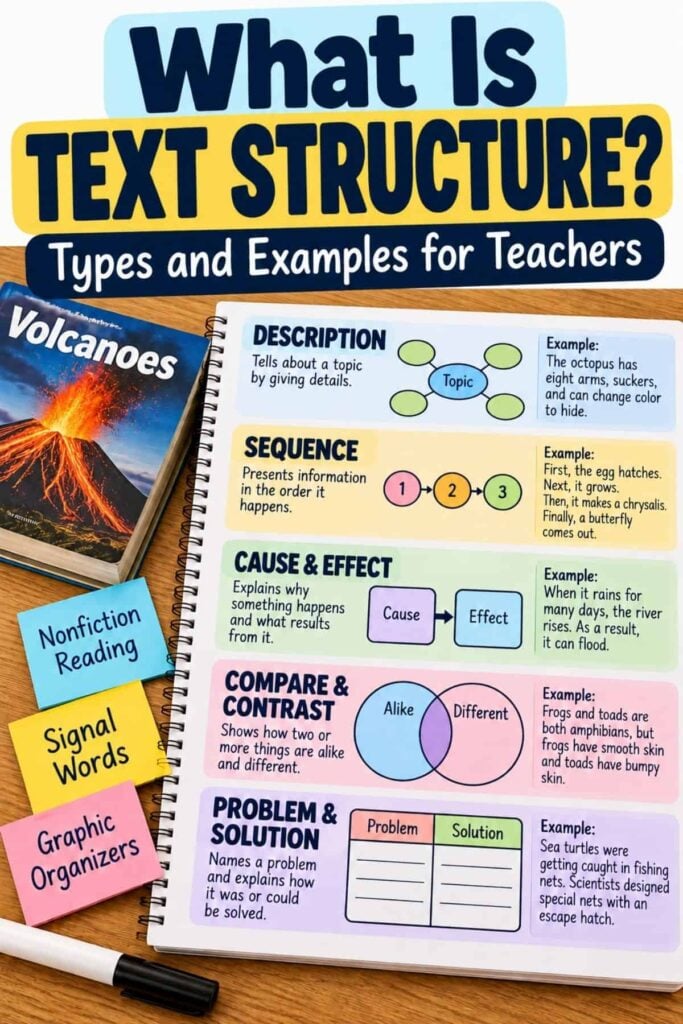
This post gives you a plain-English definition of text structure, the five main types with elementary examples, a clear way to tell it apart from text features, and simple strategies for teaching it in grades K-5.
What Is Text Structure? (And Why It Matters for Reading)
Text structure is the way an author organizes ideas and information in a piece of writing. You may also see it called textual structure, which means the same thing, just phrased a little differently. Every piece of nonfiction follows some pattern: it tells events in order, it explains why something happened, it compares two things, and so on. That pattern is the structure.
It matters because structure is a comprehension tool, not just a label. A reader who notices that an article is organized by cause and effect knows to look for reasons and results. A reader who spots a sequence knows the order of steps matters. Research on reading comprehension consistently finds that students who are taught to recognize text structure understand and recall more of what they read. It is one piece of the larger comprehension picture, which I cover in my post on how to teach reading comprehension. In other words, teaching structure is teaching students how to get more out of every nonfiction text they meet.
What Does “Text Structure” Mean? A Simple Definition for Teachers and Students
Here is a definition you can say out loud to a class: text structure is the pattern an author uses to organize their ideas, like a recipe the writer follows to put the information together. Some writers follow a “first, then, next” pattern. Others follow a “here is the problem, here is how it was solved” pattern. The pattern is the structure.
One point worth clearing up for students: text structure is not the same as how a single sentence or paragraph is built. Sentence structure is about grammar and word order within a sentence. Text structure is about how the big ideas across a whole passage or article are arranged. When you introduce the term, make that distinction explicit so students are thinking about the organization of the information, not the punctuation.
The 5 Main Types of Text Structure (With Elementary Examples)
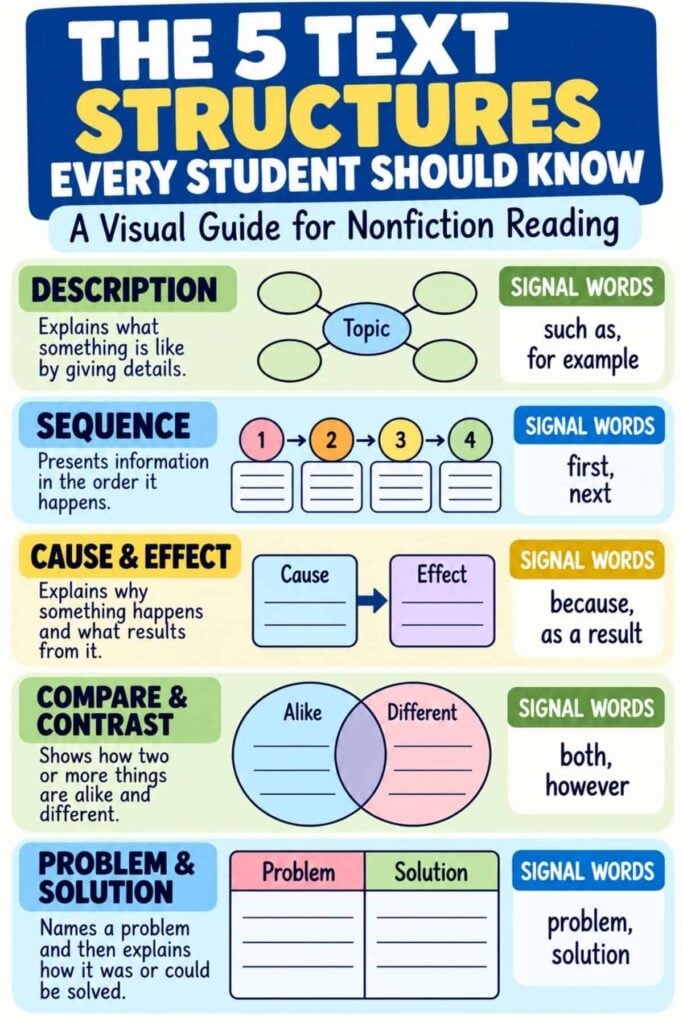
Most elementary curricula teach five core text structures. Each one has a job, and each one comes with signal words that tip readers off to the pattern. Teach students to hunt for those signal words, and they can usually name the structure on their own.
Description
A descriptive text structure explains what something is like by listing details, traits, or facts about a topic. There is no order of events, just information about one subject.
Example: “The octopus is an amazing sea animal. It has eight arms covered in suckers. It can change the color of its skin to hide, and it squirts dark ink to escape danger.”
Signal words: for example, such as, for instance, characteristics include, another feature. A simple web graphic organizer, with the topic in the center and details branching out, matches this structure well.
Sequence / Chronological Order
A sequence or chronological text structure presents information in the order it happens or in the order it should be done. Time or steps drive the organization.
Example: “First, the caterpillar hatches from a tiny egg. Next, it eats leaves and grows bigger. Then it forms a chrysalis. Finally, a butterfly comes out.”
Signal words: first, next, then, after that, finally, before, later. A flow chart or a numbered timeline graphic organizer helps students map the order.
Cause and Effect
A cause-and-effect text structure explains why something happens and what results from it. One event leads to another.
Example: “When it rains for many days, the river rises. As a result, the water can spill over the banks. Because of the flooding, people may have to leave their homes.”
Signal words: because, so, as a result, therefore, since, leads to, due to. A cause-and-effect graphic organizer with arrows from causes to effects makes the relationship visible.
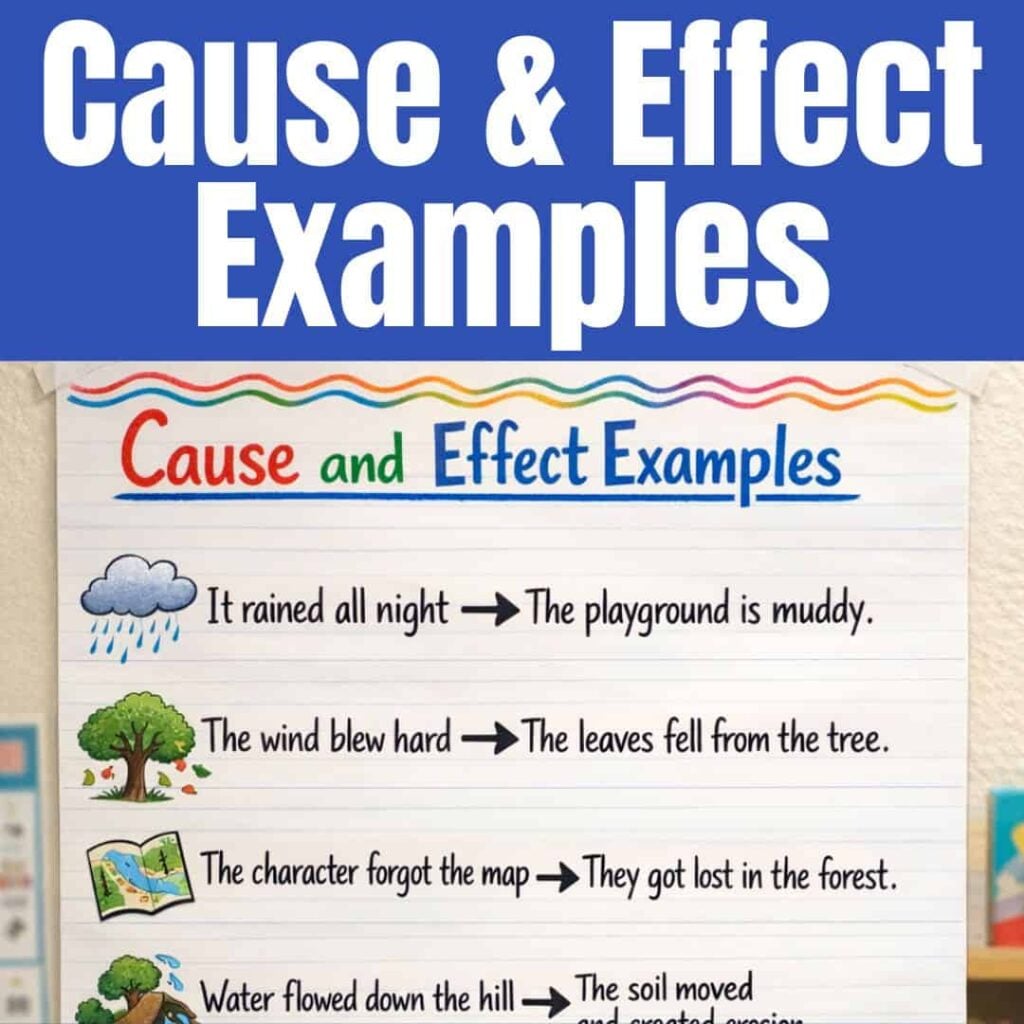
Need more cause and effect ideas? Here are examples to use in your classroom
Compare and Contrast
A compare-and-contrast text structure shows how two or more things are alike and how they differ.
Example: “Frogs and toads are both amphibians that start life in water. However, frogs have smooth, wet skin, while toads have dry, bumpy skin. Both lay eggs, but frogs usually live closer to water.”
Signal words: both, similarly, alike, however, but, in contrast, on the other hand, unlike. A Venn diagram is the classic graphic organizer here.

Problem and Solution
A problem and solution text structure names a problem and then explains how it was or could be solved.
Example: “Sea turtles were getting caught in fishing nets. To solve this problem, scientists designed special nets with an escape hatch. As a result, more turtles can swim free.”
Signal words: problem, issue, so, in order to, solution, solved by, one answer is. A two-column or T-chart graphic organizer, problem on one side and solution on the other, fits this structure.
How Many Text Structures Are There? (5, 6, or 7?)
This is where teachers get tripped up, because the number depends on who is counting. Most elementary programs teach the five structures above. Some curricula list six or seven by splitting or adding categories. You might see “description” broken into a separate “listing” or “enumeration” structure, or a “definition” or “sequence vs. chronological” split that pushes the total to six or seven.
So if your curriculum guide says there are seven text structures and the chart next door says five, neither is wrong. They are grouping the same ideas differently. No single universal number of text structures exists. For elementary students, the five core types cover nearly everything they will read, and starting there keeps it manageable. If your program adds a sixth or seventh, you can fold it in once students are comfortable with the main five.
Text Structure vs. Text Features: What’s the Difference?
These two terms get mixed up constantly, and the difference is worth clarifying. Text features are the visual and organizational tools on the page: headings, captions, bold words, diagrams, labels, maps, the table of contents, and the glossary. Text structure is the underlying pattern of the ideas themselves, the sequence or cause and effect or comparison that organizes the information.
Here is one side-by-side example. Picture a page about sharks with a labeled diagram of a shark’s body. That labeled diagram is a text feature, a tool that helps you find and understand information. The way the writing itself is organized, listing facts about what sharks are like, is the text structure, in this case, description. Features are what you see; structure is how the ideas are arranged.
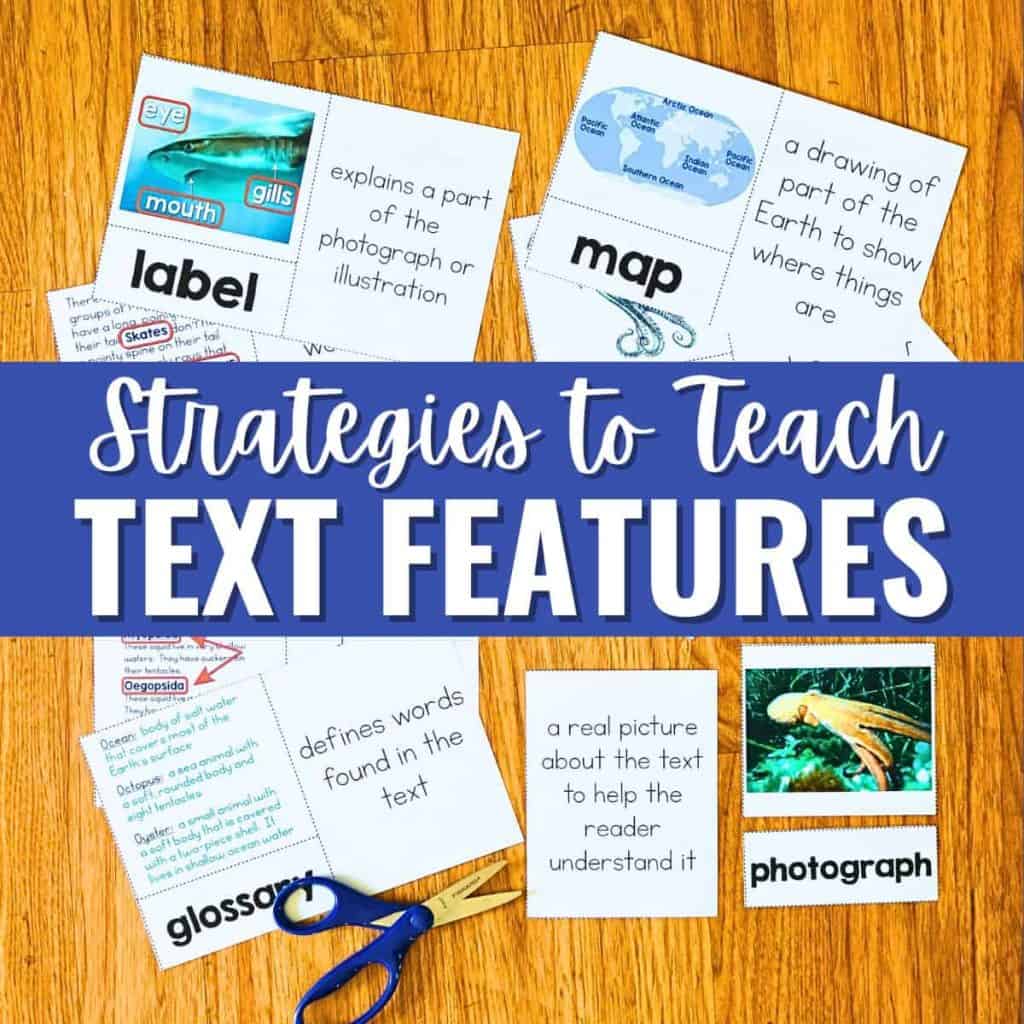
If you came here looking specifically for the visual tools, my post on text features covers those in depth.
How to Teach Text Structure in Elementary Grades
Text structure is easiest to teach one pattern at a time, with real text in front of students. Introducing all five at once usually blurs them together. A sequence that works well across grades looks like this.
Use anchor charts and signal word lists
Start with one structure and a short mentor text that clearly follows it. Read it together, then build a class anchor chart that names the structure and lists its signal words. Keep the chart up and add student examples as you find them. Pairing the chart with a few sentence frames gives students a way to talk about what they notice, like “This text is organized by ___ because the author uses the word ___.” My post on sentence stems and sentence frames has more ready-to-use options. Over time, students start spotting the signal words on their own, which is the whole goal.
Practice with graphic organizers
Each structure has a graphic organizer that matches its shape: a web for description, a flow chart for sequence, arrows for cause and effect, a Venn diagram for compare and contrast, and a two-column chart for problem and solution. Having students fill in the matching organizer after reading forces them to see the pattern, not just read the words. Match the organizer to the structure so the visual reinforces the thinking.
Connect structure to students’ own writing
Students understand a structure best when they write one. After reading several cause-and-effect texts, have them write a short cause-and-effect paragraph of their own. Reading and writing the same structure back-to-back locks it in. This connects naturally to informational writing, where organizing facts into a clear pattern is the whole task.

My post on organizing facts in informational writing is a good next step.
FAQ: Quick Answers About Text Structure
Helping Students See the Pattern in Nonfiction
Once students can name a text’s structure, comprehension improves because they know what to expect and where the important ideas will sit. You do not have to teach all five structures at once. Pick one to introduce this month, build an anchor chart of its signal words, and give students a matching graphic organizer and a chance to write one themselves. For a deeper look at how to reinforce comprehension, Reading Rockets has a helpful overview of teaching text structure. Teach students to see the pattern, and nonfiction stops being a wall of facts and starts making sense.
Jessica BOschen
Jessica is a teacher, homeschool parent, and entrepreneur. She shares her passion for teaching and education on What I Have Learned. Jessica has 16 years of experience teaching elementary school and currently homeschools her two middle and high school boys. She enjoys scaffolding learning for students, focusing on helping our most challenging learners achieve success in all academic areas.