
Compare and Contrast Examples for Students: Sentences, Paragraphs, and Essays
Compare and contrast examples for students show what this type of writing actually looks like in practice. Understanding the skill is one thing; seeing a finished sentence, paragraph, or essay makes the expectation much clearer.
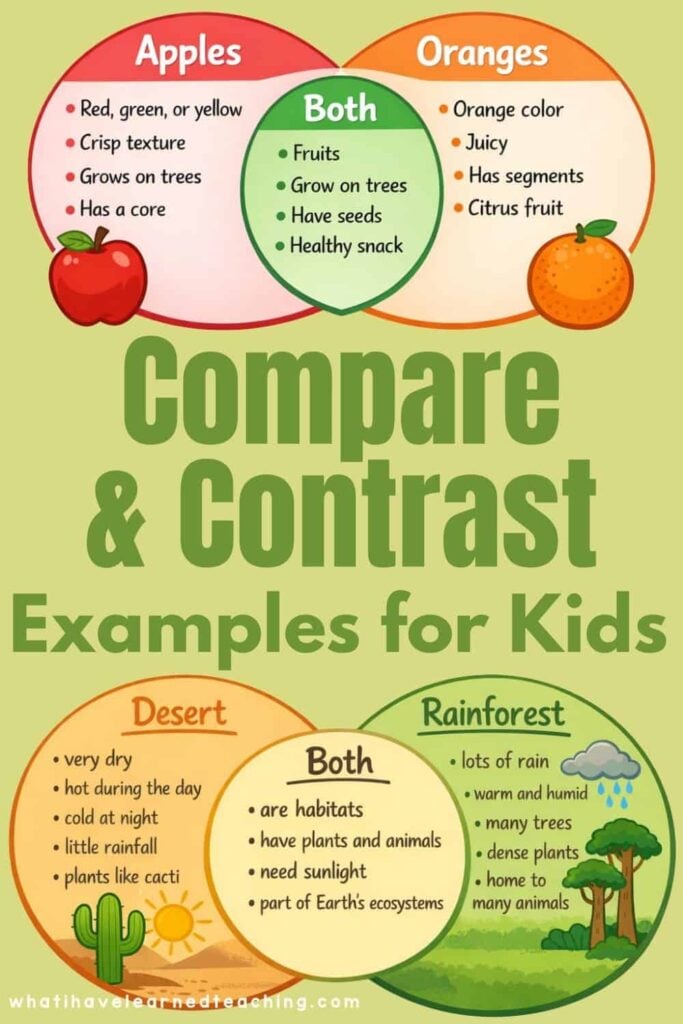
This post includes simple compare and contrast sentences, short paragraph models, and essay examples that students can study before writing their own. Examples are organized from simple to complex so you can meet students where they are.
If you are looking for sentence starters and frames to scaffold student writing, see compare and contrast sentence starters.
If you’re working with second or third graders and want grade-level practice ready to go, check out my compare and contrast activities for 2nd and 3rd grade for worksheets and lesson plans you can use right away.
What Are Compare and Contrast Examples?
Compare and contrast examples show students how to explain similarities and differences between two or more things.
These examples can include:
- Simple sentences
- Short paragraphs
- Full written responses
- Visual comparisons
Students need to see multiple examples before they can independently apply the skill.
If you’re just starting, you may want to read more about how to teach the skill step-by-step in this post on teaching compare and contrast.
Compare and Contrast Examples for Kids
When introducing the skill, start with familiar, concrete topics. These are easier for students to describe and discuss.
Simple Compare and Contrast Examples
Here are some simple compare and contrast examples for kids:
- Cats and dogs are both animals, but dogs are usually more social than cats.
- An apple and an orange are both fruits, but an orange has a peel and segments.
- A pencil and a marker are both used for writing, but a pencil can be erased.
- Soccer and basketball are both sports, but they use different types of balls.
These examples help students hear what comparison language sounds like before they try it themselves.
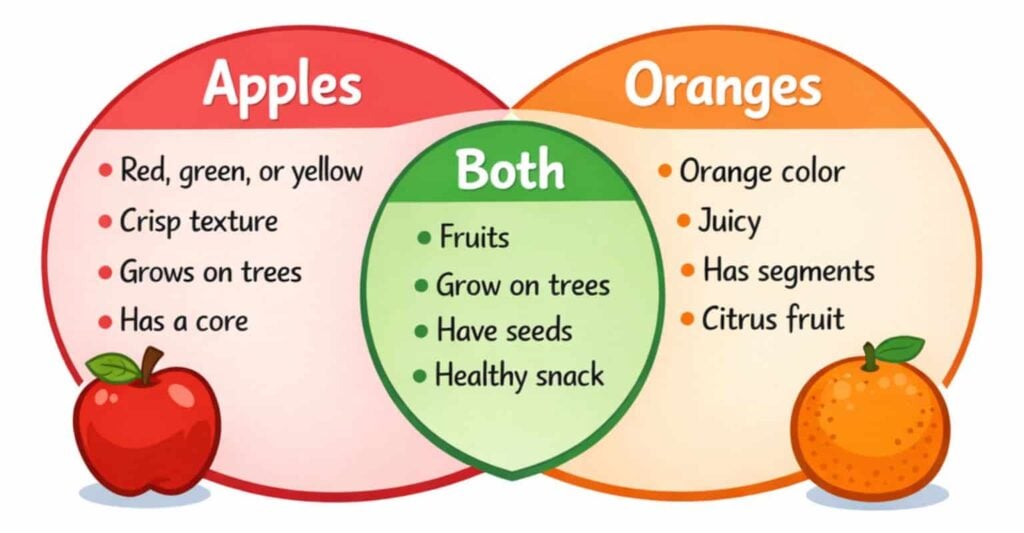
Compare and Contrast Sentence Examples
Students often need support in forming complete sentences. These compare and contrast example sentences can be used as models or practice.
Simple Sentences
- Both dogs and cats make good pets, but dogs need more daily exercise.
- An apple and an orange are both fruits, but an orange has a peel and segments.
- Soccer and basketball are both team sports, but they use different types of balls.
Expanded Sentences
- Although frogs and toads look similar, toads have drier, bumpier skin and live mostly on land.
- The sun and the moon are similar because both appear in the sky, but only the sun produces its own light.
- One difference between a city and a suburb is that cities have taller buildings and more public transportation.
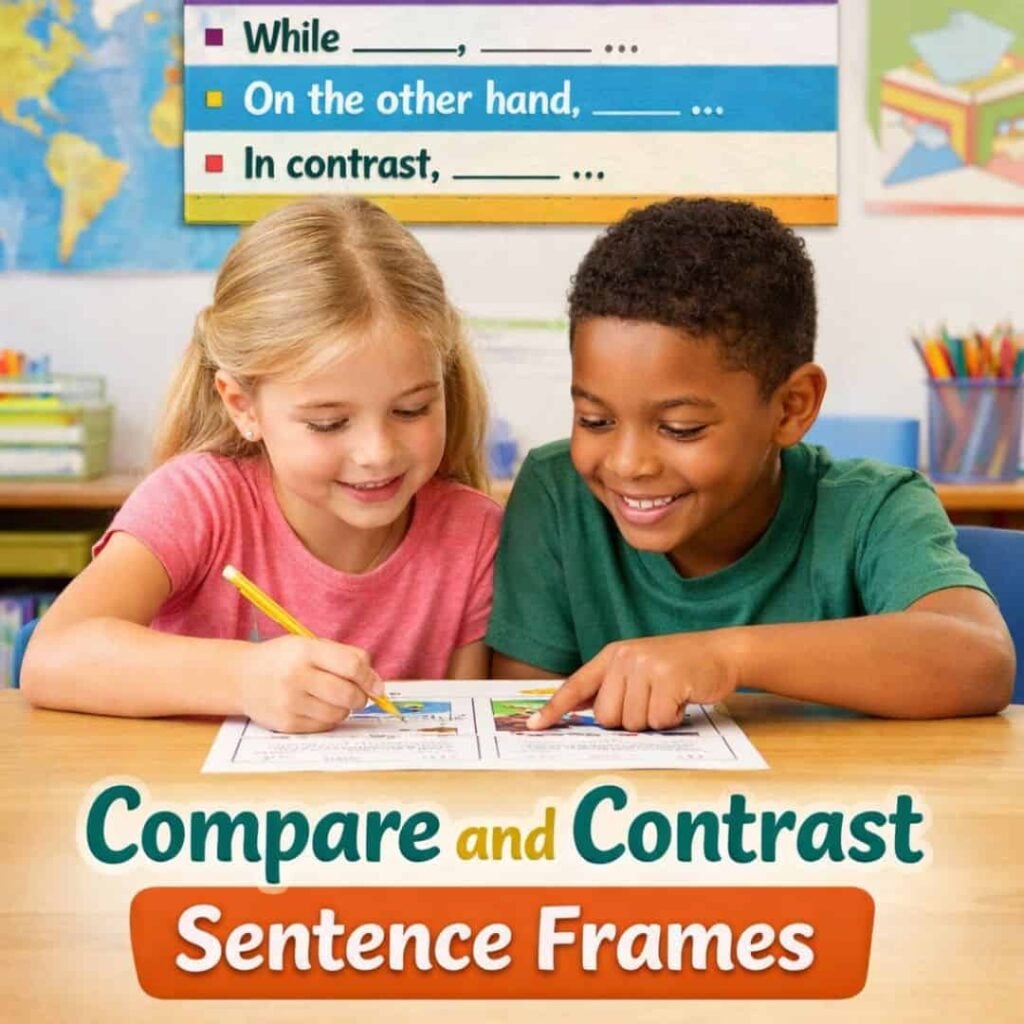
You can find even more structured support in this post on compare and contrast sentence starters.
Keep the Content Simple When Teaching Academic Language
When students are learning compare and contrast, they are not just learning a new skill; they are also learning new academic language. That adds an extra layer of challenge.
Because of this, it helps to keep the topic or content simple at first. When students are working on sentence structure, you don’t want them to also struggle to understand the topic.
For example, it’s much easier for students to compare:
- cats and dogs
- apples and oranges
- pencils and markers
These familiar topics allow students to focus on how to say the comparison, not what they are comparing.
Once students are comfortable using sentence frames and sentence starters like:
- Both ___ and ___…
- ___ has ___, but ___ has ___
- One difference between ___ and ___ is ___
Then you can begin to introduce more complex content, such as:
- characters in a story
- different habitats
- historical events
- scientific concepts
This gradual shift helps students build confidence and accuracy. They first learn the structure of compare and contrast, then apply it to more challenging topics.
When students try to learn both new content and new sentence structures at the same time, they often become overwhelmed. Keeping one part simple allows them to be successful with the other.
Compare and Contrast Paragraph Examples
Once students are comfortable with sentences, they can move into short paragraphs.
Here is a basic compare and contrast paragraph example:
Example Paragraph (2nd–3rd Grade)
Cats and dogs are both popular pets. They both have fur and need food and water to live. However, dogs usually need more attention and exercise than cats. Cats are often more independent and can stay home alone more easily. Even though they are different, both animals can make great pets.
This type of paragraph helps students:
- Combine similarities and differences
- Use transition words
- Organize their thinking
Example Paragraph (4th–5th Grade)
Deserts and rainforests are two very different biomes. Both receive sunlight and support diverse forms of life, but the amount of water in each habitat shapes everything else. Deserts receive very little rainfall each year and are home to plants and animals that store or conserve water, such as cacti and camels. Rainforests, in contrast, receive heavy rainfall and support dense vegetation and a wide variety of animal species. Although both biomes can be found near the equator, the conditions for survival in each are very different.
Compare and Contrast Examples for Students (Across Subjects)
Students should practice comparing and contrasting in different subjects so they can transfer the skill.
Reading
- Compare two characters in a story
- Compare two versions of the same folktale
Science
- Compare habitats (desert vs. forest)
- Compare states of matter
Social Studies
- Compare two communities
- Compare past and present life
Math
- Compare two strategies for solving a problem
- Compare shapes or numbers
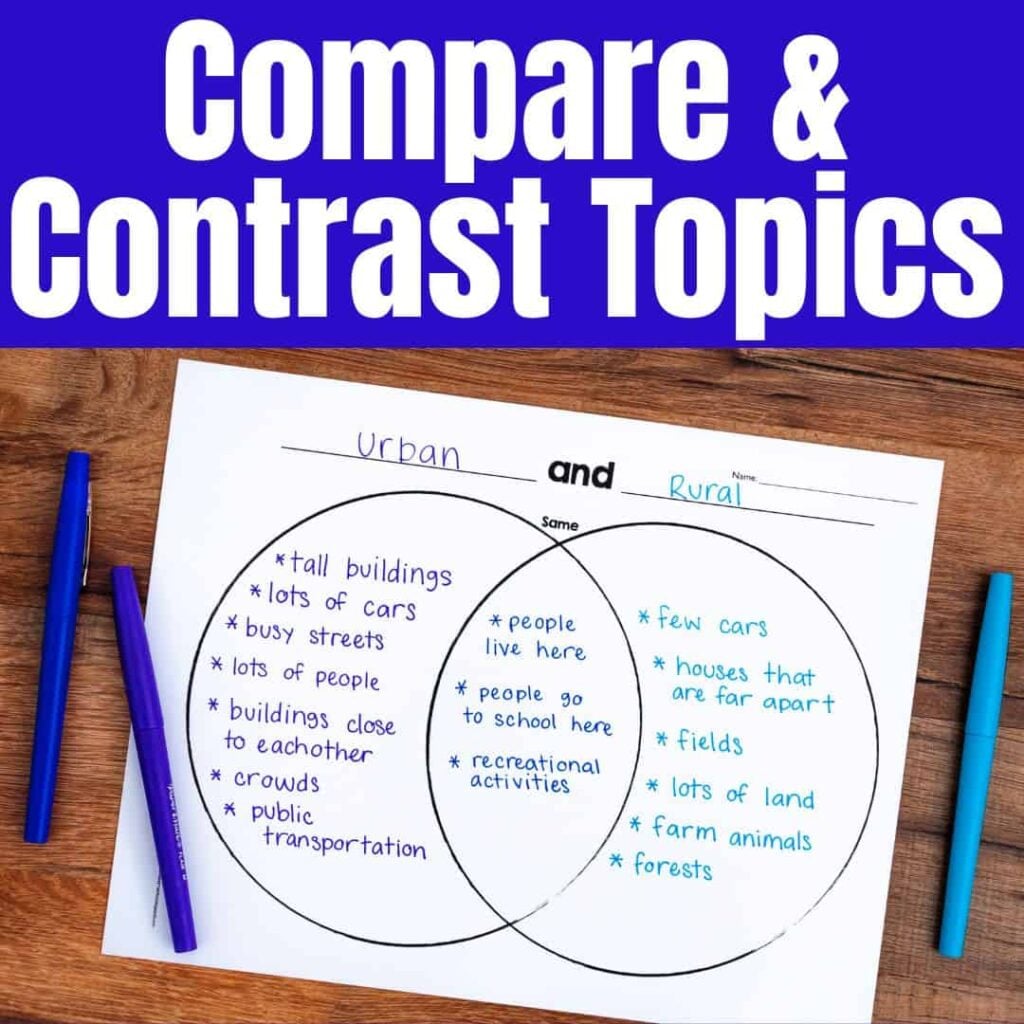
Need more ideas to teach compare and contast? Take a look at these ideas.
Compare and Contrast Essay Examples (Upper Elementary)
As students progress, they move from paragraphs to longer responses.
A simple structure includes:
- Introduction
- Similarities
- Differences
- Conclusion
Short Essay Example (Simplified)
Dogs and cats are both common household pets, but they have several differences. Both animals need care, food, and shelter. However, dogs often require more attention and daily exercise, while cats are more independent. Dogs are usually more social, while cats tend to be quieter. In conclusion, both pets can be great companions, depending on a person’s lifestyle.
Compare and Contrast Examples Using Pictures
Visual comparisons are powerful, especially for younger students and English learners.
Using pictures:
- Reduces language barriers
- Builds observation skills
- Supports discussion before writing
You can show two images and ask:
- What is the same?
- What is different?
Then guide students into writing sentences.
Compare and Contrast Words and Phrases
Students need the right language to explain their thinking.
Common compare and contrast words include:
- both
- similar
- alike
- different
- however
- on the other hand
Teaching these words alongside examples helps students write more complete responses.
Helping Students Move from Examples to Writing
Examples are only helpful if students can apply them.
To support students:
- Start with oral discussion
- Use graphic organizers
- Provide sentence frames
- Gradually release responsibility
If you need topic ideas, this list of compare and contrast topics can help you plan lessons.
You can also pair this with mentor texts using these books for compare and contrast.
Building Strong Compare and Contrast Skills Over Time
Students don’t master compare and contrast in a single lesson. It develops over time with repeated exposure, practice, and support.
When students see strong examples, practice with guidance, and apply the skill across subjects, they begin to use comparison naturally in their thinking and writing.
And once that happens, you’ll start to see clearer explanations, stronger writing, and deeper understanding in everything they do.
Jessica BOschen
Jessica is a teacher, homeschool parent, and entrepreneur. She shares her passion for teaching and education on What I Have Learned. Jessica has 16 years of experience teaching elementary school and currently homeschools her two middle and high school boys. She enjoys scaffolding learning for students, focusing on helping our most challenging learners achieve success in all academic areas.