
Sentence Frames for Science: Teaching Academic Language with Familiar Content
When students struggle to talk about science content, the problem often isn’t the concept — it’s the language. Sentence frames for science give students a structure for practicing academic language patterns before they’re expected to use them with unfamiliar vocabulary. Teach the sentence frame using something students already know, then bring in the science content once the language itself isn’t the obstacle.

A student who can say “While a snail goes across a sidewalk slowly, a bird flies off a branch quickly” already knows the sentence structure they need to compare slow and fast changes to Earth’s surface. The grammar is learned. The complexity is learned. Only the vocabulary changes, and that’s a much smaller leap to ask students to make.
This post walks through how that approach works in practice using a second-grade Earth science unit on processes that shape the Earth. The example focuses on compare and contrast, but the same structure applies to cause and effect, sequence, and main idea with details.
Four Comprehension Skills, One Consistent Approach
Four comprehension skills show up in science content again and again: compare and contrast, cause and effect, sequence of events, and main idea with details. Students who can speak and write within these frameworks can handle most of what science asks of them academically.
The challenge is that students often try to learn these language patterns at the same time they’re learning new science content. When both the vocabulary and the sentence structure are unfamiliar, students hit a wall. Separating the two — learning the sentence frame first with familiar content, then applying it to science vocabulary — lets students build real fluency with the language before the content complexity increases.
Start with What Students Already Know
In this lesson, the goal was for students to eventually compare and contrast slow and fast changes to Earth’s surface: things like weathering, erosion, and volcanic eruptions. Before any of that came into the lesson, the class started with something every student could access immediately: everyday actions.
Does a snail going across a sidewalk happen slowly or quickly? Does popcorn popping happen slowly or quickly? These aren’t science questions — students already know the answers. That’s the whole point. When the content is familiar, students can put all of their attention on the sentence structure.
Sort the Actions
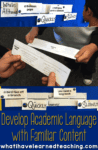
The first step was a whole-class sort using a pocket chart. Action cards — a snail goes across a sidewalk, a balloon pops, a plant grows a new leaf, lightning flashes, a bird flies off a branch, popcorn pops, you walk a mile, your dad blows up a balloon — went into “Slowly” or “Quickly” columns. Students already understood every one of those actions. The sort moved quickly because understanding the concept wasn’t the challenge. That’s exactly where you want to be before introducing a new sentence frame.

Fill in the Sentence Frames
With the sort in place, the first sentence frame went up: “___ ___, but ___ ___.” Along with the frame, academic connectors like “however,” “while,” and “although” were displayed as options for building different versions of the same comparison.
Students practiced filling in the blanks using the sorted action cards and the connectors. “A snail goes across a sidewalk slowly, but a balloon pops quickly.” “While lightning flashes quickly, a plant grows a new leaf slowly.” The whole class said each sentence together after each example.
After several whole-class rounds, student volunteers came up to the board to build sentences themselves while the class repeated each one aloud. The choral practice isn’t just for participation — students who aren’t yet confident speaking independently still get full exposure to the sentence pattern, and the repetition builds the kind of familiarity that makes the frame feel natural rather than forced.


Practice with a Partner
After whole-class practice, students moved to partner work using sentence construction strips — long printed strips with the sentence frame on one side and all the word choices (slow actions, fast actions, connectors) printed alongside. Having the frame and words written out removes the mental work of remembering them, so students can focus entirely on building and saying the sentence.
Because there are multiple ways to build the same comparison (you can name the slowly action or the quickly action first, and you can use “but,” “however,” “while,” or “although”), partners swap strips so each person practices different combinations. A few minutes of partner practice gives every student far more speaking repetitions than a whole-class discussion alone.


Individual Practice
Once partner practice wraps up, students complete an individual cut-and-sort activity. They cut action cards from the bottom of the worksheet, sort them into the “Slowly” and “Quickly” columns, and use the linking words to write complete comparison sentences in the spaces provided.
This is the first time students work entirely on their own, but by this point they’ve heard and said the sentence structure enough times that the frame is already familiar. The worksheet confirms what they’ve learned rather than asking them to figure it out from scratch.

Follow-up Partner Practice
As students finish, they partner up and practice again using their completed worksheets. Not everyone reaches this step in a single lesson, and that’s fine — the materials carry over to the next day naturally. Students who finish early get additional oral practice, and the worksheets become a ready-made tool for a quick warm-up the next session.

Now Make the Transfer to Science Vocabulary
Here’s where the lesson pays off. Once students are comfortable with the sentence structure using everyday actions, you swap in the science vocabulary.
Instead of sorting everyday slow and fast actions, students now sort slow and fast changes to Earth’s surface. Instead of saying “While a snail goes across a sidewalk slowly, lightning flashes quickly,” they say “While weathering slowly breaks down rock, a volcanic eruption can change the land quickly.” The connectors are the same. The sentence structure is the same. The only new information is the science content — which is exactly where you want students’ attention.
This transfer is the whole point of the sequence. Students who go straight to the science vocabulary have to learn the academic language and the content simultaneously. Some students can manage that. Many cannot. The familiar-content step doesn’t lower expectations; it removes the language barrier so students can actually engage with the science.
Using This Structure Across All Four Skills
Compare and contrast is one starting point. The same familiar-to-academic sequence works for cause and effect (“Because I left my water bottle in the sun, it got warm” → “Because of heavy rainfall, rivers carry more sediment”), sequence (“First I wake up, then I eat breakfast, finally I leave for school” → “First, rock is broken apart. Then, water carries the pieces away.”), and main idea with details.
In each case, the process is identical: introduce the sentence frame using something students already know, practice until the structure feels automatic, then bring in the academic vocabulary. Teachers who use this approach consistently find that students begin reaching for the frames independently once they’ve had enough practice with them.
Even a ten-minute warm-up using a quick sort and two or three sentence frames is enough preparation before students are expected to write or discuss science content on their own. It doesn’t require a separate lesson block — it works as the opening of a science lesson, front-loading the language students will need.
The Earth Science Resource
The lesson sequence in this post comes from the Processes that Shape the Earth: Earth’s Systems unit, designed for second grade. The unit builds all four comprehension skills — compare and contrast, cause and effect, sequence, and main idea with details — using the same familiar-to-academic structure described above. Each section includes sentence frames and sentence construction practice before students are asked to apply the language to new science content.
The unit is available on the website store and on TPT.
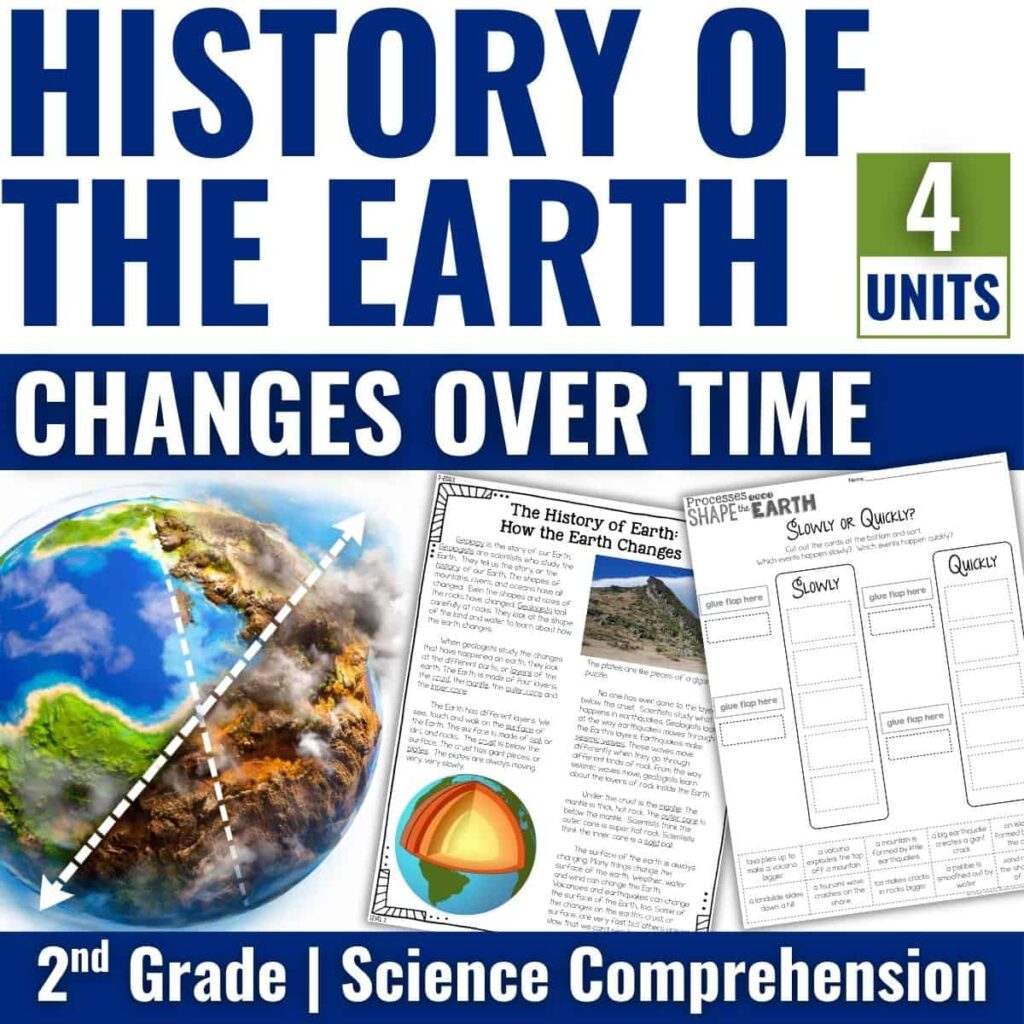
Processes that Shape the Earth – Earth’s Systems
An Earth Science / Earth’s Systems Unit that addresses the second grade Next Generation Science Standards. It focuses on processes that change the Earth’s surface and includes four units.
For more earth science teaching ideas, browse posts organized by standard in the 2nd-5th Grade Earth Science Guide, or read about using sentence frames for teaching cause and effect with soil erosion.
Starting with familiar content isn’t a shortcut. It’s a way of making sure students can concentrate on what you’re actually teaching. Once the language is in place, the science content has room to land.
Jessica BOschen
Jessica is a teacher, homeschool parent, and entrepreneur. She shares her passion for teaching and education on What I Have Learned. Jessica has 16 years of experience teaching elementary school and currently homeschools her two middle and high school boys. She enjoys scaffolding learning for students, focusing on helping our most challenging learners achieve success in all academic areas.