
Compare and Contrast 2nd Grade and 3rd Grade Activities, Worksheets, and Lesson Plans
Teaching students how to compare and contrast in 2nd grade and 3rd grade is one of those skills that shows up everywhere, from reading comprehension to science discussions and even math problem solving. When students learn to identify similarities and differences, they begin to organize their thinking in a much clearer way.
The tricky part is helping students move from simply noticing differences to actually explaining them. That’s where structured activities, sentence frames, and targeted practice come in. With the right support, students can build strong compare and contrast skills that carry into all subject areas.
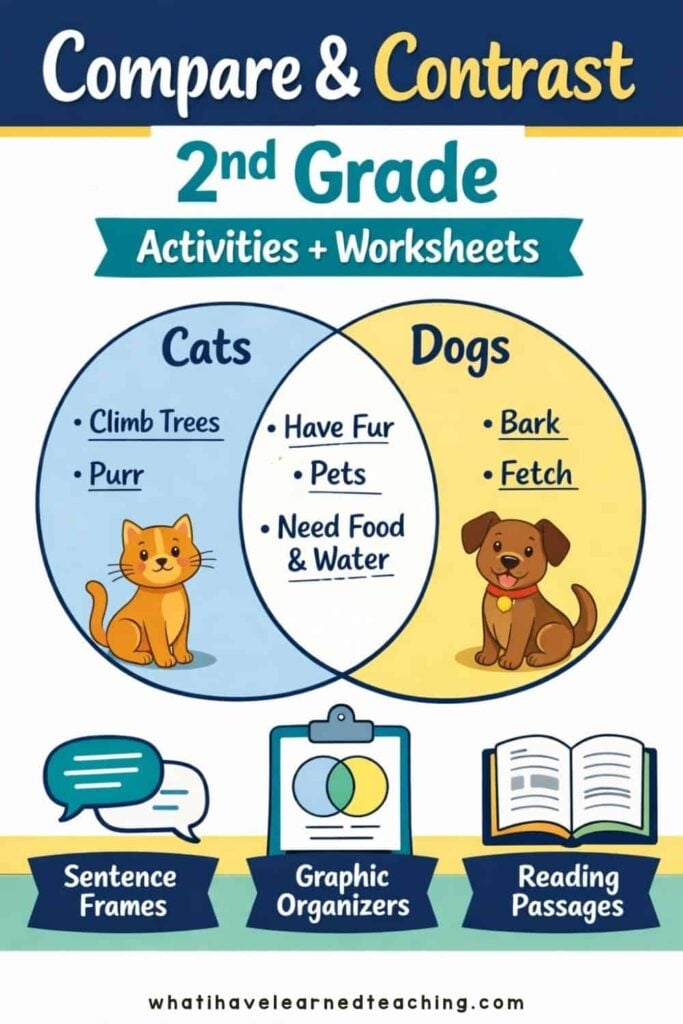
If you’re looking for compare and contrast 2nd grade worksheets, activities, and lesson plans, this post will walk you through what students need and how to teach compare and contrast effectively, plus a ready-to-use unit that saves you a ton of planning time.
What Does Compare and Contrast Look Like in 2nd and 3rd Grade?
In 2nd grade, students are just beginning to compare familiar topics. You’ll often see:
- Comparing two animals
- Comparing two objects (like a pencil and a marker)
- Using simple sentence frames
- Completing Venn diagrams
By 3rd grade, students take it a step further:
- Comparing characters, settings, or themes
- Writing paragraphs explaining similarities and differences
- Using more complex language, like while, however, and in contrast
- Applying the skill across subjects
This progression means students need consistent practice with both structure and language.
Why Students Need Explicit Compare and Contrast Instruction
Many students can tell you what’s different, but can’t always explain it clearly in writing.
That’s where instruction matters.
Students benefit from:
- Direct modeling
- Repeated practice with similar formats
- Sentence frames to support language
- Graphic organizers to organize thinking
Without those supports, compare and contrast turns into a guessing game… or a lot of “they are different because they are different.”
Compare and Contrast Activities for 2nd Grade and 3rd Grade
If you’re planning compare and contrast activities for 2nd grade or 3rd grade, start simple and build up.
Simple Activities
- Compare two classroom objects
- Sort pictures into “same” and “different.”
- Use oral discussion before writing
Intermediate Activities
- Compare two animals or topics students already know
- Fill in sentence frames
- Complete guided Venn diagrams
More Advanced Activities
- Compare two texts
- Write paragraphs using sentence starters
- Explain similarities and differences with evidence
The key is moving from spoken ideas → structured writing → independent application.

Compare and Contrast Worksheets for 2nd Grade
Worksheets work best when they follow a clear progression.
Effective compare and contrast 2nd grade worksheets include:
- Visual supports (pictures or diagrams)
- Sentence frames
- Partially completed examples
- Space for both similarities and differences
For 3rd grade, worksheets should shift toward:
- Less scaffolding
- More writing
- Open-ended responses

Compare and Contrast Lesson Plan You Can Use With Any Text
One of the most helpful parts of this compare and contrast unit is that it includes a structured lesson plan you can use over and over again with different texts or topics.
Instead of creating new lessons each time, you can follow the same routine while changing the content, making it easier for students to focus on the skill rather than learning a new structure.
The lesson progression in this unit walks students through:
Introduce the Skill
Students begin by comparing familiar objects or simple topics. The focus is on understanding what it means to find similarities and differences, often using visuals and discussion.
Guided Practice with Support
Students use sentence frames and graphic organizers to compare shared topics. This step provides the language support students need to explain their thinking clearly.
Independent Practice
Students apply what they’ve learned using worksheets and structured activities. They begin writing their own comparisons with less support.
Apply the Skill to New Texts
Once students understand the structure, they can repeat the process with any text, topic, or subject area. This makes the lesson routine flexible and easy to use throughout the year.
Because the structure stays consistent, students build confidence and independence each time they practice. Teachers can reuse the same lesson plan with new reading passages, science topics, or social studies content—without starting from scratch.

Compare and Contrast Paragraphs & Reading Passages, Comprehension Activities for Academic Language
Help students master the academic language of comparing and contrasting with this unit that enhances reading comprehension by comparing and contrasting topics through differentiated texts and sentence frames.
Compare and Contrast Unit for 2nd and 3rd Grade
If you want everything planned out for you, this Compare and Contrast Unit for 2nd and 3rd Grade pulls all of these pieces together.
This unit includes:
- Compare and contrast worksheets for 2nd grade and 3rd grade
- Structured activities that build from simple to more complex
- Venn diagrams and graphic organizers
- Sentence frames to support writing
- Reading passages designed for comparison
- Flexible options for small groups, whole group, or centers
Teachers love that it’s easy to implement and keeps students engaged while building real understanding.
You can use it for:
- Literacy centers
- Small group instruction
- Whole group lessons
- Independent practice
If you’re piecing together lessons right now, this gives you a complete set of compare and contrast lesson plans and activities in one place.

Building Strong Compare and Contrast Skills in Elementary Students
Teaching compare and contrast in 2nd and 3rd grade is about more than just filling out a Venn diagram. It’s about helping students organize their thinking, explain their ideas, and make connections across subjects.
With clear modeling, structured activities, and the right scaffolds, students can move from simple observations to meaningful comparisons.
And once they get it, you’ll start hearing those comparisons pop up everywhere—during discussions, in writing, and even in those random side conversations you weren’t planning for.
That’s when you know it’s stuck.
Compare and Contrast Paragraphs & Reading Passages, Comprehension Activities for Academic Language
Help students master the academic language of comparing and contrasting with this unit that enhances reading comprehension by comparing and contrasting topics through differentiated texts and sentence frames.
Jessica BOschen
Jessica is a teacher, homeschool parent, and entrepreneur. She shares her passion for teaching and education on What I Have Learned. Jessica has 16 years of experience teaching elementary school and currently homeschools her two middle and high school boys. She enjoys scaffolding learning for students, focusing on helping our most challenging learners achieve success in all academic areas.