
Plant and Animal Life Cycle Science Stations for 3rd Grade
Teaching life science, especially biology, inside an elementary classroom can be challenging. Do you ever just want to take your class outside? Is it hard to explain the life cycles of animals that your students have never encountered? Science lessons also take a lot of planning, on top of the other core subjects you need to teach. Life cycles are one piece of the bigger picture in elementary life science. They connect directly to inheritance, ecosystems, and the structure and function of organisms.

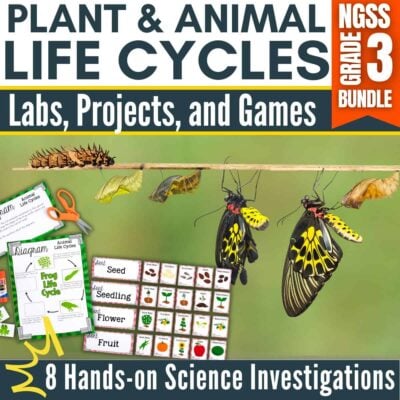
I created a set of science stations to address these needs. The science stations include a combination of games, task cards, interactive videos, dissections, worksheets, and more to engage students in learning about the growth and development of organisms that have unique and diverse life cycles.
For a deeper look at the plant side of that comparison — including how the stages work and what to teach at each grade level. My guide to plant life cycle stages covers the full cycle from 2nd through 5th grade.

Life Cycles: Plants and Animals Third Grade Science Stations
The focus is on NGSS 3-LS1.B and include concepts such as animal life cycles, plant life cycles, and parts of a plant.
An In-Depth Look at the Plant and Animal Life Cycle Science Stations
Below are details about each Plant and Animal Life Cycle Science Station, which address NGSS 3-LS1.B and include concepts such as animal life cycles, plant life cycles, and parts of a plant.
Vocabulary Cards
The colorful vocabulary cards are large and can be used as flashcards or on a bulletin board in your room.
They come in two sets. The first set includes illustrations, the word, and the definition. The second set includes only the word (printed extra large and bold for fast recognition) and the definition. The vocabulary includes plant and animal life cycles, such as egg, larva, pollinate, leaf, cocoon, and metamorphosis.

Differentiated Responses
Each station includes four different ways to respond to the experience at the station:
- short answer questions
- fill-in the blank questions
- task cards with short answers
- task cards with multiple choice
All variations are similar, but require different levels of independence. Fill-in-the-blank is the easiest and works well for students who struggle with reading, especially if you provide a word bank. The short answer is the most difficult, as it requires students to construct their own responses without much support.
Choose the format that best fits your classroom and students. Students are also encouraged to use their science journal via the task cards. Answer keys are included for all of the differentiated response formats.
Some activities also include a worksheet in addition to the differentiated responses. This worksheet is the “work” of the station. The differentiated responses require students to think broadly about the topic and concept.
Watch a Video
The video for the animal life cycle is The Life of a Dung Beetle, one of the most interesting insects (especially to third graders). The dung beetle has a lot of personality and has unique reproductive attributes. Who doesn’t like to talk about dung?
After the video, accessible via hyperlink or QR code, are a question and answer worksheet, a fill-in the blank page, or task cards for students to use with their science journals. Choose the differentiated response format that works best for your students.
For plants, the video is Stages of Plant Life Cycles. After the video are the set of learning tools.
Both videos present the material in a straightforward, academic style. Let your students choose which video they’d like to watch and follow up with the worksheets or science journal task cards.

Play a Game Science Station
Play a Game Science Station
The Play Science Station gives students a chance to reinforce their understanding of life cycles through interactive activities. Instead of relying on a single format, this station offers a mix of digital and hands-on options so students can practice key concepts in different ways.
Students can rotate through animal life cycle video games, which allow them to see stages like egg, larva, and adult in action, helping them visualize changes that happen over time. These games are especially helpful for reinforcing sequencing and vocabulary while keeping students engaged.
In addition to video games, students can work with a board game, a word search, or a crossword puzzle that focuses on life cycle vocabulary and concepts. The board game encourages discussion and peer interaction as students move through questions and prompts, while the word search and crossword provide more structured practice with key terms.
By including a variety of game types, this station supports different learning styles and gives students multiple opportunities to review and apply what they’ve learned about animal life cycles in a meaningful way.
Investigate the Life Cycle of an Ant vs. a Praying Mantis
In this science station, students learn about the praying mantis and the ant, through color diagrams, question and answer pages, and coloring worksheets. The diagrams follow the insects from egg to adult, and the questions are easy to answer after reading the instructions.
Coloring the diagrams gives students a quiet, hands-on way to engage with the content before moving into the written questions. After this activity, hand out the question and answer page, or the task cards, or the fill-in the blanks.

Diagram Animal Life Cycles
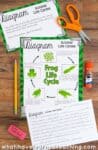
The colorful cut and paste diagrams take your class through the life cycle of various animals, explaining what happens at each stage. The corresponding worksheet encourages kids to compare different animals and how they develop. Besides frogs, these sheets cover sea turtles, chickens, and salmon.
Also available are black and white cut and paste worksheets that are similar to the color version below. Cutting and pasting sometimes gets passed over because it involves setup and cleanup, but it calms children down with gentle, repetitive motion and is a fun way to learn. You can also use the color copy during the science station, and the black-and-white copies for homework.

Read about Migrating Geese
This station explores the migration patterns and gestation periods of geese. The literature explains why geese migrate, the migration seasons, flight patterns, and a bit about habitats. Students also learn about goslings and their development into geese, specifically how their bodies and behaviors change.
After the reading section, there’s a short question and answer page, a page of fill-in the blanks, and several sheets of flash cards, to reinforce the reading, just like the rest of the science stations.
Model a Flower Dissection
In this science stations, students cut apart a flower, sort the pieces of it into the common parts of a flower: sepal, petal, pistil, ovary, and stamen. Students figure out the number of each part and then answer questions about the modeling.
After the modeling, students respond to the experiences using one of the differentiated responses.
Although the video about is mainly for the teacher, it can be used as an instructional video for students, if you fast forward through the introductory part of it.
Explore: What Part of the Plant do we Eat?
This station requires a little bit of leg work before students start their work. You need to bring some fruits and vegetables into the classroom, but other than that just print chart and included station response cards.
Looking at vegetables on trays, students write down what part of the plant they think is edible—root, leaf, flower, stem, seed, or fruit. They place these guesses in an envelope, and later compare them to the answers chart. Worksheets (fill-in, question and answer, and task cards) follow the chart segment. Your students can even eat the experiment when it’s over!
Sort: Plant Life Cycles
In the sort activity, students arrange cards into a specific order or into groups. They record the sort and describe why they chose those piles or groups. Sorting is an active learning game since it requires students to use their hands and minds to arrange the cards. Also included is a black-and-white cut-and-paste version of the activity.

Life Cycles: Plants and Animals Third Grade Science Stations
The focus is on NGSS 3-LS1.B and include concepts such as animal life cycles, plant life cycles, and parts of a plant.
How to Purchase
You can purchase the Life Cycles: Plants and Animals Science Stations on my website or on Teachers Pay Teachers.
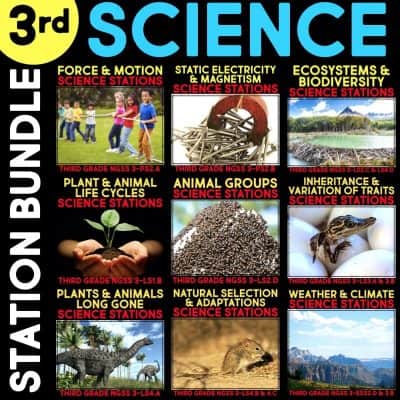
A Bundled set of all the Third Grade Science Stations are also available for purchase at a 20% discount.
Other Third Grade Science Station Sets
Related: Elementary Life Science Activities and Resources — a complete guide to teaching K–5 life science topics.
Each set of science stations is built the same way with 8 separate science stations that approach the standard and topic slightly differently and require students to do a different kind of work. The eight station themes (watch, play, investigate, diagram, read, model, explore, and sort) are repeated in each set of stations so that students become familiar with the routine.
-
 Product on saleThird Grade Science Stations BUNDLEOriginal price was: $222.12.$111.84Current price is: $111.84.
 -
-
-
-
-
-
-
-
-

Jessica BOschen
Jessica is a teacher, homeschool parent, and entrepreneur. She shares her passion for teaching and education on What I Have Learned. Jessica has 16 years of experience teaching elementary school and currently homeschools her two middle and high school boys. She enjoys scaffolding learning for students, focusing on helping our most challenging learners achieve success in all academic areas.