
Teaching Multiplication Arrays in 2nd Grade: A Hands-On Flower Pot Activity
Arrays are one of the most important conceptual models for introducing multiplication in second grade. When students can see 3 rows of 4 flower pots and connect that image to the equation 3 × 4 = 12, multiplication stops feeling mysterious and becomes something they can reason about.

This post walks through how to use a flower pot nursery context to introduce and explore arrays in 2.OA.4. Students take on the role of nursery workers arranging flower pots in rectangular displays — then write to explain their reasoning. It’s hands-on, connects to a real-world scenario, and gives you a natural opening for the mathematical vocabulary (rows, columns, factors, product) students will need through 3rd grade and beyond.
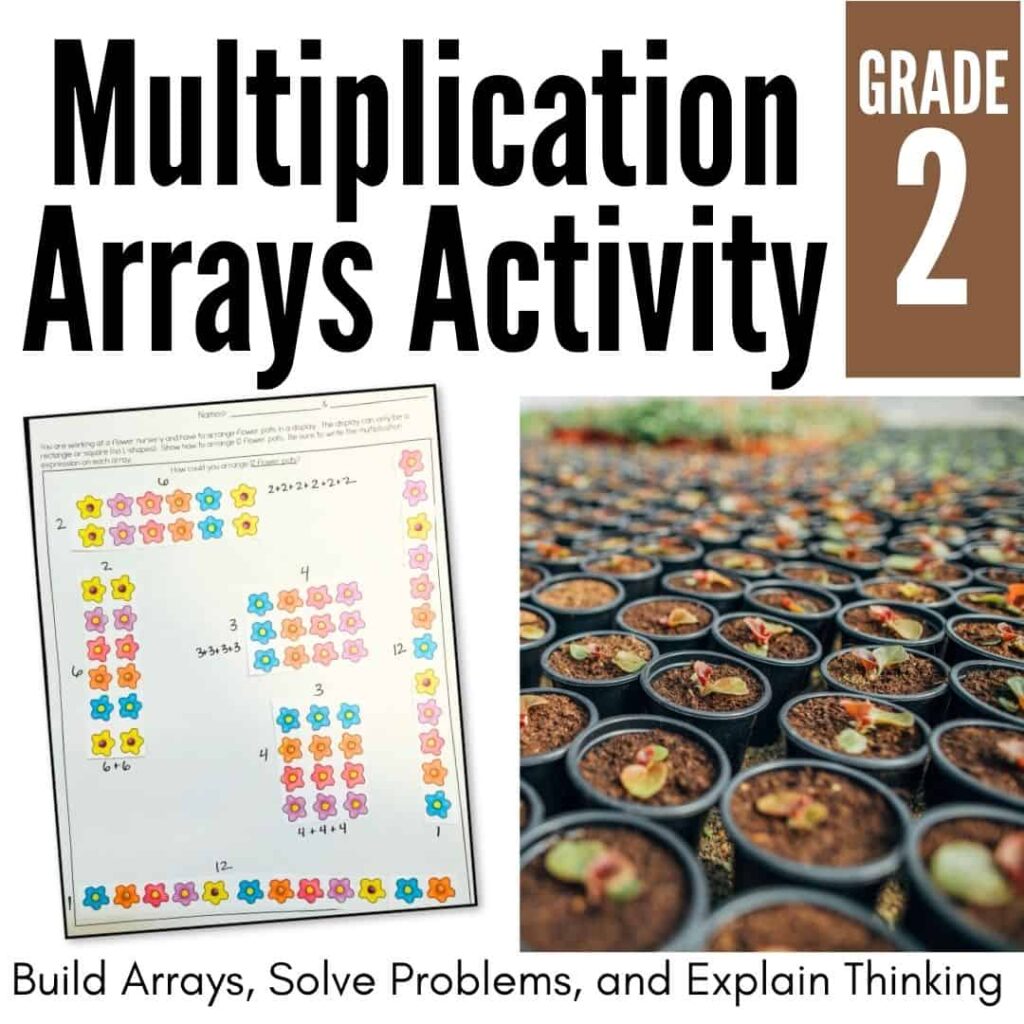
Building Arrays Flower Pot Activity | Rectangular Arrays & Multiplication Patterns
Help students explore arrays, rectangles, and multiplication patterns with this hands-on Building Arrays Flower Pot Activity! Students solve a real-world nursery display problem by arranging flower pots into rectangular and square arrays, then explain the patterns they discover through discussion and writing. Includes flower cutouts, writing pages, and extension problems.
Why Teach Arrays?
Arrays work for introducing multiplication because they make the structure visible. A student who can build a 4×6 array with manipulatives and then count the total by rows, by columns, or by skip counting is doing real mathematical reasoning — not just reciting facts. Arrays also bridge repeated addition (a 2nd grade concept) to multiplication (a 3rd grade concept), which is exactly the work 2.OA.4 asks students to do.
The key misconceptions to address early: students often don’t recognize that a 3×4 array and a 4×3 array represent the same total, just rotated. Building both and comparing them is worth the time, and the flower pot context gives students a concrete reason to care — you can fit 12 pots in a 3×4 display or a 4×3 display, and they look different even though the product is the same.
What’s Inside the Flower Arrays Packet?
The Multiplication Arrays Flower Boxes activity gives students 6, 12, and 24 flower pots to arrange in rectangular displays. They build every possible array for each number, label the arrangement with a multiplication equation and a repeated addition expression, then write to a nursery manager explaining which display they’d recommend and why.
Included in the packet: cut-out flower pot manipulatives, recording sheets for each number, writing pages for the letter-to-the-manager activity, and an extension word problem set set in a farm context (Henry’s Orange Farm and Isabella’s Plum Orchard) that asks students to apply array thinking in new scenarios.

How to structure the activity
Start with 6 pots. Students work in pairs to figure out every rectangular arrangement possible, then record each one with its equation. Six is the right starting number because it has limited factors (1×6, 2×3, 3×2, 6×1) and makes the commutative property visible without overwhelming students.
Move to 12, then 24. Each number adds more possible arrangements, which means more opportunities to see the pattern. By 24, students are thinking systematically about factors rather than guessing randomly.
Once students have built and recorded their arrays, the writing component asks them to choose one arrangement for the nursery window display and write to explain the choice. This is where math reasoning meets opinion writing — students have to justify, not just describe.
The extension word problems (Henry’s Orange Farm, Isabella’s Plum Orchard) can be used for early finishers, small group instruction, or as an independent assessment before moving to more abstract multiplication.
Why Teachers Love It
This activity aligns to 2.OA.4, which asks students to “use addition to find the total number of objects arranged in rectangular arrays with up to 5 rows and up to 5 columns.” It also works as a bridge activity when you’re beginning to prepare students for 3rd-grade multiplication work in 3.OA.
For classroom logistics: this works well as a math workshop activity, a small group center, or a whole-class investigation over two to three days. Students can complete the writing component independently after the building is complete.
If you’re looking for a way to connect multiplication arrays to a real-world context while keeping the math rigorous, the flower pot nursery structure does that work. Students build, record, reason, and write — and by the end, they have a concrete model for what multiplication actually means.
Pair It With…
This unit works beautifully with lessons on partitioning rectangles and area, especially as you begin preparing students for 3rd grade concepts.

Partition Rectangles
If your students need more practice seeing rows and columns before jumping into arrays, this partitioning rectangles activity is a good lead-in.
Building Arrays Flower Pot Activity | Rectangular Arrays & Multiplication Patterns
Help students explore arrays, rectangles, and multiplication patterns with this hands-on Building Arrays Flower Pot Activity! Students solve a real-world nursery display problem by arranging flower pots into rectangular and square arrays, then explain the patterns they discover through discussion and writing. Includes flower cutouts, writing pages, and extension problems.
Jessica BOschen
Jessica is a teacher, homeschool parent, and entrepreneur. She shares her passion for teaching and education on What I Have Learned. Jessica has 16 years of experience teaching elementary school and currently homeschools her two middle and high school boys. She enjoys scaffolding learning for students, focusing on helping our most challenging learners achieve success in all academic areas.