
Arrays and Area Models: What They Are and How They Connect
Arrays and area models are two of the most important visual tools for teaching multiplication in elementary school. Teachers use these terms interchangeably, but they are actually two different representations that build on each other — and understanding how they connect helps students make sense of multiplication rather than just memorize procedures.

Before students build full arrays, partitioning rectangles into rows and columns is a great warm-up activity that gets them comfortable seeing rows and columns inside a shape.
What Is an Array?
An array is a rectangular arrangement of objects in equal rows and columns. Every row has the same number of objects, and every column has the same number of objects. The number of rows times the number of columns equals the total.
A 3-by-4 array has 3 rows with 4 objects in each row, for a total of 12. Students can count every object individually, count by rows, or count by columns and reach the same answer. That flexibility is the point — arrays make it visible that multiplication is organized, predictable, and connected to repeated addition.
The second grade Common Core standard 2.OA.4 asks students to use addition to find the total number of objects arranged in rectangular arrays with up to 5 rows and up to 5 columns. This is where arrays belong developmentally: students are not yet multiplying formally, but they are building the mental model they will need later.
What Is an Area Model?
An area model uses the same rectangular structure as an array, but it removes the individual objects. Instead of drawing 12 squares in a 3-by-4 grid, students draw a rectangle, label the dimensions (3 and 4), and use the relationship between length, width, and area to find the total.
This matters because arrays only work well with small numbers. A student can reasonably draw a 4-by-6 array. A 23-by-14 array would take all afternoon. The area model solves that problem: the rectangle stays the same size regardless of the numbers inside it, and students work with the dimensions rather than counting individual units.
Area models become the primary tool in third grade (3.OA) and extend into multi-digit multiplication in fourth grade (4.NBT.5), where students partition a rectangle into sections and use partial products to find the total.
How Arrays and Area Models Connect
The conceptual leap from array to area model is smaller than it looks. Both represent multiplication as a rectangle. Both use rows and columns (or length and width) to describe the factors. The only difference is that the area model stops drawing the individual units inside.
When students understand arrays well enough to know that a 4-by-6 rectangle contains 24 squares without counting every one, they are ready to drop the grid and work with just the dimensions. That transition, fading the individual squares while keeping the rectangular structure, is how most teachers move from the array model to the area model in third grade.
One concept worth addressing explicitly before students make this transition: a 3-by-4 array and a 4-by-3 array look different but equal the same total. Building both on grid paper and comparing them gives students a concrete experience of the commutative property before they encounter it as an abstract rule. This is one of the most common sources of confusion, and the array model makes it easy to address.
Building Arrays in Second Grade
When I introduce arrays in second grade, I start with physical building. Students use square tiles or cut-apart grid paper to construct arrays and arrange them on their desks. They label each array with the number of rows, the number of columns, and the matching repeated-addition equation.


One of my favorite activities for this unit is a chart that students build over several days. We create a grid together that goes up to 5 by 5, recording the number of rows, the number of columns, and the addition equation for each number. I made sure all composite numbers had squares and rectangles represented, so students could see that some numbers can be arranged in multiple ways. That observation, that 12 can be a 2-by-6 or a 3-by-4 or a 4-by-3, is exactly the conceptual foundation they need.
After students can build and label arrays accurately, I add a partner game. Each pair gets a piece of grid paper, two dice, and two different colored pencils. Students take turns rolling both dice, then drawing and labeling an array based on the numbers they rolled. Play continues until neither player can fit a new array on the paper. Because everything is color-coded, students can easily see which arrays belong to whom when they write the matching addition equations at the end.
After the game, students write the addition sentences that matched their arrays on a separate sheet. Since each player used a different color, it was easy to tell them apart and for students to check their own work.
This combination of building, recording, and playing gives students multiple exposures to the same concept across different contexts, which is what it takes for the array model to become genuinely familiar rather than just practiced.


Moving Toward the Area Model in Third Grade
Once students can reliably draw an array and connect it to a multiplication equation, the transition to the area model is gradual. Start by drawing rectangles on grid paper and asking students to identify the dimensions without counting every square. Then move to unlabeled rectangles where students label the sides and find the total. Eventually, remove the grid entirely and work with just the labeled rectangle.
This concrete-to-representational progression is what makes the area model stick. Students who try to use an area model without a solid understanding of arrays often revert to counting strategies because they have no mental image to anchor the rectangle to.
For students who are ready to extend, the area model connects directly to finding the area of rectangles (3.MD.7) and later to multi-digit multiplication using partial products. The rectangle never changes; only the numbers inside it do.
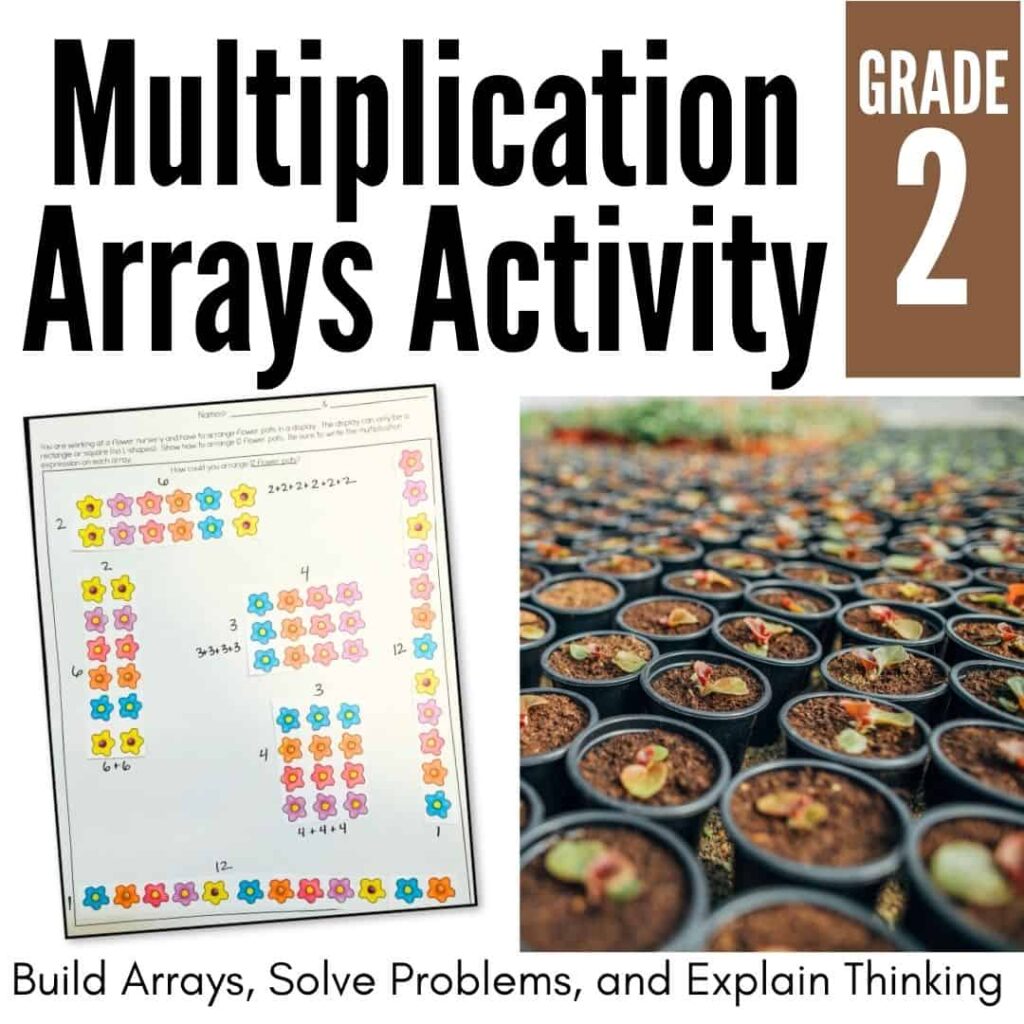
Building Arrays Flower Pot Activity | Rectangular Arrays & Multiplication Patterns
Help students explore arrays, rectangles, and multiplication patterns with this hands-on Building Arrays Flower Pot Activity! Students solve a real-world nursery display problem by arranging flower pots into rectangular and square arrays, then explain the patterns they discover through discussion and writing. Includes flower cutouts, writing pages, and extension problems.
Jessica BOschen
Jessica is a teacher, homeschool parent, and entrepreneur. She shares her passion for teaching and education on What I Have Learned. Jessica has 16 years of experience teaching elementary school and currently homeschools her two middle and high school boys. She enjoys scaffolding learning for students, focusing on helping our most challenging learners achieve success in all academic areas.