
Number Puzzles for Third Grade Math Stations
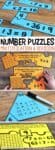
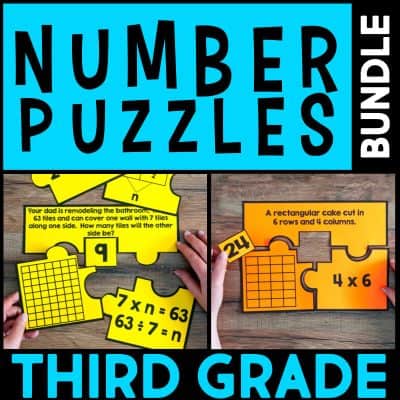
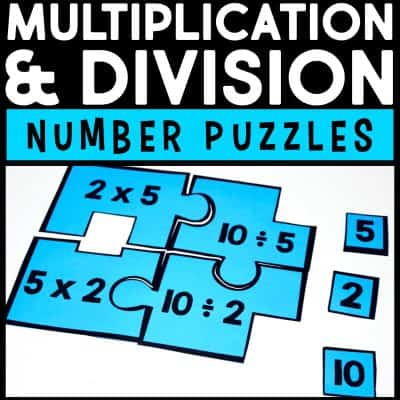
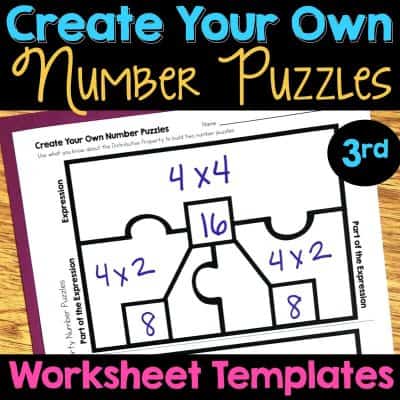
Number Puzzles for Third Grade Math Stations invites students to explore third-grade math concepts through hands-on puzzles. As they figure out how the pieces fit together, students use a variety of models, strategies, and equations across third-grade math topics. Below are examples of the multiplication and division number puzzles.

The second-grade number puzzles are a popular starting point for teachers building math stations, so this third-grade set extends the same format to third-grade standards—multiplication, division, fractions, rounding, area and perimeter, and more. You can buy puzzles individually by standard, or as a full-year bundle.
What Is Included in the Third Grade Number Puzzles
The puzzles cover almost every third-grade standard. The Operations and Algebraic Thinking strand is the most developed, with puzzles for multiplication and division concepts across several problem types. Puzzles for Numbers and Operations in Base Ten, Fractions, and Measurement and Data are also included.
Operations and Algebraic Thinking
- Interpret Multiplication – Products of Whole Numbers (OA1)
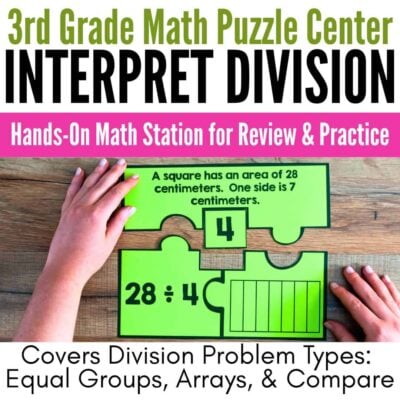
- Interpret Division – Quotients of Whole Numbers (OA2)
- Multiplication and Division Word Problems (OA3)
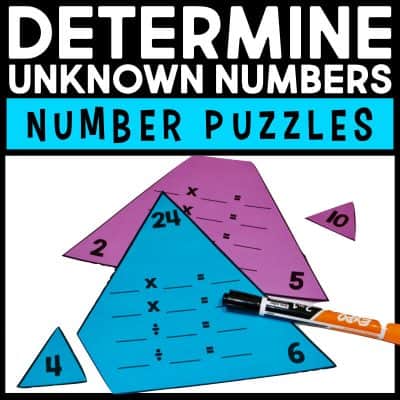
- Determine Unknown Numbers (OA4)
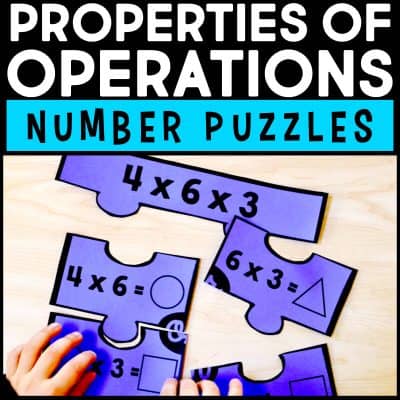
- Apply Properties of Operations (OA5)
- Relationship Between Multiplication & Division (OA7)
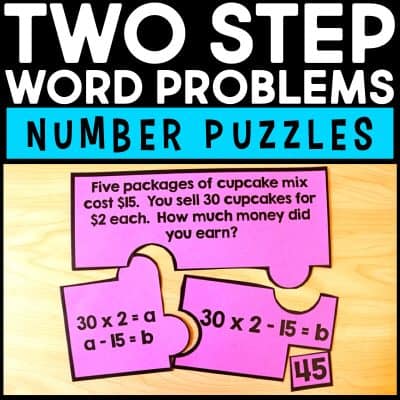
- Two-Step Word Problems (OA8)
Numbers & Operations in Base Ten
- Round Whole Numbers (NBT1)
- Three-Digit Addition (same as Second Grade)
- Three-Digit Subtraction (same as Second Grade)
- Multiply by Multiples of 10 (NBT3)
Numbers & Operations – Fractions
Measurement & Data
Here are a few images from some of the Operations and Algebraic Thinking puzzles.
-
 Third Grade Number Puzzles BUNDLEOriginal price was: $71.63.$46.44Current price is: $46.44.
 -
-
-

Interpret Multiplication – Products of Whole Numbers
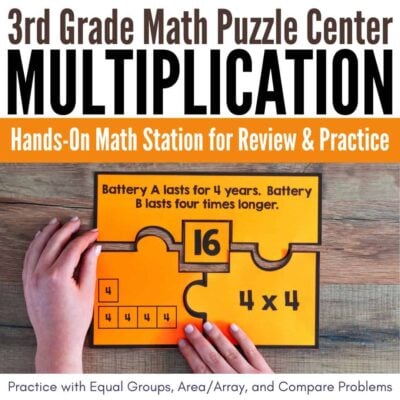
These Multiplication Number Puzzles help students interpret products of whole numbers by reading a context and identifying the expression, model/drawing, and total number. The context describes the relationship of the numbers, but does not include the question part of a word problem.
The focus is on the relationship of the numbers, not solving a word problem. That comes later.


The model or drawing matches the context of the problem, generally by problem type. Models include: equal groups, number line, array / area model, and bar model. The Puzzles are arranged by multiplication problem type, Equal Groups, Area / Arrays, Compare. For more on Multiplication & Division Problem Types, you can check out this product for Word Problems.

Interpret Division – Quotients of Whole Numbers
Division Number Puzzles invite students to interpret quotients of whole numbers by reading a context and identifying the expression, model / drawing, and quotient. The context describes the relationship of the numbers, but does not include the question part of a word problem. The focus is on the relationship among the numbers, as with the multiplication puzzles above.

The model or drawing will match the context of the problem, generally by problem type. Models include equal groups, number line, array/area model, and bar model. The Puzzles are arranged by multiplication/division problem type: Equal Groups, Area / Arrays, Compare. Each problem type includes 6 puzzles with a range of division expressions.
Multiplication & Division Word Problems
Number Puzzles for multiplication and division word problems help students match a word problem with a model, an equation, and a result/answer. Word Problems are grouped by problem type. There are 35 number puzzles, 3-4 per problem type.

Word problem models include groups, number lines, arrays/area models, and bar models. Equations have a letter for the missing number. Multiplication word problems only have the multiplication equation. Division word problems have both the division and multiplication equations.
Determine Unknown Numbers
These Multiplication and Division Number Puzzles help students learn their multiplication facts. They are simple puzzles to determine an unknown number.
There are three versions of the number puzzles:
- One version has four problems/answers in one puzzle. It’s simply a fun way to get four problems onto one odd-shaped puzzle.
- Another version has one problem and one answer per puzzle. In this version, there are six different templates with the unknown and equal sign in different places.
- The third version is traditional triangle cards. Cut off the one side of the triangle and, if laminated, students can use write the fact family on the cards.


Second Grade Number Puzzles
Several of the Second Grade Number Puzzles will also work for third grade. Some multiplication puzzles focus on multiplication models, and others cover three-digit addition and subtraction. You can find out more about the second grade Number Puzzles in this blog post.
How to Purchase
You can purchase the Third Grade Number Puzzles individually on my website or on Teachers Pay Teachers.
-
Product on saleThird Grade Number Puzzles BUNDLEOriginal price was: $71.63.$46.44Current price is: $46.44.
-
-
-
-
-
-
-
-

Jessica,
I love your number puzzles and was very excited to see that you have a 3rd-grade set. I am concerned though, the image on your main page shows a number puzzle for 4 x 6, with an array of 6 rows & 4 columns. The story problem also indicates 6 rows and 4 columns. Then the equation should read 6 x 4 not 4 x 6. We, in my district, spend a great deal of time teaching our 3rd graders that the number of rows must be listed first, that you read an array like you read sentences, left to right. Yes, the commutative property states that they can be flipped around, however, the picture and word problem clearly states 6×4. Do all of your number puzzles list the columns first? Thank you for letting me know before I purchase them.
Great question! I have not been consistent about writing rows x columns when writing the expression. The model will match the word problem. Switching the expression is an easy fix and I’ve done it for the two number puzzles in the product you were referring to. Thanks for pointing it out!
Are these puzzles self checking? It looks like all pieces are the same for each puzzle. Will they know when they put the puzzle together if they are correct?
The template is the same for each puzzle set. I print the puzzles on colored paper, which helps narrow down the choices. Students work together in pairs or triads to solve the puzzles and match the pieces. I’ve found that students are generally successful in matching them correctly, if I have taught the concepts already. When puzzles have unique pieces students tend to “try out” the pieces to make them fit, rather than doing the math to match the pieces.
You can also print an answer key of the puzzles at a reduced size with multiple puzzles on a page. Keep it in a manilla envelope at the center for students to check their work.
I would love love love if you were able to create this for fifth grade please
Thanks for the suggestion! I will consider creating it for 5th grade, but it’s not a priority right now.
How do you organize the puzzles? I recently purchased the third grade bundle, but am struggling with the best way to organize them for stations. For example, I printed all multiplication puzzles on different colors. Arrays are on one color. Equal groups are on another. Reversed equal groups are on a third color. Would you place all pieces according to color in an envelope for storing? Would you recommend placing 3-4 puzzles in an envelope at a time? What have you found to be most successful.
I store mine in gallon size Ziploc bacgs by when I use them throughout the year, which is often by topic. The Ziploc bags are only for my longterm storage. For students, I use boxes for my math stations. In those boxes, the puzzles aren’t sorted, but I only put one puzzle in a box at a time. This is a post on the boxes: https://whatihavelearnedteaching.com/math-work-stations-how-were-doing-it/
I love your cootie catcher game for multiplication!