
Helping Students Understand Division Through Number Puzzles
Division is one of those math skills that can feel abstract and confusing for students—especially when they’re just getting the hang of multiplication. Teaching the concept of division through context and models is essential if we want students to truly understand what division means, not just memorize how to “divide the big number by the little number.”
When students learn to connect division word problems with models and equations, they begin to grasp the “why” behind the math. They’re no longer just solving problems—they’re making sense of real-world situations. That’s exactly why I created these Interpret Division Number Puzzles!
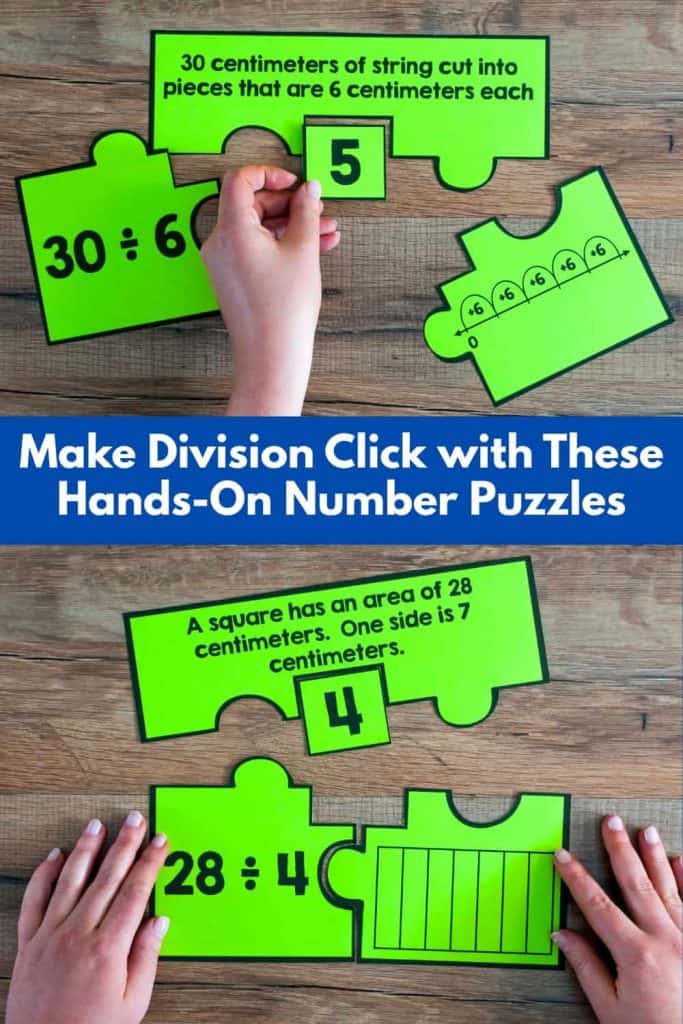
What Are Division Number Puzzles?
These puzzles are hands-on math center activities designed to help students understand three different types of division problem situations:
- Equal Groups
- Arrays
- Compare Problems
Each puzzle is made up of four parts:
- A division word problem or contextualized situation
- A visual model (to represent the situation)
- A division expression
- A quotient (the answer)
Students read the word problem, visualize what’s happening, and then match it with the correct model, equation, and answer. They’re literally piecing together a full understanding of division—one puzzle at a time.

Interpret Division Number Puzzles – OA2
These Division Number Puzzles help students interpret quotients of whole numbers by reading a context and identifying the expression, model / drawing, and quotient. The context describes the relationship of the numbers, but doesn’t not include the question part of a word problem. The focus is on the relationship of the numbers.
What’s Included in the Resource?
Here’s a quick look at what you get:
- 36 complete puzzles
(12 Equal Groups, 12 Arrays, 12 Compare – Each problem type has two sets of puzzles: quantity unknown and group unknown)
You can use colored paper to color-code by problem type, making it easy to organize and differentiate during your math block.
How to Use These Puzzles in the Classroom
These puzzles are perfect for:
- 🔄 Math centers
- 🧠 Early finisher tasks
- 🧍🏽♀️ Small group instruction
- ✋ Math intervention
- 🧑🏽🤝🧑🏼 Partner practice
Set up is simple: Just print, laminate, and cut. You can store each puzzle set in a zip-top bag or small container for easy reuse. Because each puzzle includes multiple pieces, students are actively thinking through each part of the problem instead of guessing or rushing to an answer.
Tip for Implementation:
Have students start with just the word problem and visual model. Once they match those, they can move on to finding the correct equation and quotient. This helps scaffold their thinking and avoids overwhelming them.
Want to add a bit more structure? Have students explain why each piece belongs together. This adds a layer of math talk and reflection—plus it’s great for accountability!
Why These Puzzles Work
What makes these puzzles so powerful is how they combine context, visuals, and computation. By having to connect all four parts of the division problem, students move beyond procedural math and begin to truly understand the operation.
These puzzles also help students distinguish between different types of division problems, which is something many struggle with. For example, is the question asking how many groups or how many in each group? Should it be represented as an array or a comparison?
With repeated exposure through puzzles, students build confidence and flexibility with division—and that leads to deeper math understanding.
Interpret Division Number Puzzles – OA2
These Division Number Puzzles help students interpret quotients of whole numbers by reading a context and identifying the expression, model / drawing, and quotient. The context describes the relationship of the numbers, but doesn’t not include the question part of a word problem. The focus is on the relationship of the numbers.
Ready to Make Division Click?
If you’re looking for a fun, meaningful, and low-prep way to help your students understand division, these Interpret Division Number Puzzles are just what you need. They’re great for 3rd and 4th grade students, or as a review for older learners who need more conceptual support.
Jessica BOschen
Jessica is a teacher, homeschool parent, and entrepreneur. She shares her passion for teaching and education on What I Have Learned. Jessica has 16 years of experience teaching elementary school and currently homeschools her two middle and high school boys. She enjoys scaffolding learning for students, focusing on helping our most challenging learners achieve success in all academic areas.