
How to Teach Division in Elementary School: Strategies and Activities
Most elementary teachers have seen it: a student who sailed through multiplication stares at a division problem and goes completely blank. Learning how to teach division well starts with understanding why that happens. Division is the first operation at which counting strategies stop working, and students who haven’t built the underlying concept struggle even when they know their multiplication facts cold. When you sequence the instruction carefully, connect it to what students already know, and give them multiple strategies before the standard algorithm, division clicks in a way that sticks.
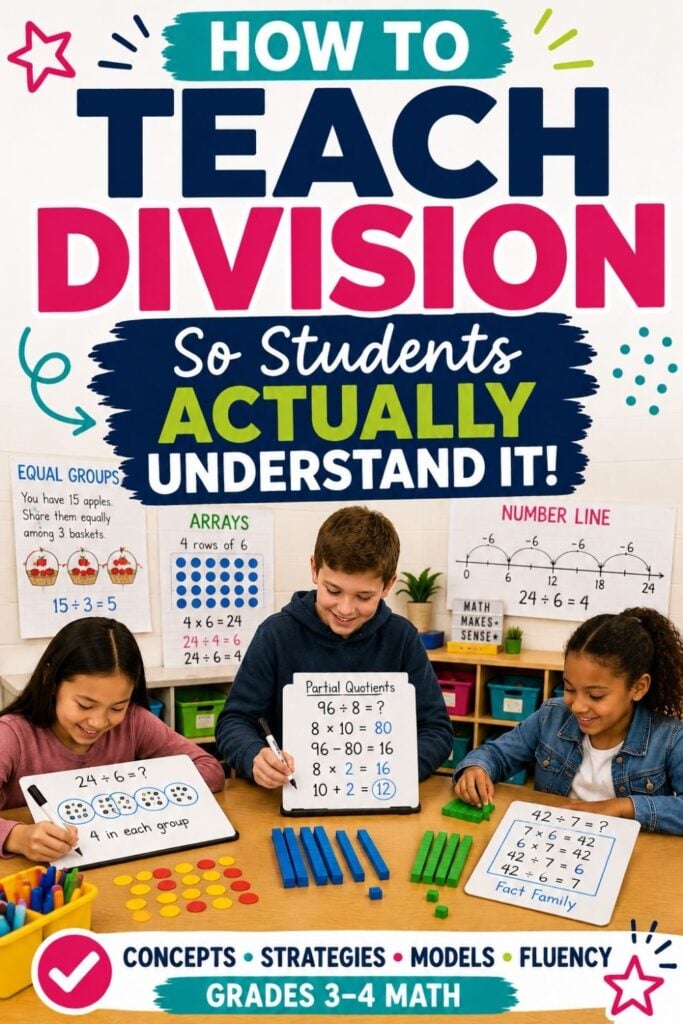
This post walks through how to do exactly that, from early equal-groups thinking in 3rd grade to multi-digit division in 4th grade.
What the Standards Say About Teaching Division
Division instruction spans two major grade levels in the Common Core, and each builds directly on the last.
In 3rd grade, students are introduced to division as both partitive (splitting into equal groups) and quotitive (finding how many groups there are). The standards (3.OA.A.2 and 3.OA.A.3) ask students to interpret whole-number quotients in real-world contexts and represent division with equations, arrays, and area models. By the end of 3rd grade, students should have fluency with division facts within 100 (3.OA.C.7), which is directly connected to their multiplication facts.
In 4th grade, the work deepens with multi-digit division. Standard 4.NBT.B.6 asks students to find whole-number quotients and remainders with up to four-digit dividends and one-digit divisors, using strategies based on place value, the properties of operations, and the relationship between multiplication and division.
Division also sets up 5th-grade fraction work. When students understand that dividing means splitting into equal parts, the concept of a fraction as a quotient makes much more sense. The investment you make in building conceptual understanding in 3rd and 4th grade pays off well beyond those grade levels.
Start with the Concept Before You Teach Division Procedures
The most common reason students struggle with division is that they were taught the procedure before they had a concept to attach it to. Long division, taught as a series of steps, divide, multiply, subtract, bring down, is almost impossible to remember without understanding why each step exists. Before students see any notation, they need to spend real time with what division actually means.
Equal Groups and Fair Sharing
Start with physical objects and simple division story problems. “You have 24 crayons and 6 students. How many crayons does each student get?” Students who can act this out with cubes or tiles are building the concept from the ground up. Do both types of problems: sharing (how many in each group?) and grouping (how many groups can you make?). Both interpretations are in the standards, and both show up later in word problems.
Arrays and Area Models
Arrays are the bridge between multiplication and division, and they are worth spending significant time on. A 4 × 6 array shows multiplication. Turn the question around, “I have 24 tiles, and I want 4 equal rows. How many columns?” and you have the exact same array showing division. Students who can see this connection understand that division is just multiplication with a missing factor, which is the most powerful insight in all of 3rd-grade math.
Number Lines
Open number lines work well for showing division as repeated subtraction, jumping back by equal amounts until you reach zero. For 3rd graders, this provides a visual anchor for division. It’s slow and inefficient for large numbers, but it clearly builds the underlying idea and gives students a way to check their thinking.
Division Strategies That Actually Build Understanding
Once students have a conceptual foundation, they’re ready to work with more efficient strategies. The goal at this stage is to have multiple tools available, not to funnel everyone to the same procedure at the same pace.
Partial Quotients (Area Model)
Partial quotients are the strategy most worth teaching before long division because they keep the math visible. Students build the dividend in chunks using multiplication facts they know, then add up the partial quotients. For 96 ÷ 8, a student might think: 8 × 10 = 80, so that accounts for 80. That leaves 16. 8 × 2 = 16. Total: 10 + 2 = 12. Every step is grounded in multiplication reasoning rather than rote procedure.
This strategy also scales naturally to 4th-grade multi-digit division, which is exactly why teaching it early is worth the time. Students who understand partial quotients in 3rd grade find the jump to 4-digit dividends in 4th grade much more manageable.
Connecting to Multiplication Facts
The most efficient strategy for single-digit division is knowing multiplication facts cold. 42 ÷ 7 = ? becomes “what times 7 equals 42?” For students who have automatic recall of multiplication facts, this is instant. For students who don’t, division practice inadvertently becomes multiplication practice, which is fine, but it helps to name what’s happening so students understand why multiplication fluency matters beyond multiplication problems.
Fact families are worth explicit instruction time here. Write 6 × 8 = 48, 8 × 6 = 48, 48 ÷ 6 = 8, and 48 ÷ 8 = 6 as a set, talk through the relationship, and ask students to generate the family from a single fact. This helps division feel connected rather than separate and new.
When to Introduce the Standard Algorithm
Standard long division is not a 3rd grade expectation in the Common Core, and there’s good reason for that. The algorithm works efficiently once students understand division deeply, but if introduced too early, it often produces students who can follow the steps on a clean problem and fall apart on anything slightly different.
By 4th grade, when multi-digit division is the focus, students who have spent a year working with partial quotients and fact families are far better positioned to make sense of what the algorithm is actually doing rather than just executing it mechanically.
Teaching Division Facts: Building Fluency Purposefully
Fluency with division facts within 100 is a 3rd grade standard, and it takes deliberate practice to get there. A few approaches that work well together:
- Fact triangles. Each triangle shows a fact family (e.g., 7, 8, 56). Students can cover any corner and practice all four related equations. This reinforces the multiplication-division relationship every time a student picks one up.
- Sorting by strategy. Have students sort division facts into groups based on how they solve them: “I know it from multiplication,” “I use doubles,” “I count up.” Making the strategy visible helps students deliberately build automaticity rather than just drill randomly.
- Spaced practice over time. Five minutes of focused division fact practice, three or four times a week, is more effective than a single long session. Short, frequent exposure is how fluency actually builds at this age.
- Meaningful contexts. Word problems that require students to use division facts in context, rather than just naked equations, develop flexible thinking alongside recall. Use both grouping and partitive problem types regularly.
Division Practice Activities That Reinforce the Concept
Students need a lot of repetition to internalize division, and variety in practice format helps sustain engagement across that repetition.
Word Problems — Both Types, Regularly
Students often see one type of division word problem (usually sharing: 24 ÷ 4 = how many each?) and are thrown off when the other type appears (grouping: 24 ÷ 4 = how many groups?). Include both structures deliberately from the beginning, and ask students to draw or act out what each problem is describing before they write an equation. The drawing step is where conceptual understanding shows itself.

Interpret Division Number Puzzles – OA2
These Division Number Puzzles help students interpret quotients of whole numbers by reading a context and identifying the expression, model / drawing, and quotient. The context describes the relationship of the numbers, but doesn’t not include the question part of a word problem. The focus is on the relationship of the numbers.
Number Puzzles
Puzzles that ask students to apply division across multiple representations, equations, arrays, word problems, and visual models are excellent for building the flexible thinking that the standards require. When a student has to recognize 48 ÷ 6 in four different forms within one activity, they’re doing the kind of sense-making that builds real fluency, not just answer-getting.

Relationship Between Multiplication and Division Number Puzzles – OA7
These Number Puzzles give students practice in seeing the relationship between multiplication and division. Each number puzzle has four expressions and three numbers for each of the four equations. The multiplication expressions have one product; each division expression has a quotient. These puzzles are also good for developing the concept of the commutative property and number bond relationships.
Partner and Small Group Games
Games that involve division fact recall, card games, board games with fact-based movement, quick-fire partner challenges, bring in the repetition students need while keeping the energy of practice high. The key is choosing games where students produce and check answers, rather than just answering one question while waiting for a turn.
Error Analysis
Showing students worked examples with errors and asking them to find and explain the mistake is one of the most underused practice formats in math. Students who can identify why a division solution is wrong understand the concept more deeply than students who can only produce correct answers on their own. This works especially well for remainder problems and multi-digit division in 4th grade, where errors often reveal specific gaps in understanding.
A Few Things That Trip Teachers Up When Teaching Division
Remainders too late, then all at once. Students often encounter remainders briefly, and then suddenly they’re everywhere in 4th grade. Introduce remainders early, even in 3rd grade, when they come up naturally, and frame them as “what’s left over after equal sharing.” Students who understand the concept of a remainder handle division with remainders much more smoothly than students who are introduced to the symbol R as notation before they understand what it represents.
Assuming multiplication fluency. Some students arrive at the 3rd-grade division without a solid recall of multiplication facts. For these students, division and multiplication practice occur simultaneously, and progress may appear slower. Providing a reference chart (not as a crutch for assessed work, but as a scaffold during conceptual development) lets these students still engage with division reasoning while their multiplication fluency catches up.
Moving to the algorithm because the pacing guide says so. Pacing guides create pressure, but students who haven’t internalized the concept will need reteaching later anyway. A few extra days on partial quotients and concrete models is almost always a better investment than pressing forward with an algorithm students don’t understand.
If you’re also working on multiplication fluency alongside division, this post on teaching multiplication goes deeper on strategies that help students build automatic recall, which pays off directly in division work.
Final Thoughts on How to Teach Division
Division doesn’t have to be the point where students lose confidence in math. When you sequence the instruction carefully, concept before procedure, multiple strategies before the algorithm, and consistent connections to multiplication, most students can get there. The work you do in 3rd and 4th grade to build genuine understanding is what allows division to feel like a tool rather than a test.
Looking for ready-made practice? The Division Number Puzzles resource gives students practice across multiple representations, equations, arrays, word problems, and visual models, in a format that works well for math centers or independent practice.

Jessica BOschen
Jessica is a teacher, homeschool parent, and entrepreneur. She shares her passion for teaching and education on What I Have Learned. Jessica has 16 years of experience teaching elementary school and currently homeschools her two middle and high school boys. She enjoys scaffolding learning for students, focusing on helping our most challenging learners achieve success in all academic areas.