
Number Line Strategy for Subtraction (3-Digit Examples)
If you’re looking for an effective number line strategy for subtraction, you’re in the right place.

Number lines are one of the most powerful visual models for helping students understand multi-digit addition and subtraction. A strong number line strategy allows students to break apart numbers, use place value reasoning, and build mental math skills — all without relying only on the traditional algorithm.
In this post, I’ll walk you through two powerful number line strategies for subtraction, show you how I used them with my second grader, and explain how to help students decide which strategy works best for a given problem.
What Is a Number Line Strategy?
A number line strategy is a way students use a number line model to solve math problems. The strategy refers to how students think about and manipulate the numbers. The number line itself is the model that organizes their thinking.
In subtraction, students typically use one of two number line strategies:
- The Count Up Strategy
- The Break Apart Strategy
Both strategies rely on place value understanding and flexible thinking about numbers.
A Real Example of a Number Line Strategy in Action
Recently, I was asked about a number line strategy I was using with my second-grade son to solve this subtraction problem:
333 − 144
This is the image that I had posted:
We had been using number lines for a few weeks to solve two- and three-digit subtraction problems with regrouping. I originally started with a horizontal number line, but I quickly moved him to a vertical format so he could focus on the jumps without needing to redraw the entire line each time.
What you see in the image is a slightly different vertical number line model than the traditional version. Instead of curved “swoopy” jumps, the friendly numbers are written on one side and the value of each jump is recorded on the other. A line at the bottom provides a place to add the jumps together.
It’s organized. It separates the thinking from the computation. And it helps students clearly see what they’re doing.
But the question I was asked wasn’t about the layout.
It was this:
How do you know what jumps to make?
That question isn’t about the model. It’s about the strategy.
A model is how we organize our thinking on paper.
A strategy is how students mentally approach the numbers.
Once we understand the strategy being used, the jumps begin to make sense.
When subtracting on a number line, students typically use one of two strategies.
Two Number Line Strategies for Subtraction
When subtracting on a number line, students typically use one of two strategies:
- Count Up Strategy
- Break Apart Strategy
Both are grounded in place value understanding. The key difference is what students do with the subtrahend.
1. Count Up Number Line Strategy
The count up number line strategy (sometimes called “Think Addition”) is when students start at the subtrahend and count up to the minuend.
For example:
333 − 144
Students begin at 144 and make friendly jumps up to 333.
They might jump:
+6 to 150
+50 to 200
+100 to 300
+33 to 333
Then they add the jumps together to find the difference.
This number line strategy works especially well for subtraction with regrouping because students are always moving toward friendly numbers instead of subtracting across tens or hundreds.
Many students prefer this strategy because it relies more on addition than subtraction.

Teaching the Count Up Strategy with Larger Numbers
As numbers increase, students need practice figuring out:
- How much to the next ten?
- How much to the next hundred?
- Can the jump be broken apart to make it easier?
This builds on early place value work like Make 10. The more fluent students become at finding friendly number jumps, the more efficient their number line strategy becomes.
2. Break Apart Number Line Strategy
The break apart number line strategy involves decomposing the subtrahend into place value parts.
144 becomes:
100 + 40 + 4
Students begin at 333 and subtract each part step by step on the number line:
- −100
- −30
- −10
- −3
- −1
Students may break apart place values even further to avoid subtracting across tens or hundreds.
This number line strategy requires strong place value understanding and can feel more challenging for students because they are subtracting down the number line instead of counting up.

Which Number Line Strategy Should Students Use?
Both.
Students should learn more than one number line strategy for subtraction so they can choose the approach that makes the most sense for the numbers in front of them.
For example:
- Problems close to friendly numbers often work well with the count up number line strategy.
- Problems with clean place value breakdowns may work well with the break apart number line strategy.
Will every student immediately know which strategy to use? Of course not.
Some students will recognize patterns quickly. Others will need guided practice and scaffolding before they can confidently choose an efficient approach. The goal isn’t to master one method — it’s to build flexibility.
As students gain experience, they begin to look at the numbers first and decide which strategy will be most efficient.
I often introduce subtraction with the count up number line strategy because many students find adding up more manageable than subtracting down. It also mirrors how many adults mentally solve subtraction problems.
That said, not every subtraction problem needs a number line. Sometimes compensation or mental math is a better fit. Helping students evaluate the numbers before choosing a strategy is where real number sense begins to develop.
How to Teach a Number Line Strategy in the Classroom
When teaching a number line strategy, start with small numbers and model your thinking aloud. Help students notice friendly numbers, place value patterns, and how the jumps connect to addition and subtraction relationships.
Gradually increase the size of the numbers and encourage students to explain why they chose a specific strategy.
Move gradually from horizontal number lines to vertical number lines if students are ready. The vertical format helps organize thinking and separates the friendly numbers from the value of the jumps.
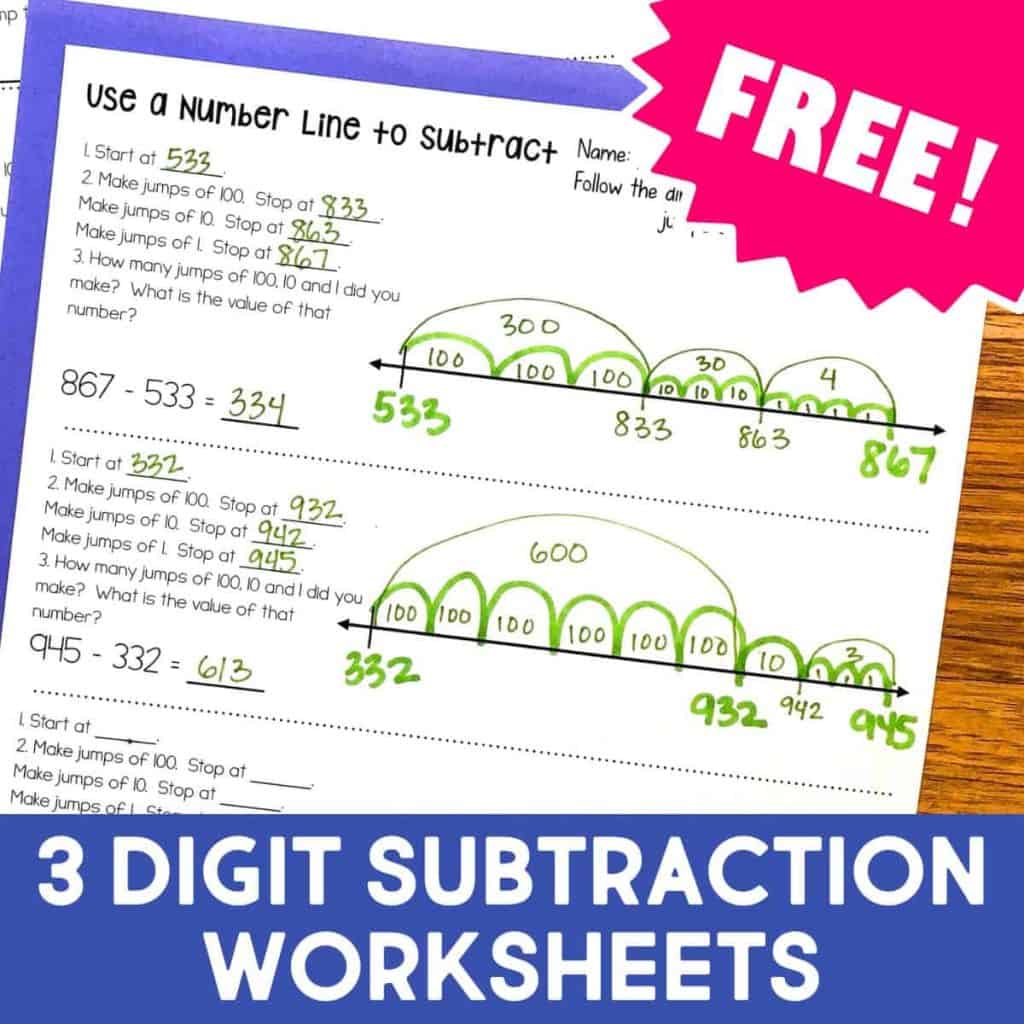
Free 3-Digit Subtraction Worksheets Using a Number Line Strategy
If you want your students to build confidence with a number line strategy for subtraction, I have a free set of 3-digit subtraction worksheets you can download.
Students practice:
- Count up number line strategy
- Break apart number line strategy
- Friendly number jumps
- Regrouping with place value reasoning
These worksheets are perfect for second and third grade students who are still developing flexible subtraction strategies.
Grab the free set below.
Final Thoughts on Using a Number Line Strategy for Subtraction
A strong number line strategy builds number sense, place value understanding, and flexible thinking.
Whether students use the count up strategy or the break apart strategy, the goal is understanding why the strategy works — not just how to perform it.
When students can choose the most efficient number line strategy for a problem, they move beyond memorizing steps and begin developing real mathematical reasoning.
And that’s the goal.
Jessica BOschen
Jessica is a teacher, homeschool parent, and entrepreneur. She shares her passion for teaching and education on What I Have Learned. Jessica has 16 years of experience teaching elementary school and currently homeschools her two middle and high school boys. She enjoys scaffolding learning for students, focusing on helping our most challenging learners achieve success in all academic areas.