


Earth’s Water Supply Science Station UNIT BUNDLE
$16.10
These Earth’s Water Supply Next Generation Science Stations include eight different science stations where students deepen their understanding of freshwater, the distribution of water on Earth, and the water cycle. The focus is on 5-ESS2-2.

These Earth’s Water Supply Next Generation Science Stations include eight different science stations where students deepen their understanding of freshwater, the distribution of water on Earth, and the water cycle. The focus is on 5-ESS2-2.
Included in the Earth’s Water Supply Science Stations UNIT BUNDLE
► Vocabulary Cards in two formats with and without pictures (only available in the BUNDLE)
► Big Idea Posters to display in your classroom (only available in the BUNDLE)
► Checklists for teachers and students (only available in the BUNDLE)
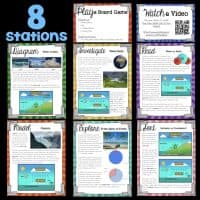
► Watch a Video – Students watch a video about water on Earth or the water cycle. They answer questions in order to reinforce what they have learned. (Google Form™️ available)
► Play a Game – Students play a board game with other students. Another option is a crossword or word search puzzle. The crossword and word search puzzles are available digitally.
► Investigate Watersheds – Students read about the water cycle and watersheds. They make their own watershed and investigate how water moves through it. They answer questions in order to reinforce what they have learned. (Google Form™️ and Google Slides™️ are available)
► Diagram Water Graphs – Students read about the water cycle and how water is distributed on Earth. They create graphs to diagram this distribution and perform an activity to better visualize it. They then answer questions in order to reinforce what they have learned. (Google Form™️ and Google Slides™️ are available)
► Read Water on Earth – Students read about the water cycle and water distribution on Earth. They answer questions in order to reinforce what they have learned. (Google Form™️ is available)
► Model Glaciers – Students read about the water cycle and how most freshwater is found in glaciers and ice caps. They create a model of a glacier to show how glaciers move. (Google Form™️ and Google Slides™️ are available)
► Explore From Salty to Fresh – Students read about water distribution on Earth, water scarcity, and saltwater on Earth. They explore saltwater in a hands-on activity. They answer questions in order to reinforce what they have learned. (Google Form™️ and Google Slides™️ are available)
► Sort Saltwater or Freshwater – Students read about water on Earth. They sort several water systems into freshwater and saltwater categories. They then answer questions in order to reinforce what they have learned. (Google Form™️ and Google Slides™️ are available)
Google Classroom™️ Components Include:
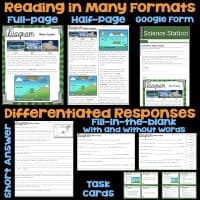
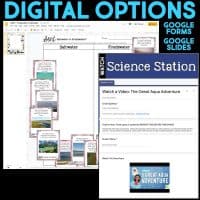
► Google Form™️ with Reading Passage & Differentiated Questions (for Watch, Investigate, Diagram, Read, Model, Explore and Sort)
► Google Slides™️ with Activity Directions & Worksheets (for Investigate, Diagram, Model, Explore, Sort)
Each station is designed to last about 15-20 minutes. Students may do one a day for eight days, two a day for four days, or any format that works for your classroom. Because there are additional activities for the Watch and Play stations, you can offer those as a choice within that station or offer them as an early finisher station, as well.
NGSS Alignment
As a Fifth Grade Performance Expectation, students are expected to “Describe and graph the amounts and percentages of water and freshwater in various reservoirs to provide evidence about the distribution of water on Earth.” (5-ESS2-2). This correlates with the DCI 5-ESS2.C, which states, “The Roles of Water in Earth’s Surface Processes: Nearly all of Earth’s available water is in the ocean. Most freshwater is in glaciers or underground; only a tiny fraction is in streams, lakes, wetlands, and the atmosphere.”
The NGSS are three-dimensional. These stations meet:
- Performance Expectation: 5-ESS2-2
- Disciplinary Core Ideas: ESS2.C: The Roles of Water in Earth’s Surface Processes
- Science and Engineering Practices: Using Mathematics and Computational Thinking
- Crossing Cutting Concepts: Scale, Proportion, and Quantity

Black Bunny Classroom –
thank you so much. this will really help with my students this year.
Pamela Bean –
This is a fantastic resource to use with students. They were very engaged.
Nicole Muratore –
Great resource! This was engaging and my students really enjoyed this and learned a great deal. Thank you!
Brandi R. –
Students loved this resource and found it to be very engaging!
Elizabeth M. –
My students loved these activities. It made teaching the required standards on water so easy. They were age appropriate and engaging. Amazing resource!