
Glacier Model Activity for 4th Grade Science
When students encounter glaciers in a science unit on Earth’s surface changes, the concept can feel abstract with ancient ice, distant mountains, and slow processes measured in centuries. This glacier model activity for 4th grade brings that process right into the classroom, giving students a tactile way to see how moving ice shapes the land.
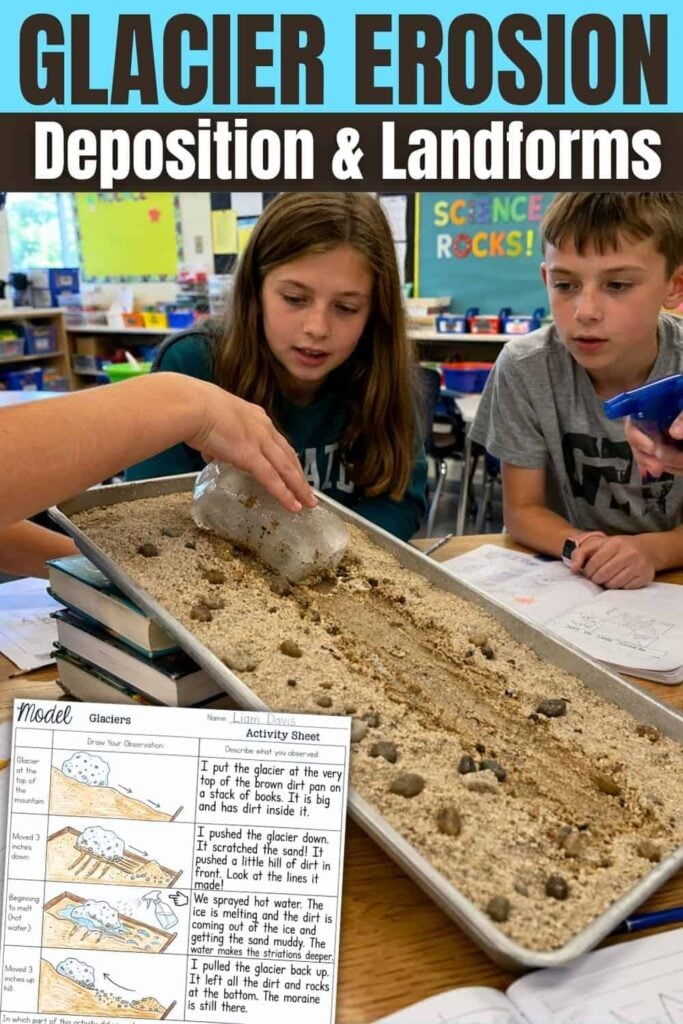
It’s one of 12 stations in the Weathering and Erosion Science Stations unit, aligned with the NGSS 4-ESS2-2 performance expectation, which asks students to make observations about the effects of weathering and erosion by water, ice, wind, or vegetation.
What Students Learn About Glacier Erosion and Deposition
Before picking up any materials, students read an informational passage about glaciers and their role in weathering and eroding mountains and valleys. The passage introduces these core concepts:
- What a glacier is and how it forms and moves
- How glaciers weather rock through abrasion, the grinding of embedded sediment against bedrock below
- How glaciers carve U-shaped valleys as they move through mountains
- How deposition works when a glacier melts and drops its load of sediment, forming landforms called moraines
- How glaciers connect to the broader story of water, ice, and land change on Earth
This reading lays the groundwork for the model activity that follows, providing students with the vocabulary and conceptual framework they need before they begin making observations.
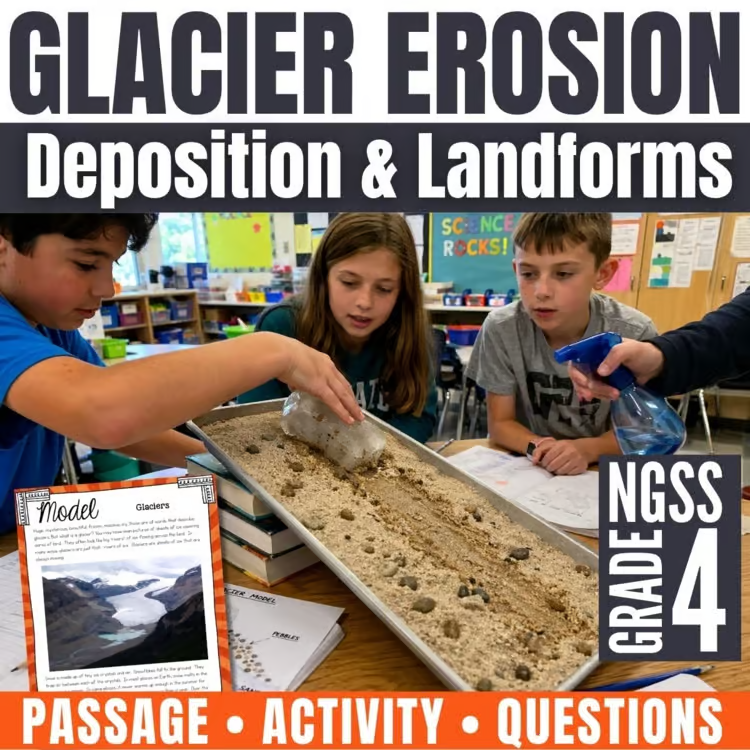
Students explore glacial erosion, deposition, and landforms through reading, modeling, and observation, helping them truly understand how glaciers shape Earth’s surface.
The Glacier Model Activity: Setup and What Students Do
The materials are simple to gather: a large pan at least three inches deep and sixteen inches long, sand, pebbles, a chunk of ice prepared ahead of time with sand and pebbles frozen inside, and a spray bottle of hot water. The ice chunk is the key. The embedded sediment pieces allow students to observe glacial abrasion in action. Preparing it the night before station day takes just a few minutes.
Students fill the pan with a layer of sand and pebbles to represent Earth’s surface, then slowly push the ice chunk across it. As the frozen-in sediment scrapes against the surface below, visible scratches form in the sand. After moving the “glacier,” students spray it with hot water to model melting, then observe where sediment is deposited, building a firsthand picture of how moraines form. Students record their observations and answer comprehension questions that connect the model back to real glacial processes.
The station runs for about 20 minutes and is designed to be completed independently using the included directions card, so you can work with other groups while this one runs on its own.
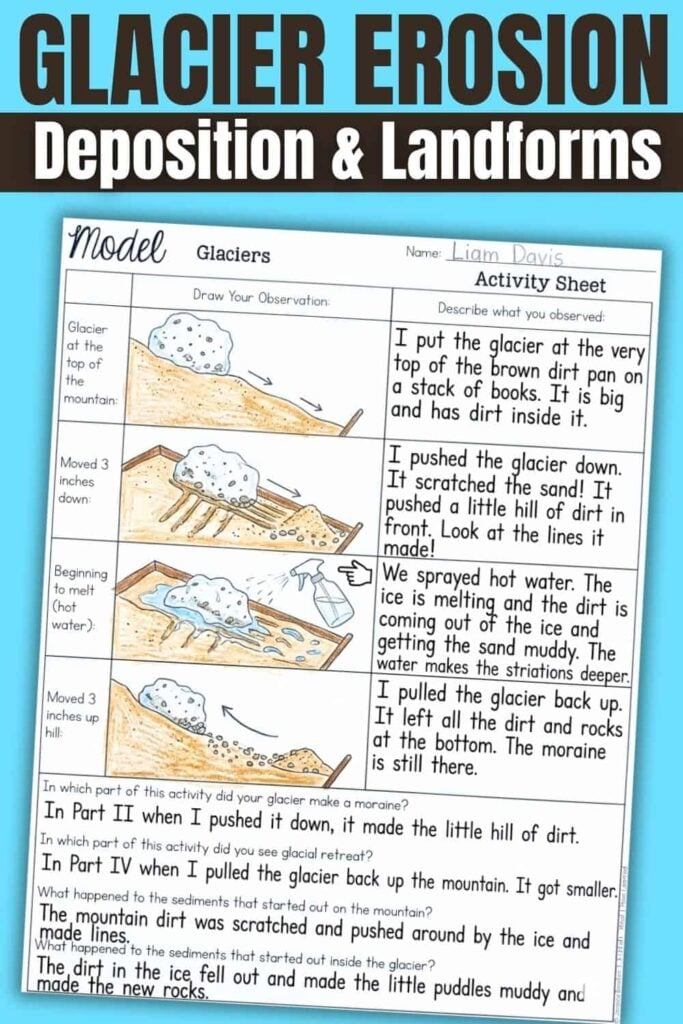
Student Sheets and Comprehension Questions
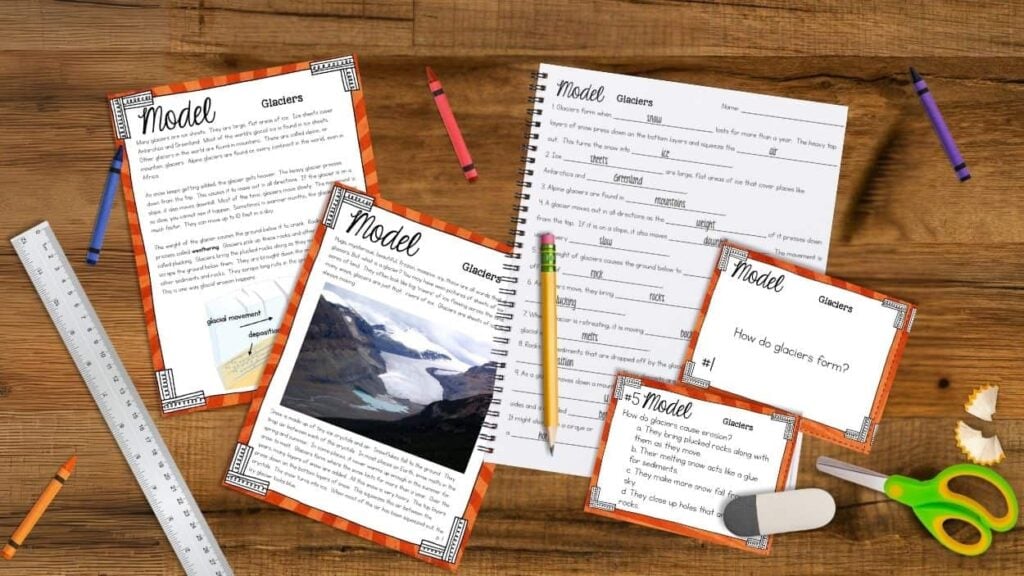
Three response formats give you flexibility depending on your class. The short-answer worksheet asks students to explain glacial processes in their own words and connect their observations to the reading. The fill-in-the-blank version uses sentence frames to reduce writing demands without lowering thinking expectations, and a word bank version is also included for additional support. Multiple-choice task cards work well for students who do better with structured response options and pair easily with science journals.
Questions cover what abrasion is and how it happens, how glaciers create valleys, what a moraine is, and how the model compares to actual glaciation. The task cards also function well as a quick exit ticket at the end of station time.
Using This Glacier Model Activity in Your Classroom
- Set it up as one of eight rotating science stations in your Weathering and Erosion unit. It pairs naturally with the other stations in the set, including the beaver dam model and the physical and chemical weathering explore station
- Use it as a whole-class demonstration at the start of your glaciers lesson, then send students to the station independently later in the week
- Have partners work together with defined roles, one pushes the glacier and makes observations while the other records, then they switch for the melting and deposition phase
Why This Glacier Erosion Activity Works So Well
Students See the Evidence Form in Real Time
Reading about glacial abrasion is one thing. Watching scratches appear in the sand as the ice drags its embedded pebbles across the surface is something students remember. The physical model produces visible evidence that students can draw, describe, and reference when answering their comprehension questions, and that kind of concrete, firsthand experience is hard to replicate with a textbook alone.
Vocabulary Takes on Real Meaning
Terms like abrasion, deposition, moraine, and erosion appear in the reading passage first, then become tangible during the hands-on activity. By the time students write their responses, they’re not guessing at definitions. They’re describing what they actually observed. That’s a different kind of vocabulary learning, and it sticks.
It Directly Addresses the NGSS Standard
The 4-ESS2.A Disciplinary Core Idea states that water, ice, wind, living organisms, and gravity break rocks and move sediment. This activity gives students direct observational evidence of ice doing exactly that. Students aren’t told what glaciers do. They observe it, record it, and explain it in writing. That’s the scientific practice of constructing explanations from evidence.
Cross-Curricular Reading Practice Built In
The informational reading passage aligns with fourth-grade ELA standards 4.RI.1, 4.RI.3, 4.RI.4, and 4.RI.7. Students practice reading closely, identifying key details, determining the meaning of academic vocabulary in context, and interpreting visual information alongside the text. It’s a strong dual-purpose station that pulls meaningful reading work into science time.
Differentiation for Every Learner
For Additional Support
- Use the fill-in-the-blank version with the word bank, the sentence frames reduce writing demands while keeping the thinking expectations intact
- Pre-teach key vocabulary (glacier, erosion, deposition, moraine, abrasion) with the included vocabulary cards before station day, so students arrive already familiar with the terms in the passage
- Pair students strategically so a stronger reader can support a peer during the reading passage portion, while both contribute equally during the hands-on model
For Extension
- Challenge students to predict what the valley shape would look like if the glacier moved faster or slower, then explain their reasoning using evidence from the reading passage
- Ask students to research a real glacier, like the Athabasca Glacier in Canada or Franz Josef in New Zealand, and compare photographs of real glacial landforms to what their model produced
- Have students write a before-and-after description of the landscape, explaining the specific processes that caused each change they observed
Bringing It All Together
By the end of this glacier model activity, 4th graders understand that glaciers are powerful, slow-moving agents of change that carve valleys, transport rock, and leave behind moraines as evidence of their journey. They’ll be able to describe abrasion and deposition using observations from the model they built, connect those processes to real-world glacial landforms, and explain how glaciers fit into the broader story of how Earth’s surface changes over time.
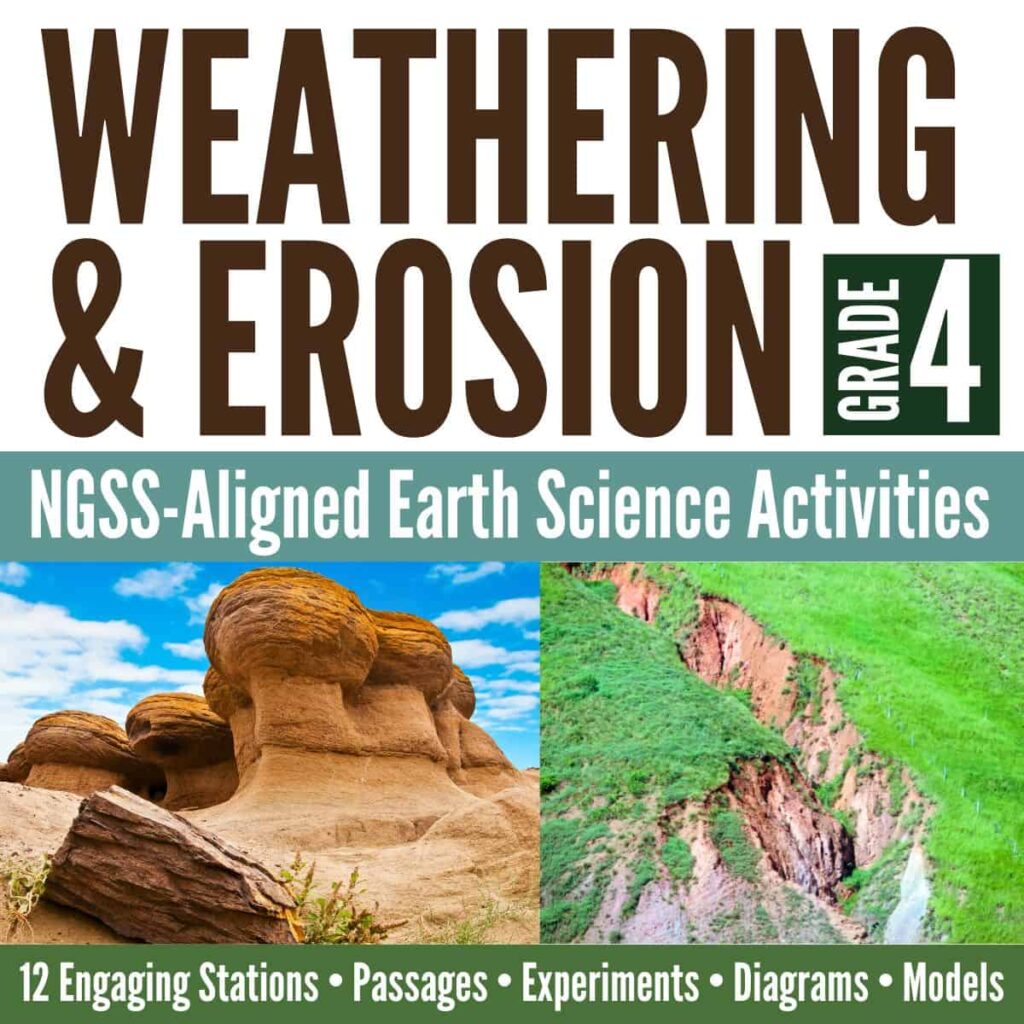
Weathering & Erosion – Earth Materials & Systems, Biogeology BUNDLE
Weathering & Earth Materials & Systems, Biogeology Fourth Grade Next Generation Science Standards include 12 different science stations where students deepen their understanding of how weathering and erosion change the Earth’s surface.
Students explore glacial erosion, deposition, and landforms through reading, modeling, and observation—helping them truly understand how glaciers shape Earth’s surface.
Jessica BOschen
Jessica is a teacher, homeschool parent, and entrepreneur. She shares her passion for teaching and education on What I Have Learned. Jessica has 16 years of experience teaching elementary school and currently homeschools her two middle and high school boys. She enjoys scaffolding learning for students, focusing on helping our most challenging learners achieve success in all academic areas.