



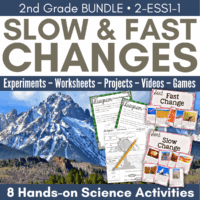
History of the Earth: Slow and Fast Changes Second Grade Science Stations
$12.93
In this set of science stations, students learn about how plate tectonics, earthquakes and volcanoes and how they affect the shape of the land around us. It includes 8 different science stations where students deepen their understanding of plate tectonics. All stations in this set meet the DCI 2-ESS1-1 and incorporate ETS1.A.
In this set of science stations, students learn about how plate tectonics, earthquakes and volcanoes and how they affect the shape of the land around us. It includes 8 different science stations where students deepen their understanding of plate tectonics. All stations in this set meet the DCI 2-ESS1-1 and incorporate ETS1.A. See below for details on how these stations meet the standards and specific DCIs.
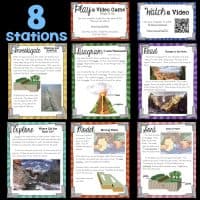
History of the Earth Stations Include
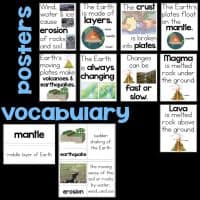
► Big Idea Posters that explain the core ideas of the stations.
► Vocabulary Cards in two formats with and without pictures.
► Watch – Students watch a video in order to learn about volcanoes, or to learn about earthquakes. They answer questions in order to reinforce what they have learned.
► Play – Students play a game in order to learn about forces of nature that shape the Earth’s surface, or to learn about volcanoes. They answer questions in order to reinforce what they have learned.
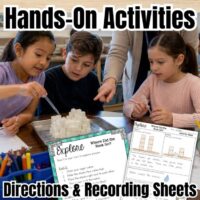
► Investigate – Students read about earthquakes. They build a building in order to investigate this. They answer questions in order to reinforce what they have learned.
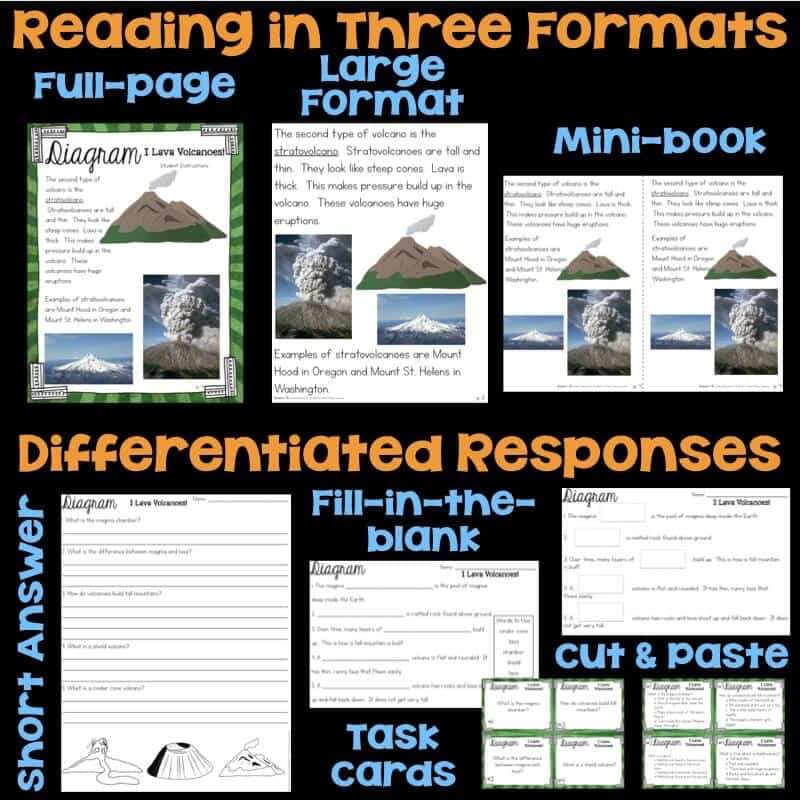
► Diagram – Students read about volcanoes. They color and label a diagram of a volcano and answer questions in order to reinforce what they have learned.
► Read a Passage – Students read about forces of erosion in the U.S. National Parks. They answer questions in order to reinforce what they have learned.
► Model – Students read about plate tectonics and put together a model of Earth’s plates. They answer questions in order to reinforce what they have learned.
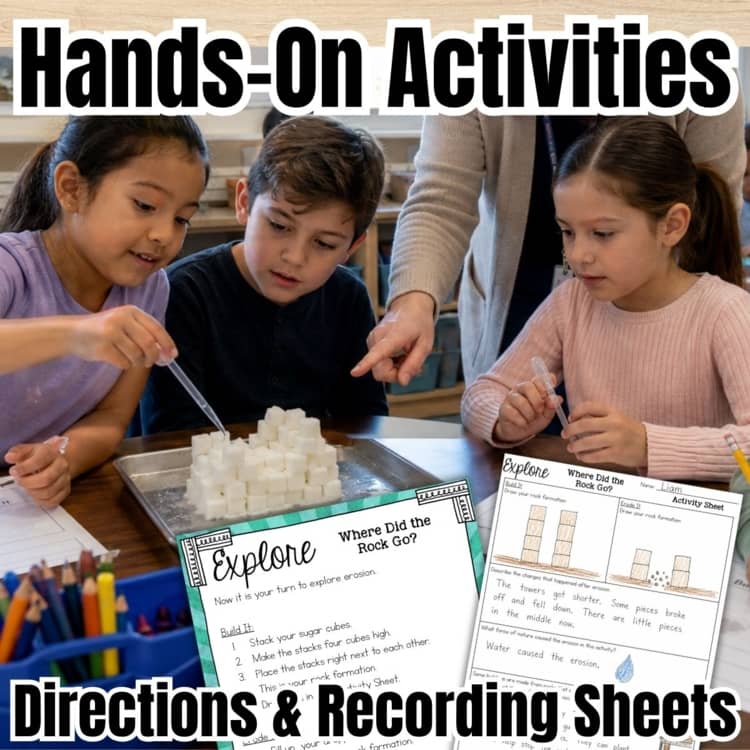
► Explore Students read about and explore erosion. They answer questions in order to reinforce what they have learned.
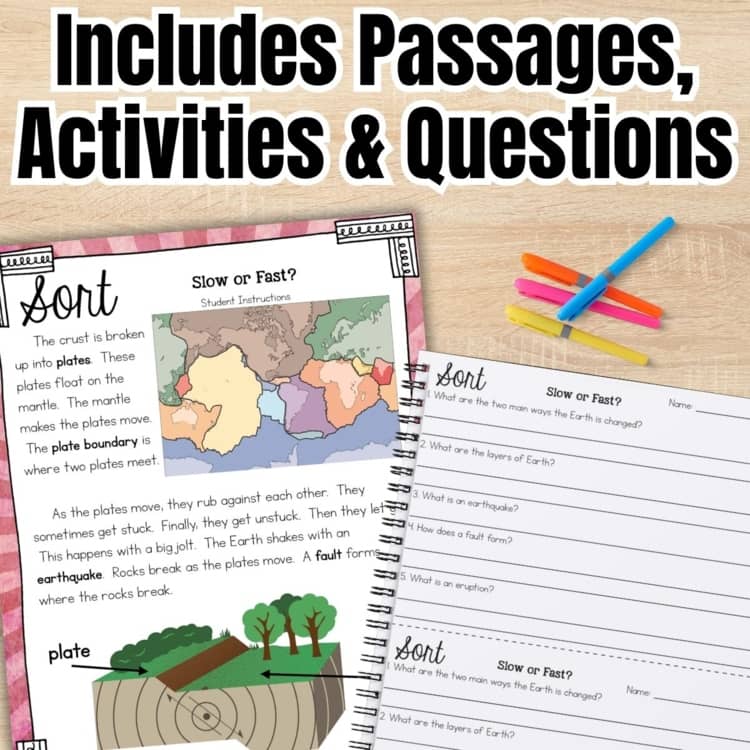
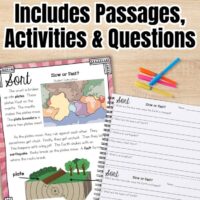
► Sort – Students read about slow and fast changes to the Earth’s surface. They sort pictures into categories of slow and fast changes. They then answer questions in order to reinforce what they have learned.
MP3 AUDIO
Now includes all MP3 audio of all text passages. You can access the MP3 via a website or install them on your devices to have students listen to the texts read aloud to them.
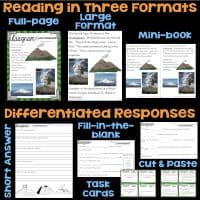
DIFFERENTIATED RESPONSES
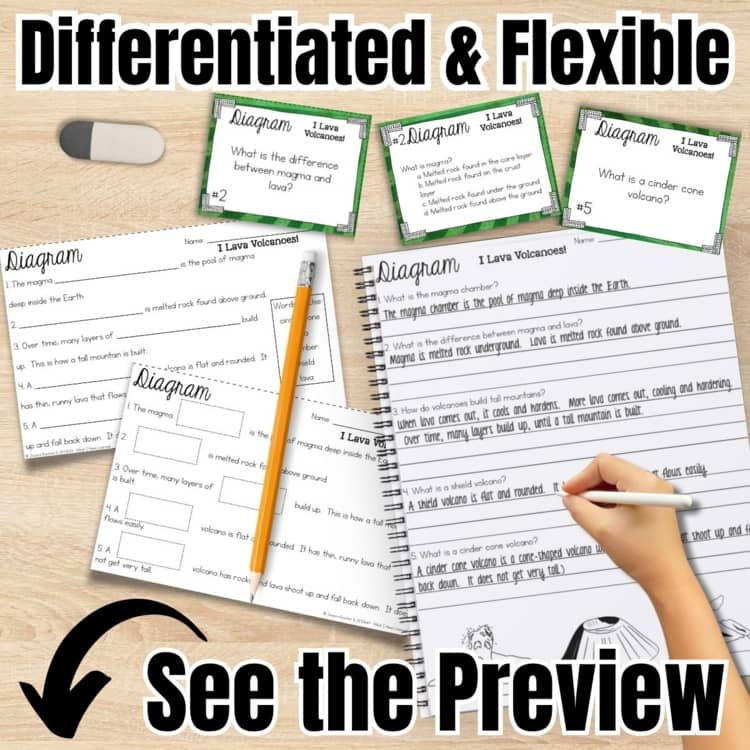
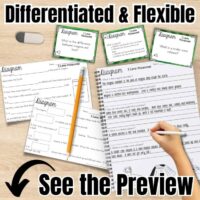
Each station includes four different ways to respond to the experience at the station: short answer questions, fill-in the blank questions, task cards with short answers, task cards with multiple choice. All the variations are similar to one another. Choose the format that best fits your classroom and students. Students are encouraged to use their science journal, but worksheets are included as well.
Each station is designed to last about 15-20 minutes. Students may do one a day for 8 days, 2 a day for four days, or any format that works for your classroom. Because there are additional activities for the Watch and Play stations, you can offer those as a choice within that station or offer them as an early finisher station, as well.
NGSS Standards
In Second Grade, students are expected to demonstrate understanding in the following area:
• 2-ESS1-1. Use information from several sources to provide evidence that Earth events can occur quickly or slowly.
This correlates with the DCI 2-ESS1-1, which states:
• Some events happen very quickly; others occur very slowly, over a time period much longer than one can observe.
The Investigate, Diagram, and Explore stations correlate with the Engineering Design DCI ETS1.A, which states:
•A situation that people want to change or create can be approached as a problem to be solved through engineering. (K-2-ETS1-1)
• Asking questions, making observations, and gathering information are helpful in thinking about problems. (K-2-ETS1-1)
• Before beginning to design a solution, it is important to clearly understand the problem. (K-2-ETS1-1)
The Investigate, Diagram, Model, and Explore stations meet the Science and Engineering Practices:
• Asking questions and defining problems in K–2 builds on prior experiences and progresses to simple descriptive questions: ((1) Ask questions based on observations to find more information about the natural and/or designed world(s). (K- 2-ETS1-1) and (2) Define a simple problem that can be solved through the development of a new or improved object or tool. (K-2- ETS1-1)
• Developing and Using Models: Modeling in K–2 builds on prior experiences and progresses to include using and developing models (i.e., diagram, drawing, physical replica, diorama, dramatization, or storyboard) that represent concrete events or design solutions. (Develop a simple model based on evidence to represent a proposed object or tool. (K-2-ETS1-2)
• Analyzing and Interpreting Data: Analyzing data in K–2 builds on prior experiences and progresses to collecting, recording, and sharing observations. (Analyze data from tests of an object or tool to determine if it works as intended. (K-2-ETS1-3)
Elizabeth Burris –
Fast and slow changes to earth surface was the perfect addition to our sc science unit.
Julie A O V. –
This was a great resource that saved me a lot of time. The kids loved it! Thanks for sharing it with us.
Sheila K. –
Great resource for my students for hands on learning
kendall C. –
Such a helpful resource! Everything was explained well and the activities were engaging for all levels.
The Bilingual Schoolhouse –
Used this resource with my 3rd graders to review science.