

Reversible and Irreversible Changes – Second Grade Science Stations
$14.87
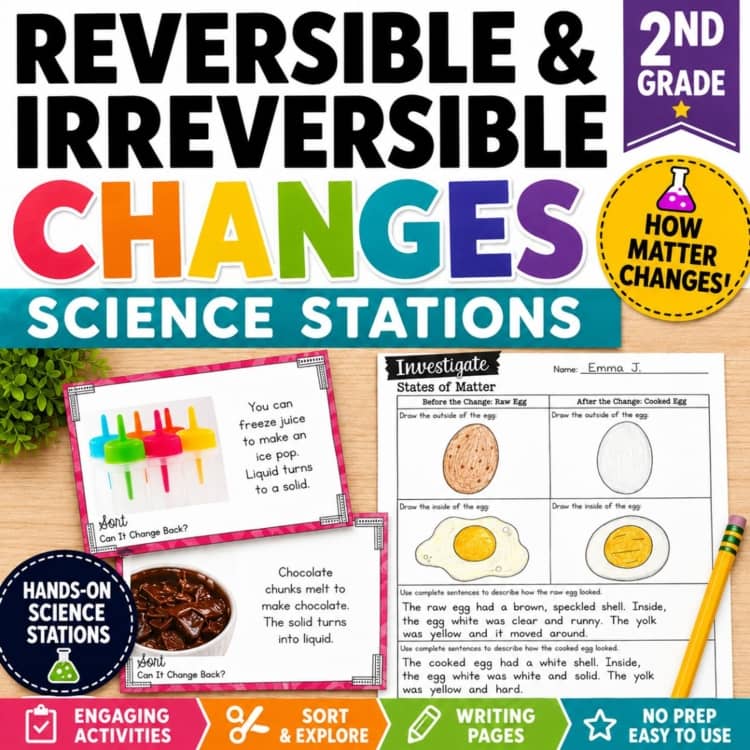
The “It’s a Matter of Change – Reversible and Irreversible Changes” Science Stations for Second Grade include 8 different science stations where students deepen their understanding of the changes of various forms of matter. All stations in this set meet the DCI 2-PS1.B, helping students gain an understanding of how some changes caused by heating and cooling can be reversed and some cannot. See below for details on how these stations meet the standards and specific DCIs.
The “It’s a Matter of Change – Reversible and Irreversible Changes” Science Stations for Second Grade include 8 different science stations where students deepen their understanding of the changes of various forms of matter. All stations in this set meet the DCI 2-PS1.B, helping students gain an understanding of how some changes caused by heating and cooling can be reversed and some cannot. See below for details on how these stations meet the standards and specific DCIs.
It’s a Matter of Change Stations Include
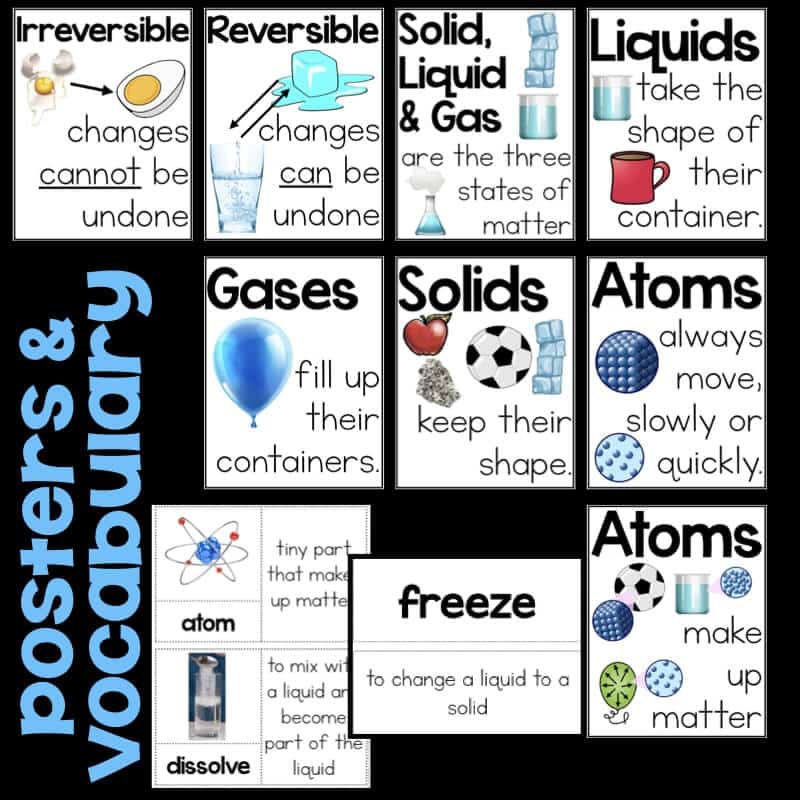
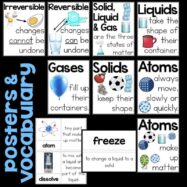
► Big Idea Posters that explain the core ideas of the stations.
► Vocabulary Cards in two formats with and without pictures.
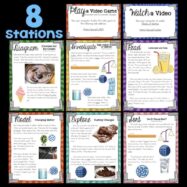
► Watch – Students watch a video in order to learn about changes in states of matter or about how the changing in states of water makes clouds and weather. They answer questions in order to reinforce what they have learned.
► Play – Students play a game in order to learn about changing states of matter or about reversible and irreversible changes. They answer questions in order to reinforce what they have learned.
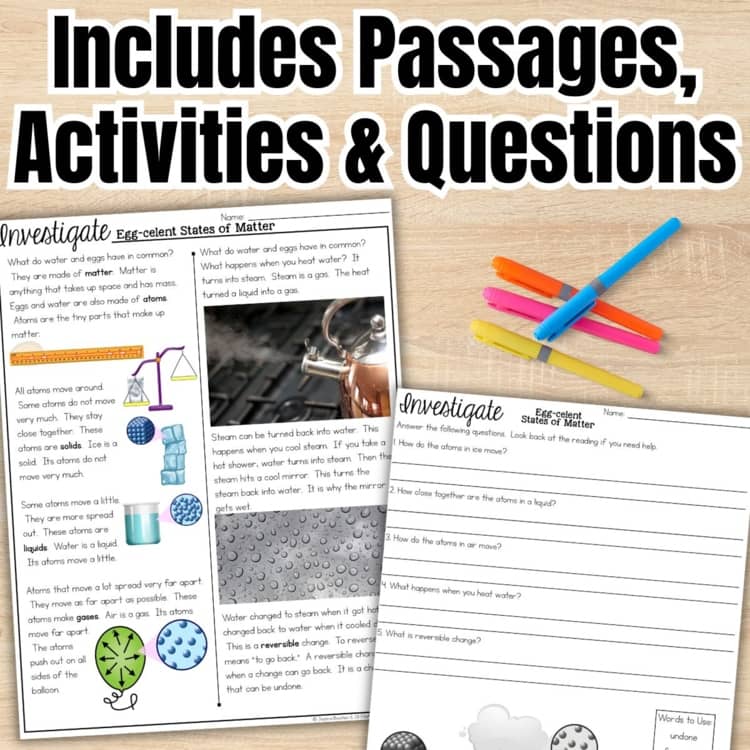
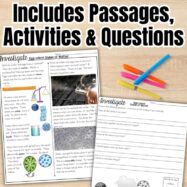
► Investigate – Students read about reversible and irreversible changes, specifically when matter changes state. They make observations of an example of an irreversible change in order to investigate this. The answer questions in order to reinforce what they have learned.
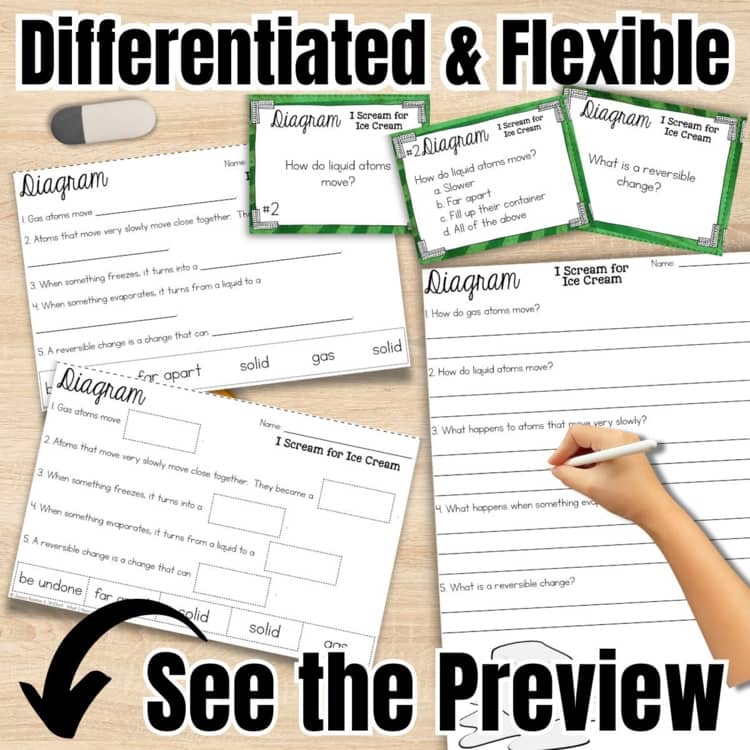
► Diagram – Students read about changes in states of matter. They put together a diagram of changing states of matter and answer questions in order to reinforce what they have learned.
► Read a Passage – Students read about properties and states of matter. They answer questions in order to reinforce what they have learned.
► Model – Students read about and states of matter and types of changes. They make a model of and answer questions in order to reinforce what they have learned.
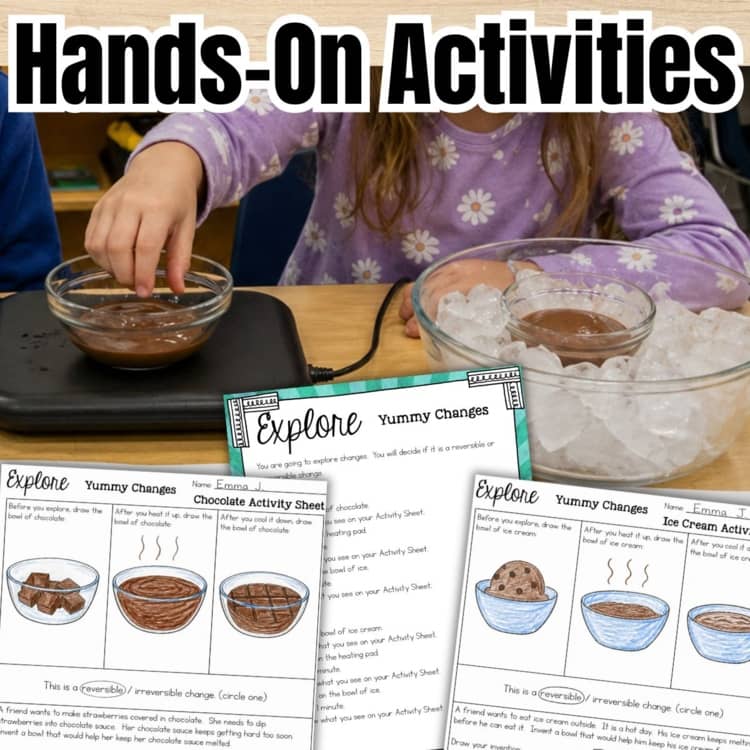
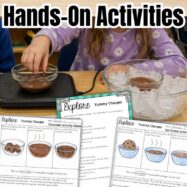
► Explore Students read about changing states of matter. They explore this and answer questions in order to reinforce what they have learned.
► Sort – Students read about reversible and irreversible changes as matter changes state. They sort pictures into two categories. They then answer questions in order to reinforce what they have learned.
MP3 AUDIO
Now includes all MP3 audio of all text passages. You can access the MP3 via a website or install them on your devices to have students listen to the texts read aloud to them.
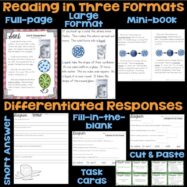
Differentiated Responses
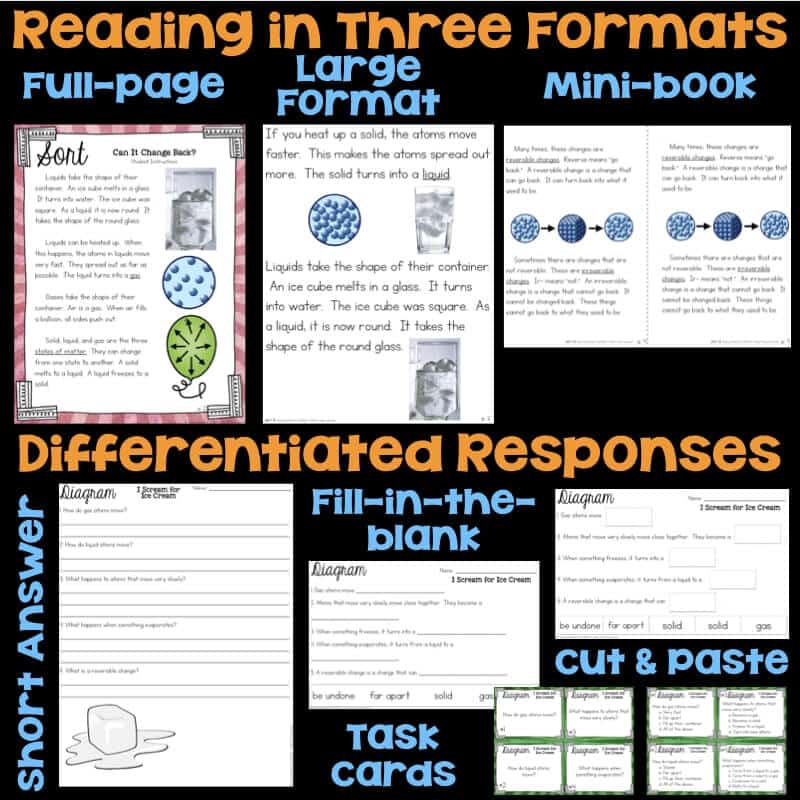
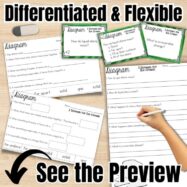
Each station includes four different ways to respond to the experience at the station: short answer questions, fill-in the blank questions, task cards with short answers, task cards with multiple choice. All the variations are similar to one another. Choose the format that best fits your classroom and students. Students are encouraged to use their science journal, but worksheets are included as well.
Each station is designed to last about 15-20 minutes. Students may do one a day for 8 days, 2 a day for four days, or any format that works for your classroom. Because there are additional activities for the Watch and Play stations, you can offer those as a choice within that station or offer them as an early finisher station, as well.
NGSS Standards
In Second Grade, students are expected to demonstrate understanding in the following areas:
• 2-PS1-4. Construct an argument with evidence that some changes caused by heating or cooling can be reversed and some cannot.
This correlates with the DCI 2-PS1.B, which states:
• Heating or cooling a substance may cause changes that can be observed. Sometimes these changes are reversible, and sometimes they are not.
The Investigate, Diagram, and Explore stations correlate with the Engineering Design DCI ETS1.B, which states:
• Designs can be conveyed through sketches, drawings, or physical models. These representations are useful in communicating ideas for a problem’s solutions to other people. (K-2-ETS1-2)
Crosscutting Concepts
The Crosscutting Concepts are met in the following ways:
• Cause and Effect: Events have causes that generate observable patterns. (2-PS1-4)
This Concept is met in the Investigate, Model, and Explore stations.
Loren W. –
Very well put together and ready to use. My students enjoyed it, and it made teaching this concept much easier.
Amy F. –
Great resource! Kept the kids engaged.
Amanda B. –
Great activities to teach the how the changes in matter happen.
Heather A. –
This was perfect for teaching the skill in a way that students really understood it.
Stephanie J. –
This is the most comprehensive unit I've found for these 2nd grade science standards. It includes observations and experiments that are easy to implement and are engaging for students.