
Writing an Expository Paragraph About Animals Using Problem and Solution
Teaching students how to write an expository paragraph about animals can feel tricky, especially once you move past simple facts. Students often list information without organizing their ideas or explaining why those facts matter. One structure that works especially well for elementary writers is problem and solution.

In this lesson, students wrote informational paragraphs about animals with a focus on identifying a problem and explaining solutions. The topic was lionfish, an invasive species that provided a clear real-world example students could understand. This approach helped students move beyond surface-level facts and write paragraphs that actually made sense from beginning to end.
Using Informational Text to Teach Problem and Solution Writing
To build background knowledge, students read an age-appropriate informational article and watched short videos about lionfish. As a class, we recorded facts about lionfish, their habitat, and their impact on the ocean ecosystem.

The videos may or may not have been these ones: Video 1, Video 2, Video 3. These were the ones I had saved as “good videos”, but I’m not sure which one we used.
Once students had enough information, we shifted the focus to text structure. Instead of sorting facts by topic, students sorted information into two categories:
- Problems caused by lionfish
- Solutions people use to control the lionfish population
This step was challenging, which made it valuable. Many students are familiar with listing facts, yet separating problems from solutions required deeper thinking and discussion.
From Fact Sorting to a Problem and Solution Paragraph
After sorting facts, students used their notes to write a problem and solution paragraph about an animal. We practiced writing introductory sentences together, then students chose several problems and several solutions to include in their paragraphs.

A big focus during drafting was sentence flow. Students were reminded that an expository paragraph should read smoothly and sound natural. This was especially important for English learners, who often need more structured practice with academic language and transitions.
Students revised their work with the goal of making their writing clear and logical, not longer or fancier.

Building an “All About Animals” Writing Book
The lionfish paragraph was the final piece students wrote before assembling their All About Animals books. Each student wrote one informational paragraph for each animal classification, which helped reinforce both science content and writing structure.
The completed book included:
- Mammal: Wolves
- Insect: Ladybugs
- Amphibian: Spade-foot toad
- Fish: Lionfish
- Reptile: Sea turtle
- Bird: Migration
Students added a cover and divider pages for each animal group, decorated their books, and bound them together. The finished product gave students a clear sense of progress and purpose for their writing.

Building an “All About Animals” Writing Book
The lionfish paragraph was the final piece students wrote before assembling their All About Animals books. Each student wrote one informational paragraph for each animal classification, which helped reinforce both science content and writing structure.
The completed book included:
- Mammal: wolves
- Insect: ladybugs
- Amphibian: spade-foot-toad
- Fish: lionfish
- Reptile: sea turtle
- Bird: migration
Students added a cover and divider pages for each animal group, decorated their books, and bound them together. The finished product gave students a clear sense of progress and purpose for their writing.
Why Problem and Solution Works for Informational Writing
Problem and solution writing helps elementary students:
- Organize facts in a meaningful way
- Explain cause and effect
- Write stronger topic sentences
- Move beyond random fact lists
This structure works well for animal research, environmental topics, and science-based writing units.

Informational Writing Resources
This post is part of a series about Informational Writing. Throughout the informational Writing series, I show you how I teach informational Writing in the classroom by scaffolding instruction for my students. Here is a list of all the posts in the series:
- Informational Writing Overview – Unit structure and instructional routine
- Week 1: Building the Informational Writing Routine (Sea Turtles)
- Week 2: Introducing the Topic (Spade-Foot Toad)
- Week 3: Finding and Ordering Related Facts (Wolves)
- Week 4: Using a Checklist to Revise Writing (Ladybugs)
- Week 5: Organizing Facts Around a Concept (Bird Migration)
- Week 6: Applying the Full Informational Writing Process (Lionfish)
- Other tools: Genius Paragraph and Bats
The lessons shown in this series are organized in my Informational Writing Tools resource. It includes fact sorts, graphic organizers, checklists, and outlines that support each week of instruction.
In this resource, I provide the fact sorts, circle maps, links, and outline of how I taught these six weeks of informational writing lessons. Also included are checklists and a rubric to use with your students.

Informational Writing Tools for Elementary Animal Reports and Paragraph Writing
Support your elementary informational writing unit with ready-to-use informational writing tools, sentence sorts, graphic organizers, anchor charts, checklists, publishing pages, and report templates designed to help students plan, organize, and write informational paragraphs and animal reports.
Free Animal Article for Informational Writing
You can grab a free informational article about frogs that includes:
- A two-page article with color photos
- A one-page text-only version
- QR codes
- A fact-sorting activity
This resource is perfect for practicing informational reading and problem-solution or main idea writing.

Do you need engaging informational texts that your elementary students will actually want to read?
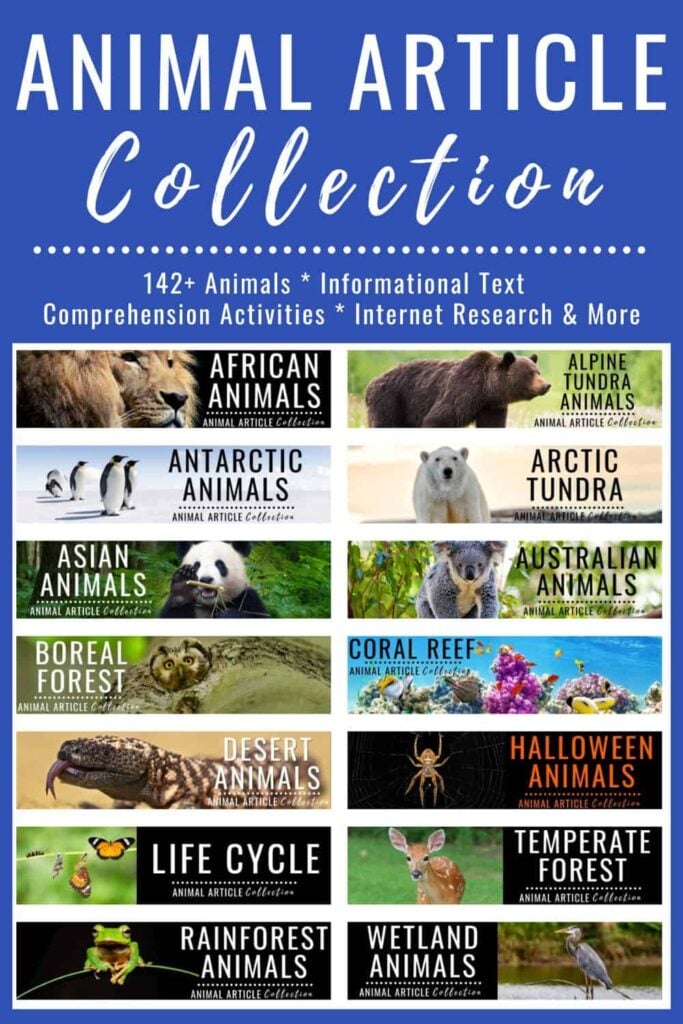
The Animal Article Collection includes 142+ animal articles spanning 14 ecosystems, complete with reading comprehension and structured writing activities. Students can choose their animal while building skills in informational text, research, and report writing.

Hello! I have just recently come across your Blog and I have to say thanks! What wonderful ideas you have I cannot wait to try these strategies with my class. I also teach 2nd grade and I can see this gather facts/sort facts/ write working great! I actually have 2 questions for you after reading about weeks 1-6 of informational writing:
1. On your writing days do you have students write a draft copy first to edit before writing a final copy of their paragraph like the ones show?
2. You referenced the writing assessment your students would have to take. I believe it was in your week 6 post you mentioned it was district wide. My current district does writing activities, but nothing like what I think you were discussing. I was wondering if you had any assessment resources that you could share.
Thanks again for these wonderful blog posts…I am about to head on over to Facebook to join that group as well!
Thanks so much! I’m glad you like the ideas and are able to implement them in your own classroom!
1. I do not have students do a draft. We didn’t have much writing time during the week. For second grade, I feel that, while drafting is a great part of the writing process, it fits better with a writer’s workshop model, where students have time to revise and edit. We didn’t have much time for the revising and editing process. My goal was to help students organize their thinking and the facts, more than establishing a writer’s workshop model. Both are good goals, but it’s hard to do both at the same time.
2. I do not have assessment resources to share, sorry. The assessment was almost exactly like the process I used while teaching. I basically replicated the process with different animals. Students were given a text about an animal and watched a video, could extract information from it, worked with a graphic organizer, then wrote their final piece. So you could use one of the animals as an assessment, with less intervention from you as a teacher. You’d just guide them through the process, but not help with the components if that makes sense.
Do you sell a packet of FACTS….like these animals that you have used as examples? The most time consuming issue for me is finding GOOD, but short text reading facts that the students can practice with.
I have animal articles for many animals. You can take a look at some of the components here: https://whatihavelearnedteaching.com/animal-articles-informational-articles-qr-codes-fact-sorts/
This gray wolf one will give you more details and images about them: https://whatihavelearnedteaching.com/gray-wolf-article-comprehension-activities/
They’re not just the facts, but include the article and the facts.
Hello
I was curious if you had an example of how you teach conclusion. It seems to be a struggle for me to get the concept to the students how they write a great conclusion. I may have missed it . So if you could point me in the right direction that would be helpful . Thanks
Not specifically. What we practice is repeating 1-3 keywords from the first sentence with a little bit more detail. In the beginning, I give students an appropriate conclusion. Referencing the Introduce the Topic blog post, I would teaching conclusions in a similar way, introducing a few variations, then adding to a list as we create our paragraphs. You can also have students highlight the keywords that are in both the introduction and conclusion so that students can see the correlation between the two sentences.
I was working with my son on this concept. His first sentence was: Beavers build homes called lodges. The paragraph was about how beavers build their homes. His last sentence was: Beavers build lodges to stay safe.