
 Open and Closed Syllables Two-Syllable Words
 How to Teach Transitions in Writing for Elementary Students
One of the places student writing most often falls apart is between ideas. Students know what they want to say — they just write it in the order it comes to mind, without helping the reader follow along. Teaching transitions in writing is one of the more direct ways to address that, and it pays off across every writing type: informational essays, opinion pieces, narratives, and procedural writing.

This post covers what transitions do, how to explain them to students, the difference between sentence-level and paragraph-level transitions, word lists organized by purpose, and a few classroom activities worth trying.
What Are Transitions in Writing?
Transitions are words and phrases that connect ideas — within a sentence, between sentences, or between paragraphs. They signal the relationship between one idea and the next: Is the writer adding information? Switching direction? Giving an example? Wrapping up?
Without transitions, writing reads like a list of unrelated facts. With them, a reader can follow the logic from one point to the next.
When students understand what a transition signals rather than just knowing it exists, they start making better choices. A student who knows “however” signals a contrast will reach for it differently than one who grabbed it off an anchor chart because it sounded right.
Why Transitions Matter in Student Writing
Transitions do two things at once: they help the reader follow the writing, and they reveal whether the writer actually understands the relationship between ideas. When a student writes “on the other hand,” they are signaling that they recognize a contrast — not just that they know a vocabulary word. That connection between signal and meaning is what makes transitions a real thinking skill, not a surface-level fix.
Transitions also work the other way: students who learn to use them as writers get better at spotting them as readers. Words like “first,” “next,” and “finally” signal sequence. “However” and “on the other hand” signal compare and contrast. When students understand this, they read informational text more strategically, too.
How to Teach Transitions in Writing
When you teach your students how to write transitions, it is important to understand that there are two types of transitions. The first way to look at them is to see them as connectors within and between sentences. The second way to look at them is to see them as connectors between paragraphs.
1. Transitions Between Sentences
When writing complex and compound sentences, students need to help their reader see how ideas are connected to each other. To do this, a writer needs to use transitions both within and between sentences.
Example:
Penguins are fascinating creatures. They also have unique behaviors that help them survive in extreme conditions.
Here, the word “also” helps connect a new fact to a previous one—perfect for informational writing.
2. Transitions Between Paragraphs
A transition between paragraphs does two things: it closes out the idea from the paragraph before and signals what is coming next. It can appear as the last sentence of a paragraph, the first sentence of the next one, or both.
These help students wrap up one idea and smoothly introduce the next.
Example:
Not only do penguins have unique physical attributes, but they also have unique behaviors.
This sentence bridges the end of one paragraph and the beginning of another, signaling that a new topic is coming while maintaining cohesion.
Teaching Tip: Use Real Student Writing
Try a mini-lesson where you take a paragraph and read it aloud without any transitions, then read the same paragraph again with transitions added. Have students describe what changed. This exercise helps them hear the difference before they are expected to apply it in their own writing.
Transition Word Lists for Elementary Writers
The English language is full of transition words, and below are just a handful of words that are perfect for all levels of elementary schoolers. Several are simple and great for emergent writers and others are great to challenge those students who have mastered the objective and are ready for more.
When to Introduce Transitions by Grade
The word lists below work for grades K-5, but the entry point looks different depending on the grade you teach.
In kindergarten and first grade, sequence words are the natural starting point: first, next, then, and finally. Students use these in procedural writing and retelling long before they write multi-paragraph essays.
In second and third grade, students can add words that show contrast and elaboration: however, but, also, for example, in addition. These come up naturally in informational and opinion writing units.
In fourth and fifth grade, students are writing multi-paragraph essays and need paragraph-level transitions that connect whole sections of writing, not just individual sentences. The closing and summary transitions (therefore, as a result, in conclusion) become more important at this level.
Here’s a collection of common transition words organized by purpose. These are great for anchor charts, writing notebooks, or reference bookmarks!
To show time or sequence
- First…second…third
- Also
- Before
- Soon
- Meanwhile
- At the same time
- Afterward
- To begin
- Once
- Another
- Lastly
- Next
- Then
- Finally
- At first
- At last
- After
- Later
To compare or contrast
- Likewise
- Similarly
- On the other hand
- But
- However
- Yet
- Rather
To add, develop, or elaborate
- In addition to
- Also
- Another
- As well as
- For example
- For instance
- However
- Therefore
- In fact
- Next
To express location/spatial
- In the center
- On the side
- On the left
- On the right
- On top
- Below
- Beneath
- Under
- Around
- Above
- Over
- Opposite
- Across
- Near
- Beyond
- Beside
To summarize or conclude
- Therefore
- Finally
- In conclusion
- As a result
Classroom Activities for Practicing Transitions
Transition Word Sort: Give students a list of 15-20 transition words and phrases and have them sort by function: Does this word show time and sequence? Contrast? Elaboration? This works well as a partner activity before introducing the word lists on the anchor chart.
Fill-in-the-Blank Sentences: Provide sentence pairs with a blank where the transition belongs. Students choose a word from the word list that fits the relationship. This is a good low-stakes way to check whether students understand what the transition signals, not just what it looks like.
Fix-Up Passages: Remove all transitions from a short paragraph and have students revise it to improve the flow. This works better than starting from a blank page because students already have the content — they just need to figure out how to connect it.
Anchor Chart Brainstorm: During shared reading or read-alouds, have students flag any transition words or phrases they notice. Add them to a class chart organized by purpose. Building the chart together over several weeks is more effective than introducing all the words at once.
Transition Hunt: During independent reading, have students use sticky notes to mark transitions they find. This works at any grade level and reinforces that transitions are tools real writers use, not just a grammar exercise.
If you are looking for resources to use alongside these activities, the informational writing post walks through the full writing process for elementary students, and the anchor chart tips post has ideas for making a class transitions chart that students will actually refer back to.
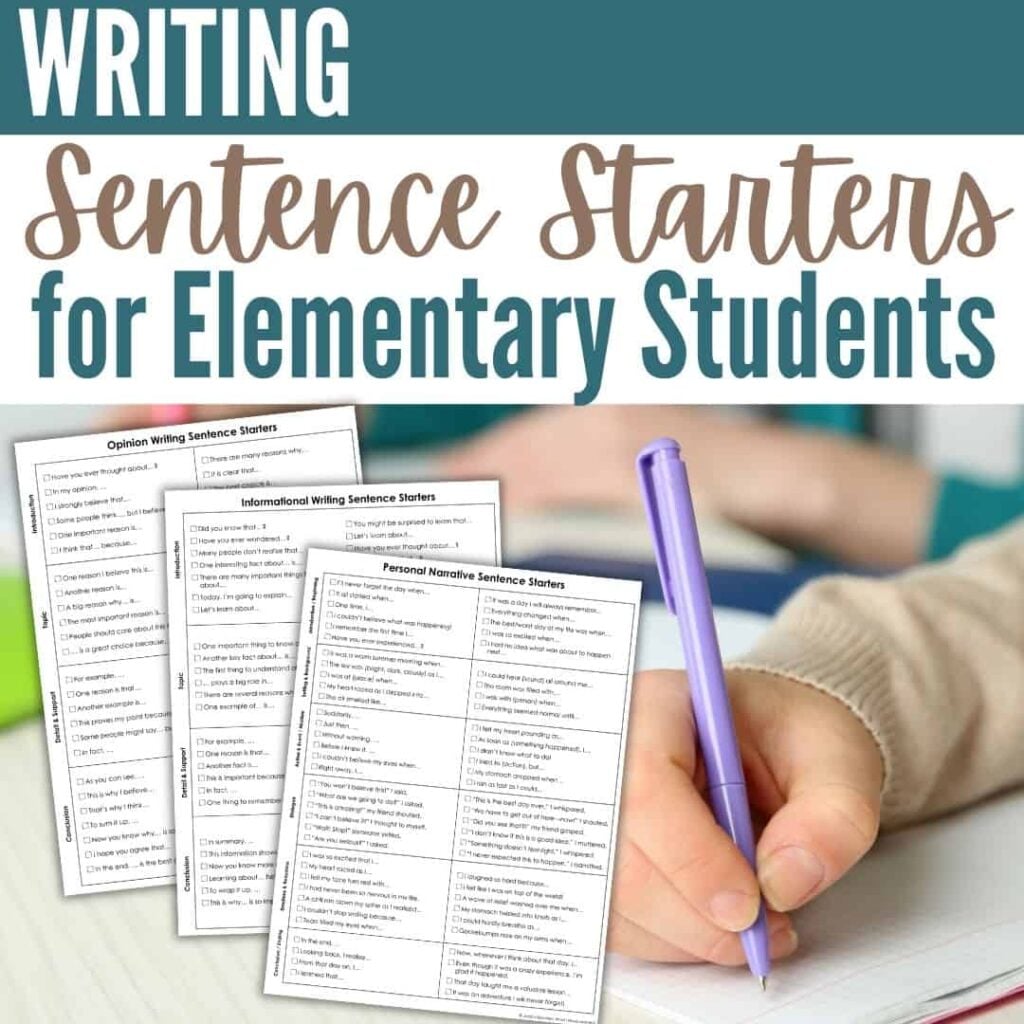
These writing sentence starters give students structured language support across all genres.

Would you like a printable version of these sentence-starters for your classroom? This resource includes anchor charts, bookmarks, and a hands-on sorting activity.
Jessica BOschen
Jessica is a teacher, homeschool parent, and entrepreneur. She shares her passion for teaching and education on What I Have Learned. Jessica has 16 years of experience teaching elementary school and currently homeschools her two middle and high school boys. She enjoys scaffolding learning for students, focusing on helping our most challenging learners achieve success in all academic areas.