
Informational Writing Week 3: Finding and Ordering Related Facts
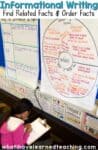
One of the biggest challenges students face in informational writing is keeping their paragraph focused. Even when students have strong facts, they often include unrelated details or struggle to decide what order their ideas should go in. During Week 3 of our informational writing unit, the focus shifts to helping students choose related facts and arrange them so their writing flows within a paragraph.

This post is part of a larger series on informational writing. The overall structure of the unit is outlined in the overview post. Here, I’m sharing how we worked on finding and ordering related facts during Week 3.
The Focus of Week 3
By the third week of the unit, students are comfortable with the routine for gathering information and sorting facts. This allows instruction to focus on paragraph cohesion rather than the process itself.
The goal for this week was not polished writing. Instead, students practiced:
- identifying which facts belong together
- separating unrelated information
- beginning to think about sentence order within a paragraph
Choosing a Topic for Practice
This week, students wrote about wolves. As in previous weeks, the animal itself was less important than the writing skill. Wolves provided enough rich information for students to practice grouping and ordering facts in different ways.
Day 1: Gathering Facts
Day 1 followed the same routine used in earlier weeks. As a class, we read informational text and watched a video to gather facts about wolves. Keeping this step consistent helped students focus their energy on the new writing skill introduced later in the week.

Many teachers have asked, so I wrote a Gray Wolf Informational Article for you to use in your classroom. It includes a fact sort, note-taking pages, and comprehension activities.
Gray Wolf Informational Article and Comprehension Activities
The Gray Wolf informational article includes vocabulary cards and comprehension activities.
Day 2: Quick Sorting and Expanding Facts
On Day 2, students completed a closed sort to group facts into categories. Because students had several weeks of experience with fact sorts, this step went quickly. Students did not glue down their facts because I wanted to use them again on Day 3.
Teaching How to Expand Sentences
Since students moved quickly through the fact sort, we spent additional time expanding simple sentences using familiar content. I modeled a few sentences and asked students to add conjunctions such as because, but, and, or, to, and so to explain ideas more clearly. Students already knew much of this information — why wolves have strong jaws, how they are related to dogs, and why they travel in packs — so the focus stayed on how to express those ideas in more complex sentences rather than generating new facts.
We practiced several examples together before students created their own sentences using a worksheet from my Informational Writing Tools resource. This work was built directly on what students were already writing, allowing me to respond to what I was seeing in their drafts. Instead of working with isolated sentence exercises, students practiced combining ideas using the same content they would later include in their informational paragraphs.

Using familiar facts, students learned to add reasons and connect ideas in ways that supported paragraph cohesion. Keeping the sentence work tied to our current topic made it easier for students to apply these skills directly to their writing.
Day 3: Grouping Related Facts
Instead of moving straight into writing, we spent time working with sentences again on Day 3. Students completed an open sort, grouping facts without pre-set categories.
How I taught students to group related facts
To help students see how facts connect, I modeled grouping small sets of sentences and identifying key words that showed what each sentence was about. I displayed three sentences together on the document camera, two that were related to how a wolf eats and one to how it looks. We analyzed each sentence and underlined the keyword that told the topic of the sentence, like eat, jaws, etc.
We discussed which sentences belonged together and which did not, emphasizing that unrelated facts should not appear in the same paragraph. We did it again, with three more sentences, one sentence being out of the group. And, again, with three more sentences.
After modeling and working with the whole class with three different sets of sentences, students were ready to try it on their own.
Here is an example from one pair of students (sorry it’s blurry, but it’s the best I have!). You can see the three groups of sentences and other random ones at the bottom of the page.

After students sorted their sentences, I discussed with the partners which topic they wanted to write about. I put a box around it and then we briefly talked about how to combine some of the sentences and how to order them. This discussion introduced the idea of sentence order, which we continue to build on in later weeks.
More Examples of How Students Grouped Their Sentences
Here are a few more sets of sentences grouped together. You can see that some of the partners have sentences with a similar theme, but they are ordered or combined differently. Here is how they grouped their related facts.

In the above example, students chose to write about how wolves work and live together.

These students wrote about how the wolves hunt and eat.

This group also wrote about how the wolves hunt and eat, but with a slightly different sentence combination. If you read the sentences in order, you can see the nuances between the three different paragraphs.
I loved doing this activity with students and helping them form paragraphs by related sentences. It opened their eyes (and mine) to how the same sentence could be used for different purposes.
Day 4-5: Ordering Sentences and Drafting
After choosing a group of related facts, students discussed how their sentences could be ordered within a paragraph. Some students combined sentences, while others focused on rearranging ideas to improve flow.
Because so much time was spent working with sentences and organization, many students did not complete a full paragraph this week. That was expected. The primary goal was to strengthen how students think about cohesion before moving forward with more independent writing.
Drafts from this week show improvement in sentence choice and flow compared to earlier weeks, even though the writing is still developing.

Here are some student samples of their drafts.


You’ll see we still have a bit of work to do on combining sentences. Students’ sentence choice and flow are better than in the previous weeks, though. It’s amazing what a little sentence work can do!
Why This Work Matters
Helping students recognize related information is a critical step in informational writing. This week gave students repeated opportunities to decide what belongs together and how ideas can be ordered to make sense to a reader. These skills continue to develop over the next several weeks of the unit.

Looking Ahead
In Week 4, the focus shifts to helping students use checklists to revise and improve their writing with greater independence.
Informational Writing Resources
This post is part of a series about Informational Writing. Throughout the series I show you how I teach informational Writing in the classroom by scaffolding instruction for my students. Here is a list of all the posts in the series:
- Informational Writing Overview – Unit structure and instructional routine
- Week 1: Building the Informational Writing Routine (Sea Turtles)
- Week 2: Introducing the Topic (Spade-Foot Toad)
- Week 3: Finding and Ordering Related Facts (Wolves)
- Week 4: Using a Checklist to Revise Writing (Ladybugs)
- Week 5: Organizing Facts Around a Concept (Bird Migration)
- Week 6: Applying the Full Informational Writing Process (Lionfish)
- Other tools: Genius Paragraph and Bats
The lessons shown in this series are organized in my Informational Writing Tools resource. It includes fact sorts, graphic organizers, checklists, and outlines that support each week of instruction.
In this resource, I provide the fact sorts, circle maps, links, and outline of how I taught these six weeks of informational writing lessons. Also included are checklists and a rubric to use with your students.

Informational Writing Tools for Elementary Animal Reports and Paragraph Writing
Support your elementary informational writing unit with ready-to-use informational writing tools, sentence sorts, graphic organizers, anchor charts, checklists, publishing pages, and report templates designed to help students plan, organize, and write informational paragraphs and animal reports.
Do you need engaging informational texts that your elementary students will actually want to read?
The Animal Article Bundle includes 142+ animal articles spanning 14 ecosystems, complete with reading comprehension and structured writing activities. Students can choose their animal while building skills in informational text, research, and report writing.
Free Informational Writing Resource
If you’d like to try this approach in your classroom, you can start with a free informational article about frogs. It includes a two-page article with photographs, a text-only version, QR codes, and a fact sort.


Can you give me the name of the Wolf book you used for your lesson? Thank you
I honestly don’t remember the title. I pulled it from our classroom library shelf and don’t have access to it anymore.
We just completed an informational article that can be used to teach your students all about wolves. Check it out here.