
Fall Leaves Math Art Activity for Second Grade
We have such a small amount of time during the day to engage in art activities, especially seasonal art. One way we have squeezed in art is to combine it with another subject.
In this Math Art Activity, we created a Fall Leaves Three-Digit Addition Activity where we combine a Fall tree with dots and then apply our three-digit addition strategies to figure out how many dots we have as a whole class.
This activity works well for second-grade students who are working on using place value strategies with three-digit addition. It can easily be adapted for first-grade and third-grade students, too!

Why Combine Art and Math?
Incorporating art with math can help children retain math facts and skills more easily. The visual aspect of art can help children better understand complex concepts such as addition and subtraction while also allowing them to express their creativity.
By creating fun and engaging math art activities for students, they are more likely to stay focused on the task at hand and stay engaged with enthusiasm. Art can be used as a tool for reinforcing math concepts in an enjoyable way that keeps children motivated and excited about learning.
How to Create this Fall Leaves three-Digit Addition Activity in the Classroom
We created this Fall leaves math art activity over a few days. This is partly due to the fact that the paint needed to dry and partly because we kept extending the math activities and our thinking about the numbers. Here is a rough outline of what we did:
- Day 1 Create the Fall Tree Art
- Day 2: Count and Add Up our Dots Individually
- Day 3: Add up our Dots as a Table Group and the Whole Class
Here are more details about each of the days and the math involved in the three-digit addition activity.
Day 1: Create the Fall Tree for the Math Art Activity
On the first day, students made their tree. I provided students with a strip of brown paper on which they drew a trunk. They then cut it out and glued it down to a piece of large white construction paper.
Students stamped the leaves with corks. We made sure to establish some norms, such as only having one cork per color and keeping each
Corks are easily available at most art stores or on Amazon. If you don’t have corks and you use a smaller sheet of paper, pencil erasers also work well for this activity. The idea is that students can see and count each individual circle.

This was my student teacher’s sample. The students had all different kinds of leaf arrangements. The designs turned out beautifully.
We let the papers dry overnight, so we could do our math problem the next day!
Day 2: Adding up our Dots to Do THe Three-Digit Addition Activity
This is the day that we practiced and applied our math strategies for three-digit addition. At this point in the year, we were just getting started on two-digit addition, so this was definitely a stretch for students.
However, the interest level was high and we approached the problem as table groups, so students were able to be successful. This activity set a good, solid foundation for our work with two-digit and three-digit addition.
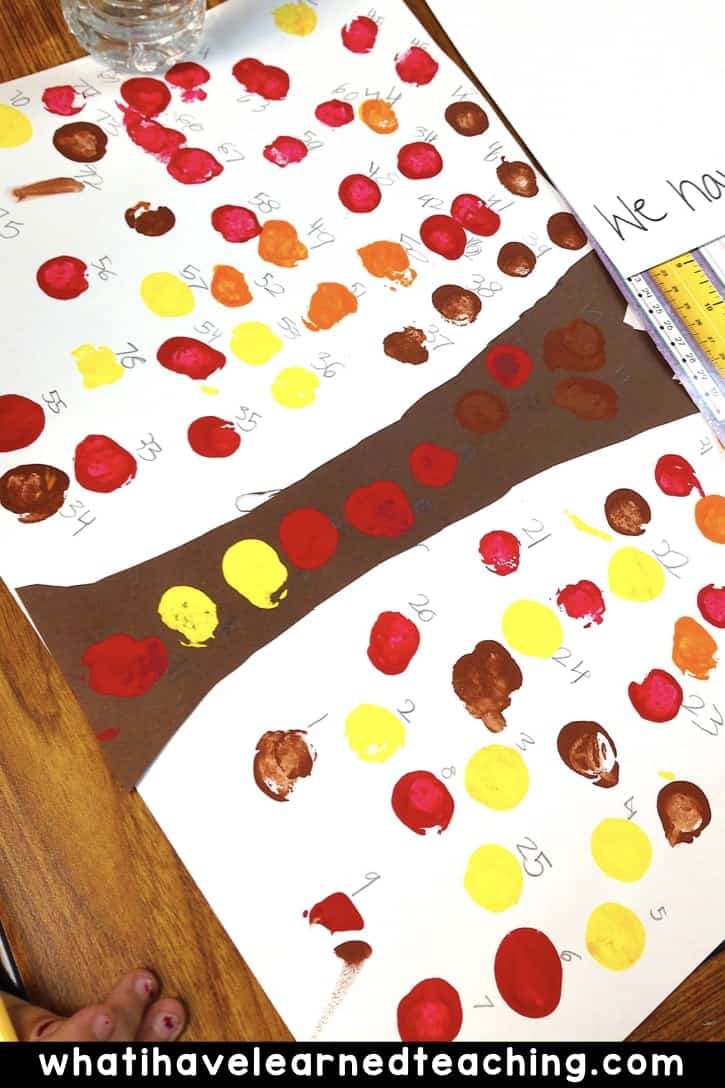
Count the Number of Leaves
Students counted the number of leaves they had on their own pictures. Students could count any way they wanted. This particular student found that numbering them was the easiest way for her to figure out how many she had.
Other students grouped the dots into groups of 10 and still others discovered different strategies.
Unfortunately, we wrote all over students’ artwork while doing the math activity. That didn’t occur to me ahead of time. In the following years, I made a photocopy of the student’s tree for them to use for the math problem.
Figure Out How Many Dots Each Table Group Had All Together
This is where the magic happened and the math art activity came to life!
After students counted their leaves, they wrote their number on a sticky note that we then put on an 11×17 piece of paper. I seat students in groups of four, so most table groups had four sticky notes. The goal was for each table to group to figure out how many dots they had as a group.
Our ultimate goal was to figure out the number of dots as a whole class and breaking it up by table groups was a way to make the task not so overwhelming.
Estimate first!
We had students estimate the number of leaves they had. That part didn’t go so well . . . we hadn’t done enough estimation in class! This was a great opportunity for me to see students’ skills with estimating and a great way to practice it.
Add up the Number of Leaves
Table groups then added up the number of leaves at their table group. Each group approached the problem in a slightly different way. Here are a few examples:
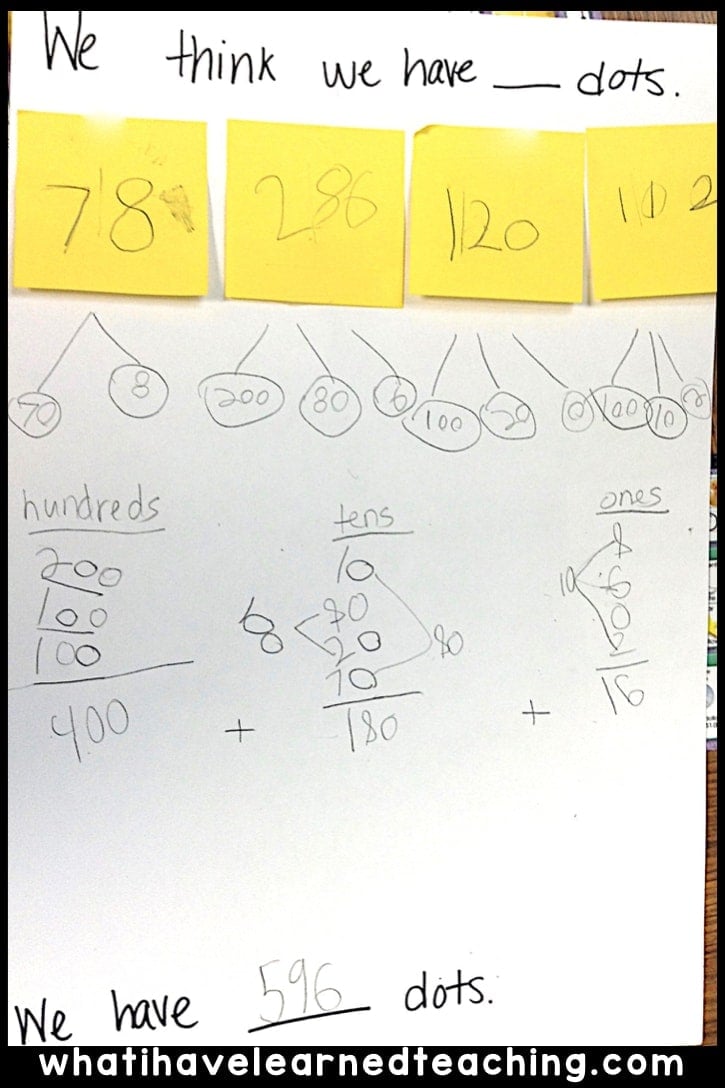
The above table group broke apart each number into hundreds, tens, and ones. They then added each place value, combined numbers to make friendly numbers, and found their total number of dots.

The above table group combined the numbers on two sticky notes using place value strategies, then combined those two numbers into the total.
We’ve been practicing the “break it apart” strategy as a whole class with our homework stars, so students were most familiar with that strategy. It’s what most table groups use to solve their problems in this three-digit addition activity. We worked a lot on emphasizing that we add ones to ones, tens to tens, and hundreds to hundreds.

As you can see, each table group had a slightly different strategy. Some needed a little bit of help and guidance, but overall, they did a great job!
Most table groups used some sort of break-apart place value strategy during the three-digit addition activity.
Have Table Groups Share Out
After table groups added their four numbers, I took the above photos and displayed them on our screen. Each group came to the front of the room and talked about how they solved the problem.
That was really difficult for most of my kiddos. Almost all of them are English learners and many have difficulty with the language to express their thinking. The three-digit math activity was a high academic task that required quite a bit of brain power. To articulate all of the math thinking involved and attaching language to it was really hard. However, it’s also a good skill to develop throughout the school year.
Students have had so much practice with getting an “answer”. My goal was to have students explain their thinking. This was a major shift for them!
Add up Each Table Group to Come Up with the Whole Class Number
I had each table group tell me how many dots they had and we added up how many dots we had as a class. We broke apart each number and added each place value. This mimicked what students did in their table groups, but with larger numbers.

This is way too large of a number for second grade students, but it was fun playing around with the digits, place value, and exploring adding large numbers.
We talked about making a 10 or a 100 when adding and other strategies. We did put the number together (1400+270+17), but I didn’t get a photograph of it!
Math Strategies Included in this Math Art Activity
We focused on a whole lot of math strategies when doing this activity. It took about three days and here is what we covered:
- Figuring out the best way to count large numbers – making equal groups, using friendly numbers
- Place value strategies for three-digit addition
- Using friendly numbers when adding larger numbers
There were also quite a few non-math skills we learned, including working together as a team toward a common goal.
Student Motivation in Math with Art
The students were super motivated because it was math related to their artwork and something they created. I didn’t really care if they counted their circles correctly. What I really wanted was to generate two-digit numbers for them to add together and give them experience working with their table group to solve a problem.
Success!
Now to find more problems like this that students can explore with partners and small groups! Do you do math problems like this with your students? I’d love to hear about them below in the comments.
Suggestions on How to Adapt this Math Art Activity for Other Grade Levels
This math art activity can easily be modified for other grade levels. Here are a few ways you can modify the activity:
First Grade Classrooms
If you teach first grade, consider providing the tree trunk cut out. Provide students with a smaller piece of paper with the intention of making fewer dots. Give instructions about making groups of 10 and focus more on making 10. If you have a lot of dots, count a specific color.
Third Grade Classrooms
If you teach third grade, consider having students choose a multiplication fact and make equal groups using that math fact.
Fourth & Fifth Grade Classrooms
If you teach upper grades, you can still do the art activity and have students count each color of leaves. Some suggestions for extending the math activity include:
- Writing word problems
- Writing equations
- Using exponents to express the amount of each color or the total number of leaves
I bet you have a few ideas of your own, too! I’d love to hear about how you have combined math and art in your classroom.

Graphing the colors might be a good follow up, as long as they are so into using the art.
What an awesome lesson! Thanks for sharing:)
Tara
The Math Maniac