
Daily Math: A Number Sense Routine for Elementary Grades

At some point in the first few years of teaching, most elementary teachers look at their calendar time and wonder if they are getting as much out of it as they could. The days of the week, the months, the weather chart, the counting of school days, the pattern activities: it is a lot of moving pieces for a routine that, by second grade, students have largely outgrown.

A daily math routine replaces that structure with something more flexible and more directly tied to the math standards you are actually teaching. Instead of counting the number of days in school, students work with a chosen number each day: pulling it apart, putting it back together, comparing it, representing it in multiple ways. It takes about ten minutes, builds number sense systematically, and spirals the key concepts your students need to keep practicing.

What Daily Math Looks Like
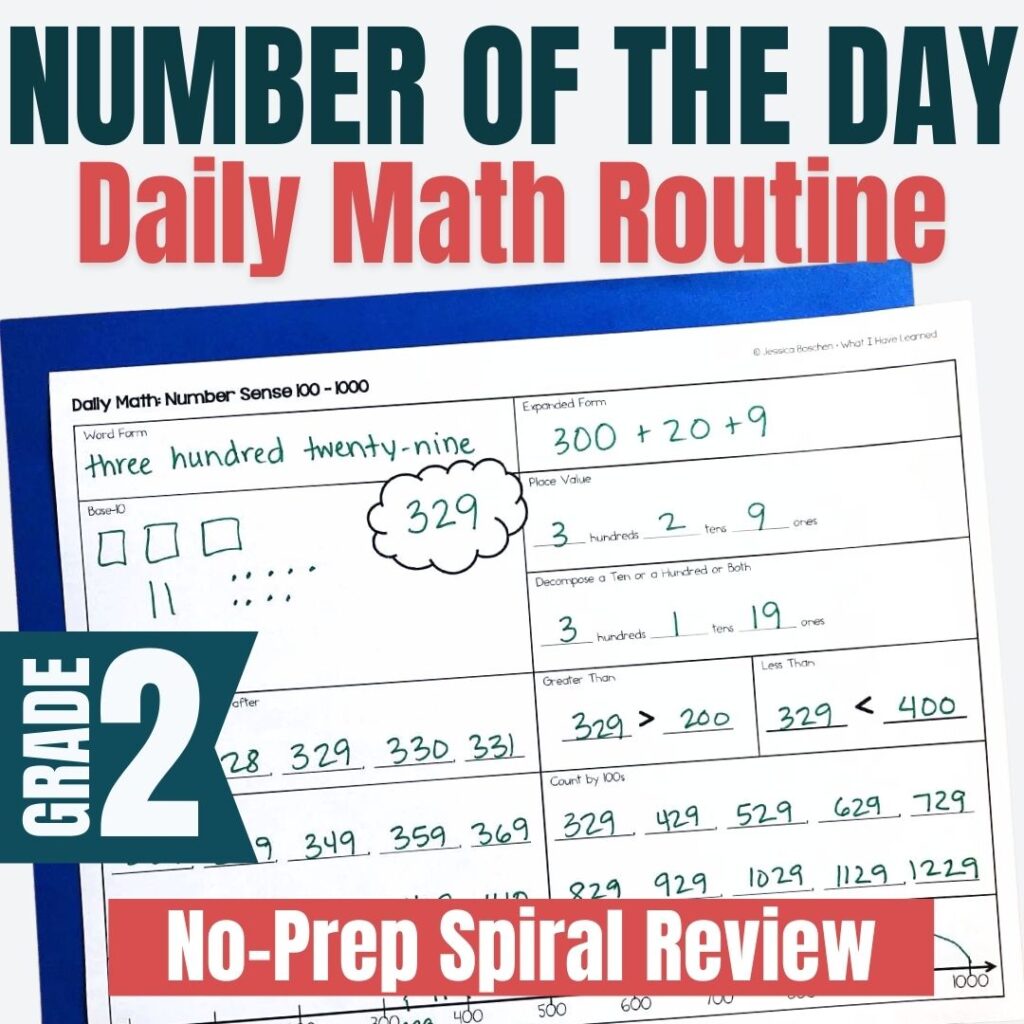
The core of the routine is a number-of-the-day format. Each day, one student (I call this person the “Daily Math Student”) selects a number and works through a structured page with that number as the focus. Depending on the level, that page asks students to write the number in word form and expanded form, write addition and subtraction equations, show it in base-10, count by 1s before and after and by 10s, compare it using greater than and less than, make the jump to 100, and represent it with tally marks and coin combinations.

The page goes in a whiteboard sleeve. The Daily Math Student sits at the document camera and fills it out while the rest of the class works along, either copying from the projected screen or working ahead on their own.

That is the whole structure. What makes it work is the consistency. Students know what comes first every day. After the first few weeks, the routine runs itself.
Why It Works Better Than Calendar in Grades 1 and Up
Calendar time has a place in kindergarten. Students are learning the days of the week, they need counting practice, and the structure of the calendar is new to them.

By first grade, most students know the days of the week. Writing the date on the board and saying it together takes thirty seconds. What they need instead is number sense practice, and calendar time does not build that directly.
Daily math keeps the same predictable structure that makes calendar work (consistent, every day, whole class) while shifting the content to the skills that matter most at this level: place value, number relationships, addition and subtraction fluency, comparing numbers, counting sequences. These are the concepts that show up in math every day, and a daily routine that spirals them builds the kind of familiarity that makes later math easier.

How to Start the Routine
The first few days are about training, not the math itself. Students need to know the sequence: who is the Daily Math Student today, where do they sit, what do they do with the page, how long do the rest of the students wait before starting to copy from the screen.
A few things that make the setup work:
Use whiteboard sleeves. The pages slide in, students write with dry-erase markers, and one set of printed pages lasts the whole year. No photocopies needed after the initial setup.

Start with simpler numbers. At the beginning of the year, use numbers in the lower ranges (10-30) so students can focus on learning the routine rather than struggling with the number itself. As the routine becomes automatic, move to more complex numbers.
Let students choose the number. This is a small thing that makes a real difference in engagement. When the Daily Math Student picks the number, they own that day’s page.

How the Routine Changes Through the Year
One of the most useful qualities of a daily math routine is that you can adjust it as students grow. The page stays the same; the numbers and complexity change.
At the beginning of the year, a first grader might work with 14. By spring, they are working with 37 or 52. A second grader who starts with 45 will work up to numbers in the hundreds. Moving back and forth across decades (9, 11, 8, 12, 7, 13…) helps students see number relationships they would not notice from counting forward only.
When most of the class has mastered the current level, switch to a more complex version of the page. The routine looks the same from the outside. The math has changed.
Daily Math Warm-Up Sheets | Number Sense, Operations, Time & Money Review
Build a consistent math warm-up routine with these Daily Math review sheets! Students practice number sense, operations, addition and subtraction strategies, time, and money by using the same reusable sheet each day with a new number or focus. Includes multiple versions for numbers 0–99, numbers 100–1000, addition and subtraction strategies, and time and money practice.
What’s Included in the Resource
The Daily Math resource includes four levels, each with multiple versions so the routine can grow with your students across the year.
Number Sense 0-99: Students work with a number in the ones and tens. Each page covers word form, expanded form, addition and subtraction equations, base-10 representation, decomposing a ten, counting sequences, greater than and less than, coin combinations, tally marks, and the jump to 100.
Number Sense 100-1000: The same structure as the 0-99 level with numbers in the hundreds, including jumps to 1000. This level fits second and third graders working on three-digit numbers.
Addition and Subtraction: Focused practice on number relationships using addition and subtraction, for students who are ready to move beyond the place value focus.
Time and Money: Integrates telling time and money concepts into the daily routine so these standards get regular review.
Each level includes versions with the count-by sequences written horizontally or vertically and versions with a pre-made number line or space for students to make their own. A Google Slides version is also available for digital classrooms.


This looks fun! I have done a “Math Meeting” with grades K-3. While the calendar was a large part of my Kinders, it took a definite backseat 1-3. However, I find that 15-20 minutes daily really reinforced what we were learning through the curriculum. This approach is also awesome! I wish I had an elmo… Have a great weekend!
I started it out on the whiteboard, so you could use that and the students could still use their mini-whiteboards in sheet protectors. I love how it reviews and teaches major concepts on an ongoing basis!
Thanks for commenting!
It looks great but I just wondered if you had an example somewhere of each sheet that comes with the resource. I am unsure what is expected in each box.
The examples above are the ones I have of the filled out sheets. There are several different sets with a few variations per set. Most of the boxes are labeled and repeat on most pages.
I want to know if this will be okay for a 4.5 years old? Thank you
These are designed for second grade students. 4.5 years old is too young. You can definitely do some early math concepts with him or her, but I wouldn’t do a written routine like this.
Thank you for the reply! I hope you can have also… Really love your reading materials. Thank you
I’m not sure how to use the time portion of the daily math skills. Are there ideal numbers to choose for that option? If the number was 62 or even 362 how do they translate that into a time on a clock?
I choose numbers that are under 60 in the tens place. Those pages stretch the concept of place value with the numbers, so we “pretend” the numbers are in a time or money form.