
How to Teach Cooperative Problem Solving (Grades 2-4)
Group work sounds great until you are standing in front of a class where one student does all the talking, two watch, and the fourth has quietly opted out entirely. Cooperative problem solving is different because it is designed so that every student has information the others need. The group can’t solve the problem without everyone’s contribution, and that structural shift changes how students interact.
What Is Cooperative Problem Solving?
Cooperative problem solving is a structured group activity where each student holds one piece of information that the rest of the group doesn’t have. Students must share their clues verbally, listen to each other, and combine what they each know to solve a shared problem. No one student can solve it alone, which is exactly the point.
This is different from traditional group work, where a capable student can carry the group while others coast. In cooperative problem solving, every student is essential. The structure removes the option to disengage because the group literally cannot move forward without each person’s clue.
This approach is rooted in cooperative learning research, which consistently shows that students learn more deeply when they explain their thinking to others and negotiate toward a shared answer. Structured interdependence, where every group member has a unique role or piece of information, produces higher-order thinking than unstructured group work.
Cooperative Learning through Problem Solving Math Activities
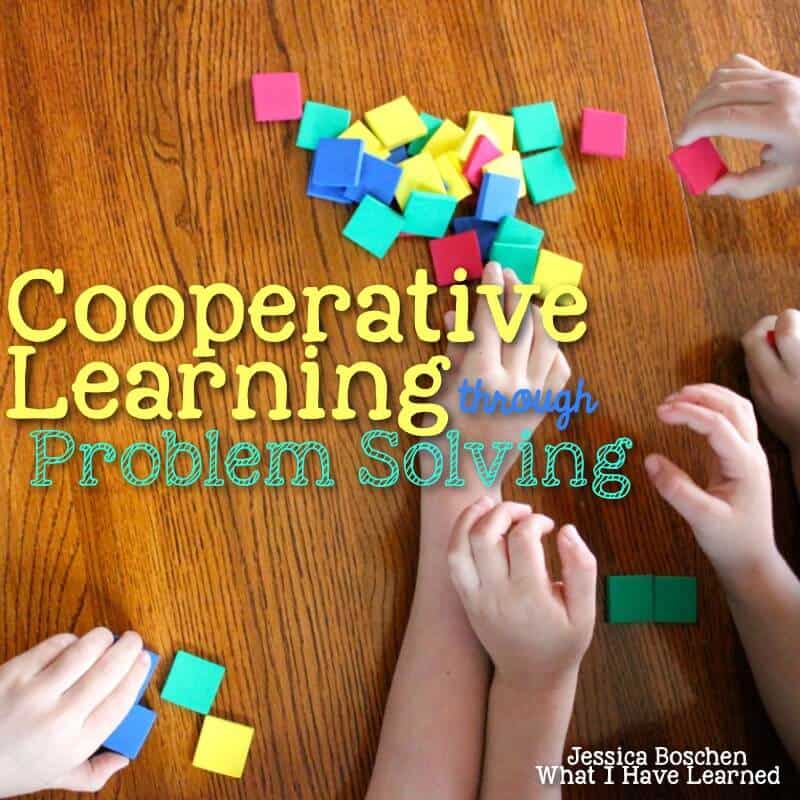
Cooperative Learning through Problem Solving contains 28 sets of cards that encourage students to work together to solve the given problem.
Why Cooperative Problem Solving Works in Grades 2-4
Second through fourth graders are at an interesting stage. They are old enough to have real conversations about math but young enough that they haven’t yet learned to compete over who has the right answer. Cooperative problem solving channels that social energy productively.
When I run these activities with my 2nd graders, a few things consistently happen that I don’t see in other formats. Students who rarely speak up in whole-group discussions will read their clue confidently because it’s their clue — no one else has it. Students who usually rush ahead slow down because they have to wait for others’ information. Students who struggle with computation can contribute equally because the activity focuses on reasoning and communication, not calculation speed.
I also didn’t anticipate a vocabulary benefit when I first started using these. Because the clue cards use precise math language (equal to, fewer than, more than, double, odd, even), students hear and use those terms in context repeatedly. By the third or fourth problem, students use the vocabulary naturally, without prompting.
How to Set Up a Cooperative Problem Solving Lesson
The lesson has three clear phases: before, during, and after. Skipping the before and after phases is the most common mistake, and it’s why these activities sometimes fall flat. The setup and reflection make the math stick and teach students how to work together.
Before: Build the Anchor Chart Together
Before students ever get into groups, I do a whole-class discussion about what it means to cooperate. I create an anchor chart with them by asking four questions:
- What does it mean to work together?
- How do you show your group that you are with them?
- What does your body look like when you are cooperating?
- What kinds of words can we say to help our group?
Students generate the responses, and I write them on the chart. I keep the chart up during the activity so groups can reference it, and I bring it back during the reflection. Creating the chart together makes it theirs—it’s not a list of rules I handed them.
If you’re running this for the first time, I also recommend a whole-group model before splitting into small groups. Walk through a problem together as a class so students understand the structure before they try it independently.

During: The Clue Card Structure
Each student receives one clue card. The rules are simple and firm:
- Students cannot show their card to anyone in the group.
- Students can only read their card aloud.
- Every student must verify that the requirements on their card are met before the group can say they are done.
That last rule is important. Each student is accountable for their own clue, not just for the group’s overall answer. This prevents the dynamic where one student checks everything while others just agree.
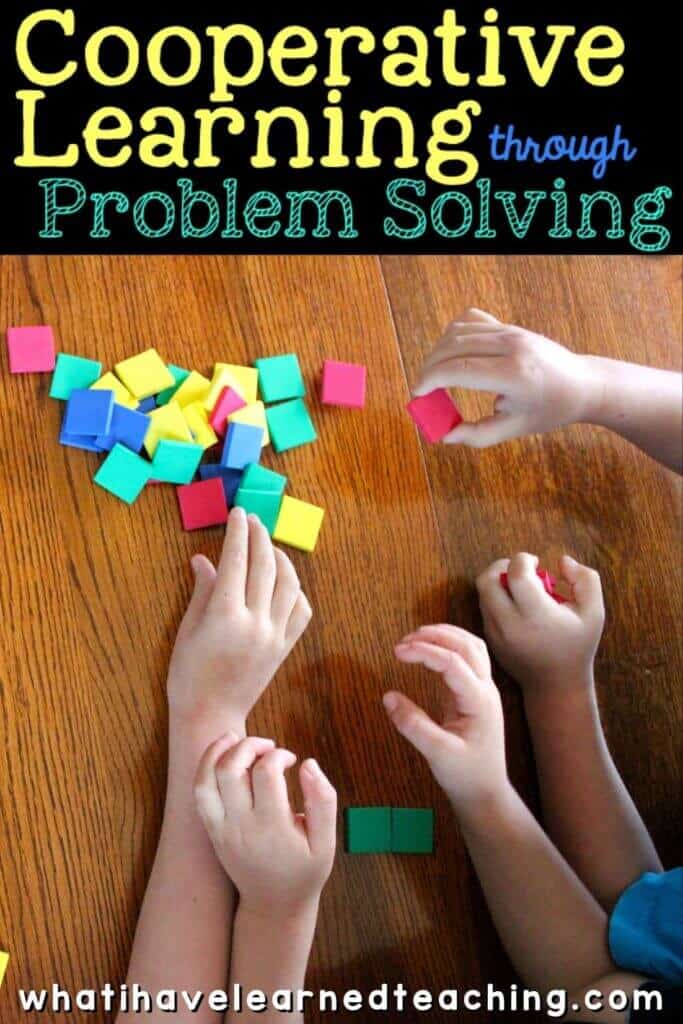
For the physical materials, groups work with colored squares or connecting cubes in blue, green, and yellow. I print the colored squares included in the activity set, or I use whatever connecting cubes I have available. I do not pre-count the squares for groups — I give them a pile and let them figure out how many they need as part of the problem.

After: Whole-Group Reflection
When groups finish, I bring everyone back together and return to the anchor chart. I ask two questions: What went well in your group? What didn’t work? I keep this honest — I want students to say things like “we talked over each other” or “I forgot to listen to my partner’s clue.” Those moments are the learning, not just the solved problems.
I also have students reflect individually: How did I contribute to my group? Did my group work well together? What would I do differently next time? This self-assessment piece is short, but it builds the metacognitive habit of thinking about how you work with others, not just whether the answer was right.

Cooperative Problem Solving Activities: The Colored Squares Structure
The specific activity I use most involves colored squares and math vocabulary clues. The problem structure is this: each group needs to figure out how many squares of each color (blue, green, and yellow) are in a specific arrangement, using only the clues each student can read aloud. The total and the color counts are distributed across the cards — no single student has the full picture.
Math Vocabulary Students Need Before They Start
The clues use precise mathematical language, and students need to be comfortable with the terms before they encounter them mid-problem. I introduce and practice these vocabulary words in the days leading up to the activity:
- equal to — the same amount as
- fewer than / less than — a smaller amount
- more than — a larger amount
- double — twice as many
- even / odd — whether a number can be divided into two equal groups
The more advanced problems introduce additional terms: half as many, twice as many, and half of. I hold these problems until I’m confident the class is comfortable with the basics. Introducing too much vocabulary at once shifts the challenge from cooperative reasoning to vocabulary decoding, which is a different lesson entirely.
Groups of Three vs. Groups of Four
The activity works with both group sizes, and I use both depending on my class. Groups of three are a better starting point for students new to cooperative problem solving because communication is simpler, with fewer voices to manage and fewer clues to hold in working memory. Once students are comfortable with the structure, groups of four add complexity because each student holds less of the total picture and the group has to synthesize more information.
I also find groups of three easier for classroom logistics. With 24 students, I get eight groups rather than six, which means shorter wait times and more active problem-solving time per student. With groups of four, I get larger groups and sometimes one student who ends up more passive than the others. The four-person problems are genuinely harder to structure equitably, so I save them for when the class has some experience with the format.
If you use this activity with other structured discussion activities in your classroom, you will notice that cooperative problem solving builds similar skills: listening carefully, using evidence to support a position, and staying with a line of thinking even when it gets confusing.
Frequently Asked Questions About Cooperative Problem Solving
Final Thoughts
Cooperative problem solving is one of those activities that looks simple on paper but does something genuinely useful in the classroom: it makes every student necessary. When students know that the group can’t finish without their clue, they show up differently. They listen more carefully. They speak more precisely. And they start to see their classmates as resources rather than competitors.
If you want a ready-made set of problems to try this week, my Cooperative Learning through Problem Solving resource includes 18 problems for groups of three and additional problems for groups of four, all using the colored squares structure described above. The problems progress from basic vocabulary (more, fewer, equal) to more advanced language (half as many, twice as many), so you can differentiate across readiness levels within the same activity.
Cooperative Learning through Problem Solving Math Activities
Cooperative Learning through Problem Solving contains 28 sets of cards that encourage students to work together to solve the given problem.

a very neat concept – I will own that pack very soon 🙂 I love how it works, it encourages listening skills as well
LOVE this!