
Make 100 and Make 1000 Place Value Strategies with Friendly Numbers
My second-grade students need a lot of work with number sense and place value strategies, especially when it comes to using number lines, base-10 blocks, and learning how to “jump” to the nearest friendly number. The resources in this product are designed to help students Make 100 and Make 1000, which is a great way for them to start working with a variety of two-digit and three-digit addition strategies.

First-grade teachers spend a lot of time helping students “make 10,” but I find that I don’t spend as much time “making 100” or “making 1000” before asking students to add and subtract two-digit or three-digit numbers.
I use this Make 100 resources toward the beginning of the year as we begin two-digit addition and subtraction, and the Make 1000 components as we start three-digit addition and subtraction.
Why should students practice making 100 or making 1000?
That’s an interesting question and can be traced back to asking, “Why do we teach students to Make 10?”
10 and 100 and even 1000 are friendly numbers. They provide a stopping point for students when doing mental math. Having students practice Making 100 helps them become fluent in adding two-digit numbers. Likewise, practicing Making 1000 helps students become fluent in adding three-digit numbers.
100 and 1000 are also a stopping point on a number line. It is a “full stop”. When practicing using a number line, students can add up to the next ten then add up to reach 100, without having to make the other jumps of tens and ones after 100.
Not only that, but I find that it helps students who are jumping each ten to begin making the full jump of the tens value. For instance, students who are making three jumps of 10 can now many one
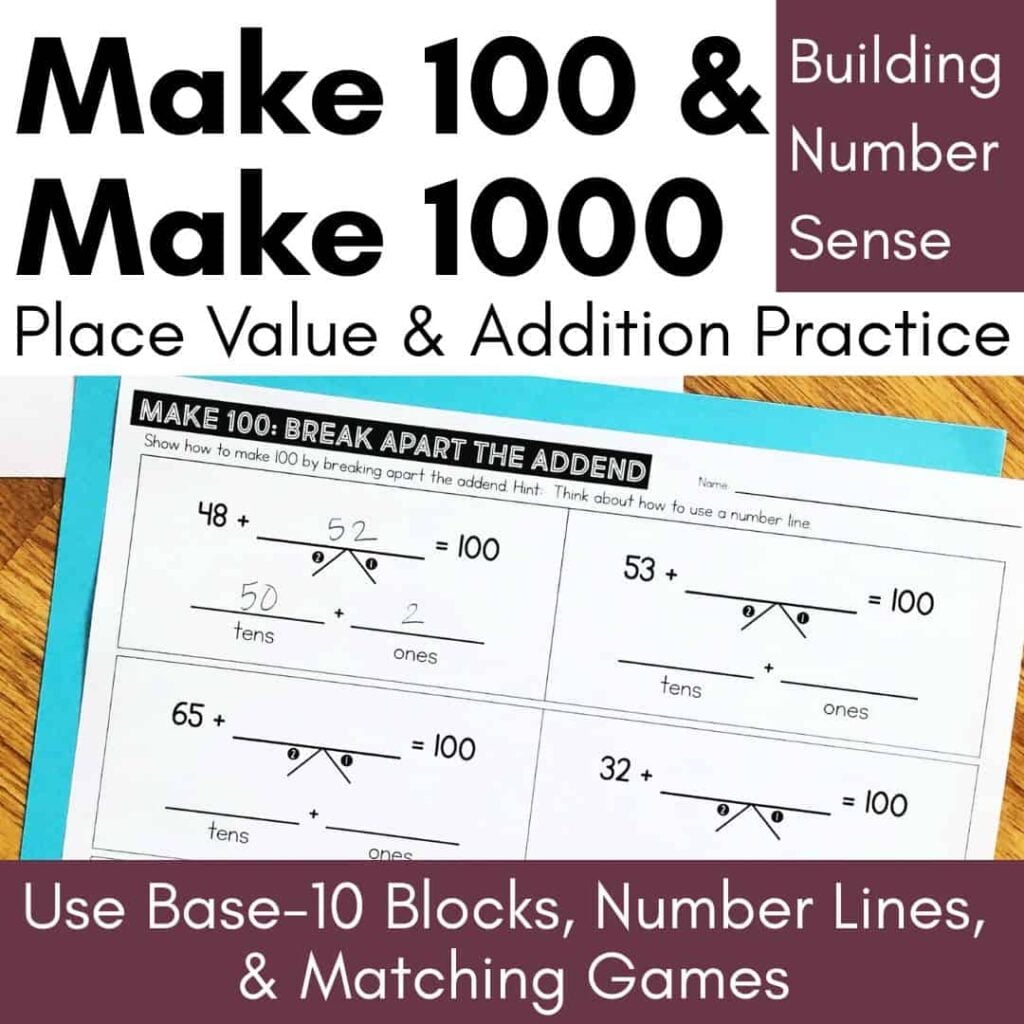
Make 100 and Make 1000 Activities and Printables
Make 100 and Make 1000 resources that help students use number lines, base-10 blocks, and learn how to “jump” to the nearest friendly number. The resources in this product are designed to help students make 100 and make 1000.
What is included in the Make 100 and Make 1000 resources?
I created a resource that has many activities and printables to help students make 100 and make 1000. It is divided into two sections and moves from conceptual understanding by using base-10 blocks and number lines to fun activities like number searches and mazes.
Make 100 Activities
Here is a sampling of the Make 100 activities. The following image is making 100 using a number line and breaking apart an addend. These two strategies complement each other.

Here

Also included are fun activities where students find pairs of numbers that make 100.


Make 1000 Activities
The Make 1000 activities mimic the make 100 activities above. Here are a few of them for you to see.
This one is using a number line. It follows a similar pattern, but adds in the hundreds.

A cut and paste with bar-models. As I noted above, the worksheets progress in complexity. The number line and base-10 ones should be used earlier on to establish the concept and some of the more “fun” worksheets later on to practice and reinforce the skill.

This dice activity has students make a two or three-digit number and then make 1000.

This is a sorting activity where students figure out whether the expression makes 1000 or does not make 1000.

Make 100 and Make 1000 Activities and Printables
Make 100 and Make 1000 resources that help students use number lines, base-10 blocks, and learn how to “jump” to the nearest friendly number. The resources in this product are designed to help students make 100 and make 1000.
How to Purchase the Make 100 and Make 1000 resource
These Make 100 and Make 1000 Activities and Printables can be purchased on Teachers Pay Teachers.
Jessica BOschen
Jessica is a teacher, homeschool parent, and entrepreneur. She shares her passion for teaching and education on What I Have Learned. Jessica has 16 years of experience teaching elementary school and currently homeschools her two middle and high school boys. She enjoys scaffolding learning for students, focusing on helping our most challenging learners achieve success in all academic areas.