
How to Set Up a Classroom for the First Time: A Guide for New Elementary Teachers
Setting up a classroom for the first time is one of those tasks that feels both exciting and completely overwhelming. You walk in, see four walls and a pile of furniture, and suddenly have to make a hundred decisions without a clear place to start. After 16 years in the elementary classroom, I can tell you that most of what you stress about in August won’t matter nearly as much as you think, but a few decisions really do set the tone for how your whole year runs.
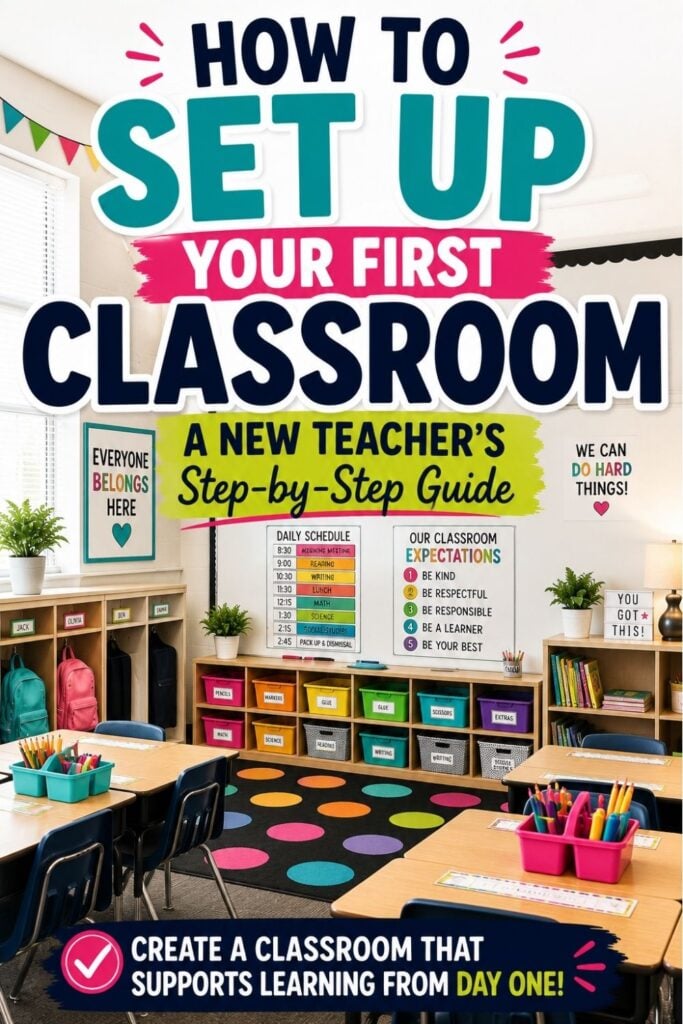
This guide walks you through how to set up a classroom for the first time, step by step, in a way that actually works for students.
Start With a Plan Before You Move Anything
The biggest mistake new teachers make is moving furniture first and thinking second. Before you rearrange a single desk, grab a tape measure and sketch out your room on paper. Note where the windows, outlets, whiteboard, and door are. These fixed elements will drive almost every other decision.
Ask yourself a few questions as you sketch:
- Where will students gather for whole-group instruction? Can everyone see the board from there?
- Where will you pull small groups? You need a clear sightline to the rest of the class from that spot.
- How will students move around the room without bottlenecks? Think about the path from desks to the pencil sharpener, the door, the supply area.
- Where will student belongings go — backpacks, folders, coats?
Draw it out before you lift anything. It saves hours of moving the same table three times.
Think in Zones, Not Just Desks
A well-set-up elementary classroom isn’t just rows of desks — it’s a collection of zones, each with a purpose. When you design around zones, your room works harder for you all year long.
Whole-Group Meeting Area
This is where you start and end the day, where you read aloud, where you teach lessons that need everyone gathered together. It should be large enough for every student to sit comfortably on the floor and see you and the board. A rug helps define this space and gives students a visual boundary. If your room is small, the meeting area and the main instructional area can overlap — but make sure students know where to go when you call them to the carpet.
Small Group and Teacher Table
Your small group table is where you pull students for guided reading, math intervention, or targeted instruction while the rest of the class works independently. Place it where you can see every other student in the room without turning your back to your group. A kidney-shaped table works well for this because you can sit in the curve and have students on both sides. Keep it stocked with the materials you use daily — dry-erase boards, markers, manipulatives — so you’re not constantly getting up during small-group time.
Independent Work Area
This is where students spend most of their time. Desks or tables should be arranged so students can work independently without constant distraction, but can also turn to work with a partner quickly when needed. Groups of four or table clusters work well in most elementary classrooms and allow for easy transitions between independent and collaborative work.
Supply and Storage Area
Students need to be able to access supplies without having to ask you. Designate a specific spot for communal supplies — crayons, scissors, glue sticks, extra pencils — and make it easy to reach from work areas without creating a traffic jam. Label everything clearly. In elementary classrooms, labeling with both words and pictures helps students across reading levels find and return materials independently.
This is a grid map activity I did with my first- and second-grade students, and it shows our classroom layout. I set up my teacher area and small group table in the center of the classroom. There was a media cart in front of my teacher desk before the teacher table. Our carpet area was in square A1, and student desks were arranged in two areas on either side of my teacher area. Setting up my teacher desk in the center allowed me to use the whiteboard for small group instruction and easily see everyone while I sat and worked with the small group.

Arrange Desks With Student Movement in Mind
When setting up a classroom for the first time, teachers often arrange desks based on what looks good in a photo rather than what works for students in motion. Here’s what to actually think about:
- Traffic flow: Can students get in and out of their seats without bumping into each other? Walk every path yourself before students arrive.
- Sightlines: Can every student see the board and the front of the room clearly? Check from the back corners — those seats are where students are most often forgotten.
- Flexibility: Can the arrangement shift easily for different activities? Tables that seat four can be pushed together or separated depending on what you’re doing.
- Your access: Can you reach every student without climbing over chairs? You should be able to easily circulate around the entire room during independent work.
Don’t worry too much about where you put students on the first day — most experienced teachers, myself included, let students choose their own seats initially. It tells you a lot about classroom dynamics before you assign anything permanent.
Set Up Your Front Wall Intentionally
The front of your classroom — the wall students look at all day — is prime real estate. Don’t fill it with decorations that look cute but don’t serve students. Every item on the front wall should earn its place by helping students do their work or understand the space.
What belongs on the front wall:
- Daily schedule — Students who can see what’s coming next feel more settled. This is especially important in the first weeks when everything is new.
- Classroom expectations or rules — Keep it simple. Three to five clear expectations are more useful than a long list.
- Learning anchor charts — Add these as you teach them throughout the year. Don’t pre-make a wall full of charts that students haven’t been introduced to yet.
- Calendar or current date materials (K–2) — If you do a morning meeting with calendar math, this belongs up front, where everyone can see it.
What can wait or go elsewhere: purely decorative posters, quotes students won’t read, and themes that require constant maintenance. Keep the front wall functional and add to it as the year unfolds.
Plan Your Teacher Area Carefully
Your desk placement matters more than you might think. If your desk is at the front of the room, students will constantly gravitate toward it. If it’s tucked in a corner, it becomes a place you visit rather than a spot that draws traffic all day. Most experienced teachers put their desk in a back corner and spend almost no time actually sitting at it. Your primary workspace is wherever your students are.
More important than your desk are your small-group table and your teaching station near the board. Make sure both are stocked and organized before day one so you’re not searching for materials during lessons.
Think Through Student Storage From Day One
Where will backpacks go? Where do students put completed work? Where do homework folders live? These logistics seem small but cause a surprising amount of chaos if you haven’t thought them through. Before students arrive, decide:
- Where backpacks and coats are stored (hooks, cubbies, or under desks)
- Where students turn in finished work
- Where students pick up materials at the start of activities
- Where take-home folders or communication folders are kept
Label everything. Then practice the procedures for using these areas in the first week — don’t assume students will figure it out on their own. Teaching procedures explicitly in those first days is what makes the rest of the year run smoothly.
Plan Your First Bulletin Board Display Before Students Arrive
Here’s something new teachers don’t always hear: your bulletin boards don’t need to be full on the first day. Student work should go up within the first week or two, and that’s fine. What you do want is one display that students contribute to right away — something that signals from day one that this classroom belongs to everyone, not just to you.
One of my favorite first-day traditions is the Community Building Puzzle. Each student decorates a puzzle piece when they walk in on the first morning. Later in the day, the class assembles it together and it goes up on the bulletin board — a display the students made themselves, on day one. It sets exactly the right tone for the year and fills a bulletin board without requiring you to prep anything elaborate in advance.
A Note on Classroom Décor for New Teachers
Pinterest and Instagram are full of classrooms that look like they belong in a magazine. Don’t let them be your standard. Those rooms often take years to build, are maintained by teachers with large followings who receive free products, or are photographed before students (and backpacks and art projects and read-aloud books) arrive.
What actually matters in a classroom setup has nothing to do with how it looks in a photo. It matters that students can find what they need, move through the space safely, see the board, and feel like they belong there. Start simple. Add things as you discover what you actually need. Your second year will look different from your first, and your tenth will look different from your second — and that’s exactly how it should be.
Classroom Setup Checklist for New Elementary Teachers
Before students walk in, run through this checklist to make sure the basics are covered:
- Room layout sketched and furniture arranged with traffic flow in mind
- Whole-group meeting area defined (rug or clear floor space)
- Small group table positioned with a full sightline to the rest of the room
- Student desks or tables arranged for both independent work and easy collaboration
- Supply area labeled and accessible to students
- Student storage for backpacks, folders, and take-home materials is designated
- Turn-in system in place (bin, folder, or tray)
- Daily schedule posted somewhere visible to all students
- Classroom expectations posted clearly at the front
- First-day morning activity ready on each desk before students arrive
- Small group table stocked with materials you’ll use in the first week
Final Thoughts on How to Set Up a Classroom For the First Time
Setting up a classroom for the first time will never be completely finished before the first bell rings — and that’s fine. The most important thing is that your students walk in and feel like the space was made for them. The puzzle pieces waiting on their desks, their names on labels, a schedule on the wall, a supply area that makes sense — those details tell students they’re expected and they belong. Everything else can be figured out as the year goes along.
Looking for a ready-made first-day activity that fills your first bulletin board and builds classroom community at the same time? The Community Building Puzzle is designed for exactly that — students decorate their piece on day one, assemble it together, and you have a display that means something all year long. The Getting to Know You Small Group Craftivity is another great first-week activity to have ready.
Jessica BOschen
Jessica is a teacher, homeschool parent, and entrepreneur. She shares her passion for teaching and education on What I Have Learned. Jessica has 16 years of experience teaching elementary school and currently homeschools her two middle and high school boys. She enjoys scaffolding learning for students, focusing on helping our most challenging learners achieve success in all academic areas.