
Community Building Puzzle: A Classroom Puzzle Activity for the First Day of School
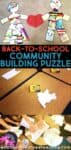
This classroom puzzle activity is one of my favorite ways to start the school year. Each student colors a puzzle piece on the first day of school, and by the end of the day the class assembles them all together — a simple, visual reminder that every student belongs. It keeps students engaged during those busy first-day moments while you’re greeting families at the door, and it produces a bulletin board display you can leave up all year.
The Community Building Puzzle is one cooperative learning activity I come back to every single year. Below you’ll find how I use it, how to prep it, and some bulletin board sayings to go with it.

Why a Puzzle Works as a Community Building Activity
A community building puzzle works because the metaphor is built into the activity itself. Students aren’t just hearing that they’re part of a community — they’re holding a piece of it in their hands. When the pieces come together at the end of the day, the connection is concrete and visual in a way that a discussion or worksheet can’t replicate.
It also works logistically. On the first day of school, you need an activity that students can do independently from the moment they sit down, requires no prior knowledge, and gives you time to handle the controlled chaos at the door. Coloring a puzzle piece checks every one of those boxes.
The assembly at the end of the day becomes its own community moment. Students work together to figure out where pieces fit, they look for classmates’ artwork, and they see the finished product as something they built together — on day one.
How to Use the Community Building Puzzle on the First Day of School
On the first day of school, I lay a puzzle piece down on each table as well as a box of crayons. As students come into the room, they find a seat. I don’t assign seats on the first day or even the first week.
If you do assign seats, you can write students’ names on the pieces and have students find their seats as they come into the room. I find that having an activity like this one at students’ desks allows me to stand at the door, greet parents and new students, and give students a quiet activity at their seats.

Students color their puzzle pieces. I save the pieces until later in the day. After lunch or near the end of the day I get the pieces out and students actively put the pieces together.
Take a look at this blog post about the First Week of Second Grade to see some of the puzzle building in action as well as other activities I plan for the beginning of the year.
How to Make Your Own Community Building Puzzle by Hand
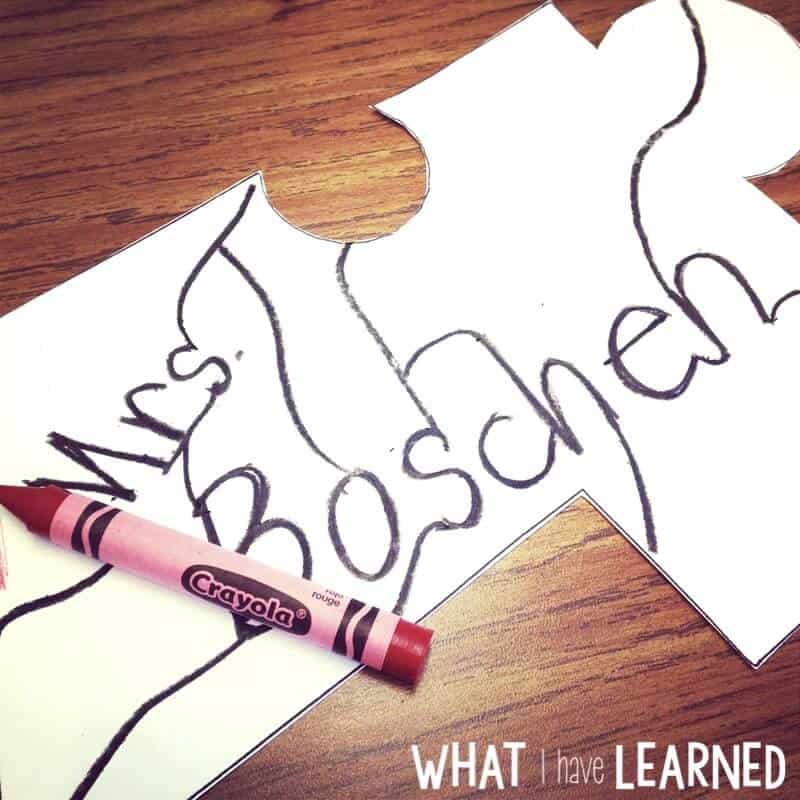
Earlier in my teaching career, I used a poster board and drew and cut apart puzzle pieces. I would calculate the rows and columns (30 kids is a 6×5 grid, 24 kids is 6×4, etc.) and calculate the space for each square to make them about even. I drew lines in pencil and circles on the sides to make it look like a puzzle piece.
Prior to the start of school, I cut out the pieces and outlined the pieces in black Sharpie. The outlining is optional, I just liked the look of it.
Printable Community Building Puzzle Already Done For you
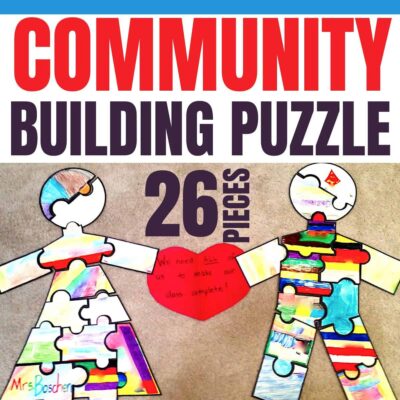
Several years ago, I created a digital copy of the below puzzle pieces that I print and reuse every year. Having a digital copy significantly cuts down on my prep time! It also makes a cuter classroom bulletin board to display!

Community Building Puzzle Activity Back to School Team Building
Build classroom community with this collaborative community building puzzle activity! Students decorate individual puzzle pieces, work together to assemble the class puzzle, and create a meaningful back-to-school display that celebrates teamwork and belonging.
How I Prepare the Printable Puzzle Pieces
The Community Building Puzzle pieces are designed to be printed and cut out from one 8 1/2 x 11 piece of paper. I choose to cut out the pieces for my students before the beginning of the year.
Why?
My goal for the activity is to keep students busy at the beginning of the day and to have a fun activity for later in the day. It is not to practice their skill with scissors. Plus, I’m kind of a perfectionist and since the puzzle will be on display, I want the cut lines to look good.
I sometimes draw a thick black line around all the pieces. I’m not sure why other than I like how it looks!

One way to make the puzzle assembly easier for students is to write an M or an F (or B / G) on the back of the boy or girl pieces. When you’re ready for students to assemble the pieces, divide students into two groups.
Another tip is to indicate directionality on the pieces so that students write their names in the correct orientation if you don’t write students’ names for them.
Community Building Puzzle Sayings for Your Bulletin Board
If you are creating a bulletin board out of the community-building puzzle, post some cute sayings with it! Here are a few suggestions!
- E pluribus Unum – One out of many
- Perfect Fit
- Everyone is a PIECE of our classroom family
- Everyone is an important PIECE of the puzzle
- We’re all different but as a team, we fit together
- Your place is here
- Our class is complete when everyone is together
- Parts of a bigger puzzle
- We are all uniquely placed in this classroom
- You are the missing piece to our class
- Better together
- Piece by piece we are a masterpiece!
- A piece of my heart is in this class
- Without you… the puzzle isn’t complete…
- Puzzling it out – one piece at a time – takes teamwork
- You are part of the whole picture.
- Without you we wouldn’t be complete.
- Building ___ grade piece by piece.
- Growing in ___ grade piece by piece.
- You are an important piece of our class
Community Building Puzzle Activity Back to School Team Building
Build classroom community with this collaborative community building puzzle activity! Students decorate individual puzzle pieces, work together to assemble the class puzzle, and create a meaningful back-to-school display that celebrates teamwork and belonging.
Here are a few more back-to-school crafts that might interest you.


Want to Reduce Disruptions So You Can Actually Teach?
Check out this 100% FREE Micro Training
from my friend Linda over at Teach 4 the Heart.
Creating a calm classroom environment can be hard…and you probably didn’t learn everything you needed to about classroom management in college. (I know I didn’t!)
But there is hope and a way to make your teaching experience more fulfilling and less stressful.
Watch this quick 28-minute training to learn how you can minimize disruptions so you can actually teach your content (and get to do the projects & activities that make learning more fun for EVERYONE!
Linda WON’T just tell you to “build relationships” because, frankly, even the best connections can’t eliminate all classroom challenges. Achieving a smooth-running class requires a more nuanced approach.

So join me for this FREE 28-minute training and discover their Calm Classroom Blueprint, used by thousands of teachers to:
- Significantly reduce disruptions during lessons & work times.
- Gain confidence In handling challenging situations (that previously left them dumbfounded).
- Lower daily stress levels and find joy in teaching again!
Jessica BOschen
Jessica is a teacher, homeschool parent, and entrepreneur. She shares her passion for teaching and education on What I Have Learned. Jessica has 16 years of experience teaching elementary school and currently homeschools her two middle and high school boys. She enjoys scaffolding learning for students, focusing on helping our most challenging learners achieve success in all academic areas.