
First Day of School Tips for Teachers: What Actually Works After 16 Years in the Classroom
The first day of school tips for teachers that actually stick are the ones you learn the hard way — from the years when something didn’t go the way you planned. After 16 years in the elementary classroom, I can tell you that my first days look nothing like those first ones did. These are the strategies I’ve refined year after year, not because they sound good in theory, but because they’ve worked with real students in a real classroom.
Whether you’re heading into your first year or your fifteenth, this post pulls together everything I know about making the first day — and first week — go smoothly.
Have Something Waiting on Every Desk
Students walk in nervously. You’re going to be at the door greeting them. Having something waiting on each desk solves both problems at once — students have a job to do right away, and you can focus on connecting with families without the class sitting idle.
On the first day of school, I put a puzzle piece and a box of crayons on each desk — and nothing else. On the board is one simple direction: write your name in large letters and color every inch of the puzzle piece so no white space is left. That’s it. Students know what to do, they’re doing something creative, and I have time to greet each person at the door.
Later in the day, we put the puzzle together as a class. It becomes our community building puzzle — a visible reminder that every single student is part of what makes the classroom work.

Community Building Puzzle Activity Back to School Team Building
Build classroom community with this collaborative community building puzzle activity! Students decorate individual puzzle pieces, work together to assemble the class puzzle, and create a meaningful back-to-school display that celebrates teamwork and belonging.
Let Students Choose Their Own Seats
I know this one surprises people, but on the first day of school, I let students sit wherever they want. Here’s why: I don’t know them yet, but they know each other. Who they choose to sit next to tells me everything — who’s friends with whom, who gravitates toward the back, who wants to be near the front, who sits alone. That information is genuinely useful, and you can only get it by stepping back and watching.
Students are usually on their best behavior on day one, so you won’t have chaos. What you’re going to have is data. Use it.
Hand Out Supplies Yourself
I don’t put folders, notebooks, or other supplies on desks ahead of time. I hand them out myself throughout the day, one item at a time, as we actually need them. This does two things.
First, it keeps students from being overwhelmed with stuff they don’t need yet. Second — and this is the real reason — it gives me multiple opportunities to walk to each student, say their name, and make a brief connection. By the time I’ve handed out pencil boxes, notebooks, and folders, I’ve interacted with every student several times. By the end of the first day, I’ve usually memorized every name and face. Once you know names, your brain is free to focus on actual teaching.
Go Slower Than You Think You Need To on Procedures
This is the first-day-of-school tip that makes the biggest difference throughout the year, and it’s the hardest one to actually follow. Go slow. So slow it feels almost painful. Slower than you think you should.
Teachers often feel pressure to get through content, especially in that first week. Resist it. The time you spend now establishing procedures is time you earn back every single day for the rest of the year. Students who know exactly what to do don’t need constant redirecting. They just do it.
Model Both the Right Way and the Wrong Way
For every routine you teach — walking in a line, working with a partner, turning in papers, transitioning between activities — follow this pattern: model the correct way, then model the incorrect way, then model the correct way again.
Yes, model doing it wrong on purpose. Students find it funny, they remember it, and it makes the expectation crystal clear. Then have a student model the right way. Then have a student model doing it wrong. Then the right way again. By the time you’ve done that sequence, students genuinely understand what you’re looking for — not just vaguely, but specifically. You can do this with any classroom procedure, from getting a teacher’s attention to handling materials.
Redirect Every Time — Without Embarrassing Anyone
When you see something that isn’t right, stop and address it. Every time. If you let things slide in the first week, students learn that the expectation has flexibility — and that flexibility grows all year long.
You can redirect firmly without making a student feel bad. Name the behavior, not the child. Then model the correct behavior again. Keep it matter-of-fact and move on.
Keep Positive — Especially with Your Most Challenging Students
Negative feedback doesn’t work the way we hope it will, especially for students who’ve been struggling in school for a while. Many of your most challenging students have already heard plenty of what they’re doing wrong — at home, in previous classrooms, everywhere. They don’t need more of it from you.
What works is catching them making good choices and naming it out loud. Not over-the-top praise, just a direct acknowledgment: “I noticed you got started right away. That’s exactly what I’m looking for.” It takes practice to retrain your eye to catch the positive, especially during a stressful first week. But it pays off quickly.
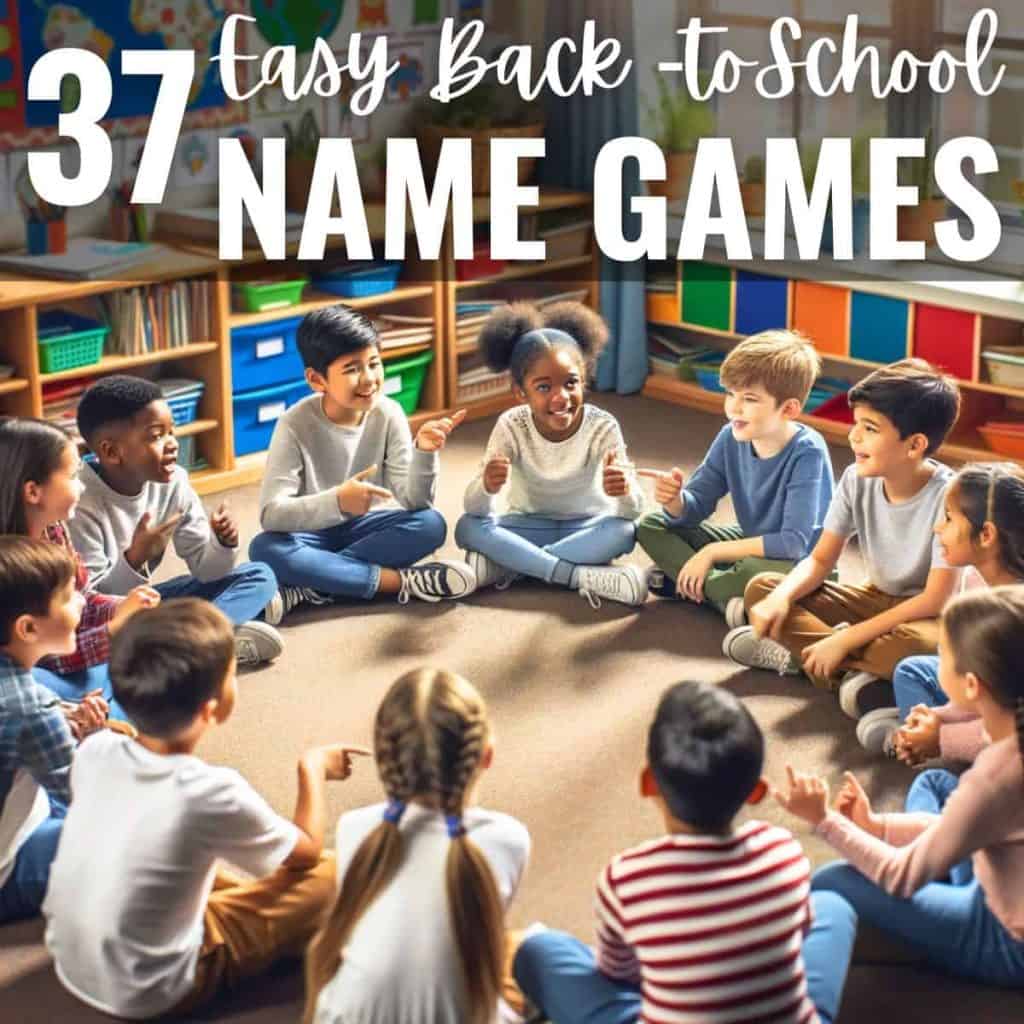
Play a Name Game on the First Day of School
Do at least one name game. Any one. Just pick one and do it.
A simple one that works at any grade level: each student says their name and one thing they like that starts with the same letter (Sarah likes soccer, Marcus likes movies). For younger students, keep it simple. For older students, make it competitive — see if the class can remember everyone’s item by the end.
Every time students hear and say each other’s names in a structured way, they get a little closer to actually knowing one another. It also helps you. The more you hear a name in context, the faster it sticks.
Over-Plan the First Two Weeks
Plan more than you think you could possibly need — especially for the first few days. It’s much better to have something in your back pocket than to have a gap you weren’t prepared for. The first week is unpredictable in ways that are hard to anticipate: assemblies run long, students take longer to transition than expected, or a lesson lands in five minutes that you thought would take twenty.
After a couple of weeks, you’ll get a feel for the natural rhythm of your class. Until then, have more ready than you need and keep a handful of sponge activities handy for those in-between moments — activities that are low-setup and genuinely useful, not just time-fillers.

Tehse activities allow you to fill small buckets of time, build classroom community, and tamp down the chaos that occurs within those 10-15 minutes.
Sit Down and Watch Your Students
This one sounds simple and is surprisingly hard to actually do. At some point during the first day, when students are engaged in an activity, sit down and watch.
Just observe. Notice who talks to whom. Notice who stays on task and who needs a nudge. Notice the student who finishes immediately and looks around for what’s next. Notice the one who is working carefully and hasn’t looked up once. Teachers are so busy running the classroom that we rarely get a chance to simply learn about who our students are as people. The first day is actually a good opportunity for it — students are engaged, their behavior is usually close to their best, and you’re getting a real picture of the class dynamic.
That picture is useful all year.
Take Care of Yourself During the First Week of School
The first week is exhausting in a way that’s hard to describe to someone who hasn’t taught. You’re “on” all day, you’re making hundreds of small decisions, and you’re doing it all while managing new relationships with 20 to 30 students at once.
Build in something small for yourself each day — a cup of coffee you actually sit down with, a walk, time to do something that isn’t school. It’s easy to keep going and going until you’re running on empty by Friday. Here are some specific ideas for de-stressing during September if you need somewhere to start.
Teaching well requires energy, and energy requires rest. That’s not a luxury — it’s part of the job.
Final Thoughts on Making the First Day Work
The best first day of school tips for teachers all point in the same direction: slow down, pay attention to your students, and build the foundation before you try to build anything on top of it. The routines you establish now, the names you learn now, and the relationships you start building now will shape how the entire year goes.
You don’t have to get everything perfect on day one. You just have to start building something solid.
Jessica BOschen
Jessica is a teacher, homeschool parent, and entrepreneur. She shares her passion for teaching and education on What I Have Learned. Jessica has 16 years of experience teaching elementary school and currently homeschools her two middle and high school boys. She enjoys scaffolding learning for students, focusing on helping our most challenging learners achieve success in all academic areas.