
Two Digit Addition and Subtraction Strategies and Models

Teaching addition and subtraction strategies in 2nd grade can feel like a balancing act. Some students are ready to move numbers around mentally, while others still need something concrete in their hands. And then there are the students who confidently solve a problem… but can’t explain how they got their answer.

This is where strong models and clear strategies make all the difference. When students understand how numbers work, not just how to get the answer. They build a foundation that supports everything from multi-digit math to problem-solving later on.
If you’re looking for addition and subtraction strategies for 2nd grade that actually stick, these approaches will help your students make sense of double-digit addition, subtraction, and everything in between.
In this post, you will read about:
- The distinction between models and strategies
- Prerequisite skills for two-digit addition and subtraction
- Models for two-digit addition and subtraction
- Strategies for two-digit addition and subtraction
- Anchor charts
- Free resources to try out
Why I Make a Distinction Between Models and Strategies
I make a clear distinction between the strategies students use to solve problems and the models they use to show their thinking.
Strategies are usually how students approach and manipulate numbers.
Models are how strategies are organized on paper so students can explain or see them.
When looking at the standards, I can see that the strategies are clearly noted in the standard:
In 2.NBT.B.5, the strategies are:
- place value
- properties of operations
- relationship between addition and subtraction
Standard 2.NBT.B.7 even notes that the models or drawings (which I also call models) are separate from the strategies that are based on:
- place value
- properties of operations
- relationship between addition and subtraction
As you can see, the strategies are clearly outlined in the standards. Now, within each of the above general strategy categories, there really are many different strategies that students can use, and you can label them whatever you’d like in your classroom. I like to label them with students’ names as an easy reference. That way, we can refer to Samantha’s strategy when solving a problem. Or you can label the strategy with the action that the student takes in the problem (for example: Add Tens First).
Students can use multiple strategies with one model.
There’s no one right way to use the model, as long as the student can explain their thinking. The models (or drawings) merely give students a tool to explain their thinking on paper or with manipulatives.
The thinking, or what students do with the numbers, is the strategy. What they use to show it to you is the model.
In all honesty, I’m not always consistent in labeling something a strategy or a model. I try to be, but like you, I’m human and sometimes mix them up, especially when I’m in the moment with students. It’s a learning process and something I’ve been continually reflecting on over the years. All that to say, you may see a few things labeled one way and question its label. Go ahead and question it, think about it, mull it over, and figure out whether it’s accurate.
Why Models Matter in 2nd Grade Math
Before jumping into abstract strategies, students need to see what’s happening with numbers. That’s where manipulatives and visual models come in.
When students use base ten blocks, number lines, or drawings, they’re not just solving a problem. They’re building understanding. For many students, especially in 2nd grade, this step is what bridges the gap between counting and true number sense.
You’ll often notice that students who struggle with subtraction strategies benefit the most from models. They need to physically or visually “move” numbers before they can do it mentally.
Prerequisite Skills for Two-Digit Addition & Subtraction
The above strategies are very powerful when students add them to their toolkit as they approach two-digit addition and subtraction. However, to effectively use the above strategies, students need a few things in place.
Addition and Subtraction Facts – Students need pretty good fluency with their addition and subtraction facts. Do they need to memorize all of them at speed? No. However, if students spend too much time trying to figure out an addition fact and it keeps them from focusing on the strategy because they forget what they were doing, they need more fluency with their addition and subtraction facts. My Automaticity Assessments help students practice their facts by strategy.
Ability to find friendly numbers – At the beginning of the year, we spend a long time developing fluency with 10 as a benchmark number. Although we do it at the beginning of the year to help with our math fact fluency, it is also beneficial when students begin their journey with two-digit addition and subtraction. Students need to know how to get to the next friendly number, which is essentially their 10s facts, but applying them to two-digit numbers to find the next ten.
Adding 10 to a number – We start our two-digit addition unit with a lot of practice adding and subtracting ten from a number. This is a foundational skill in both my two-digit addition and two-digit subtraction products. Students must see the pattern of adding 10 to a number.
Place Value – To do two-digit addition, students need a strong foundation in the concepts of ones and tens and in breaking a number apart into ones and tens. From the first day of school, we are doing Daily Math exercises that build fluency with place value and skip counting by 10s from any number.
Models for Two-Digit Addition and Two-Digit Subtraction
Below are a few models that we use with two-digit addition or subtraction.
Are these the only models you can use? No, this is not an exhaustive list. These are what I have found useful in the classroom for students to practice and build conceptual understanding and number sense.
NumberLines
When I introduce students to paper/pencil models, I usually start with number lines. An open number line is very flexible. Students can make jumps of 1 or 10 (or more) and easily manipulate them to demonstrate their mathematical thinking.
I usually help students get to the nearest 10 or a friendly or benchmark number when using a number line because it is easier to make jumps of 10. That is an example of the difference between a model and a strategy. The model is the number line. The strategy is making jumps of 10.
Teaching how to use number lines with 10 to add +9 and +8 facts solidifies this strategy when students add larger two-digit numbers.
Remember, the number line is the model and can be used with various strategies. Modeling and practicing with a number line on easier problems will help students when using it with more difficult problems.
One of the daily activities that we do with number lines is our Daily Math. This is a whiteboard sheet that we go through daily. The number line at the bottom helps students solidify their understanding of both how to use a number line and how to “make 100 or make 1000”.

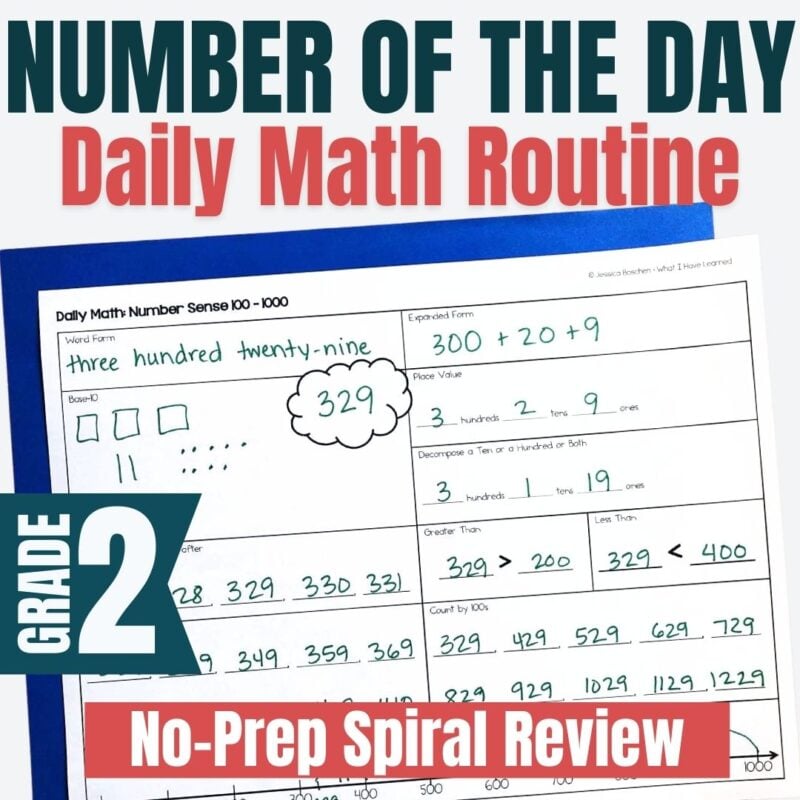
Daily Math Warm-Up Sheets | Number Sense, Operations, Time & Money Review
Build a consistent math warm-up routine with these Daily Math review sheets! Students practice number sense, operations, addition and subtraction strategies, time, and money by using the same reusable sheet each day with a new number or focus. Includes multiple versions for numbers 0–99, numbers 100–1000, addition and subtraction strategies, and time and money practice.
Here are a few more examples of how we use number lines in the classroom.

This is from my Roll & Spin Math Stations. In this activity, students practice making jumps of 10 and 100 up a number line.
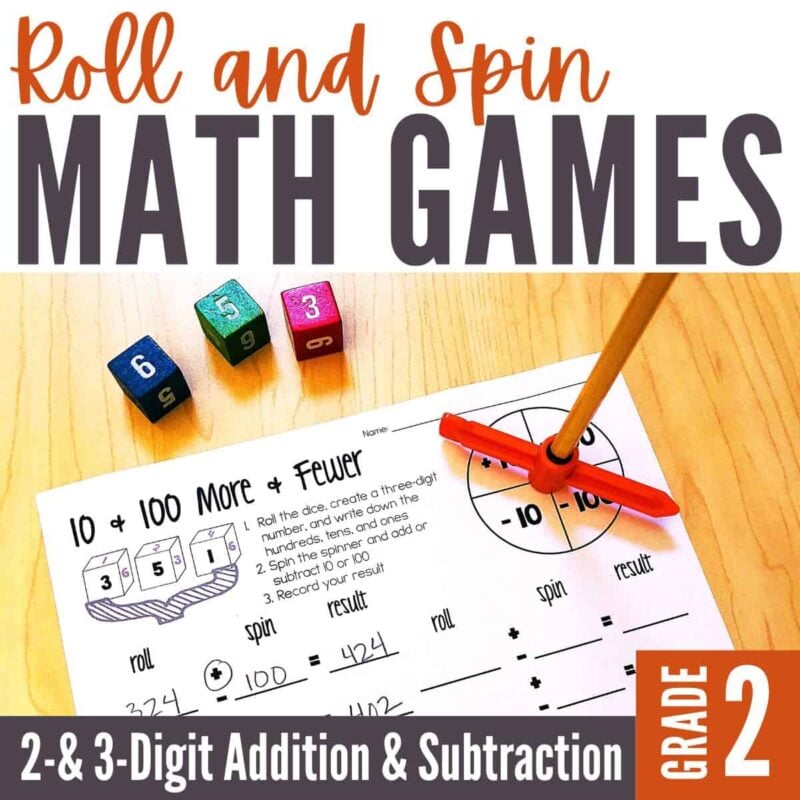
Roll and Spin Math Games for Multi-Digit Addition & Subtraction
These Roll and Spin Math Games focus on developing number sense for two-digit and three-digit addition. The activities help students develop competencies in using a number line and other place-value strategies when adding two- and three-digit numbers.
There are also versions where students subtract 10 and 100 down a number line, too. One of the skills students need to be successful on number lines is the ability to make jumps of 10 and 100.

This is an example from one of our Addition & Subtraction Word Problems, in which students had to solve a separate start-unknown problem. This student started at 15, counted 35 jumps, and then took one away at the end. This is also a great example of compensation (see below) because the student added one to 34 to make easier jumps, then took it away at the end.

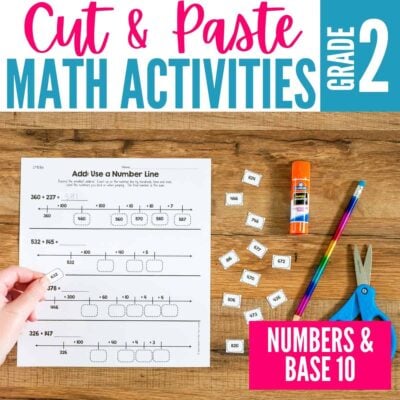
This is from my Second Grade Cut & Paste Math Activities. In this activity, students practice adding up, starting with the smallest number and figuring out how to reach the larger number by jumping to friendly numbers. This student started at 19, jumped to 20, then jumped from 10 to 60, and made a 3-point jump. The student added their jumps together to get 44.
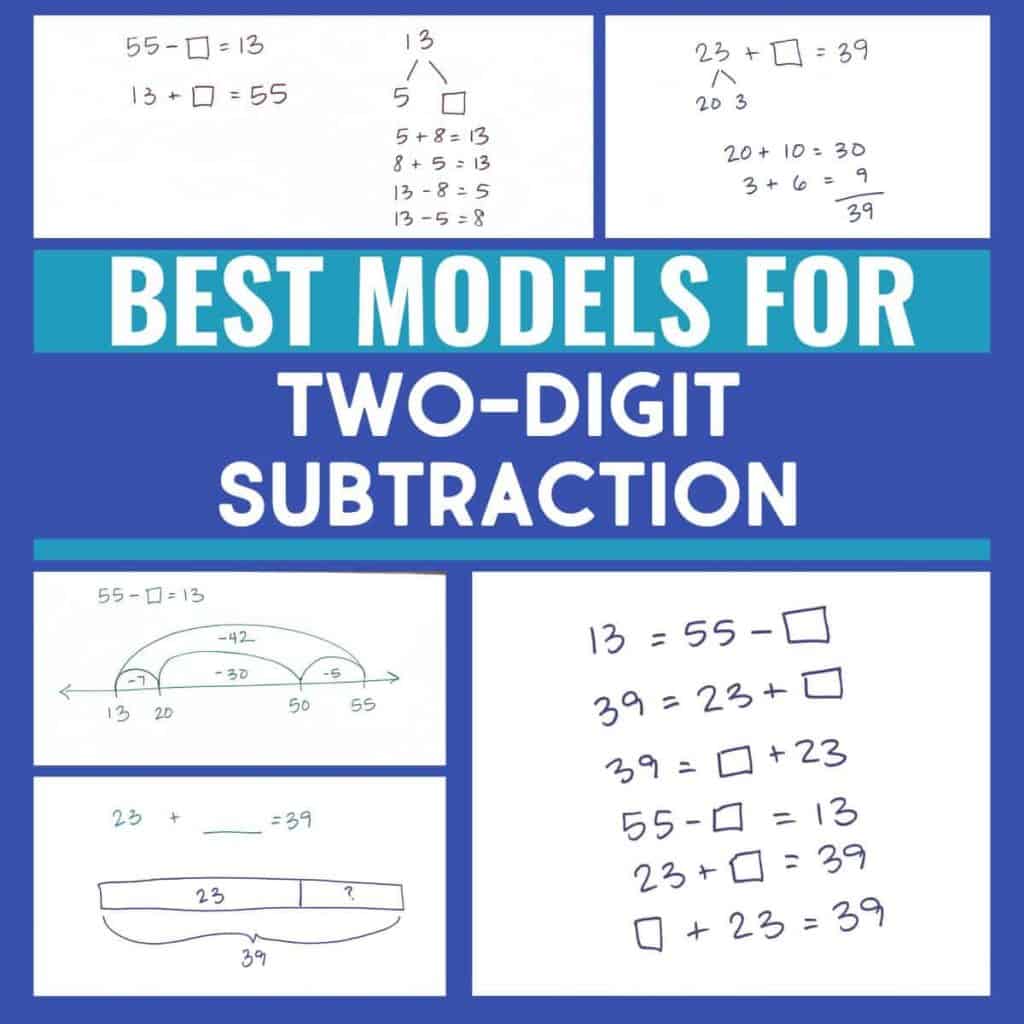
In this post, I outline some of the best models for two-digit subtraction. Use a numberline is one model, but there are many more!

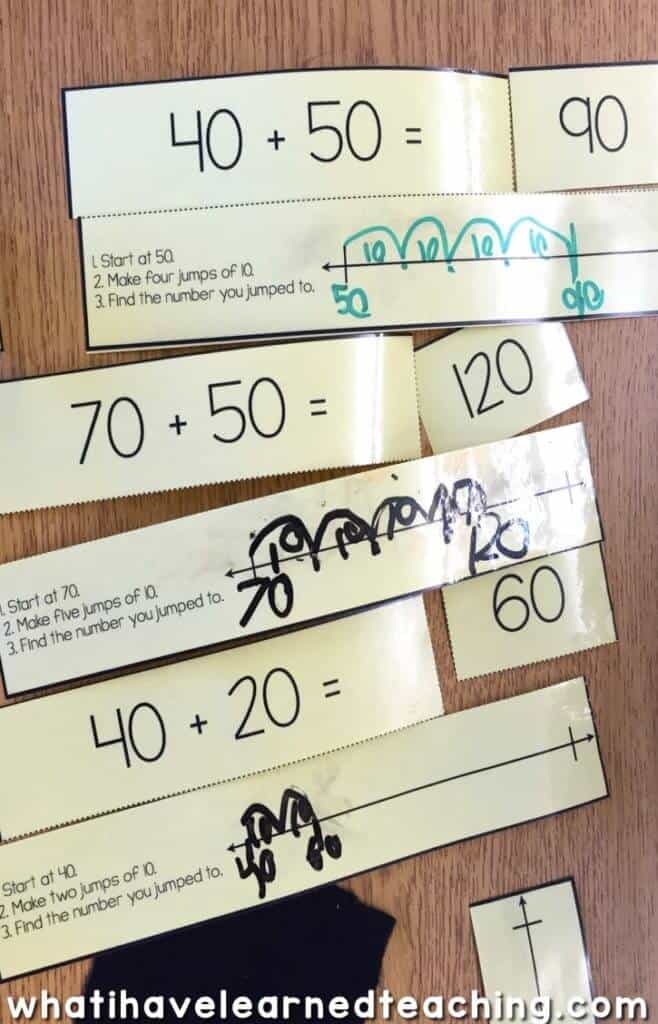


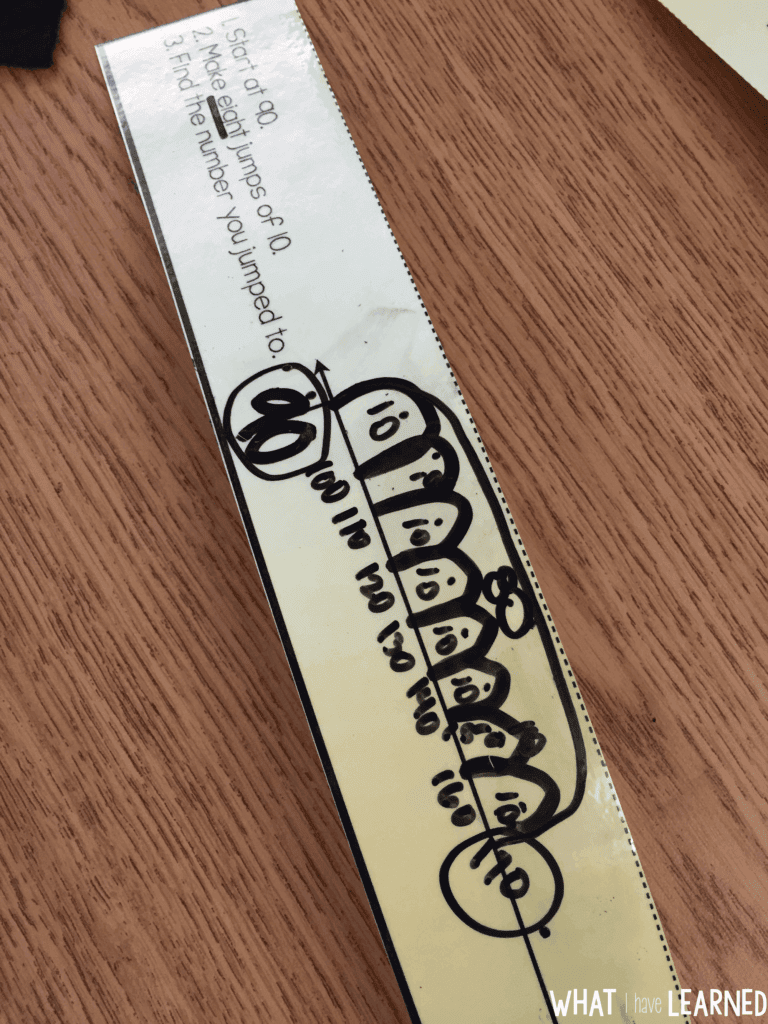
The above are a few examples from my Two-Digit Addition Math Stations. My students needed more direct practice with number lines and making jumps, despite all of our whole-group practice. So, I gave them the directions, and students followed them on the number lines.
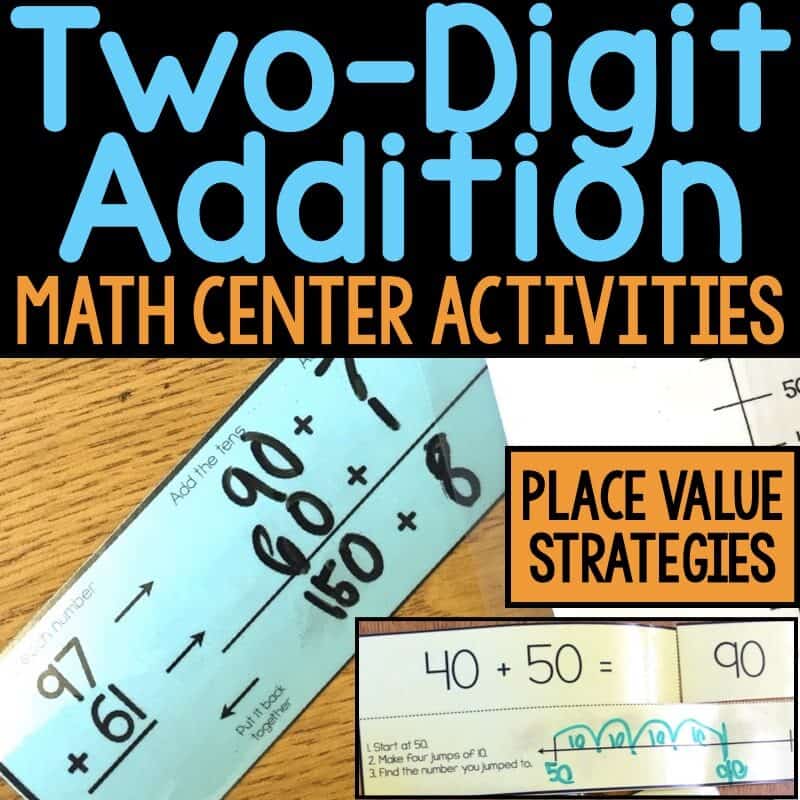
Two-Digit Addition Task Cards, Assessments, Activities, and Games
Two-Digit Addition Task Cards, Assessments, Activities & Games includes practice activities to help your students solidify their understanding of how to add two-digit numbers using multiple strategies. Do your students struggle with two-digit addition? Are they struggling with the concept of adding larger numbers? These games and activities will help.
A more recent resource that I developed to help students develop number fluency is the Make 100 and Make 1000 resource. This resource has MANY activities where students practice making 100 and making 1000. Number lines are one of the activities.

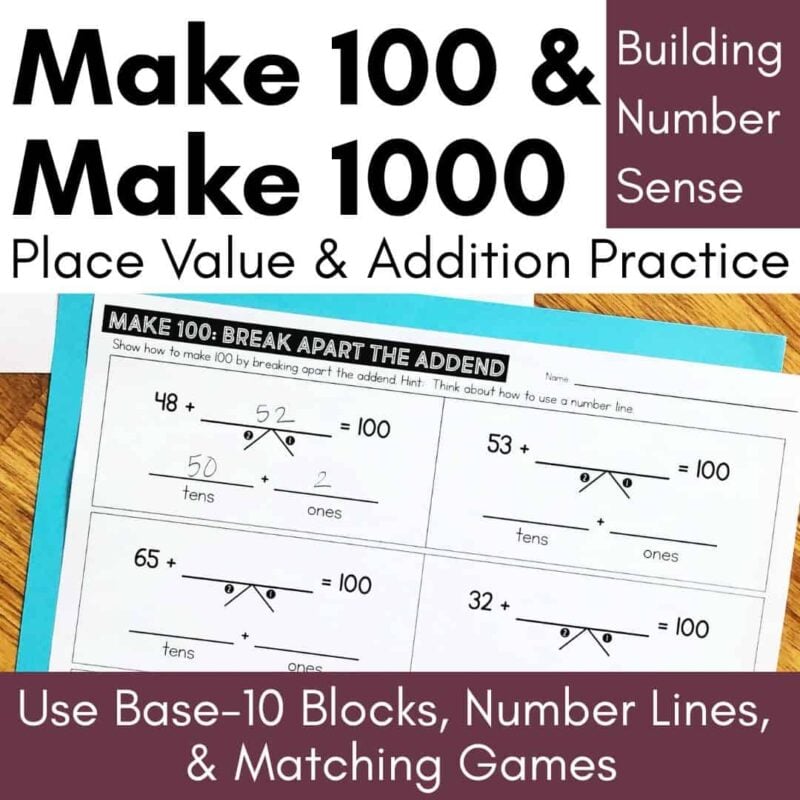
Make 100 and Make 1000 Activities and Printables
Make 100 and Make 1000 resources that help students use number lines, base-10 blocks, and learn how to “jump” to the nearest friendly number. The resources in this product are designed to help students make 100 and make 1000.
I also have a whole blog post on how to use a number line, with even more examples for developing number line fluency in the classroom.

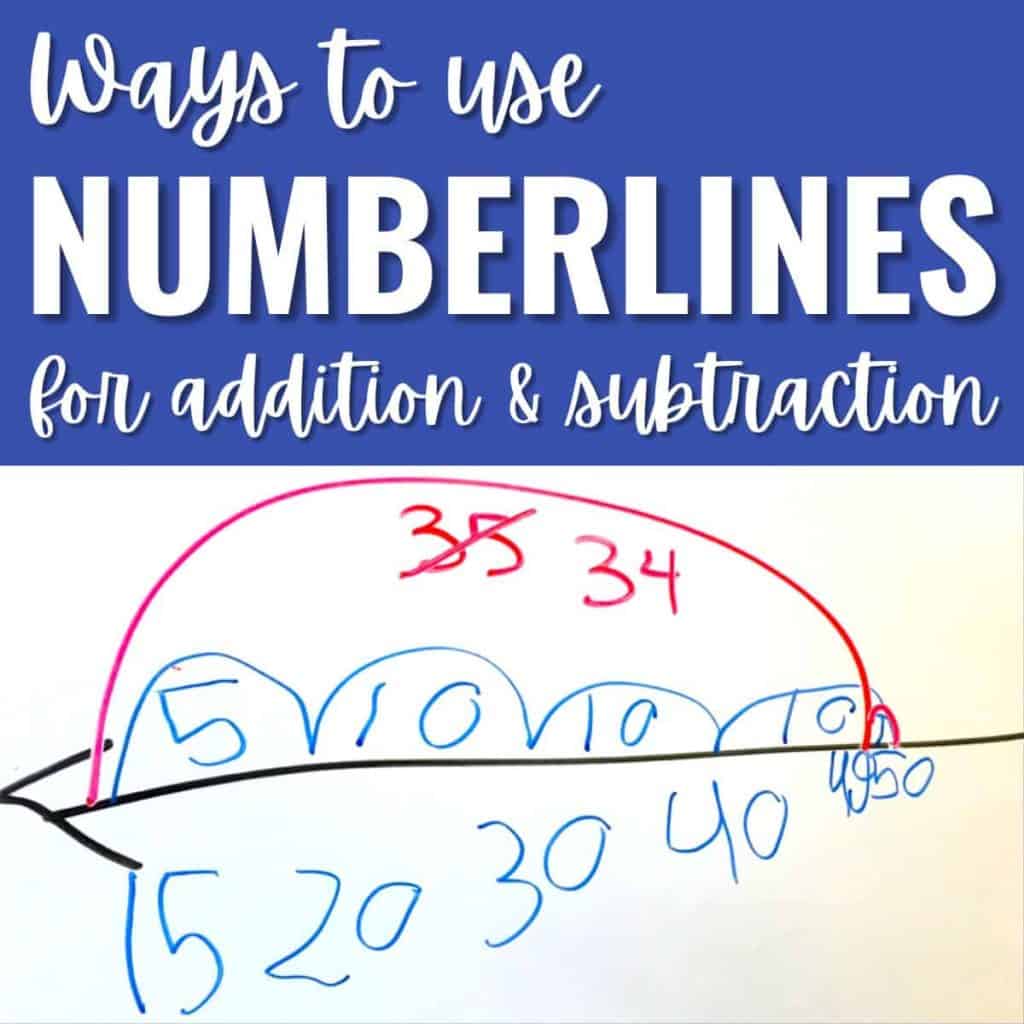
Read more about ways to use numberlines for addition and subtraction. This post goes more indepth about numberlines and hwo to use them for two-digit and three-digit addition and subtraction.
Base-10 Blocks
Base-10 blocks are another model I teach students to use; however, I generally teach students to draw the base-10 blocks. We do use real foam blocks in class, but I try to move away from them as quickly as possible.
Why? Students will always have pencils and paper to solve problems, but they won’t always have manipulatives available. Using base-10 blocks also takes a lot of time. I don’t mind spending the time on them for students who need them, but I also want to push students toward more efficient tools.
Here are a few examples of how we use base-10 blocks:


The two above use base-10 blocks by drawing out the tens as “sticks,” as we refer to them in our classroom. These particular students were having difficulty counting over 100 by tens, so I had them draw each number in tens, then count by tens until they got to 100, then start over, counting by 10s again. Not only did this help them add up numbers beyond 100, but it also gave them more experience with our base-10 number system.

The above example is from my Two-Digit Addition Math Stations again and is just a basic problem – answer matching with base-10 block representations.
The Number Line blog post also has an interesting visual activity to help students transition from base-10 blocks to number lines.
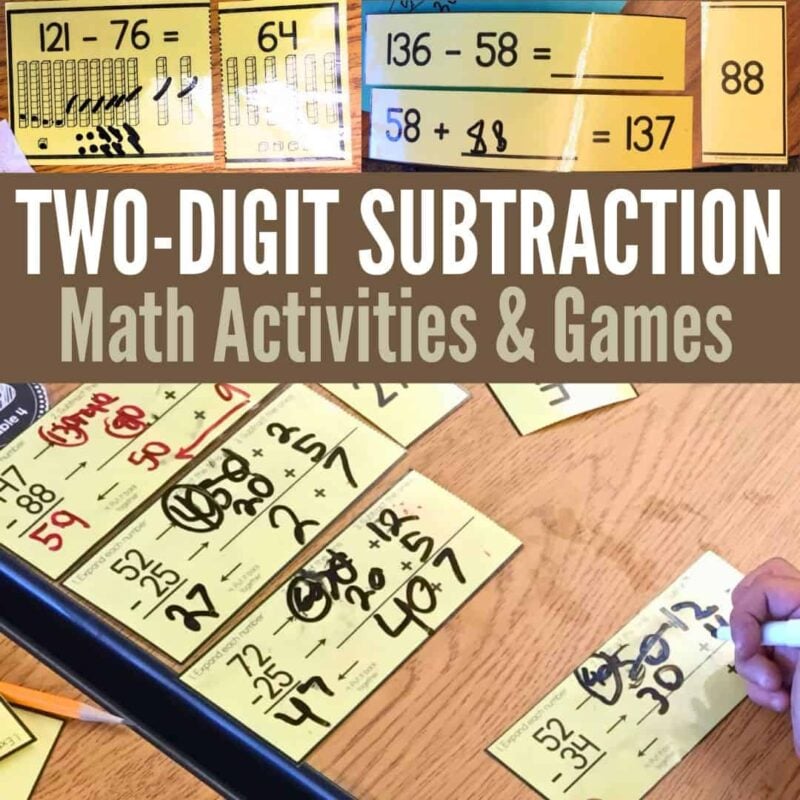
Two-Digit Subtraction Assessments, Task Cards, Activities, and Games
Do your students struggle with two-digit subtraction? Are they struggling with the concept of subtracting numbers between 100 and 199?This product includes four levels of two-digit subtraction equations, progressing from simple to complex. Also included are pre- and post-assessments, as well as quick-assessments to monitor progress along the way. You can differentiate instruction based on what a student can and cannot add.
Strategies for Two-Digit Addition and Subtraction
As noted above, the three main addition and subtraction strategies stated in the standards are:
- place value
- properties of operations
- relationship between addition and subtraction
Below are a few strategies that we use to solve two-digit addition problems. Most of them are based on place value strategies, as I find those tend to be easier for students to understand and apply. Again, these are how students manipulate the numbers in the problem to make it easier to solve.
Keep in mind that no one strategy is the “right” strategy for every student for every problem. Some problems lend themselves to certain strategies because of the numbers. Students may also switch between strategies within the same problem, depending on how they’re manipulating the numbers. The key thing to consider is whether the student can explain their thinking when solving a problem.
Break Apart or Ungroup (Place Value)
This strategy requires a bit more mental math practice, but it can be so powerful. The basic idea is that the number is broken apart into tens and ones, and then, using a number line, base-10 blocks, or just numbers, students manipulate the pieces to add or subtract.
Breaking the number part or ungrouping it helps students see the value of place value. The tens place is not just 4. Its value is 40 or 4 tens.
One resource that helps develop this strategy is the Number Talks book (affiliate link). We do number talks throughout the year, starting with addition facts and moving into two-digit addition and subtraction by the end of the year. I love seeing the strategies that my students can come up with! The Number Talk book is also a great resource for developing listening skills.
Think about problem 64-47. Students break apart the problem into 50+14-7-40 and take away the parts by place value. I’d probably start with the 14-7, but students could start anywhere that makes sense for them.

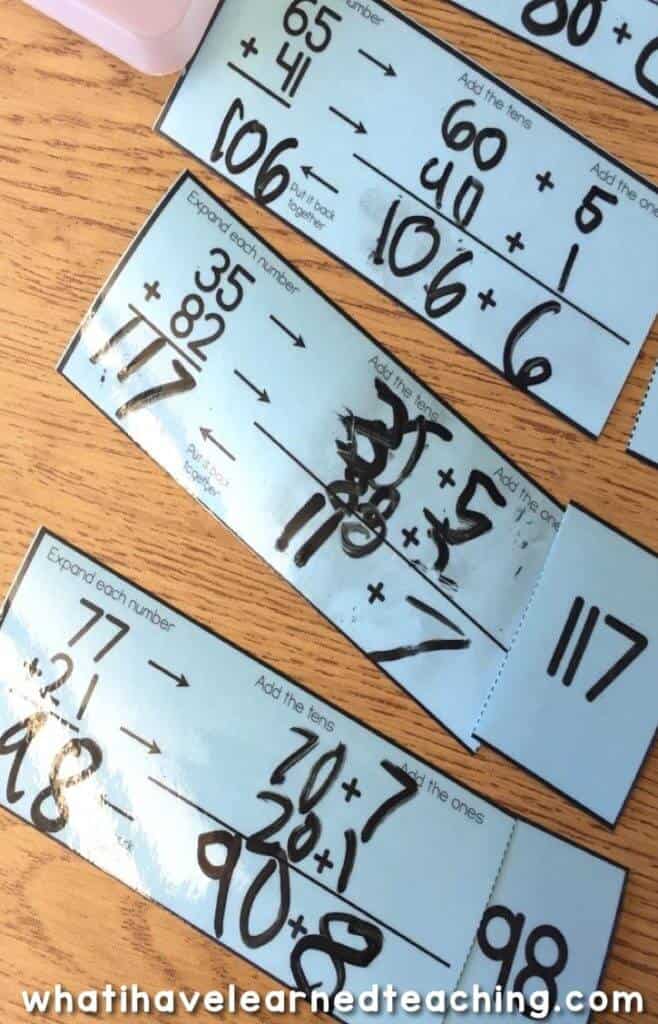
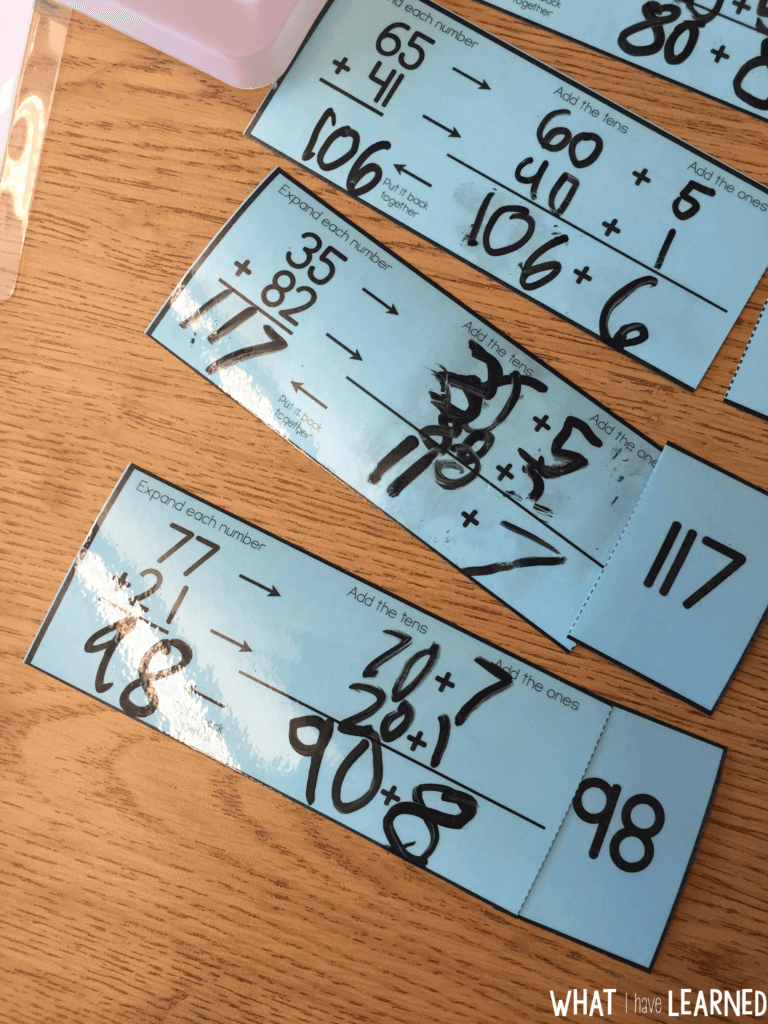

The above examples come from my Two-Digit Addition Math Stations and illustrate how students can break apart numbers and add up each place value. Breaking apart is also called ungrouping or decomposing, depending on the math program you use.
Did you notice that in one of the problems above, the student added 60 +40 and got 106, yet he wrote the correct answer to the problem? What do you think was going on with this student? Do you think he couldn’t add 60+40, made a silly mistake, or is there another reason he wrote the 106? Seeing students interact with these strategies will give you a starting point for conversations with them about their mathematical thinking and the errors in their computations.


One more example from some Addition Task Cards, where students break apart only the second number, then make jumps of 10 and 1 using 100s and 1000s charts. Although we give plenty of practice using a 100s chart in first grade, I find that students don’t necessarily transfer their learning to larger numbers in second grade.
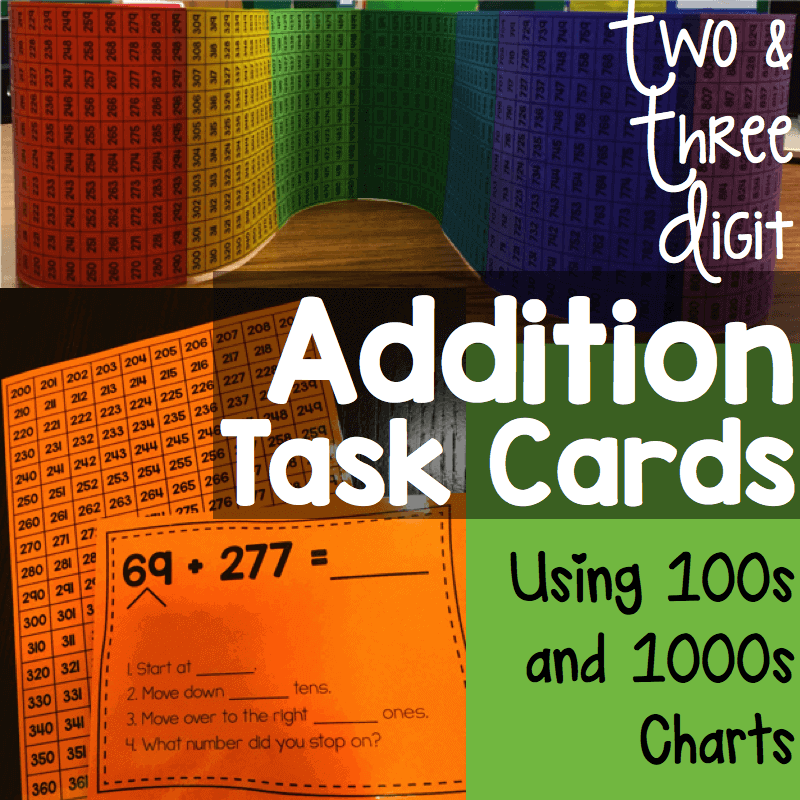
Addition Task Cards Using 100s Charts
Addition task cards in which students use 100s charts to solve two- and three-digit addition problems. Charts and task cards are divided into sets numbered 0-999, with 200 numbers on each chart. For example, if a problem is 345 + 86, students can use the chart that goes from 300 – 499 and travel across 400 when adding.Using these task cards will help students visualize larger numbers on a chart and add larger numbers by tens and ones.
Add Tens to Tens and Ones to Ones (Place Value)
This is very similar to the break-part strategies, except without breaking the numbers apart. Students can mentally add the parts of a number (tens or ones) because they know their addition facts. We basically use a V-model to draw lines connecting the tens and add or subtract those parts.
Here is one example of how we’ve used it in the classroom:

Subtract Tens, Subtract Ones (Place Value)
Similar to adding tens to tens and ones to ones, students subtract each place value separately, then subtract the ones from the tens (or add them). There are basically two ways to use this strategy. Students can decompose the ten, or they can use negative numbers.
One way that I use this strategy with students is with negative numbers. I know we don’t teach negative numbers in second grade, but for some students, this is really a way they understand and can hold on to more than other strategies. You can see examples of this in the second and third anchor charts above.
Think about 64-47. If I subtract 4-7, I get -3. I tell students that the bigger number has a minus sign in front of it, so it still has more to take away. Students then subtract 60-40, get 20, and subtract more to get 17.
Count Down / Think Addition (Count Up) / Add Up (Relationship between Addition & Subtraction or Place Value)
I’m not exactly sure whether this strategy is about the relationship between addition and subtraction or place value. The Think Addition Strategy is similar (if not the same as) Count Up or Add Up. This strategy is also very similar to the Break Apart Strategy, in that students need to break at least one number apart to add or subtract by the number’s parts.
Although students can count by ones, I highly encourage you to help them move toward more efficient strategies, such as counting by tens and then ones. Using a hundred chart gives students practice moving up and down by 10s. A hundred chart is sort of like a compressed number line. See the above photo with the 100s and 1000s charts.
Here are a few examples of counting up:


The two examples above are just the ones we did on the whiteboard, and I had students write them down in their notebooks.
The following image is a page from my Two-Digit Subtraction Flap Books. These Flap Books go through several different models and strategies, giving students practice with vocabulary and with explaining their thinking.

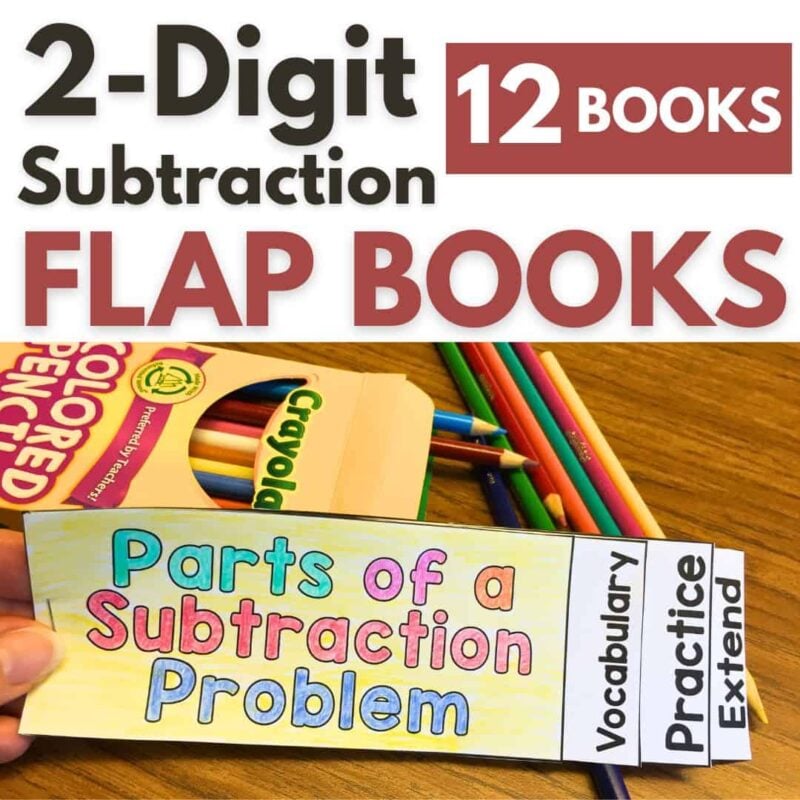
Two-Digit Subtraction Flap Books
Two-digit subtraction flap books help students solidify their understanding of two-digit subtraction in a fun activity that goes beyond normal worksheets. Students can keep the flap books in their interactive notebook or take them home for review.
The thing I LOVE about these flap books is that students can dive deep into one aspect of two-digit subtraction and attach language to the numbers and processes that they use.
Here is an anchor chart that we created to explain the Count Up Strategy for subtraction.

Use Compensation (Properties of Operations)
This last strategy is unlike any of the previous ones. It basically has students make sure the numbers are balanced in the problem and that they’re accounting for all parts. It’s a precursor to algebra and a great strategy for mental math.
There are a couple of ways to use compensation, but the basic idea is to add or subtract a number from one number and add it to the other to create a friendly number. You have to keep track of what was added or removed and account for it in the problem.
Compensation is especially useful for numbers close to friendly numbers, though it can be applied to any number. For example, 68 – 39 could be transformed into 69 – 40. I’ve added one to each number. The values +1 and -1 are 0, so I haven’t changed the problem at all.
Here’s another example: 53 + 38. I might add 53 + 40 and get 93, but since I added two to 38 to get 40, I’ll need to subtract two from 93 to get 91.
The basic idea behind compensation is that you adjust one part of the number to a friendly number to make it easier to add or subtract. However, when you adjust one number, you have to keep track of what you’ve changed and compensate accordingly.
The Traditional Algorithm
If you take a close look at the Common Core standards for 2nd grade, especially 2.NBT.B.5 and 2.NBT.B.7, you’ll notice something interesting. The standards focus on using place value, properties of operations, and visual models to solve problems. They emphasize strategies like breaking apart numbers, using number lines, and working with concrete models.
What you won’t see mentioned directly is the traditional algorithm many of us learned, often described with terms like “carry” and “borrow.”
That’s not by accident. In 2nd grade, the goal is for students to understand how numbers work, not just follow a set of steps. Standards like 2.NBT.B.9 even push students to explain why their strategies work, which is difficult if they’re relying solely on memorized procedures.
That doesn’t mean the standard algorithm has no place. It just means it shouldn’t come first. It becomes much more meaningful once students have a strong foundation in place value and flexible strategies. Keep reading to see how I introduce the traditional algorithm in a way that actually makes sense to students.
Do I Teach the Traditional Algorithm?
Yes and no. Yes, I teach the concept of regrouping, and yes, I do teach students to move toward efficiency when adding and subtracting. That could include the traditional algorithm if they can understand its meaning.
Students do not need to use the standard algorithm until fourth grade (according to the Common Core Standards). Can they do it earlier? Maybe.
I expose them to it in second grade as a model they can use; however, we don’t spend much time on it because I want students to develop problem-solving strategies rather than be tied to one model. When we do work with the traditional algorithm, we attach a lot of language and meaning to it, generally tying it to work we’ve already done, like our work with base-10 blocks.
Examples of Practicing the Traditional Algorithm in 2nd Grade
Here are a few examples of how I give students experience with the traditional algorithm.


Did you notice that it should say 7 tens and 11 ones? The student didn’t pay attention to the base-10 blocks!

These come from my Decompose a Ten packet, which balances working with the traditional algorithm with base-10 models and gives students the language of decomposing numbers.

Decompose a Ten
Subtracting Two-Digit Numbers can be confusing, especially if you don’t have the language to explain your thinking. This product provides students with sentence frames for subtracting and decomposing a ten.The activities can be used at a math station, in partner practice, or in a scoot game. The main idea is that students practice academic language to talk about how to decompose numbers for subtraction.
Anchor Charts: Two-Digit Addition and Subtraction Math Strategies For 2nd Grade
Here are some adding and subtracting anchor charts I’ve used over the past couple of years to illustrate some of the models and strategies you’ve seen in this post.


The image above demonstrates some second-grade math subtraction strategies that I have used with students.
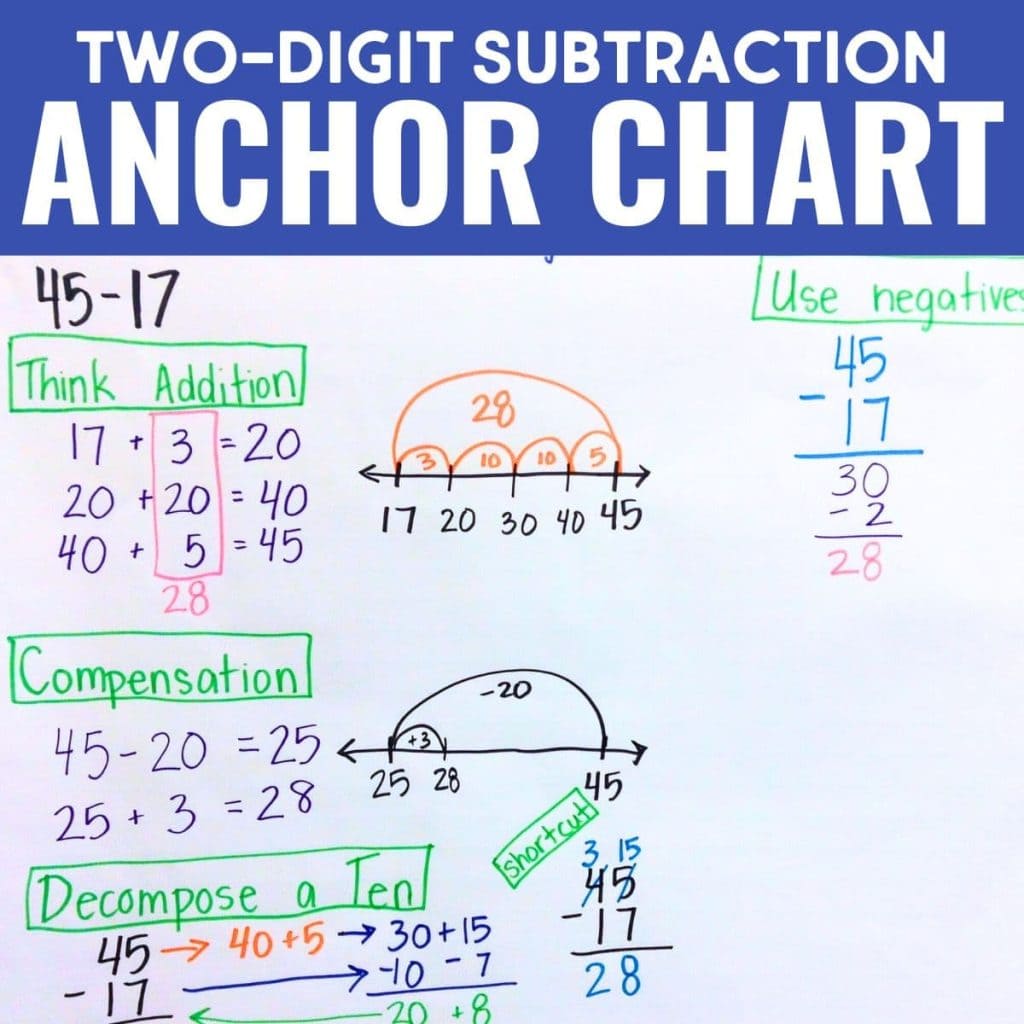
If you need more explanations about the anchor charts you see above, check out this indepth blog post about the subtraction strategies you see here.
Frequently Asked Questions about Two-Digit Addition and Subtraction Strategies
Bringing It All Together
Whew – that’s a lot of information to digest!
There are many different models and strategies a student can use to solve two-digit addition and subtraction problems. What I outlined above are a few that I have found especially helpful for students.
They help students develop a solid foundation in two-digit addition and subtraction, build a bridge to three-digit addition and subtraction, and emphasize using strategies and models to solve problems rather than just following steps in a process.
If you teach second grade, you might like a few pages from some of my two-digit addition and subtraction products. I’ve compiled this PDF of resources as a sampler from several different products that really emphasize all the work we do in our classroom to develop these strategies in depth.
Different components of the sampler can be used with whole or small groups and are perfect for helping your students think outside the box when solving multi-digit addition and subtraction problems.
Free Two-digit Addition & Subtraction Resources
If you’d like to try some of these models and strategies with your students, you can sign up to have them sent straight to your inbox.

Two-Digit Resources Mentioned Above
Here is a list with links to all of the two-digit addition and subtraction resources mentioned above. They can be purchased on my website or on Teachers Pay Teachers.
- Roll and Spin Math Stations
- Cut and Paste Math Activities for Second Grade (TpT)
- Two-Digit Addition Math Centers (TpT)
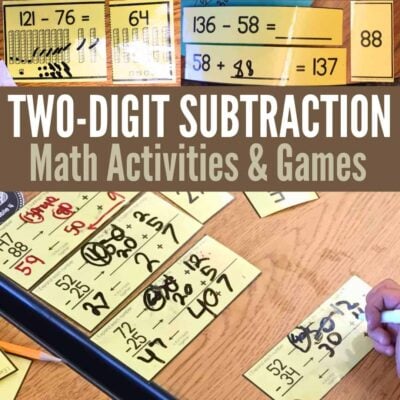
- Two-Digit Subtraction Math Centers (TpT)
- Addition Task Cards Using 100s Charts (TpT)
- Two-Digit Subtraction Flap Books (TpT)
- Decompose a Ten Task Cards (TpT)
Many of the above are also included in a Two-Digit Addition and Subtraction BUNDLE (TpT).
Additional Two-Digit Addition & Subtraction Resources
- Two-Digit Addition Number Puzzles (TpT)
- Two-Digit Subtraction Number Puzzles (TpT)
- Decompose Two-Digit Numbers Number Puzzles (TpT)
- Two-Digit Addition No Prep Printables / Worksheets (TpT)
- Two-Digit Subtraction No Prep Printables / Worksheets
-

-
-
Decompose a Ten$3.75
-
-
-
-
-
-





This entire blog has made my life easier. I am a student teacher to second graders and I have been having a difficult time figuring out how to teach my students double digit addition and subtraction with and without regrouping. A lot of kids this year have a weak number sense and I know that is contributing to their struggle. Your booklets and packets have made their struggle nearly disappear.
Is awesome to me as well and i think it will really help my students as well
Hello,
I’m curious what math program you are working with? We have just adopted EverydayMath and much of your approach reminds me of that program – but is more friendly! Thanks for your reply.
After Common Core came out we were in transition and didn’t really use one math program, but a variety of resources that meet the standards. These resources are not based on any program, but processes students can use with any program.
OMG!. Thank you so much for putting this together, and making it visible. I am a parent of a 4th grader who is still struggling with understanding this material. I’ve seen many worksheets sent home with a combination of strategies this is the first time, I’ve understood how they are all connected. I love your simple explanations, breakdown of the standards, and real-world examples. I bet you are an AMAZING teacher, and truly, truly, appreciate you.
Great explanation for some of us parents that feel kind of lost like my self right now. I grow up with other math methods, and I feel frustrated that my 2nd grader comes home with different types of strategies that I don’t know. But Thankfully, searching on the web I came along with this amazing page that really explains all those strategies that new generations are learning today. Thank you so much for this strategies, it is well appreciated from myself and I bet many parents out there. I can tell you are an amazing teacher.
Thanks a lot!