
Weather Vocabulary Activities That Actually Stick (and Don’t Feel Like Test Prep)
If you’ve ever taught a weather unit and felt like students could recognize words like evaporation or precipitation, but couldn’t actually use them, you’re not alone. Finding effective weather vocabulary activities that go beyond memorization can be a challenge, especially when students need to apply those words in real conversations and writing.
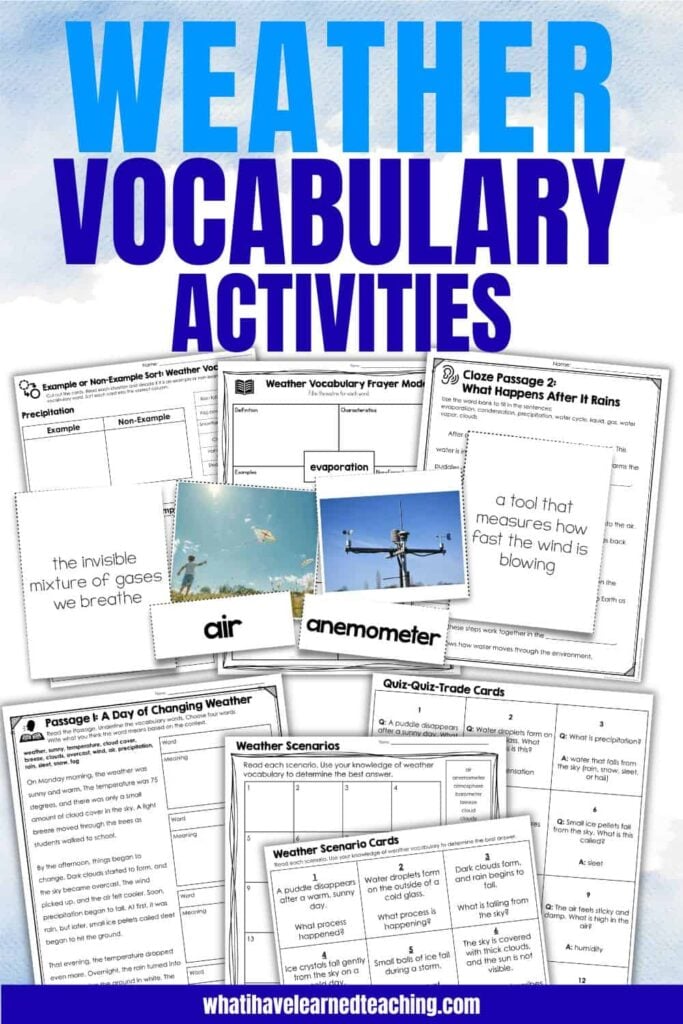
The goal isn’t just for students to match terms to definitions. It’s for them to use those words when they talk, write, and think about the weather. That’s where structured, hands-on vocabulary activities make a big difference.
This weather vocabulary resource is designed to move students beyond memorizing words and into actually understanding how those words connect to real-world weather.
What Is Included in This Weather Vocabulary Resource?
This resource is a comprehensive collection of activities focused on helping students build a deep understanding of weather-related terms and concepts.
Students work with vocabulary such as:
air, atmosphere, precipitation, evaporation, condensation, clouds, humidity, temperature, water cycle, wind, and more.
The weather activities go far beyond flashcards and worksheets. Instead, students interact with vocabulary in multiple ways so the learning sticks.
Core Weather Vocabulary Activities
- Vocabulary practice activities using key weather terms
- Water cycle connections (evaporation, condensation, precipitation)
- Weather tools exploration (thermometer, barometer, anemometer, rain gauge)
- Cloud types and weather condition identification
- Reading, writing, and discussion-based tasks
- Application-focused activities that connect vocabulary to real weather situations
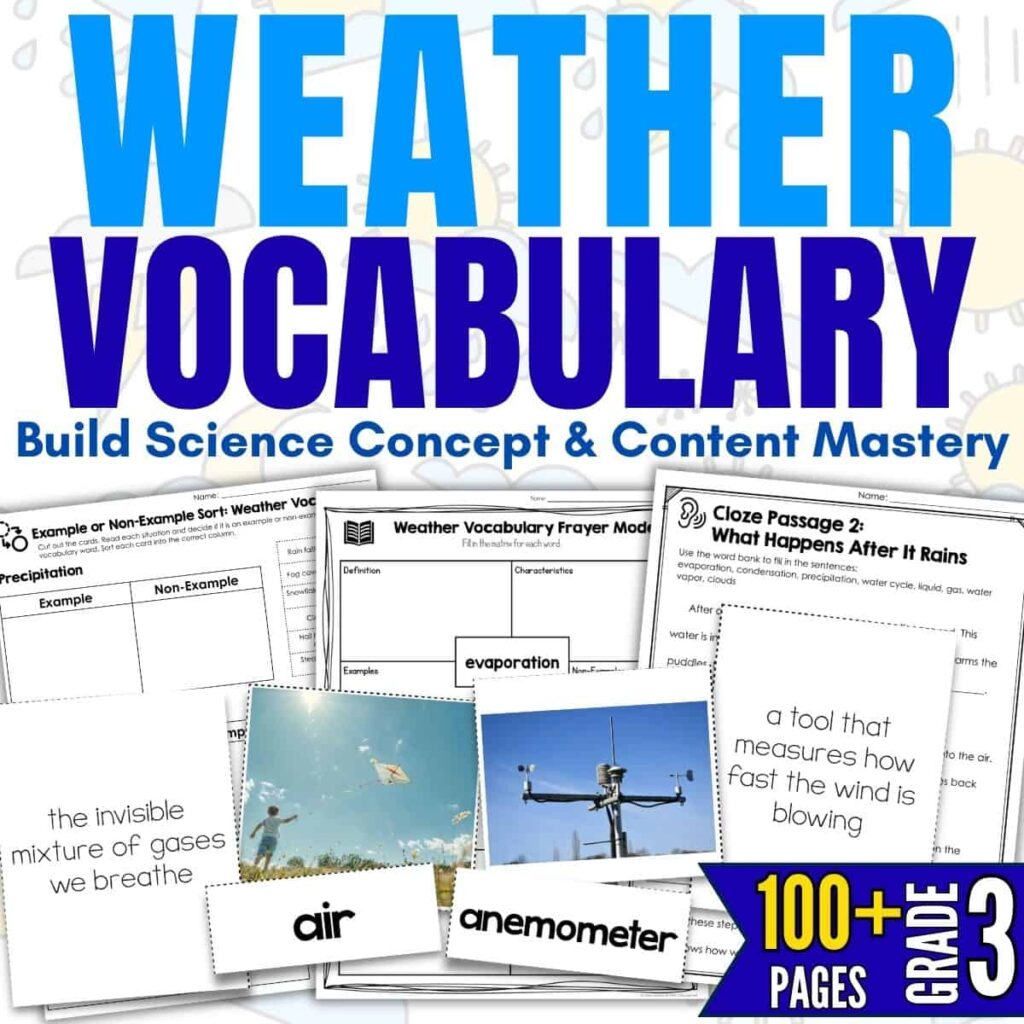
Build a strong foundation in weather vocabulary, science of weather activities, and weather word practice with this comprehensive, engaging resource!
Why Weather Vocabulary Is So Important
Weather units are full of academic language. Students are expected to understand and use terms that don’t always show up in everyday conversation.
Without strong vocabulary instruction:
- Students struggle to explain scientific ideas
- Reading science texts becomes harder
- Writing about weather stays vague (“It’s rainy”) instead of specific (“There is heavy precipitation and low cloud cover”)
When students truly understand vocabulary, they can:
- Describe weather patterns
- Explain processes like the water cycle
- Interpret charts, diagrams, and forecasts
- Participate in meaningful science discussions
How to Teach Weather Vocabulary (Without Losing Your Sanity)
Teaching vocabulary doesn’t need to be a stack of worksheets and crossed fingers. Here are practical ways to use this resource in your classroom.
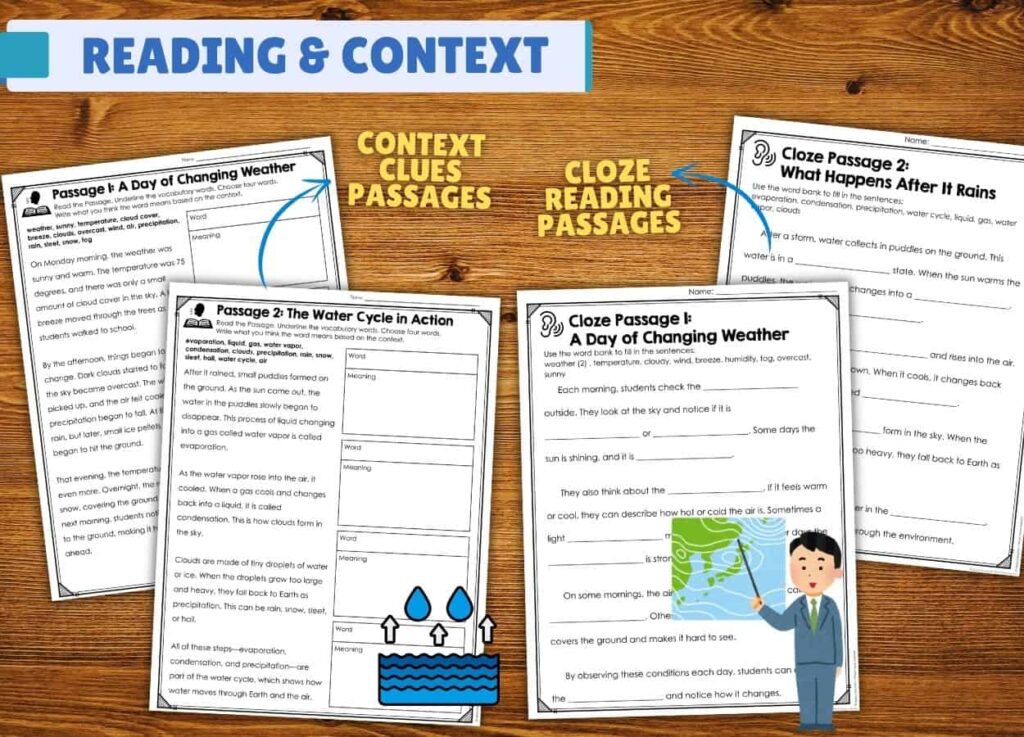
Use Vocabulary in Context
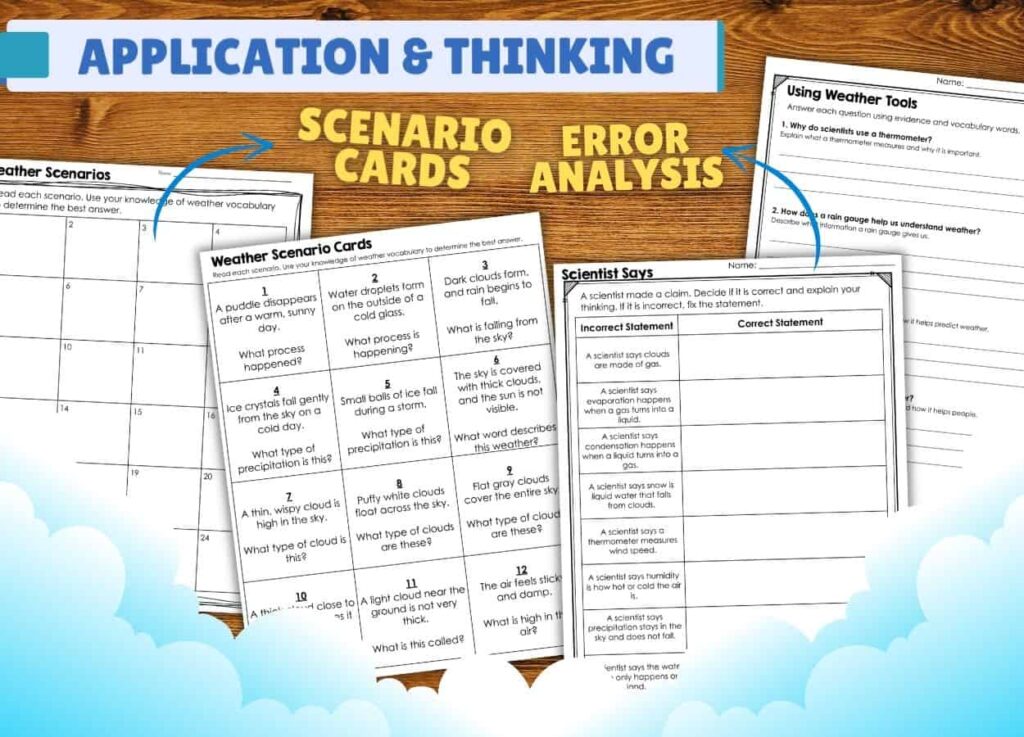
Have students read short passages or scenarios where vocabulary is used naturally. Then ask them to:
- Identify key terms
- Explain what they mean in context
- Connect them to real-life weather examples
Incorporate Discussion
Give students opportunities to say the words out loud:
- Partner discussions
- Turn-and-talk moments
- Quick verbal responses
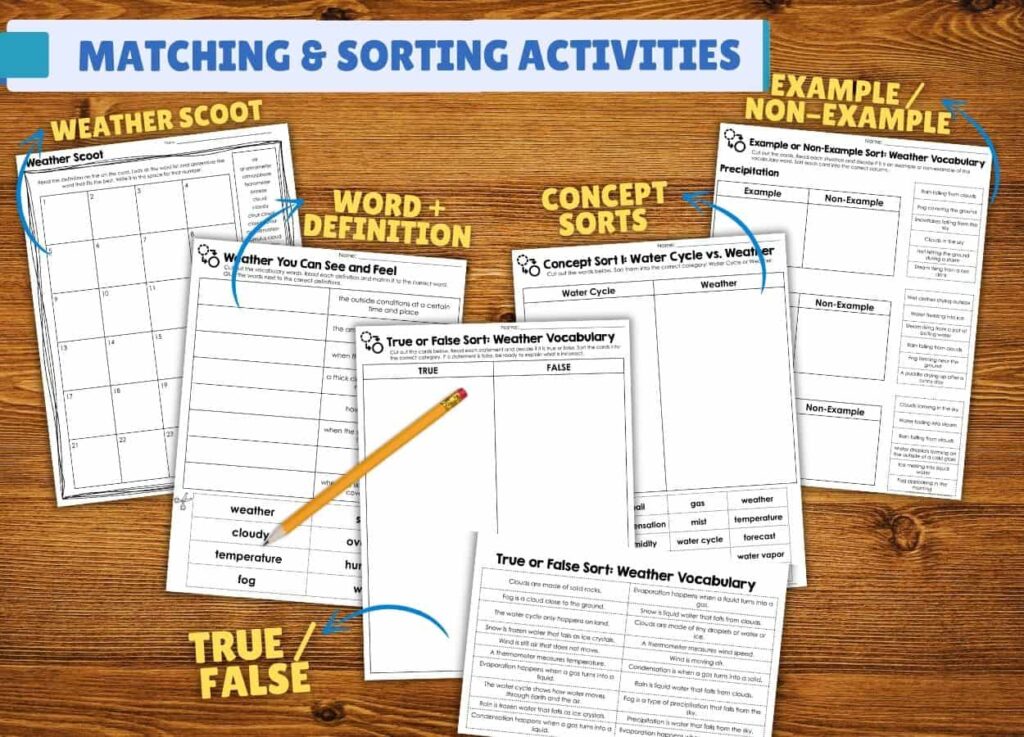
- Quiz, Quiz, Trade Activities
This helps students move from recognition to actual use.
Connect to Real Weather
Ask questions like:
- “What type of precipitation are we seeing today?”
- “What tool would measure today’s temperature?”
- “Which cloud type do you see outside?”
Suddenly, vocabulary becomes part of their daily thinking.
Spiral the Practice
Don’t teach vocabulary once and move on. Revisit words across:
- Reading tasks
- Writing activities
- Science discussions
- Quick review routines
Repetition in different formats is what makes the learning stick.
How This Resource Supports Different Grade Levels
2nd Grade
- Focus on understanding basic terms
- Use visuals and simple explanations
- Emphasize speaking and identifying vocabulary
3rd Grade
- Connect vocabulary to weather patterns and tools
- Introduce short written responses
- Begin using terms in explanations
4th–5th Grade
- Apply vocabulary to deeper concepts like the water cycle and data interpretation
- Write detailed explanations using academic language
- Analyze scenarios and make predictions
Ways to Use This Resource in Your Classroom
This resource is flexible and can fit into multiple parts of your day.
Whole Group Instruction
Introduce vocabulary and model how to use the terms in context.
Small Groups
Work with students who need extra support or enrichment.
Science Stations
Turn activities into rotating stations where students:
- Read
- Write
- Discuss
- Apply concepts
Independent Practice
Use activities for reinforcement, morning work, or early finishers.
Test Prep (Without Feeling Like Test Prep)
Because students are working with vocabulary in context, they’re naturally preparing for assessments—without drilling isolated definitions.
Built for Understanding, Not Just Memorization
One of the biggest strengths of this resource is its focus on contextualized learning. Students aren’t just matching words to definitions—they’re using vocabulary in meaningful ways that connect to real science concepts.
This makes it a great fit for:
- NGSS-aligned weather instruction
- Science notebooks
- Review before assessments
- Building academic language for English learners
Ready to Use Weather Vocabulary That Works
If you’re looking for a way to help students actually understand weather vocabulary, and not just memorize it, this resource gives you structured, engaging activities that make a difference.
It’s designed to support students as they move from learning new words to confidently using them in science discussions, writing, and real-world connections.
And once you see how well students respond to this approach, you might find yourself wanting similar resources for other science topics too.
Build a strong foundation in weather vocabulary, science of weather activities, and weather word practice with this comprehensive, engaging resource!
Jessica BOschen
Jessica is a teacher, homeschool parent, and entrepreneur. She shares her passion for teaching and education on What I Have Learned. Jessica has 16 years of experience teaching elementary school and currently homeschools her two middle and high school boys. She enjoys scaffolding learning for students, focusing on helping our most challenging learners achieve success in all academic areas.