
How to Teach Supporting Reasons in Opinion Writing
How do you teach students to support opinions with reasons? Many students can tell you what they think, but they often struggle to explain why. This post focuses on teaching students how to supply reasons that support an opinion, which is a key step in opinion writing.

This post focuses only on supplying reasons. Instruction on stating an opinion, writing introductions, and writing conclusions is addressed in separate posts.
If you’re looking for instruction on other parts of opinion writing, these posts may be helpful:
- 7 Ways to Introduce Opinion Writing
- Picture Books to Teach Opinion Writing
- Teaching How to State an Opinion
- Teaching How to Write an Introduction for Opinion Writing
- Teaching How to Write a Conclusion for Opinion Writing
- Teaching Ideas to Solidify Students’ Understanding of Opinion Writing
This post builds on instructions for stating an opinion, but the instructional focus here is on developing reasons. While students may state opinions at the same time, the teaching emphasis is on helping students explain why they think what they think. Students will give reasons, but their reasons may not be strong reasons. That’s okay. The goal during that week is to state an opinion using academic language.
Supporting an opinion with clear reasons is one of the most important skills students learn during opinion writing. After students state their opinion, they must explain why they believe it. To see how this step connects to the rest of the writing process, read this complete guide to teaching opinion writing in elementary school, which explains each stage of instruction.
In my classroom, this work typically becomes the focus of its own week once students can state an opinion using academic language. Gauge whether or not your students can work on both skills within the same week. If they are confused by the reasons, pull back and only focus on stating an opinion using explicit sentence frames. If they need more practice with supplying reasons outside of stating an opinion, these ideas will deepen their understanding of how to do that.
Ask “Why?” to Help Students Generate Reasons
Before students can write strong reasons, they need to understand how a reason is different from an opinion.
One of the easiest ways to teach supplying reasons is to ask, “Why?”
Just asking students why they think or feel a certain way will generate a lot of reasons and more opinions. Asking why helps students brainstorm ideas. Some of the ideas and reasons students give will be weaker than others, but it’s a great starting point.

Opinion Writing Unit | 2nd & 3rd Grade Common Core Writing Resource
Teach opinion writing with confidence using this Common Core-aligned Opinion Writing Unit for 2nd and 3rd grade students. This comprehensive resource includes graphic organizers, sentence frames, anchor charts, writing prompts, assessments, and engaging activities that help students develop strong opinion writing skills through both oral language practice and written application.
Explicitly Teach the Difference Between a Reason and an Opinion
When you read through a list of students’ reasons, you might see more opinions. It’s important to teach the difference between an opinion and a reason.
Before you elicit ideas from students, consider explicitly teaching them how to supply strong reasons. Give many examples of strong reasons and give students examples of weaker reasons.
Students who have had little formal experience with opinion writing will give reasons such as, “It’s fun.” or “I like it.”. These simple reasons can be expanded with more words, but they are still weak.
Why? (See what I did there?)
“It’s fun.” and “I like it.” blur the line between an opinion and a reason. An opinion tells what the writer thinks or feels about the topic. A reason answers the question WHY. Why does the student think or feel that way?
“It’s fun.” and “I like it.” can be developed into concrete reasons by asking why. Students can expand on WHY it’s fun or WHY they like it.
Emphasize that reasons are where students convince the reader why their opinion makes sense.
Opinion and Reason Sort
One way to teach the difference between an opinion and a reason is through a sorting activity. Use a pre-made one in our Opinion Writing Resource or use students’ own ideas.

If students have brainstormed a list of ideas on an anchor chart or graphic organizer, have them cut apart the ideas with scissors. Have students list several reasons for each idea. Have a discussion about whether or not the reason is an opinion or can stand on its own as a reason. See an example of this below.
You can also play a two-corners game where you read a statement, and students stand in one corner if they think it’s an opinion or another corner if they think it’s a reason.
Rank the Quality of Reasons
At this stage, the goal is not perfect paragraphs, but helping students recognize which reasons are stronger and why.
Deepen the discussion by ranking the reasons. Some reasons have more depth and value than other reasons and can help students form and defend a stronger opinion. Play a four-corners game where students rank the reasons on a scale of 1-4 and stand in the respective corners.
If you use student samples, make sure they are several years old so students can’t attribute weak reasons to specific individuals.
Rewrite Weak Reasons
As you present students with weaker reasons, have them verbally reorganize the statement to be a strong reason. After you have done this orally, take it to writing. Give students a list of weak reasons to rewrite into stronger reasons.
Use an Anchor Chart or Graphic Organizer to Record Ideas
In the Picture Books for Opinion Writing post I go in depth about using an anchor chart to record the opinion components of mentor texts. Most mentor texts will have some solid reasons and some weaker reasons. You record an opinion and reason from the books you read with students and also rank the quality of the reasons.
In this post about solidifying students’ understanding of opinion writing, I go into detail about using student samples with a rubric or a checklist. As you spend this week working on helping students write reasons for their opinion, gather samples and keep them year after year to support your opinion writing unit.
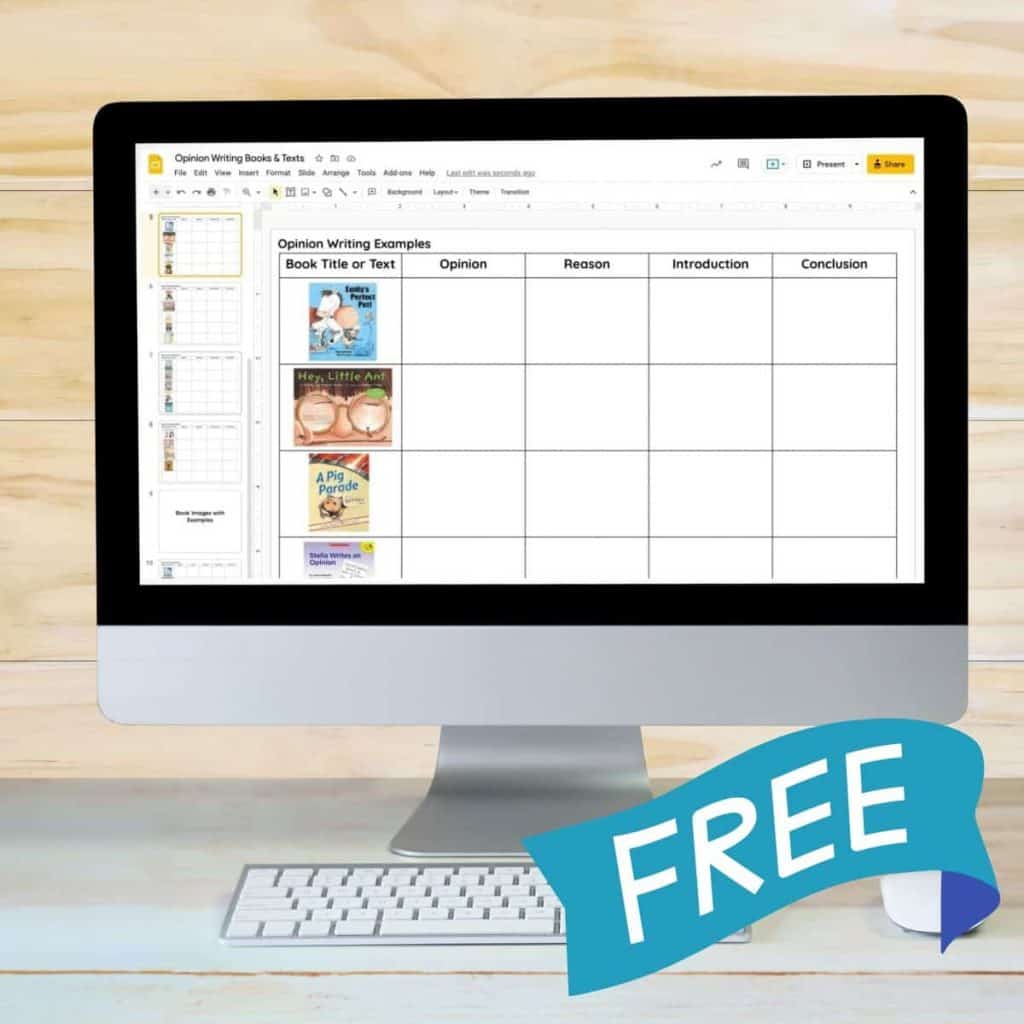
Free Digital Anchor Chart of Picture Books
Would you like a free digital anchor chart of the picture books in this blog post? Click the image below and sign up to receive a link to copy this fully-editable Google Slides file. Use it as a starting point to create your own classroom anchor chart for opinion writing.
Generate a Lot of Opinions and Have Students Write Reasons for 1-2 Opinions
During my first week of opinion writing, I create a word web with all the fun things students like doing at recess.

I cut it apart and in pairs students write about 3 reasons for each activity. You can read more about this process in the State an Opinion blog post.

This process can be repeated for many topics. In the Opinion Writing Unit are graphic organizers for several topics as well as a blank one where teachers or students can fill in their own topic.
Opinion Writing Unit | 2nd & 3rd Grade Common Core Writing Resource
Teach opinion writing with confidence using this Common Core-aligned Opinion Writing Unit for 2nd and 3rd grade students. This comprehensive resource includes graphic organizers, sentence frames, anchor charts, writing prompts, assessments, and engaging activities that help students develop strong opinion writing skills through both oral language practice and written application.
Use Sentence Frames to Teach Students to Supply Reasons
Sentence frames give students the academic language they need to explain their thinking clearly.

Encourage students to use sentence frames and practice them through cooperative learning strategies outlined in the post on how to solidify students’ understanding of opinion writing. A few more ideas are below.
Provide a Lot of Practice
Students need a lot of practice supporting their opinions with reasons. Practice both in whole group settings, with partners, and in small groups. The more students practice orally with the sentence frames, the easier it will be for them to take it to writing.
Repeated oral practice helps students internalize what a strong reason sounds like before they write. Here are a few more ideas for ways students can practice giving reasons to support their opinions:
- Provide half of your students with an opinion printed on a strip of paper. Have students pair up with a student who does not have a piece of paper. Student A reads the opinion. Student B supports the opinion with a reason. Student A reflects on whether Student B used a sentence frame and gave a reason vs. an opinion. Student A gives Student B the paper, and the two students find another partner to repeat the process.
- Give your whole group an opinion statement and provide them with sticky notes. Have students write 1-2 reasons, one per sticky note. Sort the reasons with the whole group and determine whether the reason fits the criteria and expectations taught.
Opinion Writing Unit
The activities used to teach students how to supply reasons come from my Opinion Writing Unit, which includes sentence frames, games, sorts, and graphic organizers for each component of opinion writing.
Opinion Writing Unit | 2nd & 3rd Grade Common Core Writing Resource
Teach opinion writing with confidence using this Common Core-aligned Opinion Writing Unit for 2nd and 3rd grade students. This comprehensive resource includes graphic organizers, sentence frames, anchor charts, writing prompts, assessments, and engaging activities that help students develop strong opinion writing skills through both oral language practice and written application.
Read More about Teaching Opinion Writing
7 Ways to Introduce Opinion Writing
Teaching How to State an Opinion
Teaching How to Supply Reasons
Teaching How to Introduce Opinion Writing
Teaching How to Conclude the Opinion Writing
Teaching Ideas to Solidify Students’ Understanding of Opinion Writing
Picture Books to Teach Opinion Writing
Opinion Writing Unit
Opinion Writing Sentence Starters
100 Opinion Writing Prompts
Jessica BOschen
Jessica is a teacher, homeschool parent, and entrepreneur. She shares her passion for teaching and education on What I Have Learned. Jessica has 16 years of experience teaching elementary school and currently homeschools her two middle and high school boys. She enjoys scaffolding learning for students, focusing on helping our most challenging learners achieve success in all academic areas.