
Anchor Chart Examples for Second Grade
We create and use anchor charts all the time in our second-grade classroom! Anchor charts are a great way to help students learn new information and make connections between what they know and the new information.

A Variety of Classroom Anchor Charts
Here are a few fun anchor charts that I have used in my second-grade classroom.
Daily 5 & Goal Setting
This anchor chart is one that I have used at the beginning of the year to set up Daily 5. It aligns with some of my goal setting resources and leads into setting classroom goals.

Folktales and the Central Message
Discover the central message in folktales by creating an anchor chart, reading a few folktales and having students identify the lessons or morals in the stories.

Ask and Answer Questions
This anchor chart is from a unit that I have all about Thanksgiving. This unit teaches some key nonfiction reading comprehension skills, including asking and answering questions.
I created an anchor chart that could be used for any unit and used sticky notes to record students’ questions. You can read about the lesson here as well as see more examples of student work.

This anchor chart is also part of the Thanksgiving unit. You can read more about how I created it in this blog post. The focus on this anchor chart was to describe the relationship between historical events.

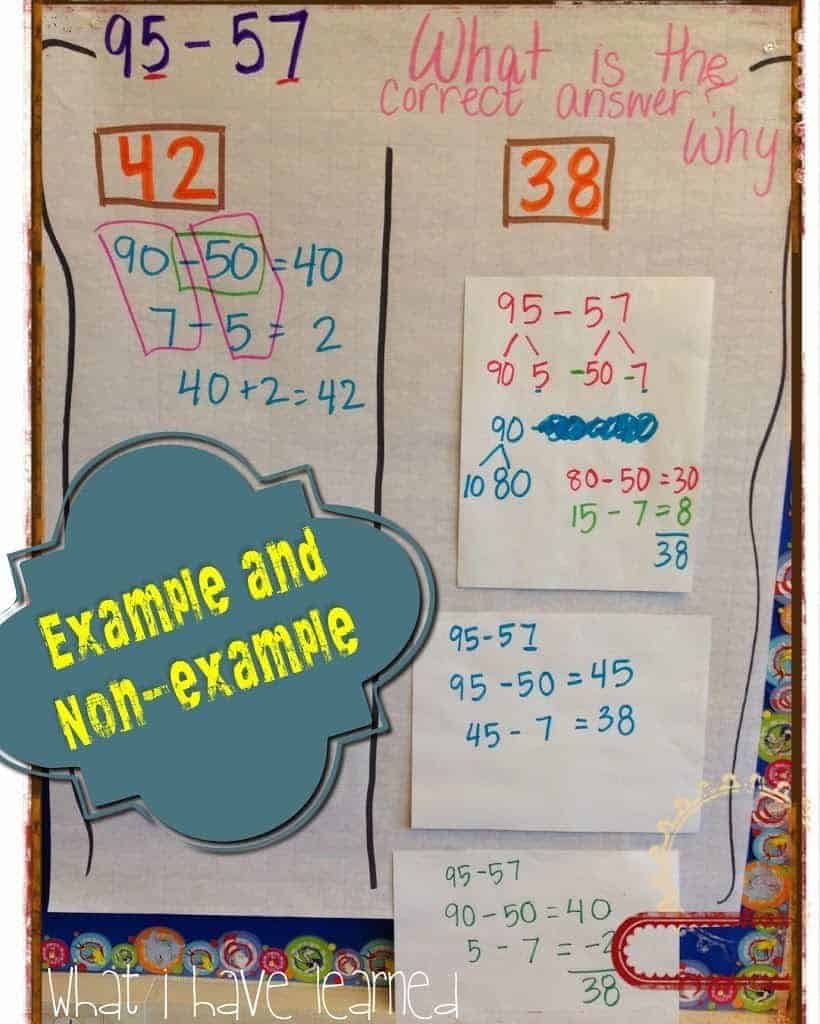
Example and non-example in math
Math is very important subject in which to use anchor charts. Students need to visually see how math equations are solved, but you can also build students computational strategies with anchor charts.
In this anchor chart, I posed a question to students, which was the right answer and why. Students demonstrated explained their reasoning and we talked about some errors in computation, as well as multiple ways to solve the problem.
Here is the blog post on using example and nonexample to build students knowledge about math.
Ways to Subtract
When we dig deep into our subtraction unit, we focus on a variety of models and strategies to solve two-digit and three-digit subtraction problems. Toward the end of the unit, I create a large anchor chart that summarizes the strategies we have learned so far, so students can see them all in one place.

Favorite Read Alouds
I love reading aloud to students. I have fallen in love with several books and read them year after year, diving deeper into the characters and text each time.
The following anchor chart is from when we read George’s Marvelous Medicine. We focused on character traits and description in this anchor chart.

This anchor chart is from Lulu and the Brontosaurus. It is another favorite book, mainly because it shows how the character changes during the story. This anchor chart illustrates some descriptive words about Lulu at the beginning of the story and at the end of the story.

Writing about Information
I have an entire series about informational writing. We study animals and create a few anchor charts during the unit. The one below is one of my go-to anchor charts for learning what students already know and finding out new information. You can read more about how I use this specific anchor chart in this blog post.

This is our writing wall. I change out the word “information” when we switch to narrative or opinion. On this wall, I display the standards that we’re working on and anchor charts that help students meet that standard.

What favorite anchor charts do you have? Do you ones that you go back to time and time again? I’d love to hear about them in the comments below!
More Information about Anchor Charts
I created an entire blog post about tips for creating great anchor charts in your classroom. If you find yourself in need of some help to create eye-catching anchor charts, this is the post for you!


Thanks so much for linking up! I love that Lulu anchor. That’s a great visual of her!
Tessa
Tales from Outside the Classroom
Amazing tips. great site…